Why Rising Japanese Bond Yields Are Becoming Bitcoin’s Hidden Macro Driver

bitcoinist发布于2026-04-05更新于2026-04-05

文章摘要

In a recent analysis, XWIN Research Japan highlights the significant impact of rising Japanese Government Bond (JGB) yields on Bitcoin's price dynamics. Amid inflationary pressures and expectations of policy normalization, JGB yields have increased, causing bond prices to fall and resulting in substantial unrealized losses for domestic institutions like banks. With approximately $2.6 trillion invested in JGBs, even a 1% yield rise could push trillions of yen into negative territory, straining the financial system. This pressure forces institutional investors to rebalance their portfolios, often targeting risk assets such as Bitcoin. The liquidity contraction from rising yields directly affects Bitcoin, as historical patterns show low-rate environments support its growth, while rising rates hinder it. Additionally, stablecoin supply has surged to record levels, indicating capital is waiting on the sidelines but not entering risk markets. About $9.6 billion exited Bitcoin in early 2026, rotating into stablecoins, further weakening demand. Until macroeconomic conditions improve, Bitcoin may continue to face long-term challenges due to reduced institutional demand. Currently, Bitcoin is trading at $67,391 with a modest daily gain but a monthly loss of 5.47%.

In a recent QuickTake post on CryptoQuant, XWIN Research Japan explains how the rising Japanese bond yields are currently affecting Bitcoin’s price action.

Japanese Gov’t Bonds Face Downturn Amid Macroeconomic Pressures

According to XWIN Research Japan, yields on Japanese Government Bonds (JGBs) have been rising amid persistent inflationary pressures, expectations of policy normalization, and rising concerns over fiscal expansion. In response, there has been a corresponding fall in bond prices, indicating that Japan’s domestic institutions, e.g., banks, are simultaneously holding through heavy unrealized losses.

With approximately ¥390 trillion (approximately $2.6 trillion USD) currently invested in JGBs, even a modest 1% increase in yields could push tens of trillions of yen worth of holdings into negative territory, amplifying financial strain across the system.

Expectedly, this scenario has exerted significant pressure on institutional investors, forcing adjustments on their balance sheets. According to the crypto research group, risk assets, including Bitcoin, are the easy targets of this “rebalancing” activity. Considering that Japan maintains a large external investment portfolio, any liquidity withdrawal exhibits a signal effect on the market.

Therefore, this chain of rising yields, which leads eventually to liquidity contraction, often affects Bitcoin directly. Notably, historical patterns have suggested that low-rate environments often support price growth or expansions, while increasing rates typically impede the flagship cryptocurrency’s growth.

Stablecoin Supply Surges Toward Record Levels

Furthermore, XWIN Research Japan cites the All Stablecoins (ER20): Total Supply metric to report a significant growth in the available stablecoin supply. According to research analysts, this suggests that there is actually capital waiting on the sidelines. However, this available liquidity is clearly not being introduced into risk markets.
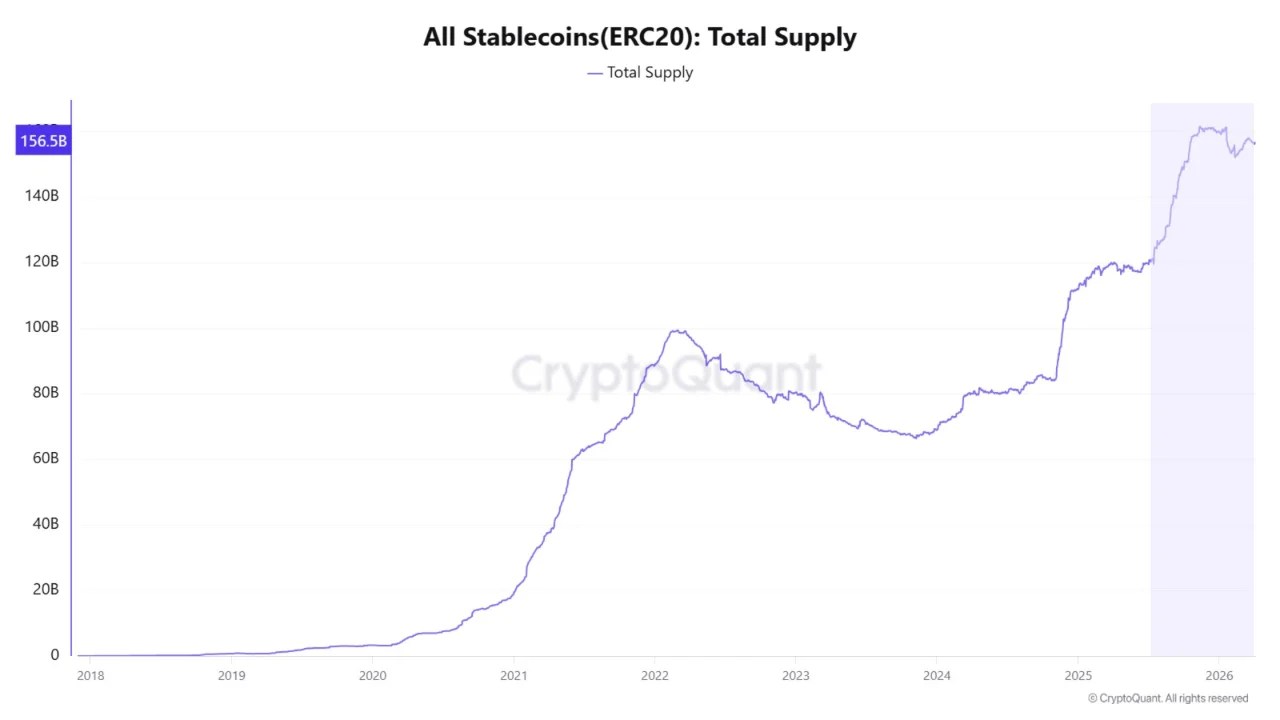
Source: CryptoQuant

Hence, it becomes apparent that Bitcoin is currently within a classic environment where liquidity exists, but is yet to be deployed. Interestingly, exchange flows also reveal that about $9.6 billion left the Bitcoin market in early 2026, with capital evidently rotating into stablecoins. These two conditions also contribute to weakened demand, as rising rates already cause demand to taper.

Therefore, until macroeconomic conditions improve, the Bitcoin price might continue to struggle in the long-term, as institutional demand might even then become weaker. As of this writing, Bitcoin is valued at $67,391, reflecting a positive daily shift of 0.76%. On larger time frames, the premier cryptocurrency reports a weekly gain of 1.34% and a monthly loss of 5.47%. With a market cap of $1.34 trillion, Bitcoin remains the world’s 13th largest asset and largest digital asset.

BTC trading at $66,827 on the daily chart | Source: BTCUSDT chart on Tradingview.com

热门币种推荐

相关问答

QAccording to the article, what are the main factors causing the rise in Japanese Government Bond (JGB) yields?

AThe main factors causing the rise in JGB yields are persistent inflationary pressures, expectations of policy normalization, and rising concerns over fiscal expansion.

QHow does a 1% increase in JGB yields potentially impact the financial system, given the current investment level?

AWith approximately ¥390 trillion (about $2.6 trillion USD) invested in JGBs, a 1% increase in yields could push tens of trillions of yen worth of holdings into negative territory, amplifying financial strain across the system.

QWhat is the 'rebalancing' activity mentioned in the article, and how does it affect Bitcoin?

AThe 'rebalancing' activity refers to institutional investors adjusting their balance sheets in response to pressure from rising yields. Risk assets, including Bitcoin, are the easy targets of this activity, as liquidity withdrawal from Japan's large external investment portfolio affects the market.

QWhat does the significant growth in the stablecoin supply indicate, according to the All Stablecoins metric cited?

AThe significant growth in the stablecoin supply indicates that there is capital waiting on the sidelines, but this available liquidity is not being introduced into risk markets like Bitcoin.

QWhat are the specific price movements of Bitcoin mentioned in the article as of the writing date?

AAs of the writing date, Bitcoin is valued at $67,391, reflecting a daily gain of 0.76%, a weekly gain of 1.34%, and a monthly loss of 5.47%.

你可能也喜欢

崔泰源离婚案落槌:揭秘SK海力士万亿帝国背后的继承暗线

2024年底,SK集团会长崔泰源在家族活动上向子女强调“饮水思源”与继承责任。此时,旗下SK海力士市值已突破1000万亿韩元,成为韩国最值钱资产,但集团第三代接班格局却与传统财阀剧本迥异。 崔泰源与前总统卢泰愚之女卢素英育有三名子女。长女崔允贞被视为最明显接班候选,她拥有生物学背景和咨询经历,现任SK生物制药高管及集团“成长支援部”主管,主导精准医疗等新业务,其婚姻也联姻AI领域创业者。 次女崔敏贞路径独特,曾自愿服役韩国海军并参与亚丁湾护航,退役后曾在SK海力士美国部门处理国际政策,后离职在硅谷创立AI医疗公司。她与曾服役美国海军陆战队的华裔企业家结婚,连接军旅与地缘政治网络。 长子崔仁根最符合传统继承人形象,毕业于布朗大学物理系,曾任职SK旗下能源公司,后转入麦肯锡首尔办公室。他公开表现极为低调,未持有集团股份,也未公开表态。 子女们的成长与父母旷日持久的离婚诉讼交织。2025年,最高法院将涉及1.38万亿韩元财产分割的判决发回重审,期间三名子女曾向法院递交未公开内容的请愿书。 随着SK海力士在AI时代成为全球核心地缘政治资产,崔家第三代继承的已非简单的企业控制权。他们被置于AI科研、华盛顿政策圈与全球投资前沿,必须证明自己有能力应对新时代的产业博弈,而非自动承接旧式家族剧本。

marsbit1小时前

崔泰源离婚案落槌:揭秘SK海力士万亿帝国背后的继承暗线

marsbit1小时前

交易

现货

热门文章

加密市场宏观研报:《GENIUS Act》法案取得重大进展,BTC突破历史新高,后市全新展望

2025年5月22日,比特币价格正式突破11万美元大关,创下历史新高。在政策面、宏观经济、资金面与投资者结构共同作用下,一场结构性牛市浪潮正在展开。而此轮上涨背后的核心驱动,是美国《GENIUS稳定币法案》的实质性进展以及多项利好的叠加。本文将从政策端突破、宏观环境转向、链上与ETF资金结构、交易行为演化,以及重点受益赛道五大维度,全面解析此轮BTC再创新高的深层逻辑,并前瞻下半年市场的潜在趋势。

1.8k人学过发布于 2025.05.22更新于 2025.05.22

加密市场宏观研报:《GENIUS Act》法案取得重大进展,BTC突破历史新高,后市全新展望

相关讨论

欢迎来到HTX社区。在这里,您可以了解最新的平台发展动态并获得专业的市场意见。以下是用户对BTC(BTC)币价的意见。

活动图片