Bitcoin Nears $90K – Bitcoin Hyper ($HYPER) Presale Heats Up as Bulls Return

bitcoinist发布于2025-11-25更新于2025-11-25

文章摘要

Quick Facts: ➡️ Bitcoin’s rebound toward $90K has been underpinned by digital asset treasuries, with institutional-style buyers steadily accumulating $BTC...

Trusted Editorial content, reviewed by leading industry experts and seasoned editors. Ad Disclosure

Quick Facts:

  • ➡️ Bitcoin’s rebound toward $90K has been underpinned by digital asset treasuries, with institutional-style buyers steadily accumulating $BTC and $ETH through volatility.
  • ➡️ As $BTC becomes a core treasury asset, demand rises for infrastructure that makes Bitcoin usable in DeFi, payments, and programmable finance ecosystems.
  • ➡️ Bitcoin Hyper aims to fuse SVM-level performance with Bitcoin settlement, targeting low-latency, low-fee smart contracts that address $BTC’s speed and programmability gaps.
  • ➡️ $HYPER raised over $28.4M in presale with a price of $0.013325 and a projected release by Q1 2026; price predictions suggest a 1,400% ROI by the end of next year.

Bitcoin’s latest bounce has put the market back on offense.

After a sharp pullback that carved out several local lows, $BTC has climbed back toward the $90K zone, erasing much of the recent drawdown and reminding you how quickly sentiment can flip from fear to renewed greed in this cycle.

When treasury desks treat Bitcoin as strategic collateral rather than a trade, every 10% pullback looks less like a crash and more like a rebalancing opportunity. That structural bid is one reason $BTC’s slide stalled where it did, and why the rebound toward $90K has come with less forced liquidations.

For $BTC-centric altcoins, that backdrop is powerful. If more balance sheets are denominated in Bitcoin, demand naturally rises for infrastructure that makes $BTC productive: usable in DeFi, payments, gaming, and beyond.

That’s the lane Bitcoin Hyper ($HYPER) is trying to own – a Bitcoin Layer 2 that bolts Solana-style performance onto Bitcoin’s settlement layer, aiming to turn dormant $BTC into programmable capital.

You can buy $HYPER on the official presale page today.

Why Bitcoin’s Rebound Supercharges The Hyper Race

$BTC’s recovery toward $90K is reinforcing a familiar tension: the asset that dominates crypto’s market cap is still clunky to use.

On-chain transactions can take minutes or even hours to confirm, fee spikes can push simple transfers into double-digit dollar costs, and native programmability is essentially absent on the base layer.

That’s why capital has been rotating into Bitcoin infrastructure. You’ve seen the rise of Lightning for payments, sidechains like Rootstock for EVM-compatible contracts, and newer rollup-style designs experimenting with Bitcoin as a settlement and data-availability layer.

Each tries to solve the same trilemma: keep Bitcoin’s security while adding speed, scale, and a cost-effective profile.

Zooming in, Bitcoin Hyper ($HYPER) positions itself as a modular Bitcoin Layer 2 built around the Solana Virtual Machine (SVM).

The idea is straightforward but ambitious: use Bitcoin L1 purely for settlement and state anchoring, while pushing execution to an SVM-based L2 that can, in theory, process smart contracts faster than Solana’s own mainnet.
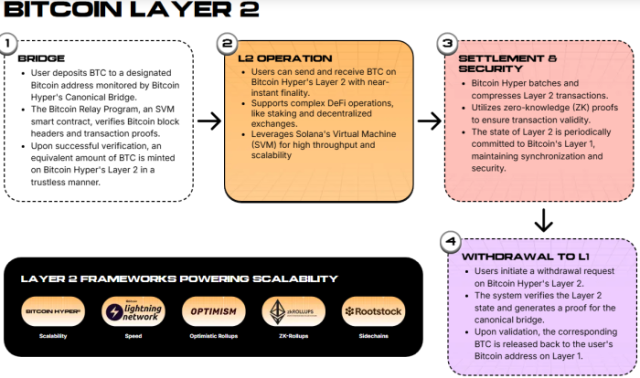
How Hyper’s Layer 2 works.

Instead of trying to cram complex logic onto Bitcoin itself, $HYPER runs a real-time execution environment where Solana-style programs – written in Rust and compatible with modified SPL token standards – execute with extremely low latency and sub-cent fees.

On paper, that architecture targets the three pain points Bitcoin users know well:

  • The Canonical Bridge reduces finality times to seconds
  • The batched transactions bring fees down, keeping the network cheap and eliminating the fee-based priority system
  • Improve scalability, allowing for more and faster transactions, helping Bitcoin grow at scale.

All this without impacting Bitcoin’s native security or brand appeal.

If the proposition makes sense to you, you can buy $HYPER right here.

$HYPER Presale, Predictions, and Release Date

The Bitcoin Hyper ($HYPER) presale has raised over $28.4M, with $HYPER valued at $0.013325 – a material signal that a segment of the market is willing to fund a Bitcoin-centric, SVM-powered experiment while $BTC trades near cycle highs.
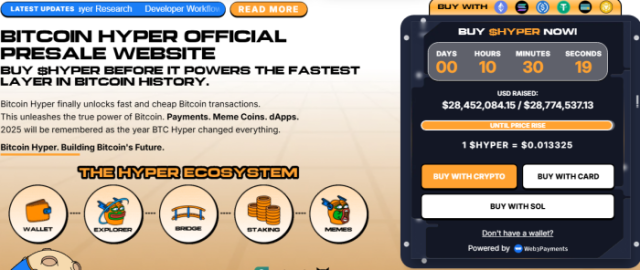
$HYPER’s presale numbers.

For you as a $BTC holder or builder, the potential unlock is straightforward: move wrapped $BTC into Bitcoin Hyper’s Layer 2, tap high-speed payments, access DeFi protocols, or deploy Rust-based dApps without leaving Bitcoin’s security umbrella.

The utility is obvious and feeds into the hype we’re seeing right now, which explains the presale’s impressive performance.

Based on these factors, our price prediction for $HYPER post-launch puts the token at $0.20 by the end of 2026 and $1.50 by 2030. In terms of raw profit, you’re looking at an ROI of 1,400% for a 1-year investment and 11,155% for a 5-year one.

Naturally, these numbers can fluctuate depending on market conditions, but considering Bitcoin Hyper’s utility, our vote is for it to increase over time.

You can read more about what Bitcoin Hyper is right here, or our guide on how to buy $HYPER before visiting the presale page.

As a final heads-up: $HYPER has a projected release window between Q4 2025 and Q1 2026, so there’s not much time left.

Go to the official presale page and buy your $HYPER today.

This isn’t financial advice. DYOR before investing.

Authored by Bogdan Patru, Bitcoinist: https://bitcoinist.com/bitcoin-$90k-market-rebounds-as-bitcoin-hyper-reaches-$28M

Editorial Process for bitcoinist is centered on delivering thoroughly researched, accurate, and unbiased content. We uphold strict sourcing standards, and each page undergoes diligent review by our team of top technology experts and seasoned editors. This process ensures the integrity, relevance, and value of our content for our readers.

As a crypto writer, Bogdan’s responsibilities are split between researching and writing articles and entertaining the team with his humor bordering on the politically incorrect, an aspiring Bill Burr, if you will. Thanks to his 12+ years of writing experience in just as many fields, including tech, cybersecurity, modelling, fitness, crypto, and other topics-that-shall-not-be-named, he's become a genuine asset to the team. While his position as a senior writer at PrivacyAffairs thought him valuable lessons about the power of self-management, his entire writing career was and is an exercise in self-improvement. Now, he's ready to sink his teeth into crypto and teach people how to take control of their own money on the blockchain. With fiat as an eternally devaluing currency, Bitcoin and altcoins seem like the best-fitting alternative for Bogdan. Bogdan’s biggest professional accomplishment, aside from securing a position as a main writer for Bitcoinist, was his 5-year run as a writing manager at Blackwood Productions, where he coordinated a team of four writers. During that time, he learned the value of teamwork and that of creating a working environment that breeds efficiency, positivity, and friendship.

热门币种推荐

你可能也喜欢

八年投入急转弯,以太坊为何突然放弃Poseidon?

以太坊基金会研究员Justin Drake近日宣布,以太坊将在Layer 1层放弃已研发八年的SNARK友好型哈希算法Poseidon,转而采用SHA2或BLAKE2等传统哈希函数。这一重大转向源于后量子密码学研究的突破性进展。 Poseidon自2019年起因其在零知识证明电路中的高效性,被广泛用于zkRollup等应用。但其算法历史较短,密码学分析时间不足。而随着后量子安全成为硬性要求,其局限性显现。最新的SNARK设计,特别是基于“二进制域”的证明系统(如Binius和Flock),已能高效处理传统哈希函数的布尔运算,使得SHA2等成熟算法在证明性能上可媲美甚至超越Poseidon,消除了采用后者的主要优势。 另一关键因素是应对量子计算威胁的时间表正在加速。报告预测“量子破译日”可能在本世纪30年代初到来,将对区块链资产构成巨大风险。以太坊因此需要尽快采用经过长期密码分析验证的、抗量子攻击能力更强的哈希方案。其后续量子路线图计划于2027年推出核心构件leanVM,并在2028年完成共识层、执行层和数据层的部署。 与此同时,其他公链如Solana已选定后量子签名方案Falcon,而StarkNet也计划采用BLAKE2等算法。以太坊此次转向,标志着技术重点从“设计SNARK友好型哈希”转变为“设计哈希友好型SNARK”,是在后量子时代选择更成熟、更稳健的密码学基元的战略调整。

marsbit44分钟前

八年投入急转弯,以太坊为何突然放弃Poseidon?

marsbit44分钟前

全球程序员都在给Anthropic白送钱!官方终于看不下去了

Anthropic官方发布博客,针对开发者使用Claude Code时可能产生的不必要高额费用,总结了六条核心省钱建议: 1. 任务完成后及时使用 `/clear` 清理对话,避免无关历史占用上下文。 2. 对话开始时固定好模型和推理强度,中途切换会导致提示缓存失效,需全价重新计算历史。 3. 使用 `@` 引用文件,而非手动输入路径,可避免Claude进行工具调用和试探性读取,减少上下文累积。 4. 为输出冗长的命令(如运行测试)添加静默参数,减少输出内容对上下文的占用。 5. 在会话缓存仍有效时(如休息前)进行 `/compact` 压缩对话,成本仅为十分之一。 6. 将产生大量输出的任务交由子Agent处理,其独立上下文不会污染主对话。 文章解释了费用产生的机制:输入token(预填充)成本较低,输出token(解码)成本约为其5倍。模型(Opus/Sonnet/Haiku)和推理强度直接影响单价和token数量。 **提示缓存是关键的省钱杠杆**:若请求前缀与之前完全相同,服务器可加载缓存结果,读取成本仅为正常输入价的10%。但切换模型、改变推理强度、执行压缩、缓存过期等操作都会导致缓存失效。 此外,对话历史会因不断追加文件内容和命令输出而“变胖”,导致后续每轮对话成本呈接近平方级(O(n²))增长。除了上述建议,还可使用 `/rewind` 回退无效轮次以保住前面缓存。 文章指出,管理token开销正成为AI时代开发者的新技能,关系到使用效率和成本控制。Anthropic自身大量使用AI编写代码,精细的成本管理至关重要。

marsbit2小时前

全球程序员都在给Anthropic白送钱!官方终于看不下去了

marsbit2小时前

交易

现货

热门文章

加密市场宏观研报:《GENIUS Act》法案取得重大进展,BTC突破历史新高,后市全新展望

2025年5月22日,比特币价格正式突破11万美元大关,创下历史新高。在政策面、宏观经济、资金面与投资者结构共同作用下,一场结构性牛市浪潮正在展开。而此轮上涨背后的核心驱动,是美国《GENIUS稳定币法案》的实质性进展以及多项利好的叠加。本文将从政策端突破、宏观环境转向、链上与ETF资金结构、交易行为演化,以及重点受益赛道五大维度,全面解析此轮BTC再创新高的深层逻辑,并前瞻下半年市场的潜在趋势。

1.9k人学过发布于 2025.05.22更新于 2025.05.22

加密市场宏观研报:《GENIUS Act》法案取得重大进展,BTC突破历史新高,后市全新展望

相关讨论

欢迎来到HTX社区。在这里,您可以了解最新的平台发展动态并获得专业的市场意见。以下是用户对BTC(BTC)币价的意见。

活动图片