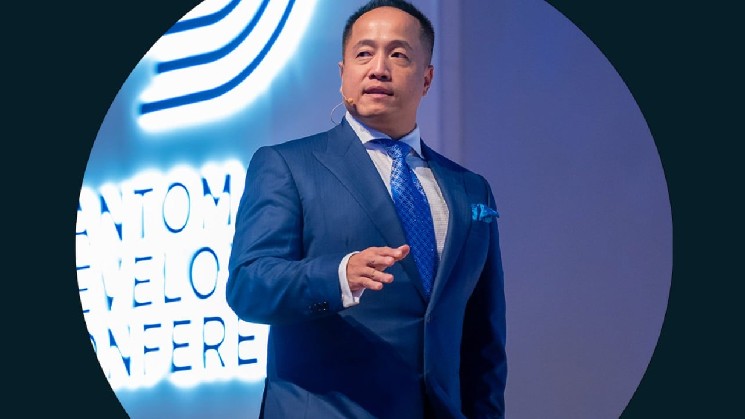
At the Midnight Summit, Cardano founder and Input Output Global CEO Charles Hoskinson set out a staged rollout for Midnight, a privacy-and-identity network he describes as crypto’s next generational layer. In a Dapp Central interview, he positioned Midnight as an extender of existing ecosystems rather than a competitor: “We’re here to make your life easier and allow you to do new things your network doesn’t do… and you can pay in that network’s token,” pointing to interoperability with major chains such as Ethereum, Solana, Bitcoin and XRP.
Cardano Sidechain Launches In Four Stages
Hoskinson’s deployment plan is a four-gate launch intended to move from distribution to full decentralization through sequential upgrades. The first gate is liquidity and token delivery. The Cardano founder said NIGHT claims and initial market trading begin on December 8, 2025, the point at which Midnight becomes price-discoverable: “They get the tokens, they can trade them on exchanges and DEXes… it creates a price signal […] it’s on CoinMarketCap, it’s a real thing.” He tied this to the Glacier Drop and Scavenger Mine funnels, estimating participation at “well more than a million users,” while acknowledging wallet counts don’t map cleanly to individuals.
The second gate is a federated mainnet targeted for Q1 2026. Hoskinson described a production environment with mixed operators—some nodes run by IOG and some by external enterprises, including a Fortune 500 participant—so Midnight’s builder base can deploy applications with real users before final decentralization. He cited more than 100 partners already building for Midnight, and summit materials likewise list federated mainnet as the next milestone after NIGHT liquidity.
The third gate is an incentivized testnet to onboard stake pool operators and validate Midnight’s final consensus protocol. Hoskinson said the protocol has formal liveness and safety proofs and targets roughly 5,000 transactions per second with sub-second blocks, but has never been deployed on Substrate. “It would be irresponsible just to kind of launch that out,” he said, arguing that both the algorithm and operator tooling must be proven under incentives before mainnet adoption.
The fourth gate follows once the incentivized testnet is stable: a hard fork into the final mainnet consensus and a completed end-to-end network. The Cardano founder expects this phase to coincide with broad exchange access and a transition from Cardano-adjacent rollout to general cross-chain privacy services: “Midnight wakes up… to a Midnight-Ethereum, Midnight-Solana, Midnight-Bitcoin […] Midnight-XRP.” In his framing, this is when Midnight becomes a neutral privacy layer that other ecosystems consume rather than a single-community product.
Midnight’s adoption strategy hinges on dual-token economics. NIGHT holders generate DUST, a consumable fuel for computation. Through a “capacity exchange,” DUST can be sold for other chains’ tokens or delegated by DApp builders so users can interact without first buying crypto.
Hoskinson framed this as importing Web2’s frictionless payment expectation into Web3: “If you have NIGHT […] your users […] can use your DApp for free without having a token […] That’s an entirely new thing in the cryptocurrency space.”
Hoskinson also argued that AI makes privacy economically existential. He said models are “hoovering up… your likeness and your output,” enabling uncompensated digital replicas and accelerating job displacement: “People realize this is existential now […] it’s I no longer have a job.”
In response, Midnight’s selective-disclosure stack is meant to let users reclaim data ownership and use zero-knowledge proofs to verify properties—such as humanity or eligibility—without revealing identity, countering what he described as bot-heavy online participation.
Governance is presented as a correction to Cardano’s institutional friction. Hoskinson said Midnight’s code governance will be housed at the Linux Foundation and executed by a KPI-driven Midnight Foundation, aiming for clearer accountability and faster delivery.
Hoskinson summarized the endpoint as a “crypto triumvirate”: “Bitcoin is the trust and value layer […] Cardano the computation layer […] Midnight the privacy and identity layer.” If the four gates land as described—December 8 liquidity, Q1 2026 federated mainnet, Q2 2026 incentivized testnet, then a final mainnet hard fork—Midnight’s cross-ecosystem privacy thesis will move from roadmap to live infrastructure through 2026.
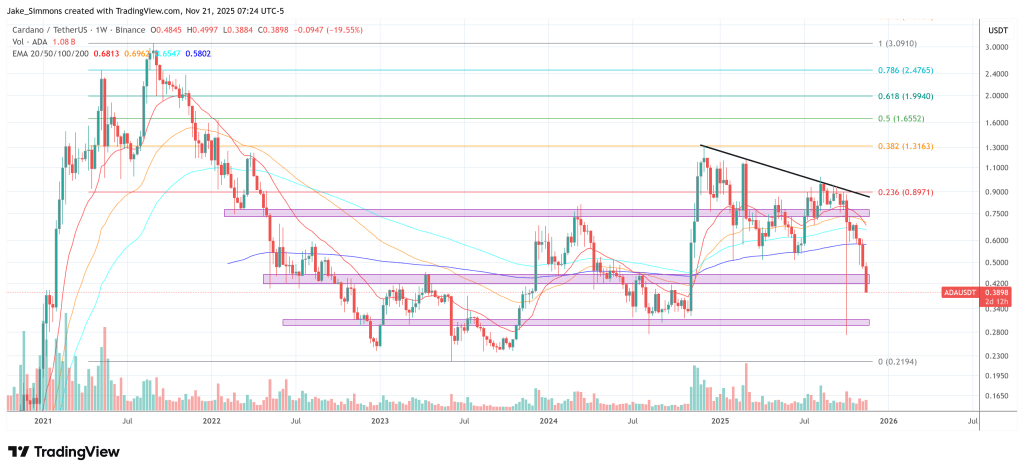
At press time, the Cardano (ADA) token traded at $0.3898.

Related Posts