Quick Facts:
- ➡️ Elevated whale accumulation during price weakness suggests Bitcoin supply is rotating from short‑term traders to long‑term balance sheets.
- ➡️ Bitcoin’s base layer remains constrained by low throughput, long block times, and volatile fees, limiting complex DeFi and high‑frequency use cases.
- ➡️ Bitcoin Hyper uses an SVM‑based Layer 2 with BTC settlement anchoring to target low‑latency smart contracts around native Bitcoin liquidity.
- ➡️ The $HYPER token presale has attracted a lot of attention from whales, helping push its raised amount to over $28.1M and counting.
Bitcoin ($BTC) is still in limbo at around $91K, which could lead to the year’s most active whale week.
Market intelligence platform Santiment showed over 102K transactions above $100K and roughly 29K transfers exceeding $1M during a recent drawdown window. That concentration of high‑value flows often appears when institutions, desks, and long‑horizon funds reposition.
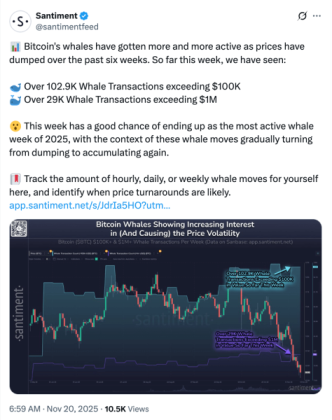
That shift matters. When price falls but whales buy, the market is signaling a rotation in who controls future supply. Bitcoin ownership slowly migrates from short‑term traders to balance sheets that think in multi‑year timeframes, not hourly candles.
For infrastructure builders watching these flows, the message is straightforward. A growing base of large, patient $BTC holders will eventually demand more than simple cold storage and occasional transfers.
They will want yield, composability, and institutional‑grade execution without sacrificing Bitcoin’s settlement security.
That is the gap that newer Bitcoin Layer-2 designs are trying to fill. In particular, Bitcoin Hyper ($HYPER) is a project aiming to give the Bitcoin ecosystem a much-needed boost with high-speed and low-cost transactions, as well as expanded $BTC utility.
Whales Are Accumulating While Bitcoin’s Base Layer Stagnates
When large holders buy dips, they are rarely chasing short‑term percentage moves. They are positioning for the next structural phase: ETF flows, macro cycles, or new yield sources built on top of existing Bitcoin liquidity.
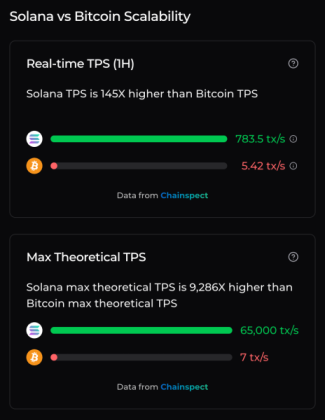
Currently, Bitcoin’s base layer can process only seven transactions per second (TPS), resulting in network congestion and high fees. In contrast, Solana can handle up to 65K TPS.
You can see the tension in exchange and custodial behavior. Many institutions still prefer to keep $BTC idle on centralized venues because moving size on-chain during peak congestion means accepting delays, volatile fee markets, and a lack of programmability.
To fill that gap, several scaling paths have emerged. Among these, Bitcoin Hyper enters the conversation with a solution that treats Bitcoin as the final ledger, while shifting heavy computation elsewhere and syncing its state periodically back to L1.
Bitcoin Hyper Bets on SVM Speed Anchored to Bitcoin Security
Bitcoin Hyper takes a modular approach that separates execution from settlement. Bitcoin remains the base settlement layer, while a high-throughput Solana Virtual Machine (SVM) environment handles transaction processing and smart contract logic in real-time.
In practical terms, that means programmable activity in an SVM Layer 2 while periodically committing state roots back to Bitcoin. This results in Solana-level transaction speeds and low costs, while retaining Bitcoin’s robust security.
On the asset side, Bitcoin Hyper uses a canonical bridge to move $BTC into the Layer-2 environment as wrapped assets. Once bridged, those tokens can flow through SVM smart contracts for swaps, lending, and staking, with SPL‑style token standards adapted for the L2.

This architecture directly addresses the three pain points that have constrained Bitcoin-native DeFi: slow block times, high Layer-1 (L1) fees, and the absence of modern smart contract support.
With its solid premise, the project has attracted a lot of attention from investors. Its presale has already raised over $28.1M at a $HYPER token price of $0.013305. It also offers a 41% APY in staking rewards to attract long-term investors.
Smart money has also started probing exposure. Whales have begun pouring serious money into Bitcoin Hyper, including one worth over $500K less than a week ago, and then one yesterday that’s worth over $75K.
For traders who track positioning, those allocations are not decisive on their own, but they are consistent with a broader shift toward infrastructure plays that closely track Bitcoin’s long-term trajectory.
Looking forward, the value proposition is simple. If Bitcoin remains the dominant settlement asset for institutions and long‑term holders, the winning infrastructure layers will be the ones that enable programmable yield, high‑speed payments, and composable DeFi around BTC itself.
For now, the narrative is less about short‑term price targets and more about whether SVM‑based execution anchored to Bitcoin can attract durable liquidity, builders, and users as whale accumulation reshapes the ownership base.
In this aspect, Bitcoin Hyper is taking solid steps to ensure that it becomes an important player in the Bitcoin L2 scene. It’s no wonder that its $HYPER token has the potential to reach a high of $0.20 based on our Bitcoin Hyper price prediction.
Don’t be left behind. Join the Bitcoin Hyper presale today.
Disclaimer: This article is informational only and does not constitute financial, investment, or trading advice of any kind.
Authored by Bogdan Patru, Bitcoinist — https://bitcoinist.com/bitcoin-hyper-pumps-as-bitcoin-whale-activity-may-peak-this-week

Related Posts