Cardano founder Charles Hoskinson used a weekend update from “up here at the clinic” in Wyoming to move the quantum-computing debate from speculation to planning. Framing DARPA’s Quantum Benchmarking Initiative (QBI) as the turning point, he said, “finally, finally, finally, we have an objective source of truth,” adding that “as of November 6, 2025, DARPA has selected 11 companies to enter the second stage […] which aims to rigorously verify and validate whether any quantum computing approach can achieve utility scale operation […] by the year 2033.”
DARPA Advances 11 Quantum Teams
He emphasized that QBI is designed to separate “fact from fiction about quantum computers,” and relayed the program manager’s stark split among experts: “Half of them are convinced that quantum computing is going to be the best thing since sliced bread […] and the other half are convinced that even if you could build a quantum computer, which you definitely won’t be able to do, it’s never going to be more useful than your laptop.”
The point of QBI, as the manager put it in the clip Hoskinson played, is to answer two questions: “if I had a really powerful quantum computer, what could I do with it?” and “is there a […] group that has a path to really build that kind of machine in the near term […] in the next 10 years?”
The Cardano founder walked through QBI’s staged process. “During the six month Stage A […] you are a quantum computer builder […] you spend six months answering every question they can throw at you […] and at the end of all of it, they say, ‘actually, there’s some merit.’” Stage B, he said, is “a rigorous one-year plan” where “you’ve opened the kimono and they’re taking a look at your quantum computing design.”
Stage C is the hardware trial: “work with the government to verify and validate that the utility scale quantum computer concept can be constructed as designed and operated as intended,” meaning “they’re actually going to watch you run it” on “objective problems.”
He named the 11 companies that, in his account, survived Stage A and entered Stage B—“Atom Computing in Boulder, Colorado […] IBM, IonQ, Nord Quantique, Photonic, Quantinuum […] Quantum Motion, QA Computing, Silicon Quantum Computing and Xanadu”—and highlighted that “there’s no canonical approach for quantum computing.” He rattled off the five families he’s tracking, each with variations: “a neutral atom approach” that uses “highly focused lasers known as optical tweezers,” “silicon-based approaches” that look like specialized chips, “superconducting approaches,” “trapped ion approaches,” and “light-based approaches” where “quantum information is encoded in the properties [of] photons.”
For crypto, he made his position explicit: “I am of the belief that quantum computers will exist in the 2030s and they will be able to run Grover’s and Shor’s algorithm,” which means “the majority of mainstream cryptocurrencies will be vulnerable if they do not implement counter measures by that time.” The Cardano founder warned of the “archiving” problem—“encrypted emails, encrypted payloads that were archived can now be decrypted even if they’re re-encrypted later on with a post-quantum scheme because they have a copy of the classical encrypted payload.”
His countermeasure checklist starts with the US standards track: “we do have some government standards that NIST came up with called FIPS 203, 204, 205 and 206.” He described them as “an array of tools either lattice-based or hash-based or other to do encryption [and] signatures.”
Cardano Prepares For Quantum Era
On Cardano’s privacy and ZK layer, Midnight, he announced a deeper pivot: “we’re going to be announcing a program project to change the heart of Midnight, PlonK and Halo 2 to a new standard called Nightstream that is relying on lattice-based crypto,” describing it as “a moonshot” co-built “with a lot of large companies through a project at the Linux Foundation.”
In the interim, he said, “next year as Midnight turns on it’ll turn on with PlonK and Halo 2,” but the design is “already pre-designing it to have a drop in replacement […] [so] the basement of it is going to be post-quantum,” with the goal that “Midnight will be immune to quantum computers well ahead of the 2033 deadline.”
He pitched lattices as both defense and performance lever. “Turns out that lattices in particular have capabilities above and beyond what Ethereum is doing in the hash-based space,” he argued, claiming they connect “to what’s going on in the AI space with tensors,” so “you can use GPUs to accelerate the writing of a proof […] and the verification of [a] proof,” without “custom chips like Ethereum is proposing.” In his words, “you just use the AI chips that are in your phone, your laptop, your desktop computer, and your server, and you can get linear scale.”
The roadmap for Midnight extends beyond internal upgrades. He positioned it as “a folding engine and a recursion engine unlike any other in the entire private computation space,” asserting that “Midnight can create some of the best and lightest weight state proofs of every system it’s connected to. Cardano, Bitcoin, Ethereum, Solana, and so forth.” The strategic aim is to sign “those payloads with post-quantum signatures,” producing “a post-quantum checkpoint for Bitcoin and for other systems,” so “even if [a] quantum computer tries to change the state of things […] you’re going to have a rollback mechanism.”
He also flagged areas still on the checklist: “There are many other things you have to do. You have to look at post-quantum VRFs and post-quantum VDFs and you have to look at post-quantum random number generation and a litany of other concerns.” The “most important step,” in his view, is “to lock truth, lock history in a state where quantum computers can’t break it.”
The upshot for Cardano, he said, is to move now: “Adapt or get cracked.”
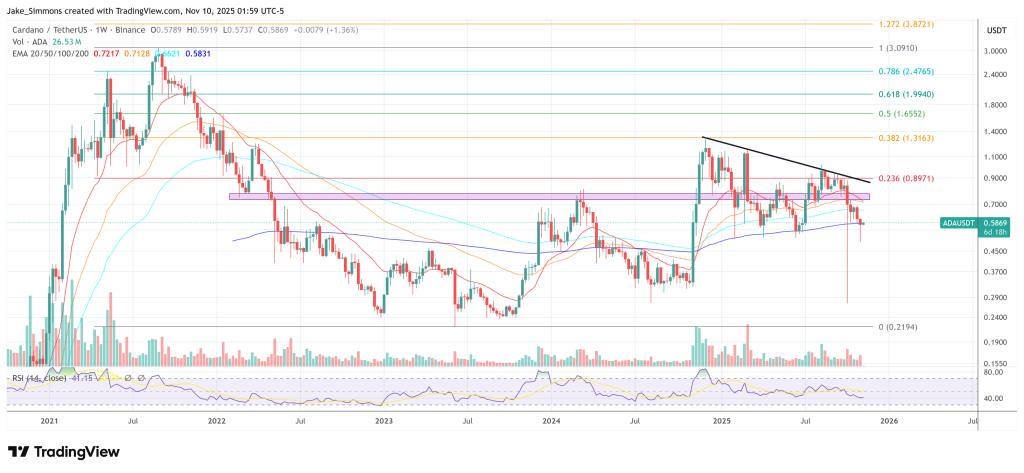
At press time, Cardano (ADA) traded at $0.5869.

Related Posts