Helius says it has re-engineered how Solana’s historical data is stored and retrieved, introducing a new archival backend and an RPC method that collapses today’s multi-call workflows into a single request.
CEO Mert Mumtaz framed the change in sweeping terms: “today, Solana changes forever… we’ve solved the biggest data/RPC problem that exists,” he wrote, arguing that the status quo—historical queries hitting Google Bigtable—has been “slow,” “expensive,” and “inflexible.”
What This Means For Solana
Mumtaz highlighted the practical pain point every Solana indexer or wallet developer knows: getting the “first tx for a Solana address without looping back endlessly” and pulling the “most recent 100 txs for an address” both require chaining calls and traversals that can balloon into “thousands of RPC calls.” “Not anymore,” Mumtaz said.
At the heart of the release is a Helius-exclusive RPC method, getTransactionsForAddress, backed by a distributed archival storage layer that the company claims is “1,000x faster, more flexible, and more scalable.” Functionally, the method merges today’s common two-step pattern—getSignaturesForAddress to enumerate signatures, then getTransaction to hydrate details—into one call that can return fully decoded transactions, with bidirectional time ordering and range filters by slot or timestamp.
Helius’ documentation spells out that it enables reverse search without back-traversal and supports pagination tuned for large, active accounts. The company also emphasizes that this is not a core Solana RPC addition; it’s a proprietary extension available on Helius nodes, priced at 100 credits per request on Developer plans and above.
Performance claims span both the new method and legacy endpoints, with Helius saying getBlock, getTransaction, and getSignaturesForAddress are now “10x faster,” while the archival system under the hood delivers the headline throughput improvements for historical queries.
The framing is squarely aimed at eliminating Bigtable-bound latency spikes and reducing call counts by “100x” alongside “10x lower latency” and “1000x less code.” Those assertions track with common developer complaints documented across Solana forums about slow historical hydration on busy addresses, but the hard numbers here are Helius’ own benchmarks.
The strategic context matters. Solana’s on-chain activity continues to skew toward high-throughput consumer and payments use cases, which punish inefficient data access patterns.
The launch landed the same day the first US spot Solana ETF went live on the NYSE—Bitwise’s BSOL. According to Bloomberg’s senior ETF analyst Eric Balchunas, BSOL recorded a volume of $56 million on day one. “BSOL’s $56m is the MOST of any launch this year.. More than XRPR, SSK, Ives and $MNU. And what’s amazing is it seeded with $220m. It could have invested seed on Day One, which would have resulted in $280m-ish, would be even more than ETHA’s debut. Strong start either way,” Balchunas wrote.
Another macro backdrop piece: Western Union announced plans to introduce a dollar-backed stablecoin, USDPT, on Solana, issued by Anchorage Digital Bank, with availability targeted for the first half of 2026.
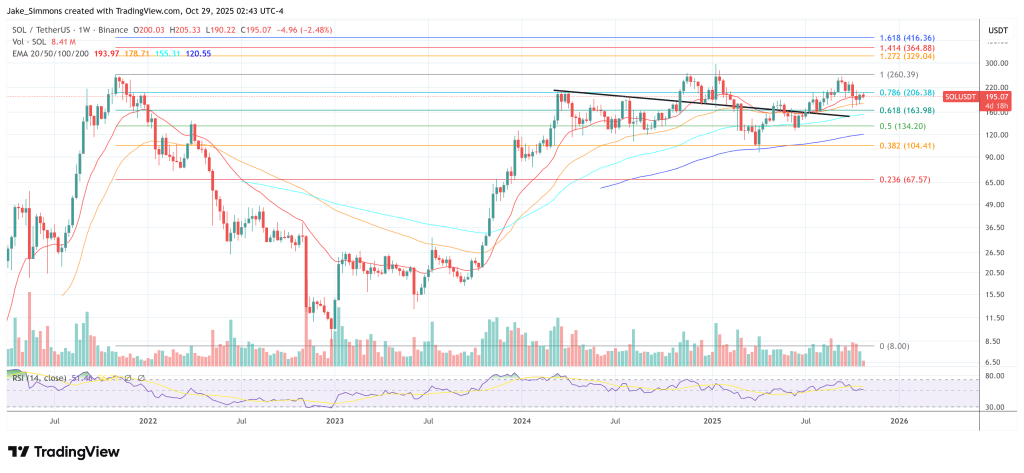
At press time, SOL traded at $195.

Related Posts