Tucker Carlson has reignited one of Bitcoin’s most charged debates—privacy, provenance, and the politics wrapped around the origin—by telling an audience on his “This Is The Turning Point” tour that he believes the asset traces back to the US intelligence community. Pressed during an open-mic Q&A on whether he invests in Bitcoin and whether he views it as a viable asset, Carlson said he supports the principle of financial self-determination but fears what he describes as a widening gap between the ideal and the implementation.
Bitcoin Is Not Private
“I love the idea of Bitcoin because I love the idea of financial autonomy,” he said, framing his stance in civil-liberties terms rather than price speculation. “I don’t want what I buy or sell to be tracked. I don’t want my money to be tracked. It’s nobody’s business.” Carlson, who noted he has spoken at multiple Bitcoin events—“I spoke at the Bitcoin conference actually last year… I’ve spoken at a couple of Bitcoin conferences”—cast himself as philosophically aligned with the original cypherpunk promise while distancing himself from the market’s practical realities.
The fulcrum of his critique is surveillance. “It turns out that it is not, to this point… a way to conduct financial transactions privately at all. And that really freaks me out,” he said. He extended that worry to the broader rise of digital money, warning that programmable account restrictions could be used as instruments of political discipline. “I’m really afraid of a digital currency because that is totalitarian in control. If you can punish people, if you can zero out their bank account and keep them from eating, you will have total obedience. That’s totalitarian.”
Carlson’s skepticism is not directed at BTC’s aspirations alone; he tied it to generational economics and political economy. He argued that young Americans, “completely screwed in the job market,” have turned to crypto as an upward-mobility vehicle.
He said he hopes that promise pans out—“I’m praying for them. I hope that’s true”—but warned it could devolve into a familiar alliance of “financial beneficiaries” and “the politicians they control.” As he put it: “I fear that it will become, like so many other things in our country, a scam of sorts run by a coalition of the financial beneficiaries… and the politicians they control who use it to further their control of American society.”
On portfolio choices, Carlson was categorical: “I’m a gold buyer, and I’ve been vindicated big time in that… It was good enough for the Phoenicians. It’s good enough for me.” He framed his approach as a discipline of staying within his circle of competence: “In general, don’t get involved in anything I don’t understand… I try to limit myself to things I understand.”
Who Created Bitcoin?
The sharpest provocation came when the question turned to Satoshi Nakamoto. For Carlson, the pseudonymous creator—and the unmoved early coins commonly attributed to Satoshi Nakamoto—remain a decisive obstacle.
“Nobody can explain to me who Satoshi was, the creator of Bitcoin, this mysterious guy who apparently died, but nobody knows who he was,” he said, before delivering the claim that will dominate headlines: “You know, I grew up in D.C. primarily, in a government family. So CIA. That’s my guess. Can’t prove it.”
He pressed the point as an investor’s threshold question: “You’re telling me to invest in something whose founder is, like, mysterious and has billions of dollars of unused Bitcoin. Like, what is that? And no one can answer the question, including some of the biggest holders of Bitcoin in the world, who I know personally. They’re like, oh, it doesn’t matter. What matters to me? Right?”
Carlson’s remarks interweave several long-running Bitcoin controversies. First is Bitcoin’s privacy model. Bitcoin is pseudonymous rather than anonymous; transaction histories are globally replicated and auditable by default, which is why surveillance concerns coexist with arguments that transparency is an integrity feature.
Second is origin risk: the unresolved identity of Satoshi, the status of the early-mined coins that have not moved, and the governance implications of dormant supply suddenly entering circulation. Carlson elevates origin risk from a philosophical curiosity to a non-starter for capital allocation.
For context, this is not the first time Carlson has floated the intelligence-origin theory around Bitcoin. At a private gathering during the Bitcoin 2024 conference in Nashville in late July 2024, he similarly speculated that “obviously, it was the CIA,” adding, “I think we all know that,” when pressed on Satoshi Nakamoto’s identity.
At press time, Bitcoin traded at $108,729.
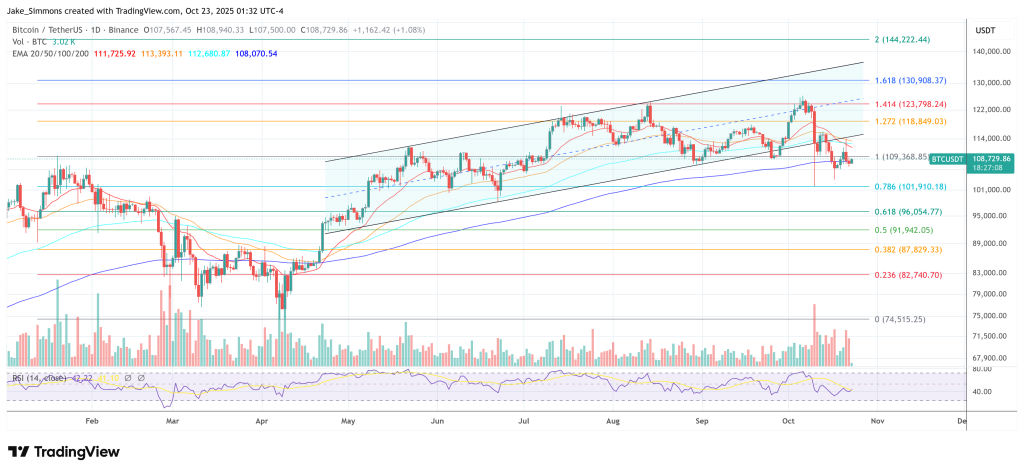
Bitcoin battles the EMA200, 1-day chart | Source: BTCUSDT on TradingView.com Featured image created with DALL.E, chart from TradingView.com

Editorial Process for bitcoinist is centered on delivering thoroughly researched, accurate, and unbiased content. We uphold strict sourcing standards, and each page undergoes diligent review by our team of top technology experts and seasoned editors. This process ensures the integrity, relevance, and value of our content for our readers.
ShareTweetShareShare
Sign Up for Our Newsletter!
For updates and exclusive offers enter your email.
Sign Up I consent to my submitted data being collected and stored.
Leave this field empty if you're human:

Jake Simmons
Follow
Jake Simmons has been a Bitcoin enthusiast since 2016. Ever since he heard about Bitcoin, he has been studying the topic every day and trying to share his knowledge with others. His goal is to contribute to Bitcoin's financial revolution, which will replace the fiat money system. Besides BTC and crypto, Jake studied Business Informatics at a university. After graduation in 2017, he has been working in the blockchain and crypto sector. You can follow Jake on Twitter at @realJakeSimmons.
Full Profile
Related Posts

Bitcoin Is ‘Like Electronic Gold,’ Says Federal Reserve Governor Waller
1 day ago
Bitcoin Leverage Reset: Futures Open Interest Plummets 30%
1 day ago
Canada’s British Columbia Bans New Bitcoin, Crypto Mining Operations
1 day ago
GENIUS Act Could Shield Bitcoin From Fed Oversight, Governor Barr Warns
1 day ago
比特幣即時新聞:日本開放加密資產持有權動態更新(10月22日)
1 day ago
Market Pullback Deepens: Bitcoin Slips, ETH Drops, and Traders Panic Over Musk’s BTC Move
1 day ago