Ripple Just Embedded XRP Into The World’s Treasury Plumbing, Experts Explain

bitcoinist发布于2025-10-17更新于2025-10-17

文章摘要

Ripple’s agreement to acquire GTreasury has triggered a sharp, technically informed reaction on X, where several long-time market observers argue...

Trusted Editorial content, reviewed by leading industry experts and seasoned editors. Ad Disclosure

Ripple’s agreement to acquire GTreasury has triggered a sharp, technically informed reaction on X, where several long-time market observers argue the deal quietly routes XRP and Ripple’s stablecoin ambitions into the center of corporate finance. Their case rests on where GTreasury sits in the value chain, what it already connects to, and how Ripple can insert settlement choices—XRP or RLUSD—without forcing enterprises to change screens, ERPs, or bank relationships.

Why The GTreasury Deal Is Massive For Ripple And XRP

“I am pretty sure no one in crypto Twitter even understands what this is,” wrote developer Vincent Van Code (@vincent_vancode), before laying out why the plumbing matters. “GTreasury provides software that enables mainly large, multinational corporations [to] handle payments, liquidity, cash flow etc. The software links into banking and payment systems such as SWIFT, and is ISO20022 compliant.”

In other words, GTreasury is not a speculative bet on future rails; it is an orchestration layer that already standardizes and routes cash, messages, and risk data between a corporate’s bank portals, payment networks, and ERP.

Van Code’s key implication is distribution, not hype: “So this acquisition along with Hidden Roads and Standard Custody and Trust, allows Ripple to introduce digital assets into the $100T Treasury market. Ripple doesn’t need to ‘sell’ XRP to the big corporates, that is just part of the plumbing. The SaaS and UI doesn’t change, it just means Ripple progressively rolls out faster, more efficient rails. That’s the game.”

That line of thinking is echoed by Ray Fuentes (@RayFuentesIO), who argues the strategic shortcut is not merely technical but also legal and compliance-oriented. “Once this deal clears with GTreasury, Ripple will own a treasury platform already live in the SWIFT-interoperability lane. Translation: no building SWIFT integrations from scratch—there’s a legal, technical, and compliant path in place. HUGE win for enterprise adoption. #XRP.”

The point is less about a headline-grabbing re-architecture and more about a low-friction insertion into flows that already pass audit, security, and regulatory muster. If the bank and ERP adapters are in place, new settlement options can be exposed as toggles rather than rebuilds.

What Ripple Gets From The Acquisition

Wrathof Kahneman (@WKahneman) expands the distribution map and the product surface area by situating GTreasury in its historical and technical context. “They have ~40 years integrating w/ 800+ banks worldwide. They integrate directly with major ERP systems like SAP, Oracle, & NetSuite, and connects to leading banks like JPMorgan, Goldman Sachs, Bank of America, Wells Fargo, and PNC.”

That list matters because corporate treasurers don’t buy ledgers or tokens; they buy time-tested connectivity that won’t break cash positioning, FX hedging, pooling, and reconciliation. The argument is that once Ripple owns the connectivity fabric and the user interface, it can surface settlement paths—on-ledger via XRP, on-chain via RLUSD, or status quo—behind an unchanged workflow.

This is also why @WKahneman frames the deal as “Direct access to the corporate global money movement. With this Ripple can bring #RLUSD & #XRP settlement options into existing treasury workflows. A co could move funds across subsidiaries, currencies, or counterparties instantly, w/ changing software or banks. It’s the last mile for corporate finance.”

The operative phrase is “existing treasury workflows.” Treasurers remain inside SAP, Oracle, or NetSuite, while GTreasury orchestrates bank messages and payments. If Ripple can slot XRPL or RLUSD as routable options under that orchestration, the adoption barrier becomes a policy decision, not a systems project.

The Long-Term Plan

The purchasing pattern that led here is not incidental. @WKahneman tallies the stack: “Metaco – $250 million (2023) / Hidden Road – $1.25 billion / Rail – $200 million / GTreasury – $1 billion. Ripple has spent ~$3b building a complete corporate finance stack. They can offer every layer between a corporate CFO’s dashboard and on-chain settlement.”

Framed this way, Metaco covers custody and tokenization controls; Hidden Road adds institutional execution and collateral plumbing across venues; Rail supplies stablecoin payment orchestration; GTreasury becomes the corporate command console with bank and ERP integrations.

This in turn raises the question most readers leap to: how, exactly, does this touch XRP? @WKahneman does not over-promise but draws the strategic circle: “I know, I know,… ‘but what about XRP?’ I will leave it to you to consider what the implications are for a company that was built around the XRPL becoming embedded in corporate finance while holding 40% of the XRP supply. It’s important market penetration.”

The assertion is not that XRP becomes mandatory; it is that XRP becomes native—present at the point of decision inside treasury workflows where speed, pre-funding, and FX paths are calculated. If the “bridge asset” case is ever to be tested at scale, it will not be via retail speculation but via the quiet default settings of treasury middleware.

At press time, XRP traded at $2.22.
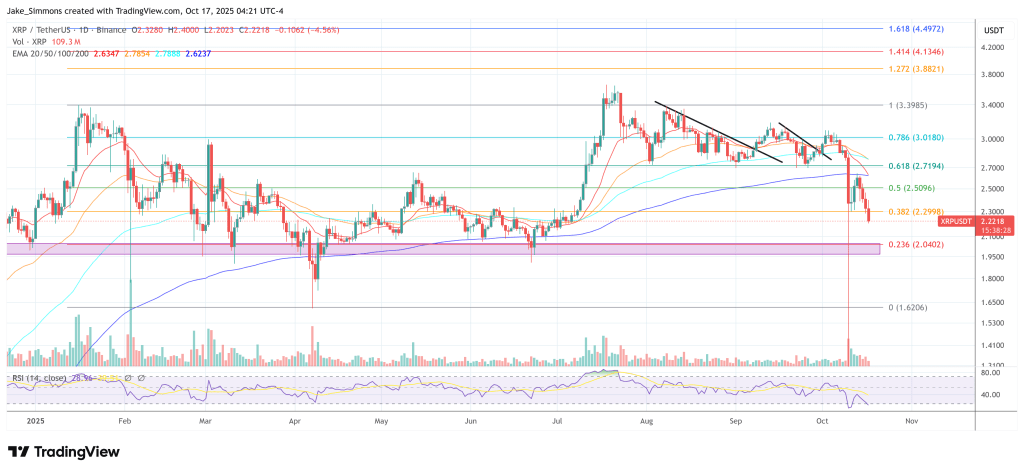
XRP price
XRP drops below the 0.382 Fib, 1-day chart | Source: XRPUSDT on TradingView.com
Featured image created with DALL.E, chart from TradingView.com
Editorial Process for bitcoinist is centered on delivering thoroughly researched, accurate, and unbiased content. We uphold strict sourcing standards, and each page undergoes diligent review by our team of top technology experts and seasoned editors. This process ensures the integrity, relevance, and value of our content for our readers.

Jake Simmons has been a Bitcoin enthusiast since 2016. Ever since he heard about Bitcoin, he has been studying the topic every day and trying to share his knowledge with others. His goal is to contribute to Bitcoin's financial revolution, which will replace the fiat money system. Besides BTC and crypto, Jake studied Business Informatics at a university. After graduation in 2017, he has been working in the blockchain and crypto sector. You can follow Jake on Twitter at @realJakeSimmons.

你可能也喜欢

重构以太坊估值:为什么手续费模型是错的,而“金库逻辑”才是未来?

本文提出了一种全新的以太坊估值框架,挑战了当前市场普遍将手续费视为其“收入”的传统观点。作者认为,手续费本质上是网络摩擦,成功的网络应努力将其降至零,而以太坊手续费下降、交易量创新高的数据恰恰证明了其成功。 核心论点是:以太坊不应被视为一家公司,而应看作一个保护着巨额链上资产的“金库”。转为权益证明(PoS)后,ETH本身成为了保护这个金库的“锁”。攻击网络的成本与质押ETH的市场价值直接挂钩,ETH的价值因此与网络安全性深度绑定。 目前,以太坊链上资产(包括稳定币、RWA、L2跨链资金等)总值约2500亿美元,而用于保护这些资产的质押ETH总价值仅约720亿美元,形成了“锁比保险箱便宜”的风险局面。作者估算,仅基于当前资产规模,ETH的合理价格应在6900美元左右(现价约2070美元)。随着链上资产规模未来增长至数万亿美元,ETH价格也必须相应上涨,才能提供足够的安全保障。 文章驳斥了“以太坊像免费的Linux或DTCC”的类比,指出Linux和DTCC的安全由外部(社区声誉、政府法律)保障,而以太坊的安全必须由其自身代币ETH的市场价值在公开市场中购买。因此,ETH必须具备高价值,这是其作为底层安全抵押品的根本需求。 最终结论是,ETH的估值不应基于其产生的手续费(“收入”),而应基于其需要保护的链上资产总价值。随着更多资产在以太坊上结算,对ETH作为安全抵押品的需求将驱动其价值长期增长。

marsbit12分钟前

重构以太坊估值:为什么手续费模型是错的,而“金库逻辑”才是未来?

marsbit12分钟前

孙宇晨接受《胡润百富》专访:变革周期里,价值流动的新秩序与确定性

在Web3行业深入发展和全球金融基础设施重构的背景下,波场TRON创始人孙宇晨接受《胡润百富》专访,系统阐述了对行业发展的判断。他指出,区块链技术正从早期探索走向规模化应用,核心目标是构建开放、普惠的价值互联网,让全球任何人都能低成本、高效地转移和使用资金。 孙宇晨强调,能够穿越行业周期的项目必须基于真实需求。目前,以稳定币为核心的链上支付已成为最成熟且具备规模化能力的应用场景。波场TRON已发展成为全球最大的稳定币流通网络之一,其链上USDT流通量超过863亿美元,增长动力来源于跨境转账、价值存储等真实用户需求,体现了技术对传统金融体系的“自然替代”。 在战略层面,他总结了“数据驱动迭代、快速执行与用户导向”相结合的方法论,以及“方向清晰、分层支撑与全员主人翁意识”的管理框架。他以波场TRON与Tether合作推出TRC-20 USDT为例,说明基于对市场趋势和风险回报的综合判断是关键。同时,他强调了全球化布局中本地合规与文化适配的重要性。 对于技术融合趋势,孙宇晨认为人工智能(AI)是对“思考与决策能力”的重构,AI与区块链在数据、算力及智能执行层面的结合是重要方向。区块链可为AI提供去中心化基础设施,AI则能提升区块链的智能化与用户体验。 最后,他建议行业参与者和年轻创业者,在不确定的环境中应持续学习、快速适应,并在理解全局的基础上聚焦核心优势,打造不可替代的竞争力。波场TRON正通过完善基础设施、推进全球化战略和前瞻技术布局,持续推动价值互联网的落地演进。

marsbit44分钟前

孙宇晨接受《胡润百富》专访:变革周期里,价值流动的新秩序与确定性

marsbit44分钟前

三星靠技术周期,海力士靠 HBM,美光凭什么赢了万亿市值?

美光科技凭借独特生存策略与硬核制造能力,成为全球三大内存芯片巨头之一。其发展历程充满争议:在行业危机中,美光多次诉诸政治与法律手段破局,例如早年投诉日企倾销、在反垄断调查中充当“污点证人”,以及通过游说打压竞争对手(如中国福建晋华),因而被贴上“政治投机者”标签。这些策略为其赢得了关键的喘息时间。 然而,美光的真正核心竞争力在于极致的制造成本控制。通过数十年工程积累,其DRAM芯片单位面积小于三星和SK海力士,同一晶圆可产出更多芯片,从而在价格战中具备更强韧性。 但美光也因战略误判付出了代价。2013年收购尔必达后,陷入技术整合困境,错失了布局HBM(高带宽存储器)的黄金十年。当AI浪潮推动HBM需求爆发时,美光已大幅落后,目前HBM3市场份额仅约3%,远低于SK海力士。同时,公司还面临三重挤压:在高端HBM市场追赶乏力;中低端DRAM市场受到中国长鑫存储低价侵蚀;加之中国对其产品实施采购禁令,导致其在中国市场份额从曾经的高位骤降至7.1%,并错失了中国AI基建高峰期的订单。 如今,美光正全力追赶,其HBM3E已获英伟达认证,并加紧研发HBM4。但竞争对手已领跑下一代技术。美光的故事揭示,政治杠杆与制造效率能助其穿越周期,却无法弥补因错失技术趋势而落后的“时间债”。未来,这家巨头能否在高端赛道实现反超,仍是一场关于技术与耐心的考验。

marsbit1小时前

三星靠技术周期,海力士靠 HBM,美光凭什么赢了万亿市值?

marsbit1小时前

交易

现货
合约

热门文章

什么是 XRP 2.0

XRP 2.0:加密货币领域的新前沿 XRP 2.0 简介 在不断演变的加密货币领域,各种新项目不断涌现,争夺关注和采用。其中一个颇具前景的倡议是 XRP 2.0,这是一个旨在利用先进区块链技术和强大加密方法的新型加密货币项目。尽管其名称与 Ripple 的 XRP 存在一定的相似性,但必须指出的是,XRP 2.0 独立运营,专注于提升交易安全性、隐私和可扩展性。随着数字金融领域越来越多地采用去中心化解决方案,XRP 2.0 旨在为 web3 和加密项目的整体扩展做出重要贡献。 XRP 2.0 是什么? 从根本上说,XRP 2.0 是一个旨在创建安全、去中心化数字货币生态系统的加密货币项目。其基础技术将复杂的区块链原理与前沿的加密技术相结合。XRP 2.0 的总体目标是建立一个可靠、高效的平台,以实现快速的交易执行,同时优先考虑用户的隐私保护。 该项目被宣传为克服现有加密货币面临的许多局限的解决方案,提出了一个可以处理更高交易量且速度和隐私得到改善的系统。这种多功能性使 XRP 2.0 在充满各种数字货币的市场中成为一个重要竞争者。 XRP 2.0 的创造者是谁? XRP 2.0 的创建者被标记为“Wilbur”。然而,关于 Wilbur 或其相关实体的详细信息仍然难以捉摸。许多加密货币创造者的匿名性在行业中并不少见,通常旨在保持一定程度的隐私和安全。 XRP 2.0 的投资者是谁? 目前,有关支持 XRP 2.0 的投资基础或组织的具体信息尚未公开。在加密货币领域,知名投资者的支持可以显著影响项目的可信度和成功,但关于 XRP 2.0 财务支持者的透明度尚未建立。 XRP 2.0 如何运作? XRP 2.0 的一个亮点是采用了区块链技术与先进加密算法的结合,以确保安全和去中心化的交易。其创新结构包括旨在促进用户参与和拓宽功能的独特特性,超越了传统加密货币交易。 在这些特性中,XRP 2.0 集成了 AI 驱动的能力,如文本转图像和文本转语音功能。这些添加旨在增强用户的交互体验,促进在各个行业中更广泛的应用。通过将技术进步与以用户为中心的设计相结合,XRP 2.0 旨在吸引寻求将加密货币解决方案融入其运营框架的多样化个体和企业的注意。 XRP 2.0 时间线 要理解 XRP 2.0,就需要审视定义其迄今为止旅程的里程碑: 2023年7月23日:XRP 2.0 作为一个新型加密货币项目被推出,旨在革新区块链领域的安全和去中心化交易能力。 2023年9月8日:另一个项目 XRP20 启动,这标志着在以太坊区块链上出现一个与 XRP 2.0 无关的 ERC-20 代币。 2023年11月13日:XRP 分类账经历重大更新,发布了 rippled 服务器软件版本 2.0.0。值得注意的是,此发展与 XRP 2.0 加密货币项目无关。 XRP 2.0 的关键点 要提炼出 XRP 2.0 的本质,有几个关键因素浮现: 独特特性:诸如 AI 驱动的文本转图像和文本转语音的功能进一步丰富了 XRP 2.0 的潜在应用。 区块链技术:该框架利用先进的区块链机制和加密协议,确保交易的安全和去中心化环境。 可扩展性和隐私:XRP 2.0 优先考虑交易过程中的增强隐私保护以及满足日益增长的用户基础所需的可扩展性。 与 Ripple 无关:重要的是,尽管名称相似,XRP 2.0 与 Ripple 的 XRP 并无任何忠诚或合作关系,区分了其在加密货币生态系统中的运营框架和目标。 结论 XRP 2.0 代表了在加密货币领域的一项雄心勃勃的探索,旨在在数字交易中提供安全、隐私和效率的结合。通过集成复杂技术和用户友好的功能,该项目希望拓宽加密货币在当今数字经济中所能实现的可能性。 尽管其创造者的匿名性和缺乏公开投资者的信息可能引起一些人的疑问,但 XRP 2.0 对先进功能和去中心化的关注增强了它在日益拥挤的加密市场中的吸引力。随着加密货币领域的持续演变,XRP 2.0 可能会成为安全和可扩展区块链解决方案扩展的关键参与者。

163人学过发布于 2024.04.01更新于 2024.12.03

什么是 XRP 2.0

相关讨论

欢迎来到HTX社区。在这里,您可以了解最新的平台发展动态并获得专业的市场意见。以下是用户对XRP(XRP)币价的意见。

活动图片