Southeast Asian country of Laos is planning to reroute power away from Bitcoin and crypto mining operations by the end of Q1 2026.
Laos To Direct Power From Crypto Mining To AI, EVs
As reported by Reuters, Laos is looking to shift energy to industries that contribute more to economic growth than mining operations related to Bitcoin and other cryptos.
BTC and some other blockchains use a consensus mechanism based on the proof-of-work (PoW), where validators known as miners compete against each other using computing resources (measured as “Hashrate“) to solve a mathematical puzzle. The first to find the solution earns the opportunity to add the next block to the chain and claim the associated rewards.
Before 2021, China dominated Bitcoin mining, hosting a significant part of the total world Hashrate. In May 2021, however, crypto mining in the nation fell prey to an infamous ban, leading to a sharp crash in the network Hashrate.
Filling the void left behind by Chinese miners, several energy-rich countries began attracting mining operations to their grids. Laos was one of them. “We proposed to the government in 2021 to supply to crypto mining due to the oversupply of electricity domestically,” said Chanthaboun Soukaloun, the country’s deputy energy minister, in an interview with Reuters.
Laos is a big hub of hydroelectrical power and a key exporter of clean energy in the Southeast Asian bloc. Despite its abundant energy reserves, the government has now judged that its power can be better allocated to supplying industries that produce more jobs and build domestic supply chains, instead of crypto mining.
The sectors the government is considering prioritizing include AI data centers, metal refining, and electric vehicles. Initially, the country had planned to cut off crypto mining completely this year, but abundant rainfall made it decide to maintain electricity supply for a while longer. Soukaloun said that the government is now planning to end supply by the end of the first quarter of 2026.
The shift isn’t a sudden one, as Laos has already been scaling back on crypto mining operations. Mining farms related to Bitcoin and other assets utilized a peak power of 500 MW back in 2021 and 2022, but their consumption is down 70% to just 150 MW today.
Speaking of Bitcoin mining, the global Hashrate has been on the decline recently, as the chart for the 7-day average value of the metric from Blockchain.com shows.
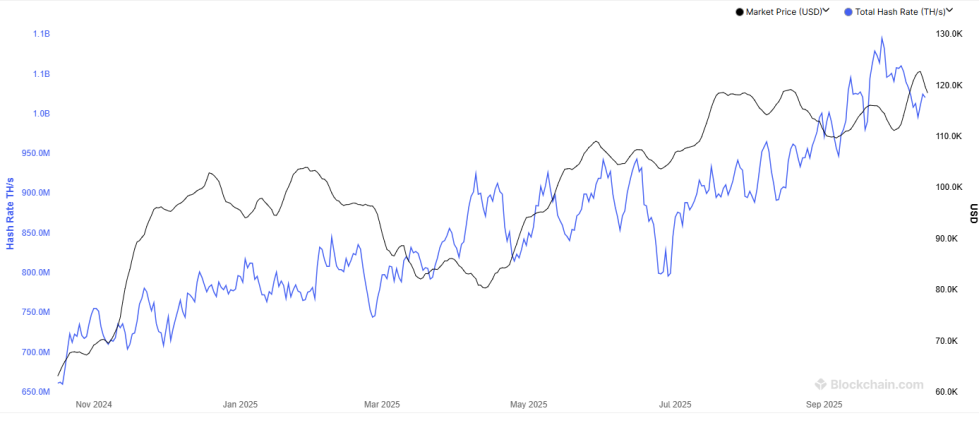
Looks like the 7-day average Hashrate set a new record last month | Source: Blockchain.com
The indicator set a new all-time high (ATH) in late September, but it has since seen a notable drop, indicating that miners are scaling back on their facilities.
Bitcoin Price
Bitcoin has witnessed a further drop of 3% over the last 24 hours that has taken its price back to the $107,900 level.
The price of the coin seems to have been on the way down since the ATH | Source: BTCUSDT on TradingView

Related Posts