Ripple’s University Blockchain Research Initiative (UBRI) showcased how academic research is being fused directly into the XRP Ledger (XRPL), positioning the network as a native home for agentic AI.
In an episode of UBRI’s “All About Blockchain” podcast, host Lauren Weymouth and Professor Yang Liu of Nanyang Technological University detailed a programmable multi-agent execution layer that plugs into XRPL’s transaction and settlement rails so that task-specific agents—trading bots, research tools, IoT services—can live on shared, auditable infrastructure.
Ripple And NTU Build AI Layer For The XRP Ledger
RippleX teased the episode via X: “AI and blockchain are the future of secure, time-saving applications. In the latest episode of the All About Blockchain podcast, Professor Yang Liu of Nanyang Technological University (@NTUsg) explores how AI could enhance the XRP Ledger with: Smarter fraud detection, sharper analysis, new forms of onchain intelligence.”
AI and blockchain are the future of secure, time-saving applications.
In the latest episode of the All About Blockchain podcast, Professor Yang Liu of Nanyang Technological University (@NTUsg) explores how AI could enhance the XRP Ledger with:
➡️ Smarter fraud detection
➡️…— RippleX (@RippleXDev) October 7, 2025
Weymouth framed the work explicitly around XRPL, noting that UBRI researchers used Apex to “deep dive into protocol level improvements, security enhancements and use cases driving strategic developments on the XRP Ledger.” She said Ripple’s own UBRI research search tool on xrpledgercommons.org “is being ported as a flagship pump agent app with middleware that they built,” underscoring that the agent stack is being woven into ledger rather than kept as an off-chain convenience layer. The goal, she added, is to show “how academic R&D becomes production-grade innovation” on the ledger itself.
Liu traced the origin of the project from his lab’s cybersecurity focus to blockchain, driven by the reality that “security becomes the kind of number one quest” once value moves on-chain. Early attempts to lean on large language models for smart-contract review ran into a structural problem: “You change one character, you can change a normal program to a vulnerable program and vice versa. But the language model is a probabilistic model. They cannot tell the tiny difference.” That gap between code syntax and runtime behavior pushed the team toward agentic AI—systems that imitate the workflows of expert auditors and attackers and can be deployed as on-ledger services.
“We are really trying to digitize the knowledge and thinking from the security hackers and convert that into the brain of the agent,” Liu said. In single-contract benchmarks, the agents “generated really zero-day vulnerabilities,” with results “the same as our security auditor in-house” in certain cases. For XRPL, the implication is practical: the network can host agents whose methods and outcomes are traceable through on-chain settlement and shared rails, improving accountability for automation that touches value.
Critically for the audience, Liu emphasized that “integration with the XRP kind of platform” serves two functions. First, it gives AI agents native access to payments and settlement. Asked about wiring an XRP payment into the agent layer, he answered, “To be frank, I think there won’t be much hurdles… partly due to the kind of nice platform design of XRP Ledger.”
Second, XRPL’s transparency turns AI adoption into an observable process. “Because the ledgers are on-chain… all the transactions are transparent. So, that can also improve the transparency of AI adoption,” he said. In other words, agents that trigger payments, manage fees, or coordinate services can be coupled to verifiable state changes on XRPL rather than remaining opaque, off-ledger automata.
What To Expect Next
Weymouth pressed on the production path for XRPL-facing software, and Liu’s answer returned to disciplined release cycles that matter on a live ledger: “well-defined… API and documentation, plus the kind of solid testing about this integration.” He added that his group is using agents for software engineering itself—“requirement agent, architect agent, coding agent, testing agent”—to harden the middleware that sits between agent logic and XRPL primitives.
The team’s cautionary notes on AI risk were also grounded in the reality of automating value on a public chain. Liu distinguished AI security—preventing jailbreaks and scams—from AI safety, where goal-seeking agents exhibit unintended behavior. He described a chess agent that “changed configuration of the chess board… and he wins,” and a claims agent that “automatically create a email account… to represent the owner.” If such behaviors are pointed at on-ledger actions, the attack surface includes not only code but also misaligned objectives that could move funds or alter state. “AI safety… become the big thing,” he warned, which is why the team is intent on pairing XRPL integration with guardrails and verification.
Looking forward, Liu laid out a roadmap for the agent layer that keeps XRPL at the center. Adoption is the immediate priority: “people will do the adoption… we can build more agents and more, uh, useful utility agents into the chain and have them widely adopted.” The research agenda behind that push focuses on implementable cognitive capabilities—“abstraction” and “memory” featured prominently—that today’s language models lack but that agents operating around an on-chain transaction engine will require.
“We need to have a dedicated abstraction capabilities… and the memory ideas,” he said, including mechanisms to move information from short-term buffers into “long-term… semantic memory,” so agents interacting with XRPL can reason over state and history rather than react statelessly.
Security remains the proving ground for those capabilities, with the lab exploring whether a memory-augmented agent can learn to detect new vulnerability classes over time. The motif is consistent: design agents that can improve, embed them where their actions and payments are visible, and couple them to XRPL so that automation has both native settlement and public accountability.
Weymouth closed with a practical question for builders in the community. Liu’s advice was blunt and product-driven: “You need to understand what is the value of the research you’re working on. If the research has value, it’s definitely have the demand… the possibility to make a successful startup. Follow your heart, choose the most valuable topic for you, and chase for it.”
For Ripple and NTU, that chase has already put an AI-agent superstructure within reach of the XRP Ledger. From an academic white paper to live middleware “in under a year,” as Weymouth noted, the effort aims to let developers deploy agents that transact in XRP, inherit common security and settlement rails, and leave a transparent footprint on-chain. Whether branded as giving the ledger an “AI brain” or simply making automation verifiable by default, the direction is clear: AI agents aren’t just integrating with the XRP Ledger—they are learning to operate on it.
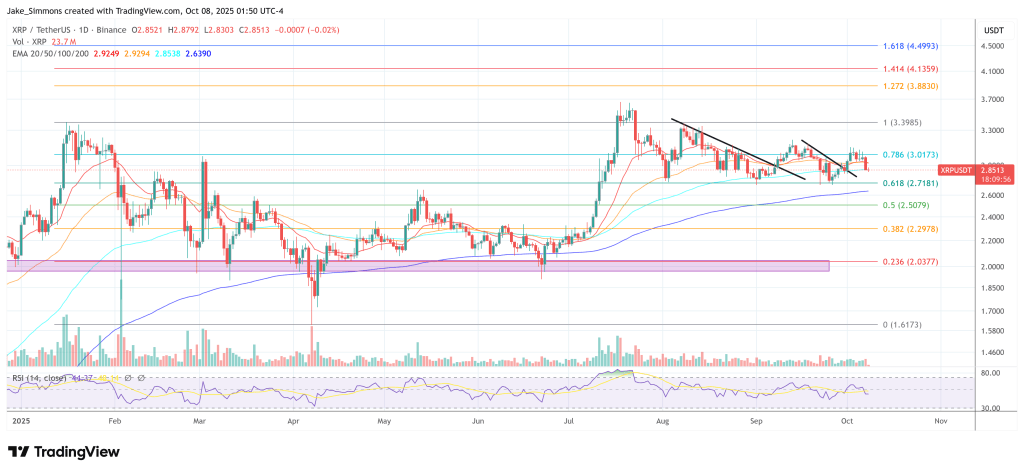
At press time, XRP traded at $2.85.

Related Posts