Swift’s decision to embed a blockchain-based, shared ledger into its core infrastructure has triggered a new round of soul-searching around Ripple’s strategy and the XRP Ledger’s utility. Announced at Sibos 2025 in Frankfurt on September 29, Swift framed the move as a “pivotal step” toward instant, always-on cross-border settlement at global scale—positioning its new ledger as an extension of two years of tokenization trials rather than a wholesale system replacement.
“Make XRP Great Again”
Against that backdrop, CoreNest Capital GP Bob Ras urged Ripple to rethink its roadmap. “So Ripple has been trying to replace SWIFT for years. SWIFT just added blockchain instead. The plot twist writes itself. What’s the next move? Maybe it’s the right time to pivot?” he wrote on X.
In a follow-up post he sharpened his critique: “Ripple has been all over the map: cross-border payments, then NFTs, then tokenization, now stablecoins. The core issue is XRPL itself. Without smart contracts it’s just not a friendly chain for developers, which is why you don’t see much serious building happening on it. Even the attempts to add smart contracts, like the grant to Axelar, haven’t really materialized.”
In anticipation of the expected pushback from the XRP army, he added: “Hate me or love me, the reality is, right now XRP doesn’t offer real utility beyond simple value transfers from one wallet to another. Any tokens can do that. For a project that once aimed to flip SWIFT, that’s not enough. Ripple needs a pivot toward true utility if it wants to stay relevant. MAKE XRP GREAT AGAIN!”
Ras’s remarks landed as Chainlink publicly congratulated Swift and underscored a multi-year collaboration that includes 2023 interoperability experiments using Chainlink’s Cross-Chain Interoperability Protocol (CCIP) and Swift’s messaging rails. Chainlink called the Sibos announcement “a landmark moment,” reiterating that oracles and messaging standards can bridge banks to public and private chains without ripping out existing infrastructure.
XRP Vs. Chainlink And SWIFT
That framing spurred a valuation and token-economics debate. “Can someone from the XRP army explain how XRP is more than TEN times LINK’s value, when LINK has a REAL partnership with SWIFT, AND a clear path to revenue to be shared with token holders…,” wrote Dave Weisberger, co-founder and former chairman of CoinRoutes, who later clarified that he holds both assets but sees “delusional” price calls.
Community replies ranged from market-cap arithmetic to claims about on-chain volume, with critics countering that high transactional throughput does not, on its own, translate into accrual of value to a token. The exchange captured a persistent fault line: does institutional adoption of bank-friendly rails and oracle networks favor neutral middleware like Chainlink more than L1 tokens whose payment-network ambitions overlap with Swift’s upgrade path?
Ras’s central technical claim—that XRPL’s base layer is inhospitable to developers because it lacks general-purpose smart contracts—has historical grounding but requires nuance in late-2025. Ripple has long prioritized deterministic, built-in primitives for payments, a native DEX, and, more recently, NFTs (XLS-20), rather than a Turing-complete VM.
Community proposals such as “Hooks” seek to add lightweight, on-ledger programmability; in parallel, Ripple and ecosystem teams shipped an XRPL EVM Sidechain, live on mainnet since June 30, 2025, to provide Ethereum-compatible smart contracts connected to XRPL via the Axelar bridge. That sidechain—and Ripple/Axelar interoperability work—directly addresses developer surface area, even if it does so off the L1.
Strategically, Ripple has broadened beyond cross-border messaging into tokenization and dollar settlement. Its US dollar-denominated stablecoin, RLUSD, was announced in 2024 with distribution partners across exchanges and payments platforms; Ripple has also pursued institutional infrastructure, including a 2025 agreement to acquire prime broker Hidden Road.
These moves suggest a pivot toward providing liquidity and balance-sheet utilities around tokenized assets—an area Swift’s new ledger explicitly targets at the messaging layer. Whether that ends up complementary or competitive for XRP’s investment case depends on how much value accrues to the ledger (or its EVM sidechain) versus to bank-operated ledgers linked by oracles and standards.
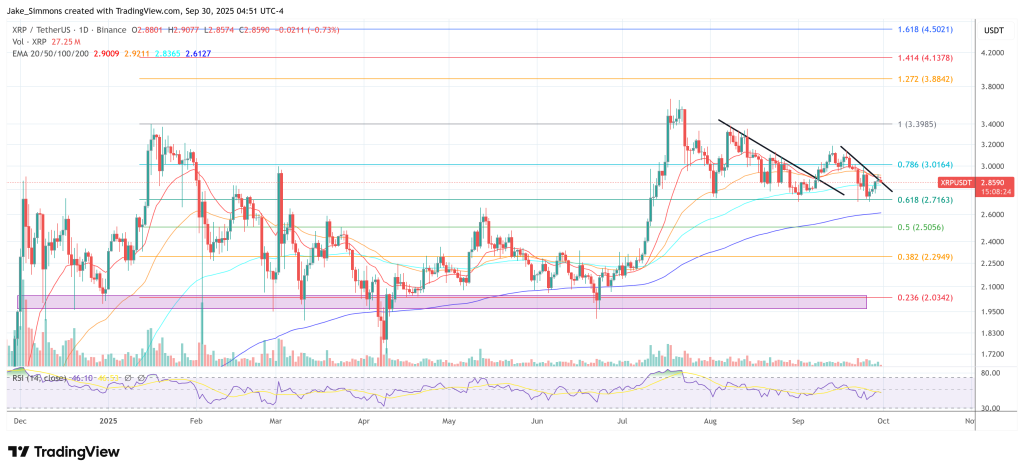
At press time, XRP traded at $2.86.

Related Posts