Ethereum co-founder Vitalik Buterin framed the network’s next scaling step as both audacious and tightly risk-controlled, saying “Fusaka will fix this” while underscoring that “safety first is of the utmost importance.” In a detailed post, Buterin described Fusaka’s core feature—PeerDAS—as “trying to do something pretty unprecedented: have a live blockchain that does not require any single node to download the full data.”
He added that PeerDAS relies on probabilistic sampling of data “chunks,” and, if more than half of those chunks are available, nodes can retrieve them and reconstruct the remainder via erasure coding. “This is all new technology, and the core devs are wise to be super cautious on testing,” Buterin wrote, noting that blob supply will ramp “conservatively at first,” then more aggressively if conditions permit.
Buterin Calls Fusaka the Key To Ethereum L2 Scaling
Buterin’s remarks arrive just as Ethereum’s new blob market shows signs of strain. Head of Data at Dragonfly Hildebert Moulié reported that the chain “hit 6 blobs/block for the first time,” attributing the recent surge primarily to rollups and projects including Base and Worldcoin. According to the same thread, Base submitted roughly 35% of blobs and used about 42% of blobspace, with Worldcoin contributing around 20% of submissions and 25% of usage; Arbitrum, OP Mainnet, Soneium, Scroll and others comprised most of the remainder.
The analyst added that L2s now account for about $200,000 per week in mainnet fees for submissions, validators require more than 70 GB of storage for blobs (over 1.2 TB if unpruned), and that many blobs are not fully utilized—particularly on smaller rollups posting more frequently than they can fill 128 KB payloads. The first sustained base-fee spike since the Pectra hard fork was also observed, although hildobby cautioned that “blob price discovery” still requires a more prolonged saturation of demand.
PeerDAS is the architectural response. Buterin explained that each node requests only a small number of chunks to verify that over half of the data is available; if so, the node “theoretically can download those chunks, and use erasure coding to recover the rest.”
In its initial incarnation, two non-custodial roles still require full-block data to exist somewhere on the network—initial broadcast and emergency reconstruction when a publisher reveals only a fraction of a block—though “we only need one honest actor” for those tasks, and future “cell-level messaging and distributed block building will allow even these two functions to be distributed.” The endgame, he suggested, is to unlock sustained L2 scaling and, as L1 block gas limits rise, to eventually route more L1 execution data into blobs as well.
This pivot lands amid a rapidly evolving blob marketplace. After Pectra, Ethereum increased the blob target and maximum per block, expanding daily data capacity and paving the way for higher throughput from rollups; research desks have linked that shift to a complex interaction between L1 base fees, blob fees, and L2 submission behavior.
The Fusaka timetable adds urgency. Core developers have signaled a mainnet activation for December 3, 2025, following staged testnet rollouts, placing Buterin’s “safety first” emphasis in clear relief. PeerDAS will debut under strict limits, with blob counts increased “conservatively at first,” a posture designed to avoid fee whiplash and to observe how diverse L2s actually consume the added capacity.
Outside the protocol notes, empirical work is accumulating around how networks might use blobspace more efficiently. A 2024 study on “blob sharing” argued that smaller rollups frequently under-fill blobs and could cut posting costs by more than 85% by cooperatively packing data into shared blobs, smoothing the base fee and lowering the total number of blobs submitted.
Ethereum researchers have since expanded that argument, modeling how sharing reduces blocks with more than the target number of blobs and thereby dampens the exponential blob-fee adjustments that kick in when usage overshoots targets. Those findings dovetail with Moulié’s observation that “many blobs aren’t full,” implying large savings are available through better coordination as the market matures.
The conceptual roots of PeerDAS stretch back through Ethereum research notes on data-availability sampling and Buterin’s own writings on “The Surge.” PeerDAS itself implements one-dimensional sampling with erasure coding and succinct per-cell proofs, enabling nodes to validate availability without naively downloading everything. That’s what makes the approach “pretty unprecedented” in a live, high-value blockchain: it seeks to reconcile decentralization and throughput by reducing per-node bandwidth and storage requirements while preserving strong guarantees that data actually exists.
Still, the shift is not without risks. Buterin’s insistence on a careful rollout reflects the reality that Ethereum’s blob economy is young, volatile, and sensitive to sudden changes in demand. As L2s jostle for capacity, fee dynamics can invert quickly, and incomplete blobs, spiky usage, and MEV side effects complicate forecasting. The promise of Fusaka is that PeerDAS can bend those dynamics toward sustainable growth by letting the network scale data availability without forcing any single node to shoulder the whole chain—and by doing so in a way that keeps security assumptions explicit and testable.
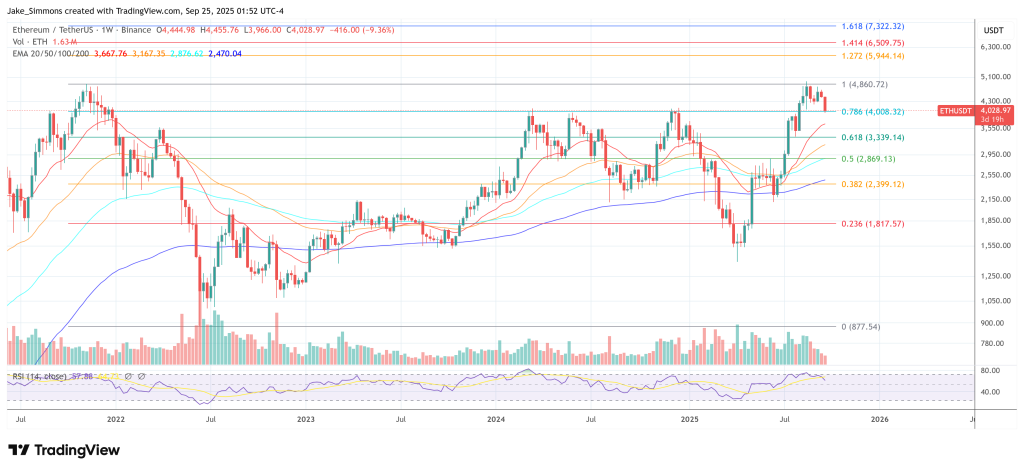
At press time, ETH traded at $4,028.

Related Posts