Ethereum co-founder Vitalik Buterin has waded directly into a fast-escalating dispute over the role and risk profile of Coinbase’s Layer-2 (L2) network, Base, arguing that critics are conflating core concepts and overlooking concrete guarantees that protect users on modern L2s. “Base is doing things the right way: an L2 on top of Ethereum, that uses its centralized features to provide stronger UX features, while still being tied into Ethereum’s decentralized base layer for security,” Buterin wrote, adding that L2s like Base “are non-custodial… not glorified servers that happen to submit hashes.”
Ethereum’s Buterin Clarifies L2 Security
Buterin’s post arrived after Coinbase’s chief legal officer Paul Grewal pushed back on commentary likening L2 sequencers to “exchanges,” and Base creator Jesse Pollak published a detailed thread explaining what a sequencer actually does. Pollak described Base’s sequencer as a system that “collects user transactions, orders them on a first-in/first-out basis, computes the resulting state changes, and batches them to Ethereum’s L1 for final settlement that’s faster and cheaper than transacting on L1.”
In his words, sequencers “do NOT act as ‘matching services’ or engines like those in traditional exchanges… the sequencer ensures these transactions are executed in a consistent, ordered manner, but it doesn’t decide matches or control trade logic. That’s up to the code.”
The crux of the controversy is custody and control: if an L2 can re-order, censor, or halt, does that make it functionally similar to a centralized intermediary? Buterin’s answer is that the Ethereum base layer ultimately governs user funds and provides the escape hatches that matter.
“Base does not have custody over your funds, they cannot steal funds or stop you from withdrawing funds (this is part of the L2beat stage 1 definition),” he wrote, pointing readers to L2BEAT’s taxonomy and to concrete examples of “force-exit” and anti-censorship pathways implemented at the L1 contract layer. He emphasized that these are not theoretical niceties: “There are concrete pathways implemented in smart contract logic on Ethereum L1… that ensure that the L2 users’ funds are ultimately controlled by L1, they cannot be stolen or blocked by the L2 operator.”
Buterin also addressed a recurring point of confusion: the notion that L2BEAT is some kind of ideological gatekeeper rather than a scorecard of objective assurances. “Many people have been confused by recent cynicism and think that things like L2beat are a weird sort of nerd-sharia compliance authority. This is NOT what is going on. The security that L2s provide, that L2beat measures, reflects concrete properties that protect you as a user from being rugged.”
To illustrate, he linked to a walkthrough of user withdrawals when an L2 shuts down, and to a censorship-resistance incident earlier this year where an L2’s design allowed transactions to bypass an uncooperative operator—examples meant to make the guarantees tangible.
The “stage-1” designation, often cited to critique Base’s current decentralization, was another flashpoint Buterin tackled head-on. “Yes stage 1 means that a security council with a 75% vote can override the onchain code,” he conceded. “However, stage 1 also requires that a quorum-blocking (>=26%) portion of the council sits outside the org that is managing the L1. Hence, the org cannot unilaterally censor or steal via a security council vote, so they are not a custodian.”
Base Is Eying ‘Stage 2’
The Ethereum co-founder again pointed readers to his framework for when and how projects should progress to “stage-2,” where even a unanimous council cannot override functioning on-chain logic. The policy implication is explicit: the presence of an emergency-brake governance layer does not, in itself, transform an L2 into a custodian under normal operation, provided minority independence and L1-enforced exits are real.
For Base, Pollak sketched a roadmap that aligns with that trajectory. “We’ve progressed Base to stage 1 decentralization over the last 2 years and enabled permissionless block proposals. Today, we’re actively working towards stage 2 and investing in further decentralizing block building. Still day one.” Framed this way, the debate is not whether Base is an exchange—Pollak was blunt: “so no, @base isn’t an unlicensed securities exchange”—but how quickly and credibly it can reduce governance and operator powers while preserving the UX advantages that made L2s popular.
Underneath the rhetoric are two technical assurances that determine whether users are actually protected. First is inclusion: even if a sequencer refuses a transaction, L2s like Base expose direct submission routes through Ethereum L1, letting users force their transactions into the rollup and inherit the censorship-resistance of the L1 validator set.
Second is exit: if an L2 halts or misbehaves, users can initiate withdrawals enforced by L1 contracts—without the operator’s cooperation. Buterin’s point is that these are “concrete properties,” and both L2BEAT’s framework and recent real-world incidents exist to verify that they work in practice.
The stakes are larger than a single network. How regulators and market participants interpret “sequencer,” “custody,” and “decentralization stage” will shape the next phase of Ethereum scaling.
Buterin’s intervention was, at core, an attempt to reset definitions to what the code guarantees.“This is what we mean when we say that L2s are non-custodial, they are extensions of ethereum… There are concrete pathways… that ensure that the L2 users’ funds are ultimately controlled by L1.”
Whether that reframing cools the fevered discourse—or accelerates Base’s push to stage-2—now rests on how convincingly these assurances are demonstrated in production and audited by neutral frameworks.
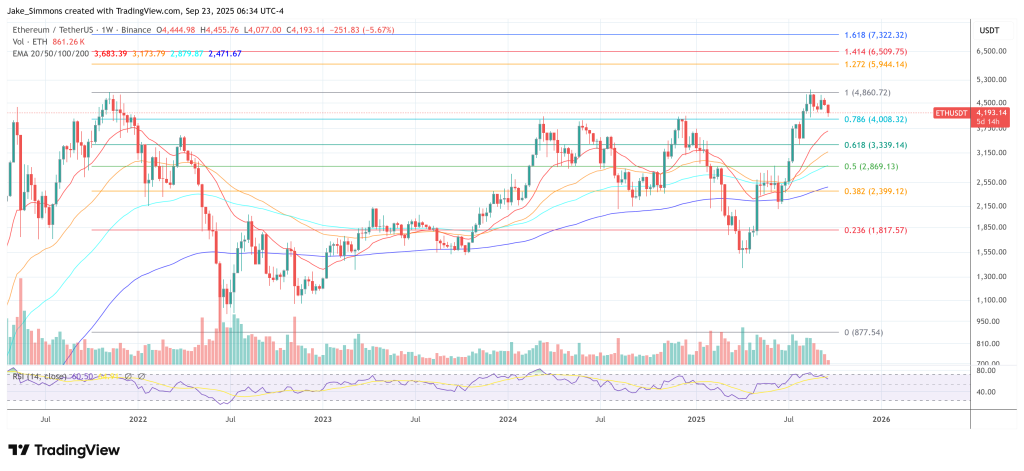
At press time, ETH traded at $4,193.

Related Posts