Deutsche Bank’s Research Institute argues that Bitcoin is on track to sit alongside gold in central bank reserves by the end of this decade, provided current adoption and market-structure trends persist. In a paper published on September 22, 2025, research analysts Marion Laboure and Camilla Siazon conclude “there is room for both gold and Bitcoin to coexist on central bank balance sheets by 2030,” positioning the two assets as complementary hedges rather than competitors for the same reserve slot.
Central Banks Will Embrace Bitcoin Like Gold By 2030
The report frames its thesis against a year in which gold has again validated its defensive role. Spot prices set a record high above $3,700 per ounce in September, buoyed by geopolitical uncertainty, continued central-bank purchases, expectations of additional Federal Reserve rate cuts, and questions about Fed independence. Those drivers, the authors note, have reinforced gold’s status as a safe-haven and a core portfolio diversifier for official institutions.
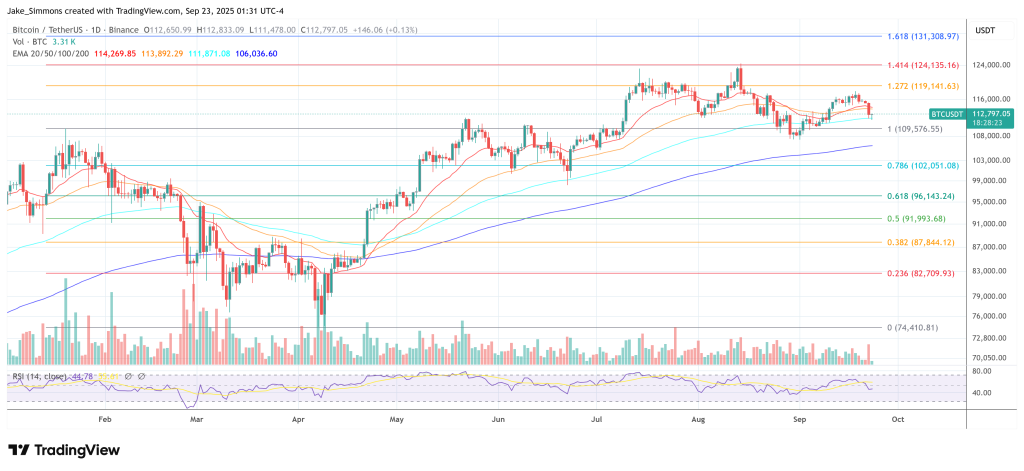
Running in parallel, Bitcoin has displayed uncharacteristic composure at elevated price levels. After surpassing $123,500 on August 15, the asset has traded close to all-time highs, which Deutsche Bank reads as evidence of deepening institutional adoption and an “emerging status as a potential macro hedge.” The authors explicitly evaluate whether Bitcoin meets key reserve-asset criteria—volatility, liquidity, strategic value and trust—and find that while it still falls short on trust and transparency today, its trajectory resembles an earlier phase in gold’s own evolution.
A central plank of the case is volatility. The analysts acknowledge that Bitcoin “still lacks key components of a reserve asset: trust and transparency,” yet argue that the market’s maturation is beginning to compress realized swings.
They point to a notable marker in August, when Bitcoin’s 30-day volatility declined to 23% even as spot prices pushed to records. That “combination suggests we may be witnessing the start of a gradual decoupling between Bitcoin’s spot prices and volatility as the crypto’s integration into portfolios is maturing,” potentially signaling a more durable regime change beyond episodic speculation.
Regulatory clarity is cast as the catalyst: with US initiatives, the EU’s MiCA framework and the UK FCA’s crypto roadmap “accelerating,” Deutsche Bank expects deeper liquidity and, over time, lower volatility—preconditions for reserve acceptance.
Will Bitcoin Replace The US Dollar?
The authors are careful not to overstate Bitcoin’s endgame. They write that neither Bitcoin nor gold is likely to supplant the US dollar as the primary reserve asset or payment medium. History is instructive: in the 1930s and 1970s, US authorities deliberately curtailed the international system’s reliance on gold when it was seen as threatening dollar primacy.
Policymakers today, the report contends, will likewise ensure that Bitcoin and other digital assets “do not threaten the sovereignty of their currencies.” In other words, coexistence on balance sheets does not equate to displacement of the dollar at the system’s core.
If the destination is coexistence, the portfolio case hinges on diversification properties—and here Deutsche Bank presents a decade-plus of correlation data. Since 2011, Bitcoin’s correlations have been low or near-zero with most traditional assets, while remaining tightly linked to Ethereum.
The figures cited are 79% with Ethereum, 12% with the Russell 2000, 10% with the S&P 500, 8% with the Nasdaq 100, 3% with gold, 1% with WTI crude, 1% with US 10-year Treasuries, 1% with 2-year Treasuries, and −7% with the US Dollar Index.
Gold’s pattern over the same period looks markedly different: stronger positive correlations with rates markets (30% with the 10-year, 25% with the 2-year), modest positive links to equities and commodities (12% with both the S&P 500 and Russell 2000; 14% with WTI; 9% with the Nasdaq; 11% with Ethereum; 8% with Bitcoin), and a pronounced negative relationship with the Dollar Index at −48%.
Taken together, the series imply that gold and Bitcoin diversify across different channels: gold against dollar strength and real rates, Bitcoin against risk factors that do not neatly map onto traditional macro exposures. That complementarity underpins the reserve-allocation logic.
The historical analogy is explicit. “This time is not different,” the authors write, arguing that gold “was once subject to skepticism, suspicion and demand speculation,” and that its path to reserve orthodoxy was marked by episodes of volatility and sentiment swings.
These Central Banks Could Adopt BTC First
They see Bitcoin adoption continuing as demographics, macro conditions and—crucially—time allow more of the public to “embrace Bitcoin as a store of value.” In their view, the trend is secular rather than cyclical, with human preference periodically shifting toward alternative assets that sit outside conventional financial architecture. “So long as we are human,” they add, “Bitcoin and other alternative assets will likely continue to compete for our attention.”
The geography of adoption matters as well. Deutsche Bank sees a particularly strong reserve-use case in emerging markets, where capital controls and currency instability are recurring features. Citing countries such as Argentina, Egypt and Nigeria, the paper argues that Bitcoin can help holders circumvent capital controls and is “increasingly seen as a workable alternative to relatively unstable local currencies.” That argument does not require global monetary hegemony; it requires localized, functional demand and the institutional arrangements—custody, liquidity, regulatory guardrails—that make such demand durable.
What would get Bitcoin into central bank vaults? The report’s answer is incrementalism. Greater regulatory harmonization, rising transaction volumes and progressively deeper two-way liquidity are expected to continue compressing volatility and addressing the trust deficit.
The authors frame Bitcoin and gold not as substitutes vying for a single reserve slot, but as “complementary diversifications to central bank portfolios” owing to their low correlations with other asset classes, relatively scarce supplies, and roles as hedges against inflation and geopolitical risk. The institutional North Star remains unchanged—dollar centrality and currency sovereignty. Within that architecture, however, Deutsche Bank’s base case is a steady broadening of the reserve palette.
At press time, BTC traded at $112,797.

Related Posts