The cryptocurrency industry and the XRP market have scored a major win, with the United States Securities and Exchange Commission (SEC) approving Grayscale’s Digital Large Cap Fund, known as GDLC, for uplisting as an Exchange-Traded Fund (ETF). The timing of this approval has sparked renewed optimism among investors, particularly as XRP cements its position in a rapidly evolving crypto ETF landscape.
XRP Gains Legitimacy Through Grayscale’s GDLC ETF
On September 18, Grayscale Chief Executive Officer (CEO) Peter Mintzberg announced via X social media that the Grayscale Digital Large Cap Fund has been approved for trading under the SEC’s Generic Listing Standards. The move represents a watershed moment, as it will be the first multi-crypto asset ETP in the US market.
The product, now renamed the “Grayscale CoinDesk Crypto 5 ETF,” will provide investors with exposure to a diversified basket of five major digital assets, including Bitcoin, Ethereum, XRP, Solana, and Cardano. For XRP holders, this development is particularly significant, as it positions the cryptocurrency at the forefront of institutional-grade investment products.
Grayscale’s move ensures that XRP will share the same investment vehicle as the two largest cryptocurrencies, BTC and ETH, placing it firmly within the category of assets gaining mainstream recognition and adoption. This also marks a sharp turnaround from just a few years ago, when XRP’s regulatory uncertainty, stemming from the previous SEC lawsuit, had caused several crypto exchanges and platforms to delist the token.
Notably, Mintzberg highlighted the SEC Crypto Task Force’s role in driving the much-needed clarity for the industry, emphasizing that regulatory collaboration is accelerating the transition of digital assets into traditional finance. For XRP, this could mean greater visibility, more liquidity, and easier access for institutional investors who prefer ETF exposure over direct token purchases.
XRP ETF To Fuel Bull Flag Breakout To $15
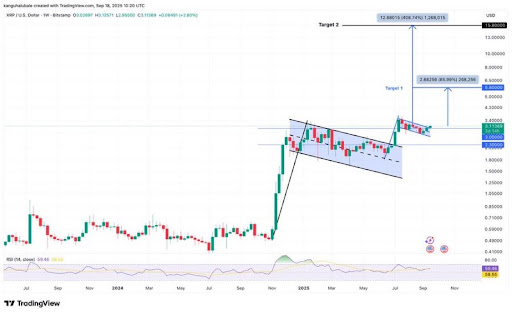
According to crypto expert Zenia, XRP has confirmed a Bull Flag breakout, setting the stage for a short-term move toward $5.80. Beyond that, the analyst notes a larger pattern that stretches back to 2024, suggesting that XRP could target $15, representing a potential gain of more than 400% from its current levels.
The weekly chart shows XRP steadily recovering from its previous consolidation phase, with bullish candles pushing above $3.10 and momentum indicators such as the Relative Strength Index (RSI) holding strong without showing signs of exhaustion. Zenia has highlighted that the first target at $5.8 serves as the immediate resistance, while the second target at $15 represents the more ambitious upside projection tied to the Bull Flag structure.
With ETF exposure now in play, XRP could finally break free from the cycle of stalled rallies that have defined past bull markets. Zenia also notes that XRP’s partnerships with global financial institutions, such as DBS Group and Franklin Templeton, are creating real-world utility to complement its bullish technical setup.

Related Posts