Caitlin Long, the CEO of Wyoming-chartered Custodia Bank, delivered a stark assessment of crypto’s path to the Federal Reserve’s rails, arguing that firms operating under trust charters—including Ripple—will not be granted direct access to the Fed’s payment system unless they become true depository institutions.
“Stablecoin issuers are not legally depository institutions,” she said. “To be able to use Fedwire and ACH, the Fed has taken the position that you have to be a depository institution… A trust company by law is prohibited from accepting a US dollar deposit.” She added that while some trust companies have historically had limited master-account arrangements, it was “not for moving money in the payment system,” and the key prize—“the par guarantee”—belongs to banks alone. “You’ve got to legally be a depository institution,” Long said, concluding, “I firmly do believe… the Fed is not going to change that.”
Long’s view arrives as Ripple pushes deeper into bank-grade infrastructure. Ripple closed its acquisition of Standard Custody & Trust Company in June 2024, positioning the New York-chartered trust company at the center of its stablecoin stack, and has continued to expand its regulated footprint since then.
In early July 2025, Ripple applied for a US national bank charter and is pursuing a Federal Reserve master account—moves that would, if approved, put Ripple USD (RLUSD) reserves and settlement closer to the Fed’s balance sheet and its payment services. Long’s message to that strategy is unambiguous: trust status is an “intermediary stop.” “There have been several now who have applied for Fed master accounts,” she said, but access to Fedwire/ACH “is the distinction,” and “the stablecoin market, I firmly believe, will go entirely to the banks.
Can Ripple Get A Fed Masters Account?
The Fed’s legal and policy framework backs up the distinction Long describes. In August 2022, the Board finalized its Account Access Guidelines, which formalized a three-tier review system and made clear that Reserve Banks evaluate requests for access to “master accounts and services” against safety-and-soundness, legal eligibility, and systemic-risk criteria. The framework subjects non-insured, novel charters to the most stringent review.
Separately, the Federal Reserve defines a master account as “the record of financial rights and obligations” between an account holder and its Administrative Reserve Bank—precisely the ledger relationship that enables par settlement on Fed rails.
Courts have since affirmed broad Fed discretion to deny master-account requests even for legally eligible institutions, a precedent set in 2024 rulings that rejected arguments the Fed must grant access upon request. That judicial backdrop is central to Long’s claim that policy won’t bend for trust companies: “I have had very extensive conversations with the actual decision makers,” she said, and the line drawn around deposit-taking banks “is not going to change.”
Naming names clarifies where crypto stands today. The Federal Reserve’s public Master Account and Services Database—updated most recently with data current as of May 31, 2025—lists new “access requests” and their status, offering an official window into who is asking to join the payment system directly. A Congressional Research Service report, citing that database, notes that Kraken Financial and Protego Trust have pending applications, while Bankwyse, Commercium Financial (a Wyoming SPDI) and Paxos withdrew theirs; Custodia’s request was denied.
After that, Standard Custody & Trust (Ripple-owned) and WisdomTree Digital Trust have entered the crypto-adjacent access requests, underscoring the sector’s shift toward bank-grade plumbing even as eligibility questions remain for trust companies.
Long, for her part, emphasized the legal dividing line those lists reveal: “All these trust companies, including OCC trust companies, [are] not eligible to get access to the payment system for moving US dollar deposits… Getting access to Fedwire and ACH at the Fed, you’ve got to legally be a depository institution.”
Her argument turns on first principles rather than policy mood. “What is a depository institution? It is a financial institution that is legally authorized to accept a US dollar deposit,” Long explained. Because trust companies are “prohibited from accepting a US dollar deposit,” the Fed’s payment system remains a bank-only lane. The consequence, she said, is structural: “These trust companies… are intermediary stops. That’s great… [they] give companies the ability to do business nationwide” without fifty separate money-transmitter licenses. “But… not for moving money in the payment system.”
In Long’s telling, stablecoin-issuance will ultimately consolidate “entirely” inside banks—some of which may be crypto-founded but will nevertheless be banks—because only banks can tap the Fed’s par-clearing privilege at scale. For Ripple, the path forward therefore looks binary. The trust-company architecture around Ripple USD can support custody and fiduciary functions; it cannot, in Long’s reading and the Fed’s rule set, unlock direct Fedwire/ACH access on its own.
That explains Ripple’s pivot toward a national bank charter and a master-account application—steps that, even if they clear eligibility, must still pass the Fed’s risk-based scrutiny that tripped other applicants. In the meantime, Long’s bottom line hangs over every trust-charter strategy in crypto: “The value of moving money in the payment system? It’s the par guarantee.” And that, she insists, “won’t” be available to trust companies—Ripple included—unless they become banks.
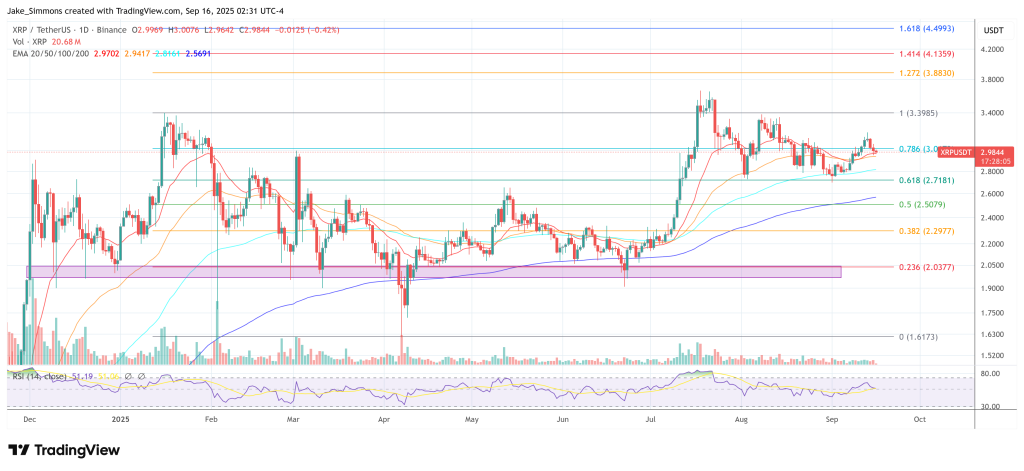
At press time, XRP traded at $2.98.

Related Posts