Key takeaways:
Whales' preferences when buying at the bottom: Bored Ape Yacht Club > other Yuga Labs' projects > other blue chips and emerging projects. The exact type and price of purchase are correlated with capital size.
Among whales with a capital size of more than $500,000, some focus on only one collection, while others adhere to a diversified combination. The majority of whales are willing to spend from $100,000 to $250,000, but their costs vary.
Whales share a number of strategies in common, such as buying in batches and buying more when prices fall. Each of them also has its own secrets to maximizing the outcome.
The crypto market went through an abrupt plunge from June 7 to June 18. This article will answer the following questions:
What NFTs did whales buy? How did they manage to buy at the bottom?
What are the combinations and average prices involved?
Determining the time frame
The crypto market has been in a downward spiral since the first half of this year. In the last two weeks (June 7-18), the BTC price has continued to fall, with a two-week drop of over 40%. On the other hand, ETH also fell below $1,000 at one point due to the impact of Celsius.
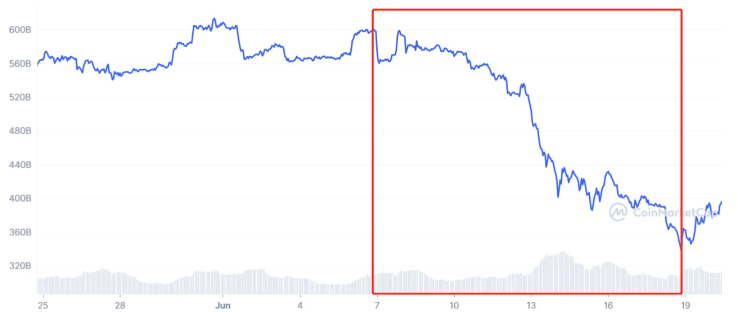
BTC Price (Source: CMC)
Similarly, the NFT market has suffered the impact of the market downturn. OpenSea trading volume has been bearish lately, but statistics from June 7 to 18 showed a brief period of heavy trading where a high turnover rate was witnessed in the NFT market. For this reason, we will focus our analysis on this time frame.
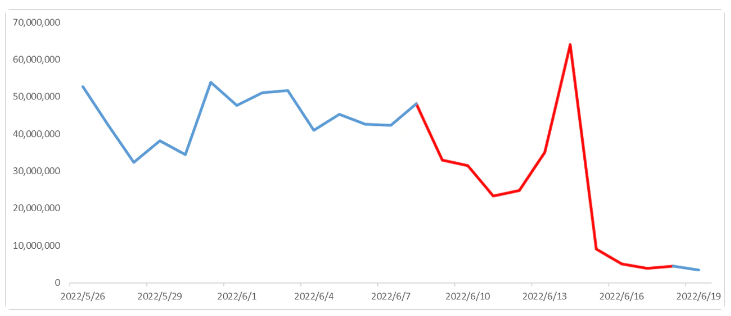
Trading Volume on OpenSea (6.7-6.18) (Source: NFTGo.io)
What NFTs did the Whales Buy?
Having sorted through thousands of whale wallets, we first place our focus on the top 10 best-selling NFTs among whales. Otherdeed seems to be the most popular collection among whale buyers. A total of 173 Otherdeed NFTs were bought by whales during this period, with an average purchase price of 6.22 ETH, or $9410. On the other hand, Bored Ape Yacht Club is the tenth most popular collection, as 25 were purchased by whales, with an average purchase price of 135 ETH, or $179,849.
In addition to blue-chip NFTs, we also see some non-blue-chip projects on the ranking, such as tubby cats by TubbyCatsDeployer which places second. Whales bought 104 NFTs of this collection. According to on-chain data, whales are bulk-purchasing this collection, which may be because they are laying the groundwork for future plans. Most whales still adhere to their strategies despite the 40% drop in BTC.
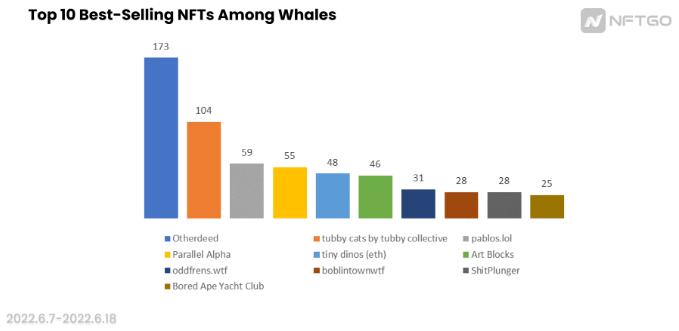
Top 10 Best-Selling NFTs Among Whales (6.7-6.18) (Source: NFTGo.io)
By multiplying quantity purchased with transacted price (USD), we have another list of the top 10 most spent-on NFTs among whales that seems to be more in line with the market consensus. When BTC price dropped sharply from June 7-18, we found that the whales category alone had bought $4.5 million worth of Bored Ape Yacht Club, $1.88 million worth of CryptoPunks, and $1.72 million worth of Otherdeed.
It's worth noting that the top 3 on the list are Yuga Labs' projects. The amount spent on BAYC is significantly higher than the sum of the second and the third. It is clear that when the market crashes, the buying preference of whales goes like this: Bored Ape Yacht Club > other Yuga Labs' projects > other blue chips and emerging projects.
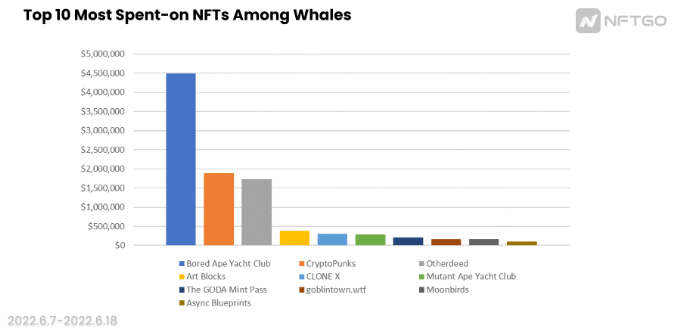
Top 10 Most Purchased NFTs Among Whales (6.7-6.18) (Source: NFTGo.io)
Which Whales Exactly?
Since ETH prices were volatile during this period (June 7-18), we will compare the amount spent by whales using USD as the standard.
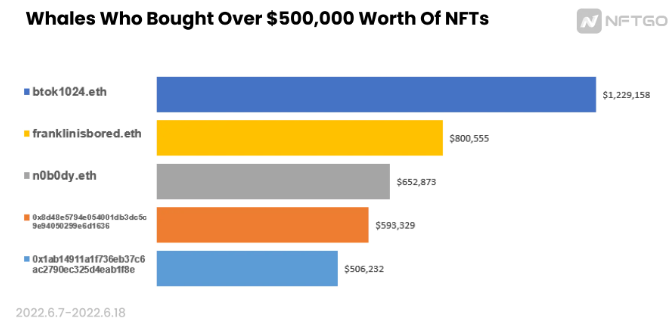
Whales Who Bought Over $500,000 Worth of NFTs (Source: NFTGo.io)
As seen from the chart above, 5 whales bought more than $500,000 worth of NFTs. The top 3 of them tend to buy into one single project. For example, the first place wallet, btok1024.eth, spent 1024 ETH only on BAYC, which is a rather extreme case. The second place wallet, franklinisbored.eth, bought 7 BAYC NFTs, and the third place wallet, n0b0dy.eth, bought 17 Otherdeed NFTs.
We begin to observe diversity in the combination of NFTs bought, starting with the fourth place wallet, including 2 Meebits + 6 Doodles + 9 Bored Ape Kennel Club + 3 Bored Ape Yacht Club + 5 Clone X + 2 Moonbirds + 2 Otherdeed. Moreover, the fifth whale went with 4 Murakami.Flowers + 4 Bored Ape Yacht Club + 2 Clone X.
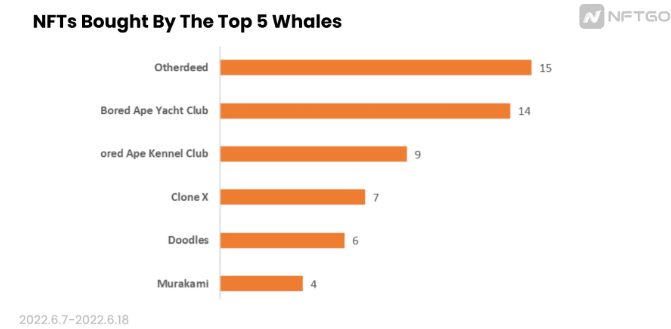
NFTs Bought by the Top 5 Whales (Source: NFTGo.io)
Among the whales that bought over $50,000 worth of NFTs, those that spent anywhere from $100,000 to $250,000 were the most common. In fact, there were 16 of them. According to the amount spent, the ranking and average costs are as follows:
Otherdeed: $152,373.80
Bored Ape Yacht Club: $82,259.15
CryptoPunks: $35,753.61
Art Blocks: $24,962.94
Clone X: $15,214.22
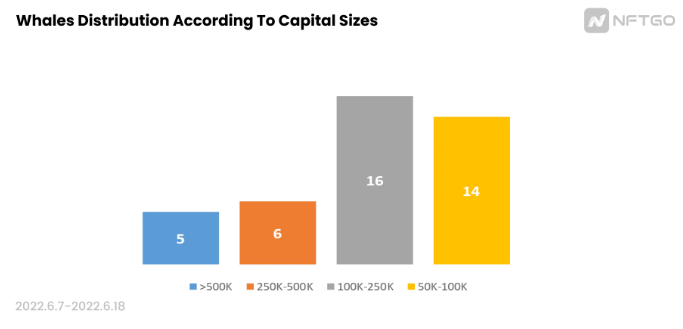
Whale Distribution According to Capital Size (Source: NFTGo.io)
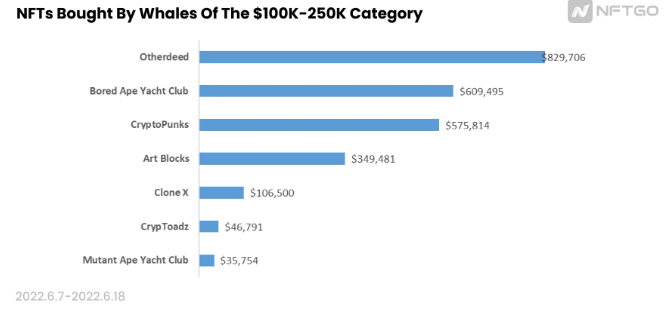
NFTs in the $100k-$250k Category Bought by Whales (Source: NFTGo.io)
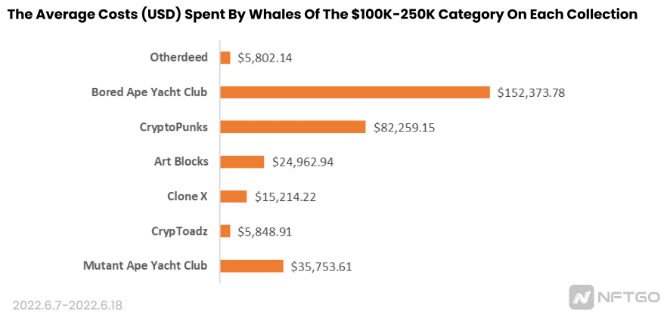
The Average Amount (USD) Spent by Whales with Between $100k-$250k Plunge Capital (Source: NFTGo.io)
Probing Into the Strategies
Among the top 10 whales who bought Otherdeed within the time frame, the #1 whale bought 55 Otherdeed NFTs with 112.97 ETH ($160,000). As of June 21, Otherdeed's floor price rose to 2.4 ETH, thus making a gain of 17%, or 19.25 ETH, for the whale. Let's see how he managed to do it with $160,000.
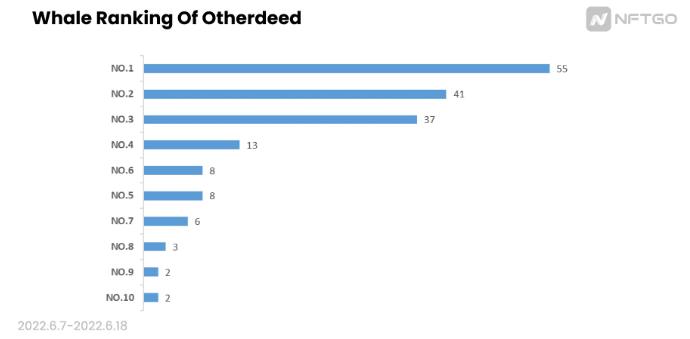
Otherdeed Whale Ranking (6.7-6.18) (6.7-6.18) (Source: NFTGo.io)
From June 7, when Otherdeed's floor price gradually decreased, the whale began to buy 6 from the collection with an average price of 2.596 ETH.
Then, on June 9, Otherdeeds's floor price fell below 2.5 ETH. The whale once again bought another 10 with an average price of 2.368 ETH, thus reducing the cost of his short-term position to 2.45 ETH.
The plunge accelerated on June 12 that the floor price dropped to 1.8 ETH. This is when the whale made his final purchase of 39 Otherdeed NFTs with an average price of 1.89 ETH. By this time, his average cost is 2.05 ETH.
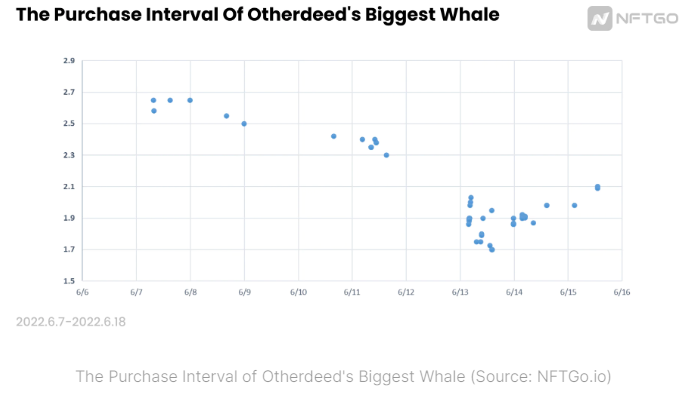
The Purchase Interval of Otherdeed's Biggest Whale (Source: NFTGo.io)
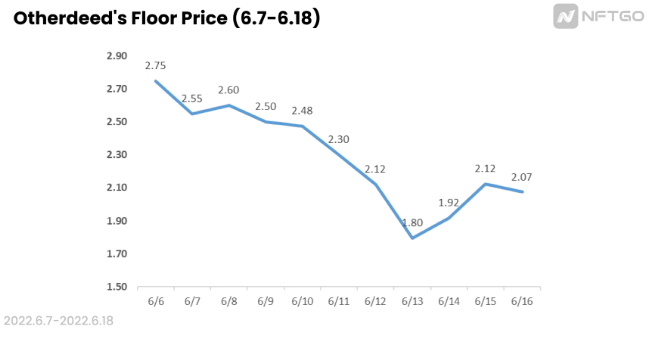
Otherdeed's Floor Price (6.7-6.18) (Source: NFTGo.io)
Overall, the whale's strategy is to gradually increase its position: the greater the decline, the more it buys. Purchase prices are divided into 3 ranges: 2.5-2.7 ETH, 2.3-2.5 ETH, and 1.7-2 ETH, where it bought 6, 10, and 39 respectively, lowering the average price to about 2.05 ETH.
Another thing worth noting is that when Otherdeed's price rebounded from June 13 to 15, the whale continued to buy instead of realizing its gains. This indicates that the whale adheres to its valuation, therefore, if the price remains in the "bottom range," it will continue to buy.
One interesting thing is that among its 55 purchases at the bottom, 34 were bought through offers and the remaining 21 were through direct purchases. This is the little secret to its success—people tend to prefer to offer prices amid the market downturns.
Additionally, Otherdeed's price trend shows that trading volume peaked on June 13, when the floor price dropped to a low of 1.8 ETH. This proves that many others were also trying to buy at the bottom besides whales.
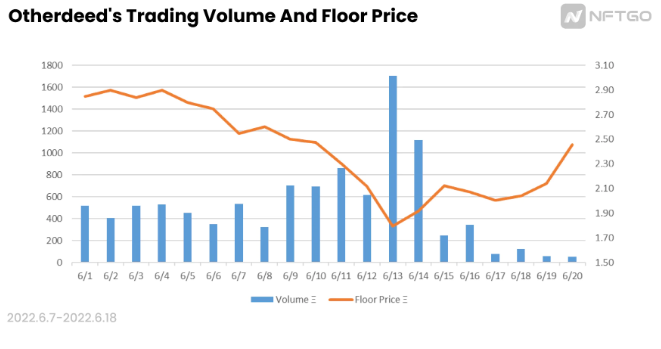
Otherdeed's Trading Volume and Floor Price (Source: NFTGo.io)
Next, let's have a look at the whale who made the most BAYC purchases during June 7-18 and see how it was done.
Starting from the price on June 7, he bought 1 BAYC NFT when it dropped by 10%. Then on June 13, the price dropped by 20%, so he made another purchase. After that, he bought 5 more when the price fell by 20%-30%, thus reducing his costs to 80 ETH. On June 14, the whale bought BAYC NFTs in the top 10% rarity with 120 ETH on LooksRare.
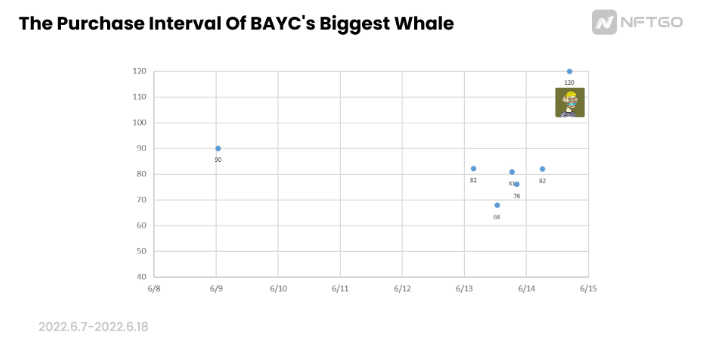
The Purchase Interval of BAYC's Biggest Whale (Source: NFTGo.io)
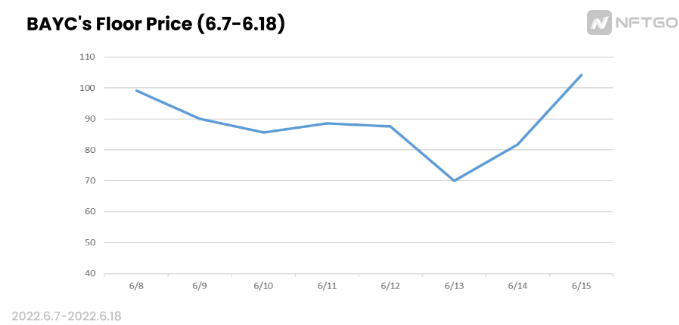
BAYC's Floor Price (6.7-6.18) (Source: NFTGo.io)
The whale buys into BAYC based on the range of price drop. For every 10% slump, it would buy 1 NFT. Plus, this whale also bought NFTs of different rarities by category.
Through the analysis above, we can conclude some underlying rules whales go by when buying at the bottom:
For individual NFTs, bought in batches (3 batches) according to ranges, and buy as soon as the price enters your valuation range.
Buy according to the margin of the plunge instead of time—the more it slumps, the more you buy.
Try to make an offer.
For main blue chips, go by rarity classification; for new and emerging blue chips, diversify your combinations.
Try out multiple platforms including X2Y2 and LooksRare instead of limiting yourself to OpenSea.
Note: The above information is for informational purposes only. Investing in digital assets such as NFTs and cryptocurrency brings with it a high degree of risk. Please consult with a financial advisor before making any investment decisions. NFTGo does not provide financial advice and is not responsible for any losses incurred as a result of investing in digital assets.