BlackRock’s iShares Bitcoin Trust (IBIT) has surpassed the firm’s long-established iShares Core S&P 500 ETF (IVV) in annual revenue generation. The development, first highlighted in a June 2 report by Bloomberg, marks a milestone moment for institutional adoption and exposes a growing financial incentive among traditional giants to see BTC’s price rise.
BlackRock’s New Game: Pump Bitcoin, Print Cash
Despite being a fraction of IVV’s size in terms of assets under management, IBIT has now overtaken it in fee revenue. IBIT currently manages approximately $75 billion in assets and charges a 0.25% fee, generating around $187.2 million in estimated annual fees. In contrast, IVV, BlackRock’s flagship S&P 500 tracker, holds $624 billion but charges just 0.03%, netting about $187.1 million in fees. As Bloomberg’s Isabelle Lee put it, “a Bitcoin exchange-traded fund now generates more revenue than [BlackRock’s] signature tracker of the S&P 500 Index.”
This revenue discrepancy, despite IVV’s immense asset base, stems from the sheer profitability of managing BTC exposure in an ETF wrapper, particularly given IBIT’s higher fee structure and the velocity of capital inflows it has witnessed. The fund has recorded inflows in all but one of the past 18 months and now holds over 55% of all US spot Bitcoin ETF assets.
The explosive growth of IBIT is closely tied to the January 2024 decision by US regulators to approve spot ETFs, a watershed moment that brought Bitcoin further into the financial mainstream. This regulatory opening has unleashed a torrent of institutional capital, with hedge funds, pensions, family offices, and banks now actively allocating to Bitcoin in SEC-compliant vehicles.
Market commentators were quick to highlight the implications. Anthony Pompliano noted succinctly on X: “BlackRock’s Bitcoin ETF drives more revenue than its S&P 500 fund. Bitcoin has Wall Street’s full, undivided attention now.”
Crypto analyst Jacob Canfield provided a more detailed financial interpretation, posting: “Blackrock makes more money the higher the price of Bitcoin goes, just an FYI. (not financial advice)”
He elaborated further: “Some people don’t seem to understand my meaning. Blackrock makes 0.25% fees on their IBIT ETF. That currently translates to $184 million in annual revenue (just for custody) and it’s based on AUM (assets under management). That means if the price of Bitcoin goes to $1,000,000 (a 10X from here), they will make $1.84 billion per year in fees. This is why Blackrock is incentivized by higher prices in Bitcoin.”
Canfield’s logic lays bare the core economic engine at work: BlackRock’s revenue from IBIT is a direct function of the BTC market price. Since ETF fees are derived as a percentage of AUM, any appreciation in price amplifies the dollar-denominated value of the assets under custody—and, by extension, BlackRock’s fee income. At current rates, each doubling of the BTC price could potentially yield nearly double the revenue for IBIT, assuming static inflows.
The broader implication is profound: BlackRock, the world’s largest asset manager with nearly $10 trillion under management, is now structurally aligned with Bitcoin’s success. That alignment goes beyond product strategy or public messaging—it is embedded in fee economics.
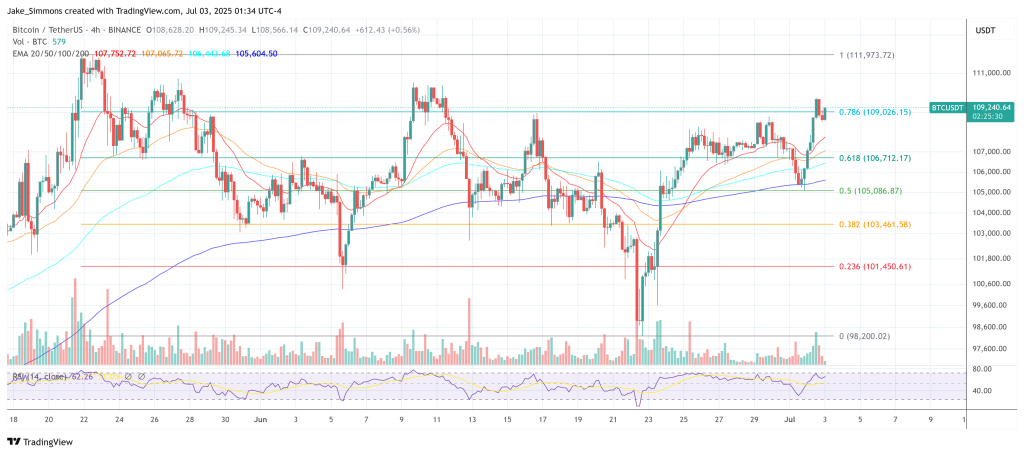
At press time, BTC traded at $109,240.

Related Posts