A new research report from Fidelity Digital Assets underscores a deepening structural shift in Bitcoin’s supply dynamics, revealing that the portion of BTC classified as “ancient”—coins that have not moved in 10 years or more—is now growing faster than new issuance, a first in the asset’s 16-year history. If current trends hold, Fidelity projects that by 2035, up to 30% of all Bitcoin could fall into this ultra-long-term dormant category.

‘Ancient’ Bitcoins Now Eclipse New Supply
The report, authored by research analyst Zack Wainwright and published on June 18, 2025, traces the accelerating trajectory of ancient supply in the wake of Bitcoin’s April 2024 halving. As of June 8, 2025, an average of 566 BTC per day is entering the ancient supply cohort, compared to just 450 BTC being newly issued via mining rewards, according to Glassnode. “A quiet but potentially significant shift occurred in Bitcoin’s ecosystem following the 2024 halving,” Wainwright writes, pointing to the moment when ancient supply began “outpacing new supply.”
This threshold—unspent transaction outputs (UTXOs) that have remained untouched for over a decade—now accounts for over 17% of total Bitcoin supply, or roughly 3.4 million BTC. At a spot price of $107,000 per coin, the value of this ancient supply exceeds $360 billion. The magnitude of this dormant wealth is amplified by the presence of early holdings, particularly those attributed to Bitcoin’s pseudonymous creator. “Approximately one-third of this ancient supply is owned by Satoshi,” the report notes, while acknowledging that an unknown portion of the cohort is likely lost or permanently inaccessible.
What Fidelity highlights is not merely the numerical expansion of ancient supply, but its growing influence on Bitcoin’s market architecture. “The strong conviction of these ultra long-term holders is having an increasing influence on the wider Bitcoin ecosystem,” Wainwright writes. He adds that the increasing concentration of supply in immobile addresses reinforces Bitcoin’s scarcity, particularly when paired with its fixed issuance schedule.
Yet the report does not frame ancient supply as a static concept immune to market stress. While daily decreases in ancient supply are rare—occurring on just 3% of all days since 2019—that figure jumped to 10% in the months following the 2024 US election. The report contextualizes this shift with a detailed chart, “Bitcoin Price Marked by Decreases in Ancient Supply,” which maps price reactions to short-term sell-offs or reallocation events among long-term holders.
This behavior is even more pronounced among holders in the five-year bracket. Since the US election, supply held for five years or longer has declined on a day-to-day basis 39% of the time—three times the historical average of 13%. Fidelity interprets this as evidence of broader reactivity within the long-term holder base, which may help explain the sideways and downward price action in the first quarter of 2025. However, Wainwright cautions against conflating coin movement with outright selling, noting that “some of this movement can be attributed to sell pressure, while another portion may simply be moving coins for any number of reasons.”
Looking forward, Fidelity offers a framework for projecting ancient supply as a growing share of total issuance. Based on the current accumulation trajectory, ancient supply is expected to reach 20% of total Bitcoin by 2028, 25% by 2034, and potentially 30% by 2035. These figures incorporate hypothetical contributions from public companies currently holding at least 1,000 BTC. As of June 8, 2025, Fidelity identifies 27 such firms, collectively controlling over 800,000 BTC.
While acknowledging that corporate wallets are not inherently long-term by nature, the report argues that public entities with significant holdings could contribute meaningfully to future ancient supply metrics—especially if they continue to accumulate and maintain cold storage policies that prevent frequent movement.
Wainwright concludes that the rise of ancient supply represents more than a numerical trend—it could reshape how investors understand Bitcoin’s scarcity. “Given Bitcoin’s preprogrammed, disinflationary supply issuance schedule—and data suggesting that long-term holders are becoming increasingly resolute, alongside factors such as lost coins—the asset’s scarcity has the potential to grow over time,” he writes. In an ecosystem where circulating liquidity and active supply increasingly matter for price discovery, the rising gravitational pull of ancient coins may emerge as one of the defining features of Bitcoin’s next era.
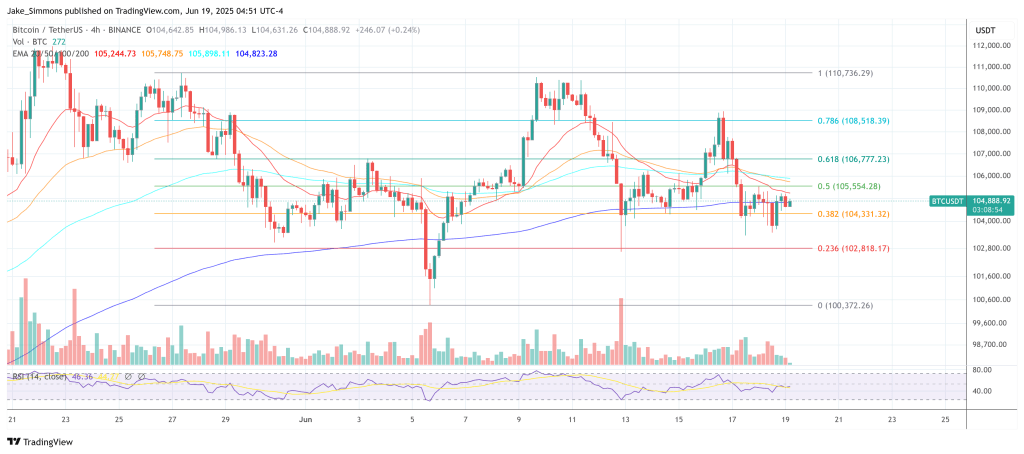
At press time, BTC traded at $104,888.

Related Posts