Senate Democrats have proposed new legislation that would charge fees on data centers and cryptocurrency mining operations that surpass federal emissions standards. The bill comes as power demands from these operations continue to increase throughout the United States.
New ‘Clean Cloud Act’ Seeks To Lower Carbon Footprint
The legislation, sponsored by Senators Sheldon Whitehouse and John Fetterman, would have the Environmental Protection Agency develop emissions standards for big data centers. Under the proposal, the standards would cover data facilities and crypto mining operations with over 100KW of installed nameplate IT power.
Penalties would start at $20 per ton of carbon dioxide equivalent emissions that exceed the limits. This fee would increase yearly based on inflation plus an additional $10. The standards would be based on regional grid emissions patterns and target an 11% annual reduction in emissions.
Power Demand From Data Centers Expected To Reach 12% By 2028
Based on reports from the US Senate Committee on Environment and Public Works, data centers could account for up to 12% of total US power demand within four years. Research from Morgan Stanley suggests these facilities might generate approximately 2.5 billion metric tons of carbon dioxide emissions globally by the end of the decade.
“Surging power demand from crypto miners and data centers is outpacing the growth of carbon-free electricity,” notes a minority blog post published on the committee’s website.
As of today, the market cap of cryptocurrencies stood at $2.6 trillion. Chart: TradingView
Bitcoin Miners Shift Focus As Industry Faces Challenges
The proposed regulation comes at a difficult time for Bitcoin miners. According to reports, mining operations have struggled throughout 2025 as cryptocurrency prices decline. These challenges follow the Bitcoin network’s most recent halving event.
In response, major mining companies including Galaxy, CoreScientific, and Terawulf have begun moving toward high-performance computing services for artificial intelligence models. Reports have also disclosed that miners are diversifying into AI data-center hosting as a way to expand revenue and repurpose existing infrastructure.
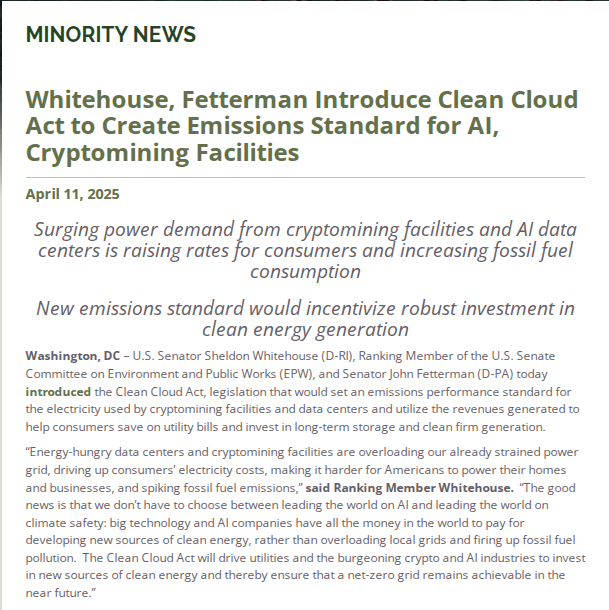
A portion of the Clean Cloud Act paper. Source: US Senate Committee on Environment & Public Works
Political Tensions May Affect Bill’s Future
The Clean Cloud Act may face significant opposition under the current administration. United States President Donald Trump has previously expressed his goal of making the US the “world capital” of both AI and cryptocurrency. Trump also reversed a 2023 executive order from former President Joe Biden that established safety standards for artificial intelligence.
Dems Double Down on Losing “Blame the Server Racks” Strategy.
New bill from Sens. Fetterman & Whitehouse would hit AI & crypto data centers with fees if they exceed regional emissions averages.
EPA & EIA would track energy use.
Proceeds to ratepayer relief & “clean” energy. pic.twitter.com/psXhlDDgl0
— matthew sigel, recovering CFA (@matthew_sigel) April 11, 2025
Matthew Sigel, head of research at VanEck, criticized the bill on social media, calling it a “Losing ‘Blame the Server Racks’ Strategy” that unfairly targets Bitcoin miners for their energy use.
Nicholas Roberts-Huntley, CEO of Concrete & Glow Finance, warned that ongoing trade disputes could create additional problems for blockchain networks. The infrastructure supporting crypto, he said, not just the assets, can become “collateral damage” in times of global uncertainty, he said.
The bill has been introduced but has not yet passed in the Senate.
Featured image from Gemini Imagen, chart from TradingView

Related Posts