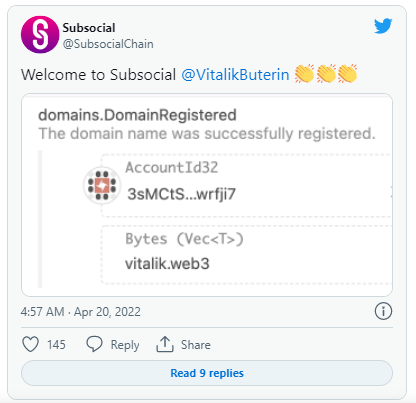
Vitalik Buterin, the inventor of Ethereum, was one of the first users to sign up for the Subsocial’s Dotsama Domains. At least, someone registered the domain vitalik.web3 on the platform. Via their official Twitter handle, Subsocial welcomed Buterin as they celebrated a new milestone for the platform.
Supported by Polkadot, Subsocial is a suite of substrate pallets with a web user interface, per their official website. The platform enables users to launch their own decentralized social media network.
In that sense, Subsocial describes itself as “a platform for building social networks”. The user under the Vitalik Buterin domain will be able to use it for Polkadot and the Kusama ecosystem.
What Vitalik Buterin Can Do With A Dotsama Domain
Similar to the Ethereum Name Service (ENS), these features enable users to own their domain and redirect it “anywhere”, integrated with Subsocial decentralized applications (dApps), or any Dotsama dApp.
In that way, the user can be easy to find across the entire ecosystem and have more control over their data. The team behind Subsocial said:
Having a single username across hundreds of social dapps will be very convenient, and the consistency would help people to find you on any app. We built a workaround for a non-existent centralized Web2 .sub TLD, and acquired sub.id domain name to redirect Web3 subdomains for all of the Dotsama Domains usernames.
The domains can vary from user to user, some can use the .polka, .ksm, .sub, .movr, or others. SUB holders will have access to 3 different domains.
In addition, the platform claimed to be working on a feature that will enable Web3 creators to monetize their work. Similar to how OnlyFans, Patreon, and other websites operate but are powered by Subsocial’s decentralized platforms.
Vitalik Buterin And The Social Media Debate
Social media has come under the spotlight lately as Tesla’s CEO Elon Musk made Twitter shareholders a multi-billion offer to take over the platform. This has been a cause for controversy in the crypto community as some users believe Musk would “save” the platform, and others that it could “ruin” it.
The inventor of Ethereum weighed in on this debate. Via his personal Twitter account, he said the following:
Don’t oppose Elon running twitter (at least compared to status quo), but I do disagree with the more generalized enthusiasm for wealthy people/orgs hostile-takeovering social media firms. That could easily go *very* wrong (e.g. imagine an ethically-challenged foreign gov doing it)
At the time of writing, Ethereum (ETH) trades at $3,000 with sideways movement on the 4-hour chart.
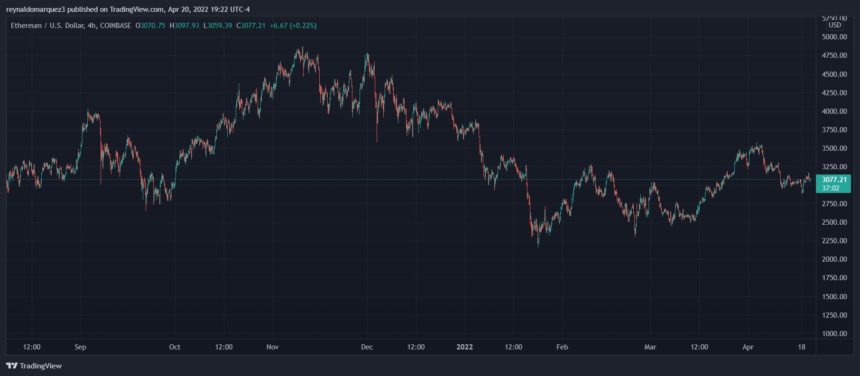
ETH moving sideways on the 4-hour chart. Source: ETHUSD Tradingview Tags: DOTDOTUSDTethereumpolkadotVitalik Buterin