The Evolution of Latin America's Stablecoin Market: From Survival to Growth

marsbitXuất bản vào 2025-12-11Cập nhật gần nhất vào 2025-12-11

Tóm tắt

Latin America's stablecoin market is evolving from a survival tool into a growth engine, driven by hyperinflation, financial exclusion, and inefficient remittances. With Argentina's 178% inflation and Brazil's $300B crypto trading volume, stablecoins like USDT and USDC are becoming essential for value storage and daily transactions. The region is witnessing the rise of Crypto Neobanks, which leverage zero-fee networks (e.g., Tether’s Plasma) and DeFi yields to offer dollar-based accounts with higher returns, challenging traditional fintech giants like Nubank. Brazil leads in institutional adoption, with 90% of crypto flows in stablecoins, while Argentina shows retail-driven growth. Key trends include the emergence of local currency-pegged stablecoins, integration of yield-bearing assets, and regulatory divergence across countries. The market, valued at $1.5T in trading volume, presents a significant alpha opportunity, with Crypto Neobanks poised to capture market share by offering faster settlements, dollar-denominated accounts, and superior yields. The window for investment and innovation is narrow, with the next 12-18 months critical for dominance.

Author: @BlazingKevin_, the Researcher at Movemaker

Latin America is undergoing a financial infrastructure revolution forced by currency failure. This article provides a panoramic analysis of the region's stablecoin market based on macroeconomic data from 2024 to 2025, on-chain behavior analysis, and regulatory policy texts. The research finds that the Latin American market has moved beyond the early stage of passive dollarization and is undergoing a deep transformation towards Web3 financial infrastructure-ization.

At the macro level, Argentina's 178% inflation rate and Brazil's $300 billion crypto trading volume form the dual backdrop of stablecoins as both a survival tool and an efficiency tool. At the micro level, the market is breeding a new species—Crypto Neobank. Compared to traditional fintech giants like Nubank, Crypto Neobanks, utilizing zero-fee networks like Tether-supported Plasma and DeFi yields, are filling the vast vacuum between traditional banking and pure crypto speculation. This report points out that the next alpha opportunity in Latin America's crypto market lies in how Web3 infrastructure can leverage this $1.5 trillion trading volume to replicate and surpass the growth miracle of traditional fintech.

1. Macro Narrative Restructuring

To understand the uniqueness of the Latin American market, one must abandon the "technological innovation theory" perspective of North America or Europe. In Latin America, the explosion of stablecoins is an inevitable product of macroeconomic structural imbalances. The core drivers here are survival and efficiency, and the intervention of Web3 technology is transforming this passive survival need into an active financial upgrade.

1.1 Currency Failure and the Loss of Store of Value Function

Inflation is the strongest catalyst for the crypto-dollarization process in Latin America. Argentina and Venezuela are typical examples of this phenomenon.

Despite the Milei government's radical economic therapy, Argentina's annual inflation rate remained as high as 178% between 2024 and 2025, with the peso depreciating by 51.6% against the US dollar within 12 months. In this environment, stablecoins are no longer investment products but de facto units of account. On-chain data shows that stablecoins account for up to 61.8% of trading volume in Argentina, far exceeding the global average. The market's demand for stablecoins exhibits extremely high immediate price elasticity: whenever the exchange rate falls below key psychological barriers, monthly stablecoin purchases on exchanges surge to over $10 million.

In Venezuela, as the bolivar's value continues to evaporate, Tether has penetrated microeconomic activities such as supermarket shopping and real estate transactions. Data shows a strong negative correlation between the local fiat exchange rate and cryptocurrency reception volume, with stablecoins providing a parallel financial system immune to government monetary policy interference.

1.2 Banking Exclusion and the Financial Vacuum of 122 Million People

Besides fighting inflation, financial exclusion is another major pain point. In Latin America, 122 million adults (26% of the population) are unbanked. This massive group is excluded from the traditional banking system due to minimum balance requirements, cumbersome compliance documents, and geographical isolation.
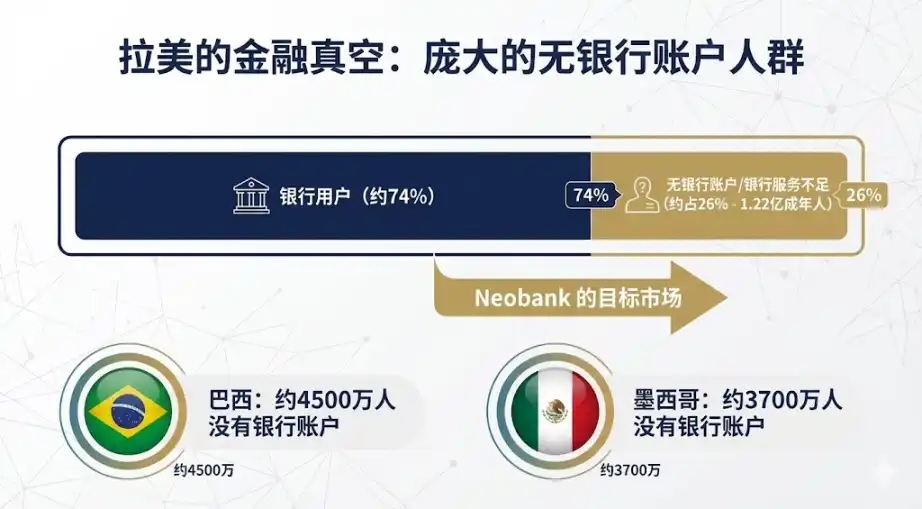
This is precisely the soil for the rise of new banks. Nubank's success proves this logic: through a branchless, low-fee mobile banking model, Nubank captured 122 million users within a decade, reaching a market capitalization of $70 billion and covering 60% of Brazil's adult population.

However, Crypto Neobanks are upgrading this logic for a second time. While Nubank solved the accessibility problem, the accounts are still denominated primarily in local fiat, and savings yields often underperform inflation. In contrast, Web3 neobanks can provide USD stablecoin-based accounts without needing a banking license, and through DeFi protocol integration, can offer 8% to 10% USD-denominated annualized yields, which is致命ly attractive to users in inflationary economies.

1.3 The Cost-Reduction and Efficiency Revolution in the Remittance Economy

Latin America is one of the world's largest remittance reception regions, receiving over $160 billion in remittances annually. Traditional cross-border remittances typically charge 5% to 6% in fees and take days to settle. This means nearly $10 billion in wealth is lost annually in the form of fees.

In the US-Mexico corridor, the world's largest single remittance channel, Bitso has processed over $6.5 billion in remittances, accounting for 10%. Blockchain-based cross-border transfers can reduce costs to $1 or even a few cents, shortening settlement time from 3-5 days to seconds. This hundredfold efficiency improvement constitutes a dimensional打击 against the traditional financial system.

2. Market Depth and On-Chain Behavior

Data from 2024 to 2025 indicates that the Latin American region has developed a unique Latin American model for cryptocurrency adoption: high-frequency, large-volume, and highly institutionalized.

2.1 Trading Volume and Growth Resilience

According to comprehensive data, between July 2022 and June 2025, the Latin American region recorded nearly $1.5 trillion in cryptocurrency trading volume, with a year-on-year growth of 42.5%. Notably, even during global market volatility, Latin America's growth baseline remained solid. In December 2024, the region's monthly trading volume soared to a record $87.7 billion. This indicates that the growth of the Latin American market is not merely beta收益 following the global bull market cycle but has an endogenous logic of rigid demand.

2.2 Brazil's Institutional Hegemony and Argentina's Retail Frenzy

Market structures vary significantly by country:

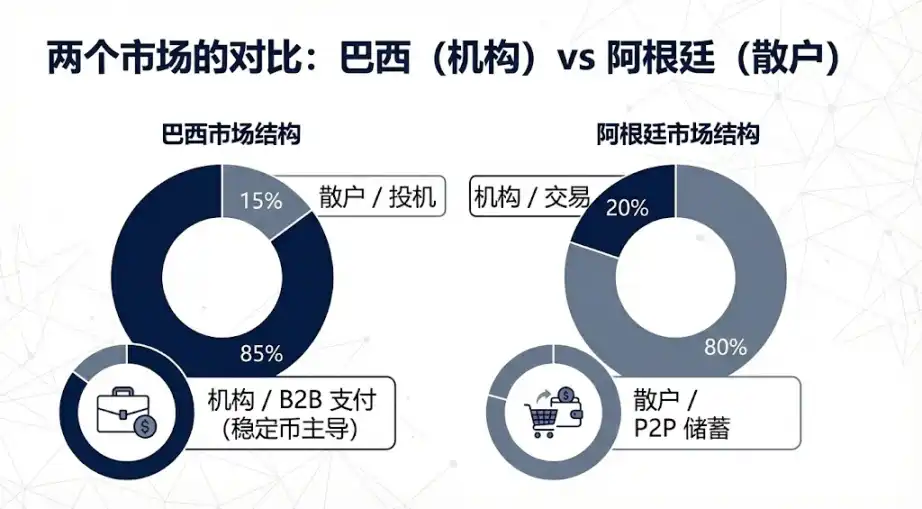
Brazil is the undisputed leader in the region, receiving approximately $318.8 billion in crypto assets, nearly one-third of the regional total. Stunning data from the Brazilian Central Bank shows that about 90% of the country's cryptocurrency fund flows are conducted through stablecoins. This extremely high比例 reveals the high degree of institutionalization in Brazil—stablecoins are primarily used for inter-enterprise payments, cross-border settlements, and liquidity transfers, rather than retail speculation.

Argentina ranks second with a trading volume of approximately $91.1 to $93.9 billion. Unlike Brazil, Argentina's growth comes mainly from the retail end, reflecting the general public's adoption of crypto dollarization as a daily lifestyle to combat inflation.
2.3 Platform Preference: The Dominance of Centralized Exchanges

Latin American users heavily rely on centralized exchanges. Data shows that about 68.7% of trading activity occurs on centralized exchanges, the second-highest proportion globally.

This phenomenon has important strategic significance for Web3 projects entering Latin America. "Borrowing a ship to go to sea" is the best strategy. Since local exchanges like Mercado Bitcoin and Bitso have compliant fiat channels and deep user trust, Crypto Neobanks should not try to directly compete with their fiat on-ramp/off-ramp business but should penetrate their vast user base through cooperation.

3. Asset Evolution

The Latin American market presents a landscape where globally universal stablecoins coexist with local innovative assets and is undergoing a generational leap from holding for保值 to holding for增值.

3.1 The Duopoly of Tether and USDC

With first-mover advantage and deep liquidity, Tether remains the hard currency in Latin American peer-to-peer markets and the informal economy. In the over-the-counter markets of Venezuela and Argentina, Tether is the absolute unit of account. Brazilian tax data also shows that Tether accounts for about two-thirds of declared trading volume. Its censorship resistance and普及度 make it the preferred choice for circumventing capital controls.

USDC is making inroads through compliance. Circle's partnerships with giants like Mercado Pago and Bitso have made it the preferred choice for institutional settlements. Bitso's report指出 that by the end of 2024, USDC had become the most purchased asset on its platform, accounting for 24%, surpassing Bitcoin.

3.2 The Bridging Role of Local Fiat Stablecoins

In 2024-2025, stablecoins pegged to local Latin American fiat currencies began to emerge, aiming to solve the friction between local payment systems and blockchain.

The launch of Meli Dólar by e-commerce giant Mercado Libre in Brazil was a milestone event. Through Mercado Pago, it is embedded in the daily shopping of tens of millions of users, used as a credit card cashback vehicle, significantly lowering the user barrier. Furthermore, Num Finance's issuance of peso and real-pegged stablecoins primarily serves cross-exchange arbitrage and enterprise-level DeFi operations, helping local businesses manage liquidity on-chain without bearing exchange rate risk.

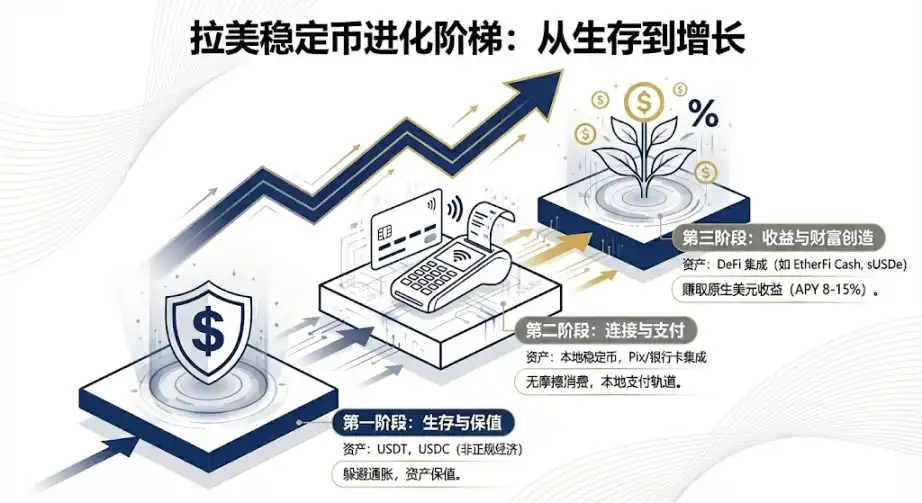
3.3 Trend Mutation: Yield-Bearing Assets and DeFi Integration

This is the next alpha opportunity in the Latin American market. Traditional banks in Latin America typically offer very low interest rates on USD accounts. Web3 neobanks, by integrating DeFi protocols, are redefining savings.

Take EtherFi as an example. As a DeFi protocol, it leveraged its multi-billion dollar Total Value Locked (TVL) to launch a credit card product. Users can stake crypto assets to earn yield while spending with the card. This model allows users to consume through borrowing without selling assets, preserving upside exposure while solving liquidity issues.

In high-inflation countries, the native yield of 10% to 15% offered by synthetic dollar stablecoins like USDe is highly attractive. Compared to the real-denominated deposits offered by Nubank, a 10% USD-denominated annualized yield is a dimensional打击 against traditional savings products.
4. Divergent National Directions

The vastly different political and economic environments across Latin American countries lead to截然不同的 development paths for stablecoins.

4.1 Brazil: A Duet of Compliance and Innovation

Brazil is Latin America's most mature and compliant market. The Brazilian Central Bank's digital currency project, Drex, underwent a strategic shift in 2025, focusing instead on the wholesale端, leaving a huge retail market space for private stablecoins.

In the same year, Brazil implemented a unified crypto tax rate and clarified the foreign exchange regulatory status of stablecoins. While this increased costs, it also赋予 the industry legitimacy. The local innovation project Neobankless is a paradigm of this trend. Built on Solana, its front end completely abstracts blockchain complexity, directly integrating with Brazil's national payment system PIX. Users deposit reais, which are automatically converted into interest-bearing USDC in the backend. This "Web2 experience, Web3 backend" model directly challenges the user habits of traditional fintech.

4.2 Argentina: A Liberalization Testing Ground

The Virtual Asset Service Provider (VASP) registration system established by the Milei government, while adding compliance thresholds,实质上默许了 the monetary competitive status of USD stablecoins. The asset regularization plan further brought a large amount of gray market stablecoins to the surface.

Lemon Cash solved the "last mile" payment problem by issuing crypto debit cards. Users hold USDC to earn yield, converting to pesos only at the moment of swiping the card. This model is highly sticky in a high-inflation environment because it minimizes the time holding fiat currency.

4.3 Mexico and Venezuela: Polarization

Due to the "Fintech Law" and central bank restrictions, Mexico has formed a landscape where banks and crypto companies are segregated. Companies like Bitso have therefore vigorously developed business-to-business (B2B) operations, using stablecoins as an intermediate bridge to optimize US-Mexico cross-border fund transfers, bypassing the inefficiencies of the traditional banking system.

In Venezuela, against the backdrop of reinstated sanctions, Tether has even become a settlement tool for oil exports. Among the populace, Binance's peer-to-peer trading remains a lifeline for obtaining foreign exchange, with the market彻底 voting with its feet for private USD stablecoins over the failed official Petro coin.

5. From Traditional Finance to Crypto Neobank

The Latin American market is undergoing a critical turning point, evolving from traditional fintech to Crypto Neobank. This is not only a technological upgrade but also a generational leap in business models.

5.1 The Valuation Gap and Alpha Opportunity

Currently, Nubank has a market cap of approximately $70 billion, and Revolut is valued at $75 billion; they validate the commercial viability of digital banks in Latin America. In contrast, the entire Web3 neobank赛道 has a combined valuation of less than $5 billion, only 7% of Nubank's market cap.

This is a huge value洼地. If Crypto Neobanks can capture even 10% of Nubank's market share, utilizing a superior unit economics model, their valuation has the potential for a 10x to 30x increase.

5.2 Next-Generation Infrastructure: The Zero-Fee Revolution

One of the biggest obstacles to the widespread adoption of crypto payments is gas fees. Plasma and its flagship product Plasma One brought a breakthrough. As a blockchain officially supported by Tether, Plasma enables zero gas fees for Tether transfers. This removes the biggest psychological and economic barrier for users using cryptocurrency for payments.

The data showing Total Value Locked (TVL)突破 $5 billion within 20 days of launch proves that when infrastructure directly provides bank-level services, the inflow of funds is惊人. This vertically integrated model of "infrastructure + neobank" could become the mainstream in the future.

5.3 Dimensional打击 of the Business Model

Crypto Neobanks have a triple moat compared to traditional banks:

  • Settlement Speed: Reduced from 3-5 days with SWIFT to seconds on the blockchain.
  • Account Currency: Upgraded from depreciating local fiat to anti-inflation USD stablecoins.
  • Revenue Source: Shifted from earning存贷利差 to allowing users to share the native yield of DeFi protocols.
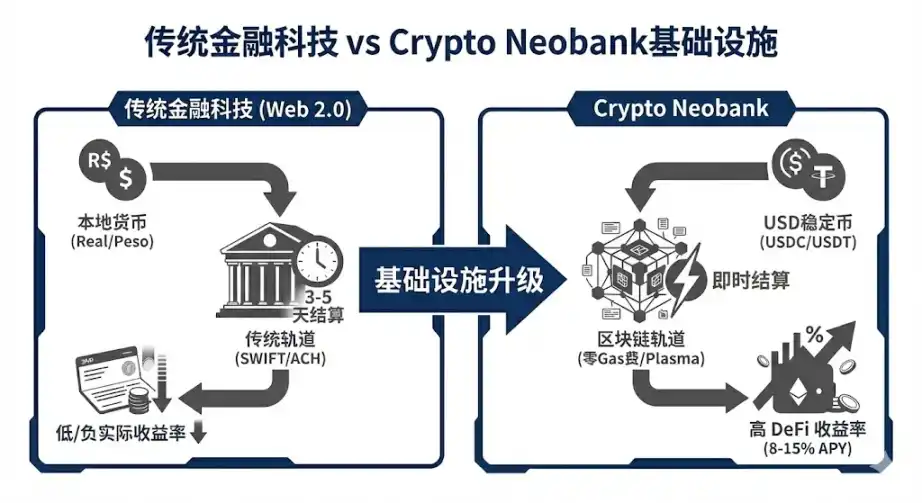
For Latin American users, this is not just a better experience but a rigid demand for asset保值.

6. Challenges, Strategies, and Endgame Predictions

6.1 Challenges and Breakout Strategies

Despite the bright prospects, events where banks关闭 crypto company accounts out of compliance fears still occur occasionally in Mexico and Colombia. Furthermore, Latin American regulation is highly fragmented, resulting in extremely high compliance costs for跨国 operations.

Targeting the Latin American market, Web3 projects need to follow a specific winner's playbook:

Brazil First: Given that Brazil accounts for 31% of Latin American crypto trading volume and has a完善的 payment system, it must be the primary battlefield.

Niche First: Don't try to be a bank for everyone from the start. The successful path is to first capture a细分 community and then扩散.

Viral Marketing: 90% of Nubank's growth came from word of mouth. Crypto Neobanks should leverage on-chain incentives to achieve low-cost裂变 in social networks like WhatsApp.

6.2 Market Predictions

Based on the above analysis, we make the following predictions for the short-to-medium term development of stablecoins:

Private Stablecoins Replacing CBDCs: Given the retreat of Brazil's Drex on the retail端, privately issued compliant stablecoins will de facto assume the role of digital fiat currency.

Mainstreaming of Yield-Bearing Assets: Stablecoins that do not generate interest may face competition from yield-bearing assets like tokenized US Treasuries. Latin American users will increasingly prefer to hold assets that are both anti-inflationary and yield-generating.

Market Stratification: The market will bifurcate into two camps: one highly compliant, bank-integrated whitelisted market, and another gradually shrinking but still existing gray peer-to-peer market.

Conclusion

Latin America's stablecoin market is the world's most cutting-edge laboratory for fintech. Here, stablecoins are not a nice-to-have technology but a must-have necessity. From the digital lifebuoy in the hands of Argentinians to the cross-border settlement tool in the hands of Brazilian financial giants, stablecoins are reshaping the financial arteries of this continent.

With the landing of regulatory frameworks in 2025 and the rise of the new species Crypto Neobank, Latin America is expected to become the first region in the world to achieve large-scale commercial adoption of stablecoins. For investors, the current window of opportunity is only 12 to 18 months. Whoever can leverage Web3 rails to replicate Nubank's user experience before 2026 will become the next hundred-billion-dollar giant. The race has already begun, and Latin America is the untapped gold mine.


Tiền kỹ thuật số thịnh hành

Câu hỏi Liên quan

QWhat are the two primary drivers behind the explosive growth of stablecoins in Latin America, according to the article?

AThe two primary drivers are survival (as a hedge against hyperinflation and currency devaluation) and efficiency (addressing financial exclusion and high remittance costs).

QHow does the market structure of Brazil differ from that of Argentina in terms of cryptocurrency adoption?

ABrazil's market is highly institutionalized, with about 90% of crypto flows in stablecoins used for corporate payments and cross-border settlements. Argentina's market is primarily retail-driven, with individuals using crypto for dollarization in daily life to combat inflation.

QWhat is a 'Crypto Neobank' and how does it differ from a traditional neobank like Nubank?

AA Crypto Neobank is a new type of financial institution that leverages Web3 infrastructure, offering dollar-based stablecoin accounts and integrating with DeFi protocols to provide high USD-denominated yields. Unlike traditional neobanks like Nubank, which primarily offer accounts in local fiat currencies with low savings rates, Crypto Neobanks do not require a banking license and offer superior returns that outpace inflation.

QWhat technological breakthrough does the article highlight as a key enabler for crypto payments, and which project exemplifies it?

AThe article highlights zero-fee transactions as a key technological enabler. The Plasma blockchain, specifically its flagship product Plasma One which is supported by Tether, exemplifies this breakthrough by enabling USDT transfers with no gas fees, removing a major barrier to crypto payment adoption.

QWhat is the article's prediction regarding the competition between private stablecoins and Central Bank Digital Currencies (CBDCs) in Latin America?

AThe article predicts that privately issued, compliant stablecoins will de facto assume the role of digital fiat currency in the retail space, as evidenced by the strategic retreat of Brazil's CBDC project, Drex, from the retail market.

Nội dung Liên quan

Sau Nỗi Buồn Lệ Rơi của Ronaldo, Polymarket Tạo Nên Một Vở Kịch 'Kiểm Tra Nước Mắt'

Sau trận thua 0-1 trước Tây Ban Nha ở vòng 16 đội World Cup 2026, hình ảnh C.Ronaldo (41 tuổi) xúc động trên sân được lan truyền rộng rãi. Tuy nhiên, trên thị trường dự đoán Polymarket, sự kiện "C.Ronaldo có khóc tại World Cup này không" lại rơi vào tranh cãi gay gắt về việc giải quyết. Theo quy tắc ban đầu, sự kiện chỉ được tính là "Có" nếu có bằng chứng video/ảnh rõ ràng cho thấy nước mắt trên mặt Ronaldo tại sân hoặc khu vực ghế dự bị. Nhiều người cho rằng hình ảnh hiện tại không đủ thuyết phục, có thể chỉ là mồ hôi hay ánh sáng phản chiếu, khiến tỷ lệ dự đoán "Có" từng lao dốc xuống dưới 20%. Cuộc tranh luận "mồ hôi hay nước mắt" đã khiến thị trường hai lần giải quyết không thành và bước vào giai đoạn tranh chấp. Tuy nhiên, một bước ngoặt lớn đã xảy ra khi ban quản trị Polymarket ra thông báo bổ sung, khẳng định đã có bằng chứng hình ảnh đáp ứng điều kiện, cho thấy Ronaldo "khóc, bao gồm cả nước mắt rõ ràng trên mặt". Ngay lập tức, tỷ lệ dự đoán "Có" bật tăng mạnh lên trên 99%, kết thúc sự kiện với khối lượng giao dịch hơn 22 triệu USD. Sự việc này cho thấy Polymarket dường như đang có xu hướng điều chỉnh để kết quả dự đoán phù hợp hơn với nhận thức chung của công chúng, thay vì chỉ phụ thuộc vào việc "câu chữ" chi tiết trong quy tắc.

Odaily星球日报7 phút trước

Sau Nỗi Buồn Lệ Rơi của Ronaldo, Polymarket Tạo Nên Một Vở Kịch 'Kiểm Tra Nước Mắt'

Odaily星球日报7 phút trước

Lý do việc bán Bitcoin 216 triệu USD của Strategy có thể không phải là tín hiệu giảm giá sau tất cả

Việc Strategy tiết lộ bán 216 triệu USD Bitcoin đã không kích hoạt đợt bán tháo như nhiều nhà phân tích dự đoán. Ngược lại, Grayscale nhận định kế hoạch bán 1,25 tỷ USD BTC của công ty này thậm chí có thể hỗ trợ sự ổn định giá BTC. Giá cổ phiếu ưu đãi STRC của Strategy đã phục hồi, phản ánh sự tin tưởng gia tăng của nhà đầu tư. Thị trường phản ứng trung lập với thông báo này, khác hẳn với phản ứng tiêu cực hồi đầu tháng 6. BTC chỉ giảm nhẹ rồi phục hồi, đóng cổ với mức tăng 0,6%. Điều này khiến một số nhà phân tích cho rằng đáy của thị trường có thể đã xuất hiện khi tin xấu không còn đẩy giá xuống. Tuy nhiên, vẫn còn những lo ngại. Các tổ chức như JPMorgan và Galaxy Research cảnh báo việc bán BTC có thể gây áp lực giảm giá và không giải quyết được các vấn đề cơ cấu của Strategy. Nhà phê bình Peter Schiff chỉ ra rằng Strategy đang bán BTC thấp hơn giá mua trung bình, ghi nhận khoản lỗ đáng kể. Tóm lại, thị trường dường như đã "tiêu hóa" tin tức về đợt bán BTC lớn của Strategy, coi đó là bước đi nhằm củng cố cấu trúc tài chính và có khả năng tìm đáy vững chắc hơn cho Bitcoin.

ambcrypto10 phút trước

Lý do việc bán Bitcoin 216 triệu USD của Strategy có thể không phải là tín hiệu giảm giá sau tất cả

ambcrypto10 phút trước

Không cá cược bàn thắng mà cá cược 'nước mắt', người dùng Polymarket tranh cãi kịch liệt về trận chia tay World Cup của Ronaldo

Viết bởi: Mahe, Foresight News Ngày 6/7, trận vòng 1/8 World Cup 2026 giữa Bồ Đào Nha và Tây Ban Nha kết thúc với tỷ số 0-1. Đây là kỳ World Cup cuối cùng của Cristiano Ronaldo (C.Ronaldo) ở tuổi 41. Hình ảnh anh đỏ mắt, lau mặt và cố kìm nén nước mắt được truyền thông toàn cầu đưa tin. Đồng thời, một thị trường dự đoán phi tập trung (Polymarket) về việc "C.Ronaldo có khóc tại World Cup 2026 không?" trở thành tâm điểm tranh cãi. Tổng khối lượng giao dịch đạt 23.94 triệu USD. Quy tắc thị trường nêu rõ: nếu có hình ảnh hoặc video rõ ràng cho thấy những giọt nước mắt chảy xuống trên mặt Ronaldo trong hoặc sau trận đấu, trên sân hoặc khu vực ghế dự bị, kết quả sẽ là "Có". Ngược lại là "Không". Sau trận thua, nhiều phương tiện truyền thông mô tả Ronaldo "đầy nước mắt". Tuy nhiên, phe "Có" và phe "Không" trên Polymarket tranh luận gay gắt: liệu hình ảnh anh mắt ướt, lau mặt có đáp ứng tiêu chí "nước mắt chảy rõ ràng" hay không. Thị trường hai lần đề xuất kết quả "Không" đều bị phản đối và bước vào giai đoạn xét duyệt cuối cùng, do cộng đồng oracle UMA bỏ phiếu quyết định. Ngày 8/7, Polymarket đưa ra thông báo chi tiết, khẳng định đã có bằng chứng video và ảnh phù hợp điều kiện, ghi lại cảnh Ronaldo khóc với nước mắt có thể nhìn thấy trên mặt ngay trên sân sau trận đấu. Sự việc cho thấy các thị trường dự đoán có thể rất hiệu quả với sự kiện có thể định lượng, nhưng dễ gây tranh cãi lớn khi liên quan đến đánh giá chủ quan hoặc sắc thái cảm xúc.

Foresight News1 giờ trước

Không cá cược bàn thắng mà cá cược 'nước mắt', người dùng Polymarket tranh cãi kịch liệt về trận chia tay World Cup của Ronaldo

Foresight News1 giờ trước

DeepSeek bí mật tự sản xuất chip, chuyên tấn công vào lĩnh vực suy luận, đã khởi động từ một năm trước, quá trình tuyển dụng hoàn toàn không công khai

DeepSeek, công ty AI Trung Quốc nổi tiếng với các mô hình thuật toán, đang bí mật phát triển chip AI tự thiết kế của riêng mình, với mục tiêu giảm sự phụ thuộc vào Nvidia. Theo nguồn tin từ Reuters, dự án tập trung vào chip chuyên cho suy luận (inference) hơn là đào tạo (training) và đã được khởi động từ khoảng một năm trước. Dự án hiện vẫn trong giai đoạn đầu. DeepSeek được cho là đã tiếp xúc với các công ty thiết kế chip, nhà máy sản xuất bán dẫn và nhà cung cấp bộ nhớ. Công ty đã tuyển dụng kỹ sư thiết kế chip một cách kín đáo, không đăng thông tin trên các nền tảng tuyển dụng công khai. Xu hướng này không đơn lẻ khi các hãng AI lớn như OpenAI và Anthropic cũng đang theo đuổi chip tự thiết kế. DeepSeek, vốn đã tối ưu hóa thuật toán để hiệu quả hơn trên phần cứng hiện có (như chip Nvidia H800 hay Huawei Ascend), nay muốn kiểm soát hoàn toàn nền tảng phần cứng. Chip chuyên dụng cho suy luận có thể mang lại hiệu quả chi phí và năng lượng cao hơn, yếu tố quan trọng cho việc mở rộng thương mại hóa. Kế hoạch được hậu thuẫn bởi khoản tài trợ 74 tỷ USD (khoảng 510 tỷ nhân dân tệ) mà DeepSeek huy động được vào tháng 6/2026. Số tiền này sẽ dùng cho việc xây dựng trung tâm dữ liệu dùng chip nội địa, tự nghiên cứu chip AI và mở rộng đội ngũ nhân tài. Công ty cũng đang tuyển dụng kỹ sư thiết kế trung tâm dữ liệu, với các địa điểm được đề cập như Ulanqab, Nội Mông. Mặc dù vậy, thách thức vẫn rất lớn vì việc phát triển một con chip AI cạnh tranh đòi hỏi nhiều năm và nguồn vốn khổng lồ, với kết quả không được đảm bảo. DeepSeek vẫn giữ thái độ im lặng trước thông tin này.

marsbit1 giờ trước

DeepSeek bí mật tự sản xuất chip, chuyên tấn công vào lĩnh vực suy luận, đã khởi động từ một năm trước, quá trình tuyển dụng hoàn toàn không công khai

marsbit1 giờ trước

Giao dịch

Giao ngay

Bài viết Nổi bật

AGENT S là gì

Agent S: Tương Lai của Tương Tác Tự Động trong Web3 Giới thiệu Trong bối cảnh không ngừng phát triển của Web3 và tiền điện tử, các đổi mới đang liên tục định nghĩa lại cách mà cá nhân tương tác với các nền tảng kỹ thuật số. Một dự án tiên phong như vậy, Agent S, hứa hẹn sẽ cách mạng hóa tương tác giữa con người và máy tính thông qua khung tác nhân mở của nó. Bằng cách mở đường cho các tương tác tự động, Agent S nhằm đơn giản hóa các nhiệm vụ phức tạp, cung cấp các ứng dụng chuyển đổi trong trí tuệ nhân tạo (AI). Cuộc khám phá chi tiết này sẽ đi sâu vào những phức tạp của dự án, các tính năng độc đáo của nó và những tác động đối với lĩnh vực tiền điện tử. Agent S là gì? Agent S đứng vững như một khung tác nhân mở đột phá, được thiết kế đặc biệt để giải quyết ba thách thức cơ bản trong việc tự động hóa các nhiệm vụ máy tính: Thu thập Kiến thức Cụ thể theo Miền: Khung này học một cách thông minh từ nhiều nguồn kiến thức bên ngoài và kinh nghiệm nội bộ. Cách tiếp cận kép này giúp nó xây dựng một kho lưu trữ phong phú về kiến thức cụ thể theo miền, nâng cao hiệu suất của nó trong việc thực hiện nhiệm vụ. Lập Kế Hoạch Qua Các Tầm Nhìn Nhiệm Vụ Dài Hạn: Agent S sử dụng lập kế hoạch phân cấp tăng cường kinh nghiệm, một cách tiếp cận chiến lược giúp phân chia và thực hiện các nhiệm vụ phức tạp một cách hiệu quả. Tính năng này nâng cao đáng kể khả năng quản lý nhiều nhiệm vụ con một cách hiệu quả và hiệu suất. Xử Lý Các Giao Diện Động, Không Đều: Dự án giới thiệu Giao Diện Tác Nhân-Máy Tính (ACI), một giải pháp đổi mới giúp nâng cao tương tác giữa các tác nhân và người dùng. Sử dụng các Mô Hình Ngôn Ngữ Lớn Đa Phương Thức (MLLMs), Agent S có thể điều hướng và thao tác các giao diện người dùng đồ họa đa dạng một cách liền mạch. Thông qua những tính năng tiên phong này, Agent S cung cấp một khung vững chắc giải quyết các phức tạp liên quan đến việc tự động hóa tương tác giữa con người với máy móc, mở ra nhiều ứng dụng trong AI và hơn thế nữa. Ai là Người Tạo ra Agent S? Mặc dù khái niệm về Agent S là hoàn toàn đổi mới, thông tin cụ thể về người sáng lập vẫn còn mơ hồ. Người sáng lập hiện vẫn chưa được biết đến, điều này làm nổi bật giai đoạn sơ khai của dự án hoặc sự lựa chọn chiến lược để giữ kín các thành viên sáng lập. Bất chấp sự ẩn danh, sự chú ý vẫn tập trung vào khả năng và tiềm năng của khung này. Ai là Các Nhà Đầu Tư của Agent S? Vì Agent S còn tương đối mới trong hệ sinh thái mã hóa, thông tin chi tiết về các nhà đầu tư và những người tài trợ tài chính của nó không được ghi chép rõ ràng. Sự thiếu vắng thông tin công khai về các nền tảng đầu tư hoặc tổ chức hỗ trợ dự án dấy lên câu hỏi về cấu trúc tài trợ và lộ trình phát triển của nó. Hiểu biết về sự hỗ trợ là rất quan trọng để đánh giá tính bền vững và tác động tiềm năng của dự án. Agent S Hoạt Động Như Thế Nào? Tại cốt lõi của Agent S là công nghệ tiên tiến cho phép nó hoạt động hiệu quả trong nhiều bối cảnh khác nhau. Mô hình hoạt động của nó được xây dựng xung quanh một số tính năng chính: Tương Tác Giống Như Con Người: Khung này cung cấp lập kế hoạch AI tiên tiến, cố gắng làm cho các tương tác với máy tính trở nên trực quan hơn. Bằng cách bắt chước hành vi của con người trong việc thực hiện nhiệm vụ, nó hứa hẹn nâng cao trải nghiệm người dùng. Ký Ức Tường Thuật: Được sử dụng để tận dụng các trải nghiệm cấp cao, Agent S sử dụng ký ức tường thuật để theo dõi lịch sử nhiệm vụ, từ đó nâng cao quy trình ra quyết định của nó. Ký Ức Tình Huống: Tính năng này cung cấp cho người dùng hướng dẫn từng bước, cho phép khung này cung cấp hỗ trợ theo ngữ cảnh khi các nhiệm vụ diễn ra. Hỗ Trợ OpenACI: Với khả năng chạy cục bộ, Agent S cho phép người dùng duy trì quyền kiểm soát đối với các tương tác và quy trình làm việc của họ, phù hợp với tinh thần phi tập trung của Web3. Tích Hợp Dễ Dàng với Các API Bên Ngoài: Tính linh hoạt và khả năng tương thích với nhiều nền tảng AI khác nhau đảm bảo rằng Agent S có thể hòa nhập liền mạch vào các hệ sinh thái công nghệ hiện có, làm cho nó trở thành lựa chọn hấp dẫn cho các nhà phát triển và tổ chức. Những chức năng này cùng nhau góp phần vào vị trí độc đáo của Agent S trong không gian tiền điện tử, khi nó tự động hóa các nhiệm vụ phức tạp, nhiều bước với sự can thiệp tối thiểu của con người. Khi dự án phát triển, các ứng dụng tiềm năng của nó trong Web3 có thể định nghĩa lại cách mà các tương tác kỹ thuật số diễn ra. Thời Gian Phát Triển của Agent S Sự phát triển và các cột mốc của Agent S có thể được tóm tắt trong một dòng thời gian nêu bật các sự kiện quan trọng của nó: 27 tháng 9, 2024: Khái niệm về Agent S được ra mắt trong một bài nghiên cứu toàn diện mang tên “Một Khung Tác Nhân Mở Sử Dụng Máy Tính Như Một Con Người,” trình bày nền tảng cho dự án. 10 tháng 10, 2024: Bài nghiên cứu được công bố công khai trên arXiv, cung cấp một cái nhìn sâu sắc về khung và đánh giá hiệu suất của nó dựa trên tiêu chuẩn OSWorld. 12 tháng 10, 2024: Một video trình bày được phát hành, cung cấp cái nhìn trực quan về khả năng và tính năng của Agent S, thu hút thêm sự quan tâm từ người dùng và nhà đầu tư tiềm năng. Những dấu mốc trong dòng thời gian không chỉ minh họa sự tiến bộ của Agent S mà còn chỉ ra cam kết của nó đối với sự minh bạch và sự tham gia của cộng đồng. Những Điểm Chính Về Agent S Khi khung Agent S tiếp tục phát triển, một số thuộc tính chính nổi bật, nhấn mạnh tính đổi mới và tiềm năng của nó: Khung Đổi Mới: Được thiết kế để cung cấp cách sử dụng máy tính trực quan giống như tương tác của con người, Agent S mang đến một cách tiếp cận mới cho việc tự động hóa nhiệm vụ. Tương Tác Tự Động: Khả năng tương tác tự động với máy tính thông qua GUI đánh dấu một bước tiến tới các giải pháp tính toán thông minh và hiệu quả hơn. Tự Động Hóa Nhiệm Vụ Phức Tạp: Với phương pháp mạnh mẽ của nó, nó có thể tự động hóa các nhiệm vụ phức tạp, nhiều bước, làm cho các quy trình nhanh hơn và ít sai sót hơn. Cải Tiến Liên Tục: Các cơ chế học tập cho phép Agent S cải thiện từ các trải nghiệm trước đó, liên tục nâng cao hiệu suất và hiệu quả của nó. Tính Linh Hoạt: Khả năng thích ứng của nó trên các môi trường hoạt động khác nhau như OSWorld và WindowsAgentArena đảm bảo rằng nó có thể phục vụ một loạt các ứng dụng rộng rãi. Khi Agent S định vị mình trong bối cảnh Web3 và tiền điện tử, tiềm năng của nó để nâng cao khả năng tương tác và tự động hóa quy trình đánh dấu một bước tiến quan trọng trong công nghệ AI. Thông qua khung đổi mới của mình, Agent S minh họa cho tương lai của các tương tác kỹ thuật số, hứa hẹn một trải nghiệm liền mạch và hiệu quả hơn cho người dùng trên nhiều ngành công nghiệp khác nhau. Kết luận Agent S đại diện cho một bước nhảy vọt táo bạo trong sự kết hợp giữa AI và Web3, với khả năng định nghĩa lại cách chúng ta tương tác với công nghệ. Mặc dù vẫn còn ở giai đoạn đầu, những khả năng cho ứng dụng của nó là rộng lớn và hấp dẫn. Thông qua khung toàn diện của mình giải quyết các thách thức quan trọng, Agent S nhằm đưa các tương tác tự động lên hàng đầu trong trải nghiệm kỹ thuật số. Khi chúng ta tiến sâu hơn vào các lĩnh vực tiền điện tử và phi tập trung, các dự án như Agent S chắc chắn sẽ đóng một vai trò quan trọng trong việc định hình tương lai của công nghệ và sự hợp tác giữa con người với máy tính.

Tổng lượt xem 922Xuất bản vào 2025.01.14Cập nhật vào 2025.01.14

AGENT S là gì

Làm thế nào để Mua S

Chào mừng bạn đến với HTX.com! Chúng tôi đã làm cho mua Sonic (S) trở nên đơn giản và thuận tiện. Làm theo hướng dẫn từng bước của chúng tôi để bắt đầu hành trình tiền kỹ thuật số của bạn.Bước 1: Tạo Tài khoản HTX của BạnSử dụng email hoặc số điện thoại của bạn để đăng ký tài khoản miễn phí trên HTX. Trải nghiệm hành trình đăng ký không rắc rối và mở khóa tất cả tính năng. Nhận Tài khoản của tôiBước 2: Truy cập Mua Crypto và Chọn Phương thức Thanh toán của BạnThẻ Tín dụng/Ghi nợ: Sử dụng Visa hoặc Mastercard của bạn để mua Sonic (S) ngay lập tức.Số dư: Sử dụng tiền từ số dư tài khoản HTX của bạn để giao dịch liền mạch.Bên thứ ba: Chúng tôi đã thêm những phương thức thanh toán phổ biến như Google Pay và Apple Pay để nâng cao sự tiện lợi.P2P: Giao dịch trực tiếp với người dùng khác trên HTX.Thị trường mua bán phi tập trung (OTC): Chúng tôi cung cấp những dịch vụ được thiết kế riêng và tỷ giá hối đoái cạnh tranh cho nhà giao dịch.Bước 3: Lưu trữ Sonic (S) của BạnSau khi mua Sonic (S), lưu trữ trong tài khoản HTX của bạn. Ngoài ra, bạn có thể gửi đi nơi khác qua chuyển khoản blockchain hoặc sử dụng để giao dịch những tiền kỹ thuật số khác.Bước 4: Giao dịch Sonic (S)Giao dịch Sonic (S) dễ dàng trên thị trường giao ngay của HTX. Chỉ cần truy cập vào tài khoản của bạn, chọn cặp giao dịch, thực hiện giao dịch và theo dõi trong thời gian thực. Chúng tôi cung cấp trải nghiệm thân thiện với người dùng cho cả người mới bắt đầu và người giao dịch dày dạn kinh nghiệm.

Tổng lượt xem 1.7kXuất bản vào 2025.01.15Cập nhật vào 2026.06.02

Làm thế nào để Mua S

Thảo luận

Chào mừng đến với Cộng đồng HTX. Tại đây, bạn có thể được thông báo về những phát triển nền tảng mới nhất và có quyền truy cập vào thông tin chuyên sâu về thị trường. Ý kiến ​​của người dùng về giá của S (S) được trình bày dưới đây.

活动图片