# Bài viết Liên quan Trends

Trung tâm Tin tức HTX cung cấp những bài viết mới nhất và phân tích chuyên sâu về "Trends", bao gồm xu hướng thị trường, cập nhật dự án, phát triển công nghệ và chính sách quản lý trong ngành tiền kỹ thuật số.

Beosin: 36 Major Security Incidents in May Resulting in Over $76 Million in Losses

In May 2026, the Web3 ecosystem suffered over $76.15 million in losses across 36 major security incidents, according to Beosin Alert. The primary causes were contract vulnerabilities and private key leaks. The top loss involved the Verus-Ethereum Bridge, which lost $11.58 million due to a cross-chain message validation flaw—a vulnerability type historically responsible for massive losses at Wormhole and Nomad. The Echo Protocol attack, resulting from a private key leak, saw the minting of 1,000 eBTC (nominal value ~$76.7M), with the attacker netting ~$5.13 million due to liquidity constraints. Cross-chain bridges were the hardest-hit category, accounting for $27.995 million in losses. DeFi protocols were the most frequently targeted, with 14 attacks. Ethereum saw the highest chain-specific losses at over $48.76 million, followed by BNB Chain, Monad, and TON, indicating a multi-chain attack landscape. A detailed analysis highlighted three key incidents: 1. **Verus-Ethereum Bridge**: A flaw where the bridge contract verified proof from the Verus chain but failed to validate the underlying asset value, allowing fake outputs. 2. **Trusted Volumes**: A signature parameter defect in its RFQ system allowed an attacker to manipulate authorization checks and drain assets from the Resolver contract. 3. **Private Key Leaks (e.g., StablR)**: Operational failures, including inadequate multi-signature wallet thresholds and lack of timelocks, led to losses exceeding $25 million across multiple projects. The report concludes that the Web3 security threat landscape is expanding systemically. Risks now span code, infrastructure, interoperability, and human processes, moving beyond code audits alone. Projects are urged to enhance operational security, review old contracts, and users should regularly revoke unnecessary approvals.

marsbit06/10 09:26

Beosin: 36 Major Security Incidents in May Resulting in Over $76 Million in Losses

marsbit06/10 09:26

Farewell to Traditional Bull and Bear Markets, Deciphering the Logic of Today's Bubble Rotation

"Farewell to Traditional Bulls and Bears: Understanding Today's Market Logic of Bubble Rotation" The article draws a parallel between modern financial markets and a meteorological chain of thunderstorms, contrasting it with the past's slower-moving, more predictable 'layered cloud' systems of long bull/bear cycles and gradual sector rotations. The author argues that today's market has undergone a permanent structural shift, creating an environment where discrete, intense thematic bubbles (e.g., AI, GLP-1 drugs, crypto, robotics, quantum tech) sequentially form, swell, and burst. These 'storm cells' are triggered when capital fleeing a dying bubble acts like a meteorological 'cold air wedge,' forcing the warm, moist capital of latent interest in a new sector to rapidly rise and condense into the next speculative frenzy. This new 'convective' market regime is driven by eight fundamental changes: 1. Democratization of speculation via zero-commission trading, gamified apps, and heavy retail participation in instruments like 0DTE options. 2. Permanent, price-insensitive buying pressure from defined-contribution retirement plans (e.g., 401(k)s). 3. Passive investing creating inelastic market participants that amplify momentum, especially into mega-cap stocks. 4. The dominance of multi-strategy funds and high-frequency trading (HFT), weakening price discovery and creating fragile microstructure prone to synchronized sell-offs. 5. Artificially suppressed volatility that eventually erupts in violent spikes. 6. A transformed market index heavily weighted toward long-duration, narrative-driven tech companies instead of stable, cyclical industrials. 7. The total elimination of information delay, accelerating fear-of-missing-out (FOMO) and herd behavior. 8. A persistently loose fiscal and monetary policy environment. These structural shifts are deemed irreversible. The article outlines the common lifecycle of these thematic bubbles: latency, catalyzing event, narrative formation, peak divergence, and rupture—with outflowing capital seeding the next bubble. In this environment, two investor archetypes can thrive: deep domain experts who understand underlying technologies and business models, and disciplined trend-followers. The author concludes that while emotionally challenging, recognizing this new "climate" is crucial. The key is to elevate one's perspective above the immediate storm to see the cyclical chain of bubbles, avoiding being swept away by the emotions of any single thematic frenzy.

Foresight News06/08 07:05

Farewell to Traditional Bull and Bear Markets, Deciphering the Logic of Today's Bubble Rotation

Foresight News06/08 07:05

Three Years Later: Looking Back at My Predictions About ChatGPT in 2023

Three Years Later: Revisiting My 2023 Predictions on ChatGPT In March 2023, shortly after ChatGPT's launch, I made 20 predictions about its future. Now, in mid-2026, I've used AI agents to fact-check each one against the latest data. Overall, most major directional forecasts were correct, with only one outright error (incorrectly stating GPT-4 had 100 trillion parameters). Key successes included predicting that RAG and retrieval architectures would become the standard for handling knowledge and hallucinations, that natural language interfaces (LUI) would create a massive new industry layer beyond the models themselves, and that China would develop viable large language models, significantly closing the performance gap with Western counterparts within about three years. Predictions about the absence of mass unemployment, the rise of a new "robot network" for agent communication, and ChatGPT not possessing consciousness also held true in their core arguments. However, the "devil was in the details." Errors frequently involved specific numbers, timelines, or overlooking distributional effects. I tended to overestimate the speed of adoption (e.g., for agent networks) while underestimating the ultimate scale of capabilities or costs (e.g., AI winning IMO gold without tools, or the extreme capital required for frontier models). Other misjudgments included: underestimating how AI would reinforce, not dissolve, information filter bubbles; incorrectly assuming AI-generated content would easily circumvent copyright (it has instead triggered record-breaking settlements); and misidentifying where value would be captured (it accrued overwhelmingly to the compute layer, like Nvidia, not just the application or model layers). Key lessons from reviewing these predictions are: 1) Directional and mechanistic insights are far more reliable than precise numbers or absolute statements. 2) There's a consistent bias to overestimate short-term speed but underestimate long-term magnitude. 3) Errors often lie in missing distributional impacts within a generally correct aggregate trend. 4) Predictions phrased with nuance and caveats aged the best. 5) Some fundamental debates (e.g., on machine consciousness or the ultimate value chain) remain unresolved even after three years. This exercise is less about scoring the past and more about establishing rules for clearer thinking about the next three years of AI.

marsbit05/31 16:02

Three Years Later: Looking Back at My Predictions About ChatGPT in 2023

marsbit05/31 16:02

After 50x Storage Surge, Justin Sun Always Looks to the Next Decade

Sun Yuchen, known for his controversial stunts like a $30 million lunch with Warren Buffett (canceled due to a kidney stone) and eating a $6.2 million duct-taped banana, is often overshadowed by a significant fact: his decade-long track record of spotting major investment trends. In 2016, he famously advised young people to invest in Bitcoin, Nvidia, Tesla, and Tencent instead of buying property. A hypothetical $20,000 investment in Nvidia and Tesla from that list would now be worth over 50 million RMB. His latest major call was on November 6, 2025, predicting a "50x storage opportunity" tied to the AI boom, which materialized with Sandisk's stock surging nearly 50-fold by 2026. Looking ahead, Sun now focuses on the next frontier: Physical AI. He identifies four key areas: 1. **Embodied AI/Robotics**: He sees this reaching its "iPhone moment," with companies like UBTech and Galaxy General leading in commercialization. 2. **Drones**: Viewed as the first commercially viable form of Physical AI, revolutionizing sectors from warfare (e.g., AeroVironment's Switchblade) to logistics. 3. **Spatial Computing**: Beyond VR, it's about AI understanding physical space, a foundational technology for robotics and autonomous systems, exemplified by Apple's Vision Pro. 4. **Space Exploration**: After a 2025 suborbital flight with Blue Origin, Sun advocates for space as the ultimate frontier, discussing blockchain's potential role in space asset management and data transactions. His investment philosophy involves betting on entire, inevitable trends rather than single companies. For robotics, he sees Tesla (the body/manufacturer) and Nvidia (the brain/AI platform) as complementary plays. In defense drones, he highlights companies making tanks obsolete (AeroVironment) and those augmenting fighter jets (Kratos). For space, he participated in Blue Origin's flight and anticipates SpaceX's potential IPO to redefine the sector's valuation. Sun Yuchen's vision frames the next two decades not as a revolution in information flow (like the internet), but in the fundamental operation of the physical world through AI-powered robots, autonomous systems, and spatial intelligence, ultimately extending human and AI activity into space. While many still focus on conventional assets, he continues to look toward the next technological horizon.

marsbit05/11 07:22

After 50x Storage Surge, Justin Sun Always Looks to the Next Decade

marsbit05/11 07:22

MSX Q1 Review and Q2 Outlook: Securing the Main Trends in U.S. Stocks, A Methodology for Precise Stock Selection

MSX Q1 Review & Q2 Outlook: Capturing the U.S. Stock Market Trends and a Precision Stock Selection Methodology In Q1 2026, the crypto market performed poorly, with Bitcoin falling about 23%, marking its worst quarterly start since 2018. In contrast, the U.S. stock market, despite significant drops in the "Magnificent Seven," still saw profitable opportunities in rapidly rotating hot sectors. The decentralized RWA trading platform MSX listed 39 new U.S. stock tokenized assets, covering five main themes: aerospace/defense, energy/resources, AI hardware, optical communications, and regional allocation tools. Among these, 38 achieved positive returns, with an average gain of 37.6%. Four stocks more than doubled, all concentrated in AI hardware and optical communications. MSX's stock selection framework focuses on identifying companies with clear industrial trends, tangible order flows, and earnings validation, rather than speculative narratives. The platform avoids high-risk bets on large-cap reversals, instead targeting small and mid-cap stocks benefiting from real capital expenditure and supply chain expansion. In Q1, the five main themes were identified through continuous tracking of corporate earnings, capex guidance, and capital flow dynamics—not macro forecasts alone. AI hardware and optical communications were confirmed as systemic opportunities based on actual order transfers and infrastructure demand from big tech's expanding data centers. Although aerospace/defense and regional tools had modest gains, they provided portfolio diversification and non-correlated hedges, enhancing structural resilience. MSX's listing节奏 was dynamically adjusted based on market signals and industrial data rather than pre-set schedules. Looking ahead, Q2 may see a continuation of the AI narrative but with increased selectivity. Aerospace and undervalued software/SaaS sectors present new opportunities. MSX emphasizes a balanced approach: maintaining core exposure to high-conviction AI infrastructure plays while incorporating defensive assets like energy and tools to navigate macro uncertainties, including interest rate paths and geopolitical risks. The platform aims to help users, especially those from crypto backgrounds, build robust, multi-asset strategies through education and thematic investing tools.

Odaily星球日报04/03 06:07

MSX Q1 Review and Q2 Outlook: Securing the Main Trends in U.S. Stocks, A Methodology for Precise Stock Selection

Odaily星球日报04/03 06:07

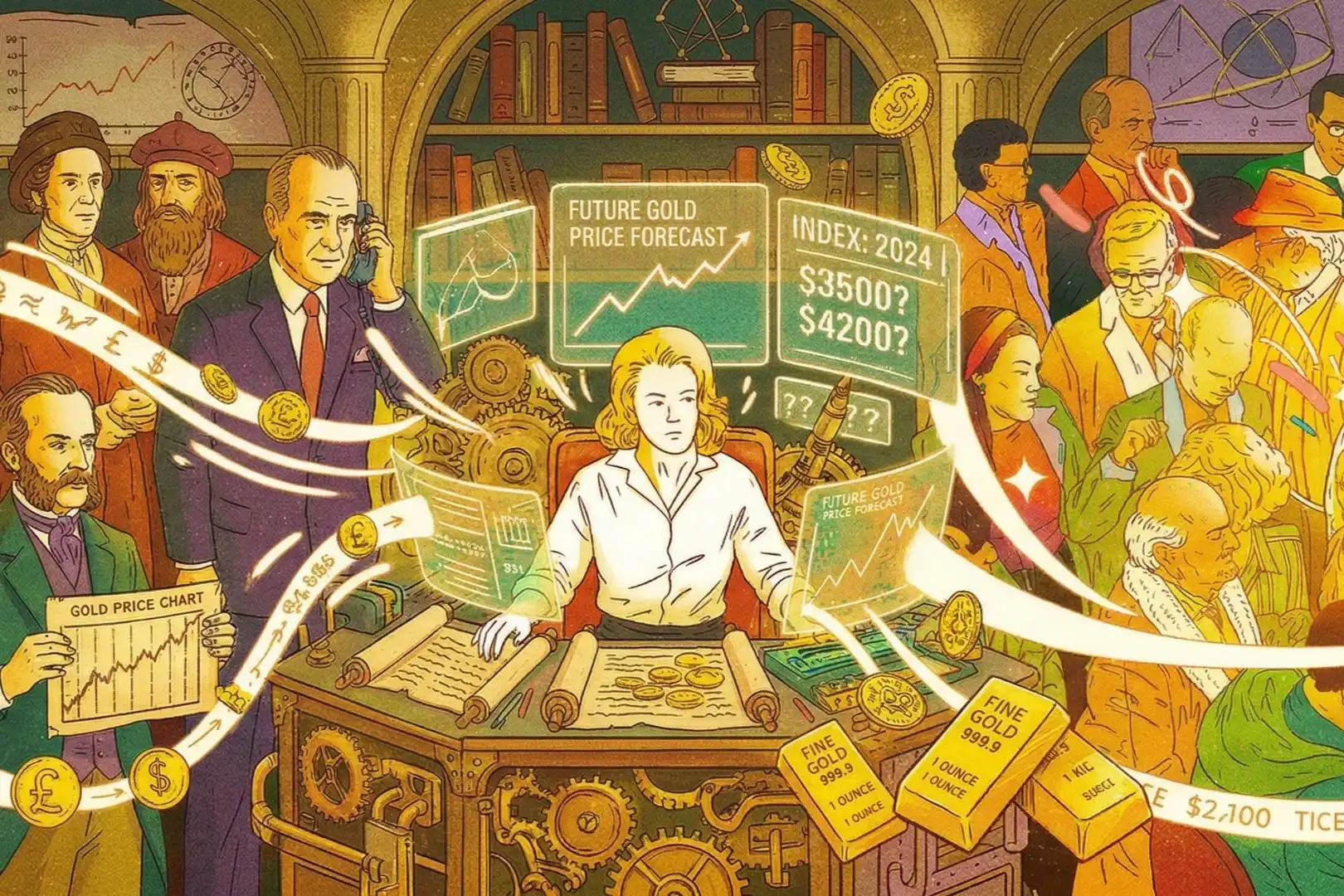
If We Gathered the Most Accurate Gold Forecasters in History, Could We Crack the Future Price of Gold? I've Compiled a Decade of the Most Accurate Gold Analysis

This analysis investigates whether compiling the most accurate historical predictions on gold prices from top analysts, institutions, and famed forecasters can unlock future price movements. After examining over a decade of data, the findings reveal that no single expert or entity consistently predicts gold prices accurately. Key observations include: - **Wall Street institutions** (e.g., LBMA, Goldman Sachs, JPMorgan) often exhibit "lagging predictions," adjusting targets only after trends are established, frequently underestimating actual price moves. - **Prominent gold bulls** (e.g., Peter Schiff, Jim Rogers) persistently advocate for higher prices over long horizons but lack timing precision, leading to extended periods of underperformance. - **"Prophetic" forecasters** (e.g., Nouriel Roubini, Ben McMillan) have moments of accuracy but also significant misses or limited track records, undermining their reliability. The study notes a pattern similar to the 2011 gold peak: extreme bullish predictions often cluster near market tops, followed by sharp corrections. Current forecasts for gold range widely from $5,400 to $35,000, reflecting high disagreement even among experts. The conclusion is that there is no consistent "most accurate" predictor for gold prices. Relying on expert consensus or individual forecasts proves chaotic and unreliable. Instead, the author advocates for a strategy akin to Ray Dalio’s: avoiding precise price predictions, embracing uncertainty, and using portfolio allocation (e.g., 5-15% in gold) for long-term risk management.

marsbit04/02 12:42

If We Gathered the Most Accurate Gold Forecasters in History, Could We Crack the Future Price of Gold? I've Compiled a Decade of the Most Accurate Gold Analysis

marsbit04/02 12:42

活动图片