# Bài viết Liên quan Industrial Revolution

Trung tâm Tin tức HTX cung cấp những bài viết mới nhất và phân tích chuyên sâu về "Industrial Revolution", bao gồm xu hướng thị trường, cập nhật dự án, phát triển công nghệ và chính sách quản lý trong ngành tiền kỹ thuật số.

Top 10% of American Households Capture 88% of Wealth, How Is the AI Era Cake Divided?

AI Worsens Wealth Inequality as Top 10% of US Families Garner 88% of Stock Gains (2019-2026) A report from the China Finance 40 Forum highlights that the AI boom is significantly widening wealth inequality in the United States. From 2019 to Q1 2026, wealth from directly held stocks by US households nearly doubled from $29 trillion to approximately $55 trillion, with rapid growth concentrated post-2023, coinciding with the AI-driven stock market surge. The distribution of these gains has been starkly uneven. Between 2022 and Q1 2026, the wealth increase of about $21 trillion was captured almost entirely by the wealthiest families: the top 10% secured roughly 88% ($18.5 trillion), while the bottom 50% received only about 1% ($0.2 trillion). This has contributed to a growing disparity in disposable income shares. The report, referencing economic historian Robert Allen, draws parallels to historical technological shifts like the "Engels' Pause" during the First Industrial Revolution, where worker wages stagnated despite productivity gains. It suggests AI could induce a similar period where capital收益 outpace labor income, exacerbating inequality. Huang Yiping of Peking University identifies four mechanisms through which AI impacts income distribution: capital-bias (reducing labor's income share), task polarization (hollowing out middle-skill jobs), skill-based digital divides, and wealth amplification through assets. He warns that if this trend continues, strong supply growth driven by AI could be undermined by persistently weak consumer demand, threatening sustainable economic growth. To address these challenges, the report proposes a three-pronged strategy: 1) Defensive measures like strengthening social safety nets and antitrust enforcement; 2) Empowering workers through education reform and lifelong learning to collaborate with AI; and 3) Rebalancing via policies such as potential taxes on AI超额收益 and mechanisms for broader sharing of technology's benefits, ensuring AI's红利 are more equitably distributed.

marsbit07/30 00:56

Top 10% of American Households Capture 88% of Wealth, How Is the AI Era Cake Divided?

marsbit07/30 00:56

Trump in Talks with AI Companies Over Profit Sharing, A Narrative Pressure of Industrial Revolution Scale Begins

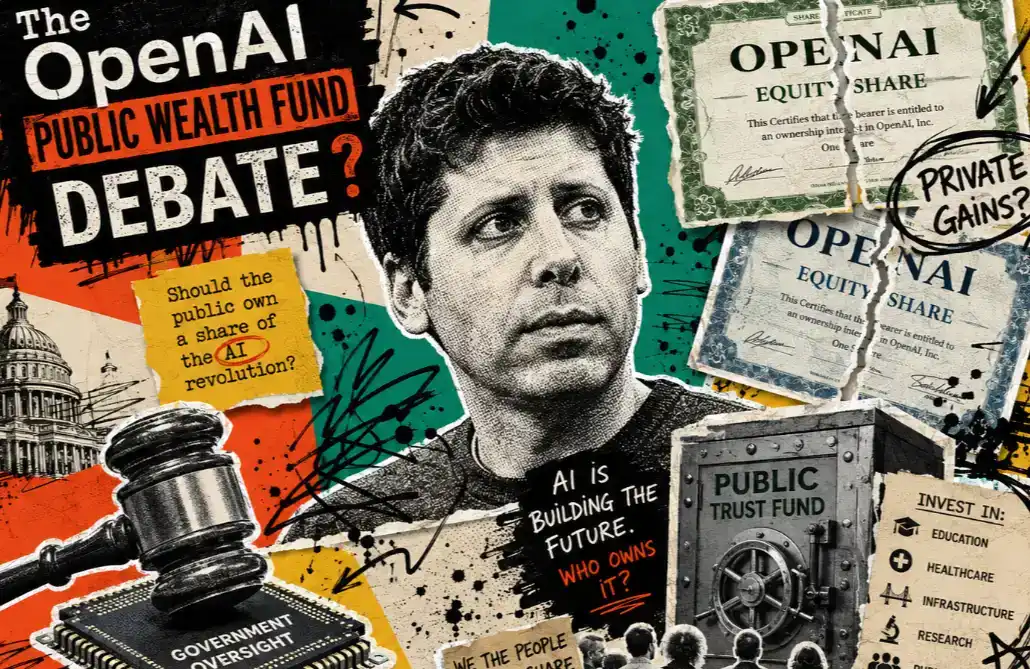
In recent AI market discussions, a new dimension beyond growth and profits has emerged: the question of how the immense wealth potentially generated by AI should be shared with the wider public. Triggered by reports of White House officials discussing "voluntary equity transfers" with top AI firms, similar to models like Alaska's Permanent Fund, the conversation focuses on public wealth funds. OpenAI's own whitepaper proposes such funds, allowing households without direct tech stock ownership to benefit from AI gains. More radical proposals, like Bernie Sanders' call for high public equity stakes and board seats, represent an extreme end of the spectrum. Currently, these are early-stage policy probes, not enacted laws. OpenAI's initiative is seen as an attempt to secure "social license" for its future expansion, mitigating risks of public backlash, stricter regulation, or anti-trust actions as AI's economic impact grows. The core market implication is the introduction of a "policy discount" to AI valuations, particularly for private model companies like OpenAI, Anthropic, and xAI. Investors must now consider not just future earnings but also what portion might be allocated to public mechanisms. The impact varies greatly based on the mechanism. A small, voluntary transfer of non-voting economic rights (e.g., 5%) acts as a quantifiable long-term cost. Government acquisition of economic rights via warrants tied to support differs from direct equity with governance power. The most disruptive scenario would be forced high-percentage public ownership affecting control and innovation incentives. Key signals to watch include whether other AI companies follow suit, if the White House formalizes proposals, related disclosures in future IPO documents, and any market price reactions. For now, this represents a shift from pricing pure AI growth to pricing its potential distribution. A manageable, voluntary economic share is akin to an insurance cost for societal acceptance, while a forced shift toward control and governance would fundamentally alter valuation logic.

marsbit06/08 04:25

Trump in Talks with AI Companies Over Profit Sharing, A Narrative Pressure of Industrial Revolution Scale Begins

marsbit06/08 04:25

AI Is Not Replicating the Internet; It’s Replicating the Industrial Revolution

AI is not replicating the Internet; it is replicating the Industrial Revolution. The past two decades of the internet were built on monetizing user attention and ad space. In contrast, the current AI commercialization path reveals a clear structural shift: the focus is moving from serving consumers (C端) to replacing human labor costs for businesses (B端). While C端 AI applications like ChatGPT face stagnant subscription growth and low conversion rates (often below 5%), the B端 market is exploding. Anthropic's annualized revenue soared from $90 billion to $450 billion in early 2026, primarily driven by enterprise API and Agent deployments. The core logic is Return on Investment (ROI): companies spend on AI to save significantly more on salary costs. For instance, an AI coding agent can replace hundreds of junior programmers, offering a clear and compelling cost-benefit equation. The fundamental mismatch lies in the underlying business logic. C端 AI struggles due to low user switching costs, lack of network effects, and an inability to capture significant user time like entertainment apps. Conversely, B端 AI thrives because enterprises buy based on measurable ROI, integrate AI deeply into workflows (creating high switching costs), and are willing to pay a premium for stability and performance. AI is evolving from a digital tool into a digital labor force—directly executing tasks rather than just assisting humans. This transformation mirrors the Industrial Revolution, where machinery replaced physical labor. Today, AI is replacing structured cognitive labor. The total global wage bill represents a market vastly larger than internet advertising. Therefore, the true value of AI lies not in capturing traffic, but in capturing the economics of labor cost replacement. The internet monetized attention; AI monetizes wages.

marsbit05/29 10:24

AI Is Not Replicating the Internet; It’s Replicating the Industrial Revolution

marsbit05/29 10:24

活动图片