Nobel Laureate Uses AI to Create Gene Scissors from Scratch, More Precise than the One Evolved Over Billions of Years

marsbitXuất bản vào 2026-07-28Cập nhật gần nhất vào 2026-07-28

Tóm tắt

Nobel laureate Jennifer Doudna and her team, along with the startup Profluent, have used AI to design novel CRISPR enzymes that do not exist in nature. These AI-generated gene-editing tools demonstrate superior performance compared to their natural counterparts. Doudna's team focused on engineering TnpB, a compact ancestor of Cas12, achieving functional enzymes with sequences approximately 30% different from natural versions—a drastic increase from the typical 1-2% modifications possible with prior methods. Meanwhile, Profluent generated entirely new Cas9 variants from scratch using protein language models. Their leading candidate, OpenCRISPR-1, exhibits higher on-target editing efficiency (55.7% vs. 48.3%) and a roughly 95% reduction in off-target editing compared to the commonly used SpCas9, despite having hundreds of mutations away from any known natural sequence. While these breakthroughs, published in *Science* and highlighted by *Nature*, mark a significant shift from discovering biological tools to actively designing them with AI, the results are currently confined to cellular experiments. The research underscores a future where AI accelerates protein design, but experts emphasize that deep biological insight remains essential to fully harness these models and advance towards therapeutic applications.

AI has created a pair of gene scissors that never existed in nature.

And they work better than the pair honed by billions of years of evolution.

On July 16th, Nature published news that scientists used AI to create CRISPR enzymes never seen in nature, which cut genes more cleanly than the "natural version." The paper was published in Science on the same day.
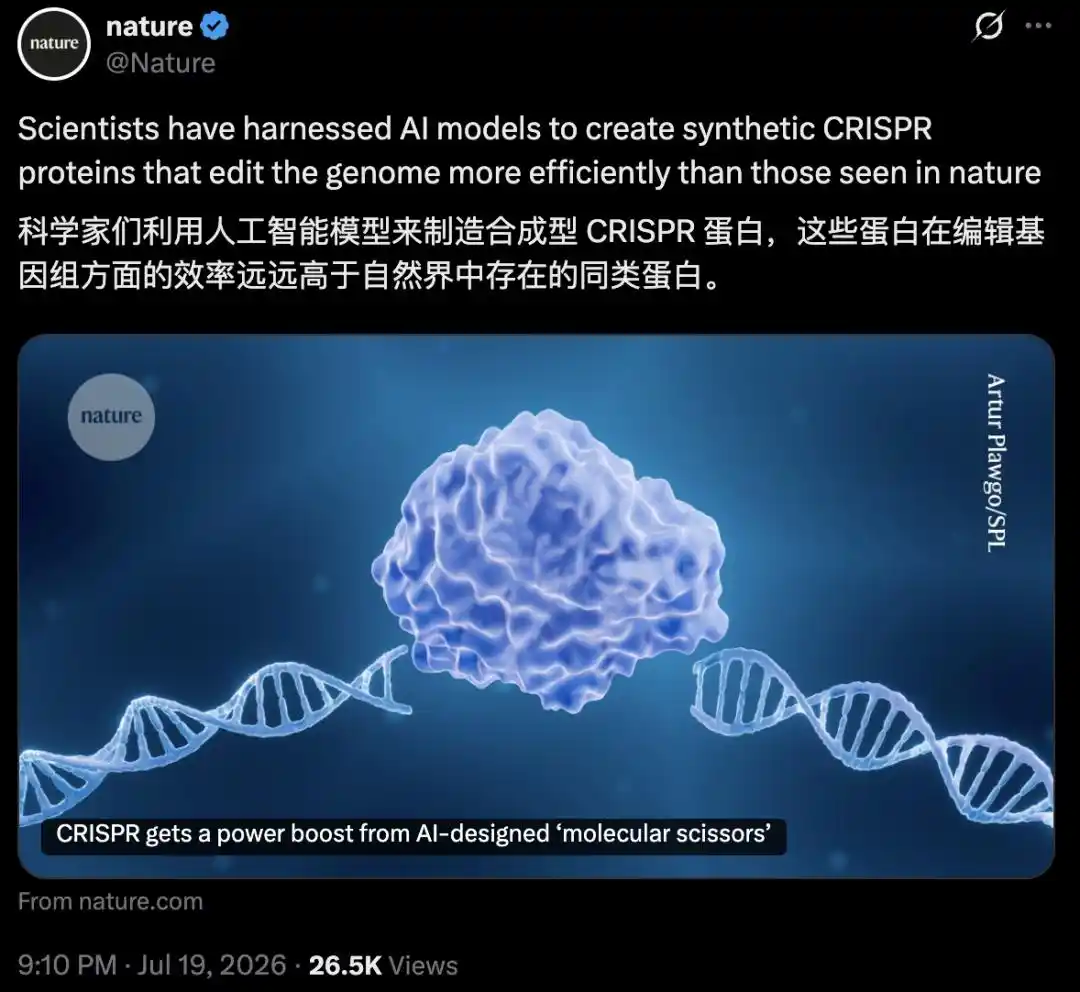
The project was led by Jennifer Doudna, who won the Nobel Prize in Chemistry in 2020 for CRISPR.

She once told Nature: proteins can be modified. But once you start, you find that after modification, it basically doesn't work anymore.

This problem has stumped humans for over a decade.

Then AI arrived, changing 30% of the protein sequence while keeping the enzyme functional.

And this is just one line of research.

On another front, the startup Profluent bypassed TnpB entirely and directly generated an entirely new Cas9.

The results were equally striking: it cuts the intended target more cleanly and barely touches unintended sites, with off-target editing rates approximately 95% lower than the most common SpCas9.

The tools produced by billions of years of evolution are being rewritten by AI in design space.
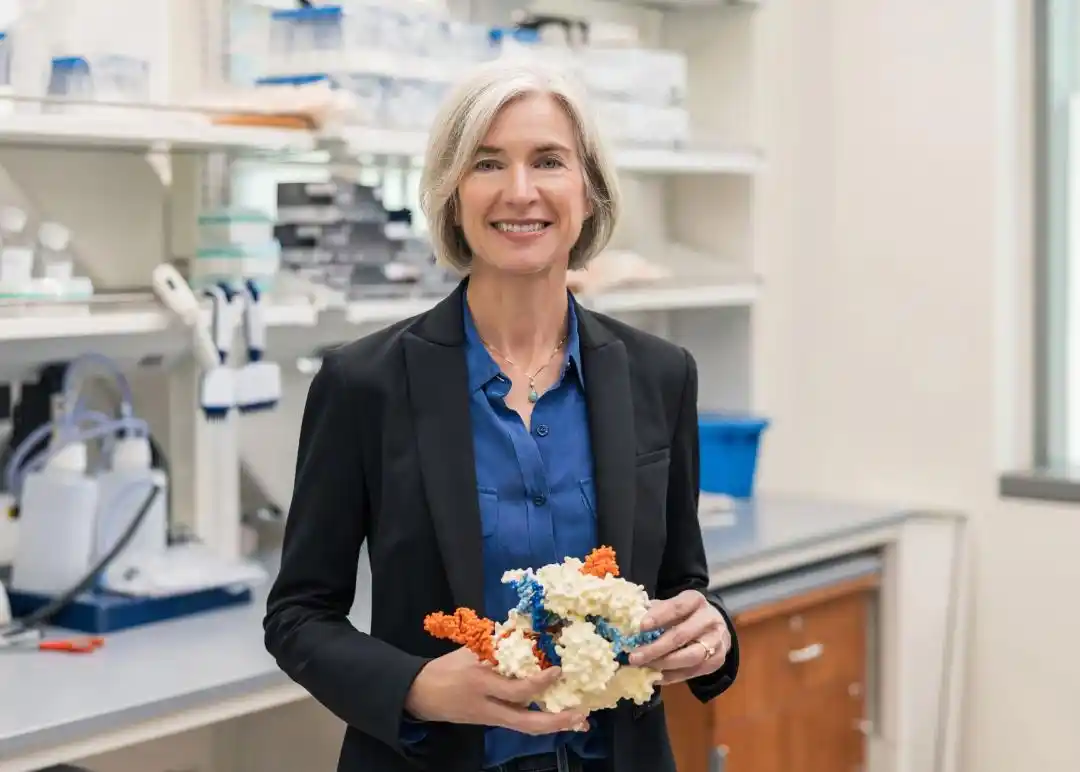
Jennifer Doudna, biochemist at UC Berkeley, 2020 Nobel Laureate in Chemistry, founder of the Innovative Genomics Institute. (Image source: Jussi Puikkonen/KNAW)

How Counterintuitive Is It to Remain Functional After 30% Modification?

CRISPR was not invented by humans.

Whether it's Cas9 or Cas12, they are all pre-existing "parts" borrowed from bacteria.

Bacteria use them to resist viral invasion. Humans took a liking to this mechanism, moved it into the lab, paired it with a guide RNA, and created "molecular scissors" that can precisely locate and cut a single position among 3 billion base pairs.

The Nobel Prize awarded to Doudna and Charpentier rewarded the "discovery" more than the "design."

But the problem lies here. Borrowed "parts" are not tailored to human needs in terms of size or behavior. To get smaller, more precise, less immunogenic, or capable of recognizing more targets, we could only rely on manual, incremental modifications.

But these things are notoriously difficult to modify.

Most Cas9 proteins are over 1000 amino acids long. The theoretical sequence space is 20 to the power of 1000: a number many orders of magnitude larger than the total number of atoms in the observable universe.

In such a vast space, viable solutions are extremely sparse, and the range humans can explore is pitifully small.

Therefore, in recent years, similar AI-assisted work has been done, but modification levels were generally kept timidly between 1% and 2%.

Modify a bit more, and it becomes useless.

AI's Two Moves

This time, Doudna's team didn't target Cas9. They chose a class of miniature nucleases called TnpB.

They are smaller and, evolutionarily speaking, are the ancestors of Cas12.

The team wanted to know: to what extent can this sequence be altered while still retaining its gene-editing capability.

The first step was handed to an AI model.

Researchers fed the model the target structure of a specific TnpB—what the protein should look like after folding—and then asked it the reverse question:

How should the amino acid sequence be modified so that the protein still folds into this shape.

The model spat out thousands of modifications.

But this step only solved "looking right." A correctly folded protein doesn't mean it's alive.

Hence the second step: train another model, feed it all the massive amounts of experimental data accumulated in labs over the years, and have it analyze the intricate interrelationships between various parts of the protein.

Specifically, which segments are untouchable vital points, where a single change destroys function.
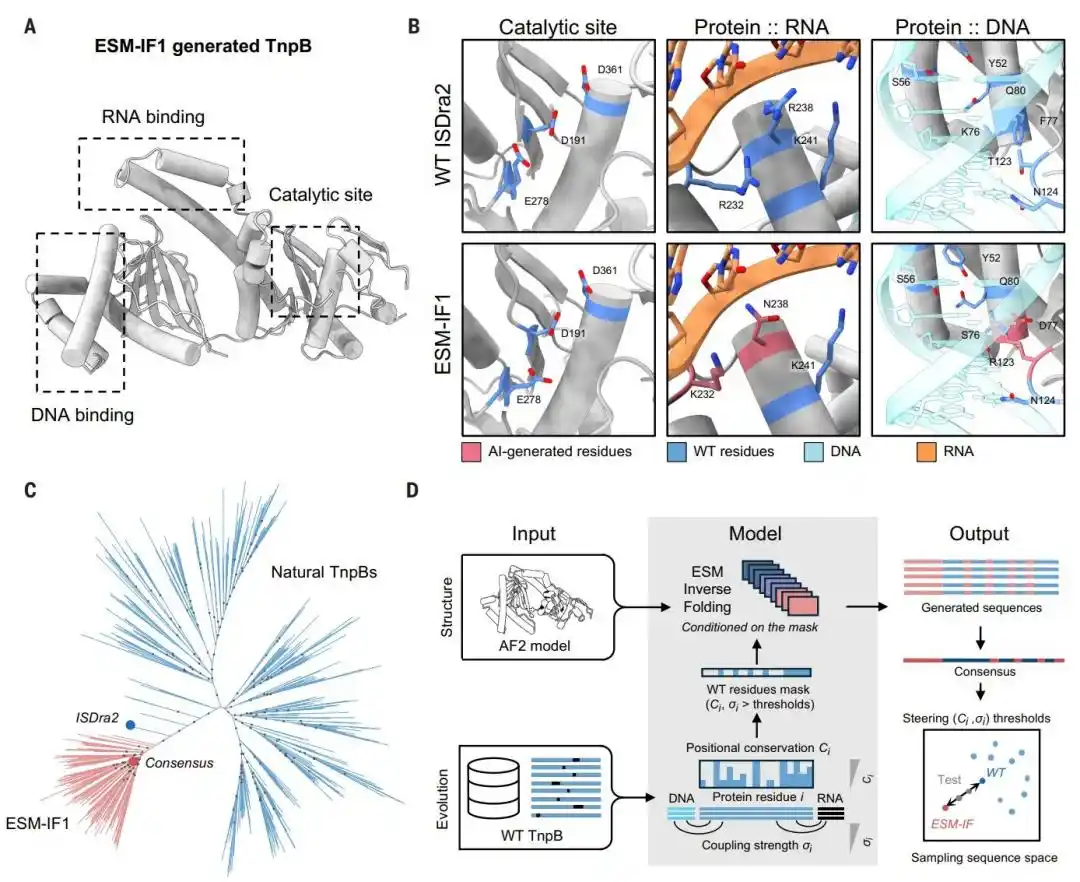
Doudna team's TnpB design process. Bottom left is the phylogenetic tree, blue represents naturally existing TnpBs, the red cluster represents AI-generated sequences, with little overlap. Bottom right shows the technical route: AF2 structure plus evolutionary constraint masking, fed into the ESM-IF1 model to generate new sequences. (Image source: Science 2026, DOI: 10.1126/science.aed6123)

The combination of the two models filtered out a small batch of synthetic nucleases.

Standard tests showed they could edit in bacteria, in plants, and in human cells.

The efficiency of inserting or deleting target fragments for some of them was even higher than their natural counterparts.

Doudna said of this result: quite exciting.

403 Mutations, These Scissors Have No Relatives in Nature

The first set of numbers was mentioned earlier: synthetic versions differ from the natural version by about 30% of their sequence, compared to 1%-2% modification in previous similar AI work.

The second set of numbers comes from protein design company Profluent, who took a different path: not modifying TnpB, but directly generating an entirely new Cas9.

They systematically mined 26TB of genomic and metagenomic data to build a database of 5.1 million CRISPR-Cas proteins, then used a protein language model to generate new sequences, achieving a diversity 4.8 times that of known natural levels.
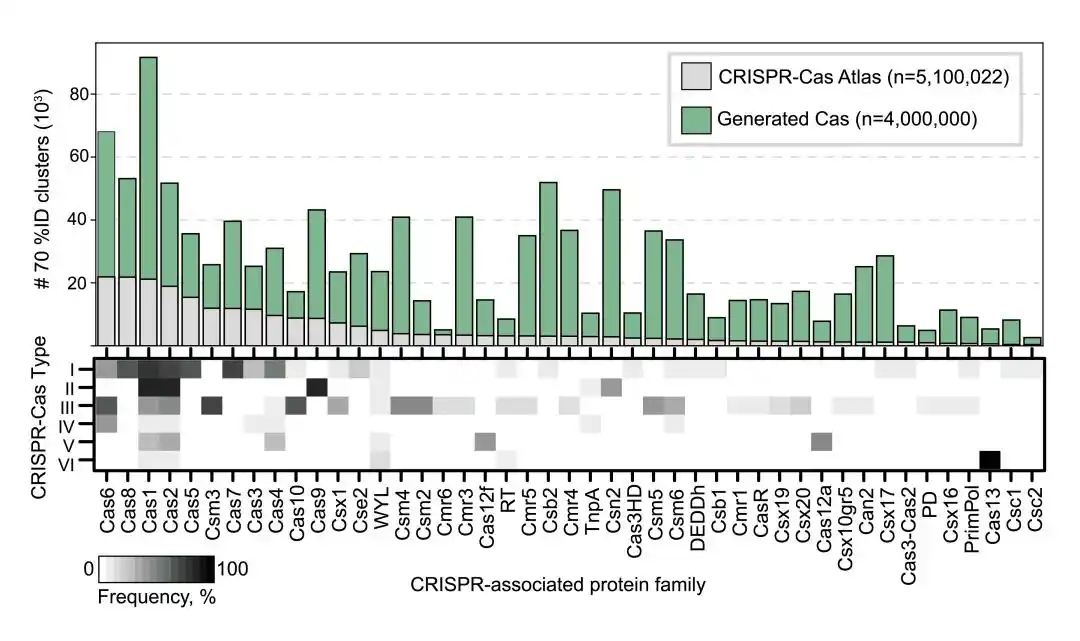
Diversity expansion of AI-generated sequences (light color) compared to natural CRISPR proteins (dark color), counted by protein cluster number. Heatmap shows distribution of protein families across different CRISPR-Cas systems. (Image source: Profluent)

They selected 48 sequences for functional validation in human cells. The best performer was named OpenCRISPR-1 and has been open-sourced.

Its report card looks like this:

On-target editing efficiency: 55.7% (SpCas9: 48.3%).

Off-target editing rate: 0.32% (SpCas9: 6.1%).

The latter represents a reduction of about 95%.

And this sequence has 403 mutations compared to SpCas9, and at least 182 mutations compared to any natural CRISPR protein in the database.

This is re-creating a "pair of scissors" from the concept itself, one that doesn't exist on Earth.
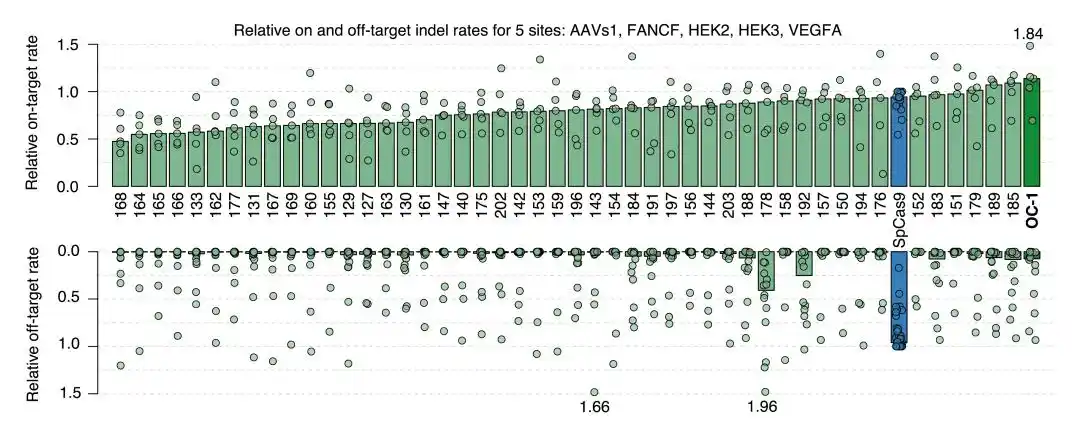
Multiple AI-generated nucleases (green, with dark green being OpenCRISPR-1) show on-target activity comparable to or higher than SpCas9 (blue), with significantly lower off-target activity. (Image source: Profluent)

The data for OpenCRISPR-1 comes from the company's own published research; independent replication will take more time.

The experiments from Doudna's line have undergone peer review by Science.

From "Discovering Nature" to "Creating Nature"

Looking at these two lines together reveals what is truly changing.

AlphaFold solved "what does this sequence look like": prediction, understanding.

Protein language models pushed further: what kind of sequence is alive, what are the patterns.

Now it's the third level: create a sequence never written by nature, and make it work in living cells.

Soeren Lienkamp, a molecular biologist at the University of Zurich, believes CRISPR allowed everyone to edit DNA as they wish, and AI-based protein design is now enabling everyone to create entirely new properties in protein space.

Those familiar with large language models might find this somewhat familiar: this approach is almost identical to how text models learn language.

Feed enough sequences, learn the internal grammar, then start generating sentences not in the corpus.

By comparison, how reliant on luck the old path was becomes clear.

Insulin was discovered in dogs, Cas9 was found in bacteria from a yogurt factory, botulinum toxin came from a food poisoning incident.

None of these tools were designed; almost all were found by chance. Now there's another path: starting from the desired function, design the molecule in reverse.

A Cas9 protein typically has over 1000 amino acids. The number of possible sequence combinations is 20^1000, far exceeding the total number of atoms in the observable universe.

Evolution groped through this space for billions of years; models can run through it in just hours.

This is the truly impactful part of this story.

Except, the AI that writes code runs its creations on computers; if it writes something bad, you delete and rewrite. The AI that writes proteins runs its creations in living cells. It alters real genetic information, not a run result that can be rolled back.

This is what makes it both more nerve-wracking and more exciting.

Can It Conquer Cancer or Delay Aging?

Not yet.

The achievements mentioned in the article currently stop at cell experiments; these validations are still in the laboratory stage.

Ahead lie animal trials, clinical trials, drug approvals—each hurdle can take years.

Has AI surpassed evolution?

A more appropriate statement is: some proteins generated by AI have exceeded specific natural versions in specific experimental metrics.

This is also not the first shot fired by AI protein design.

AlphaFold, RoseTTAFold, protein language models have been developing for five or six years now, and the preprint for OpenCRISPR-1 was posted on bioRxiv as early as April 2024.
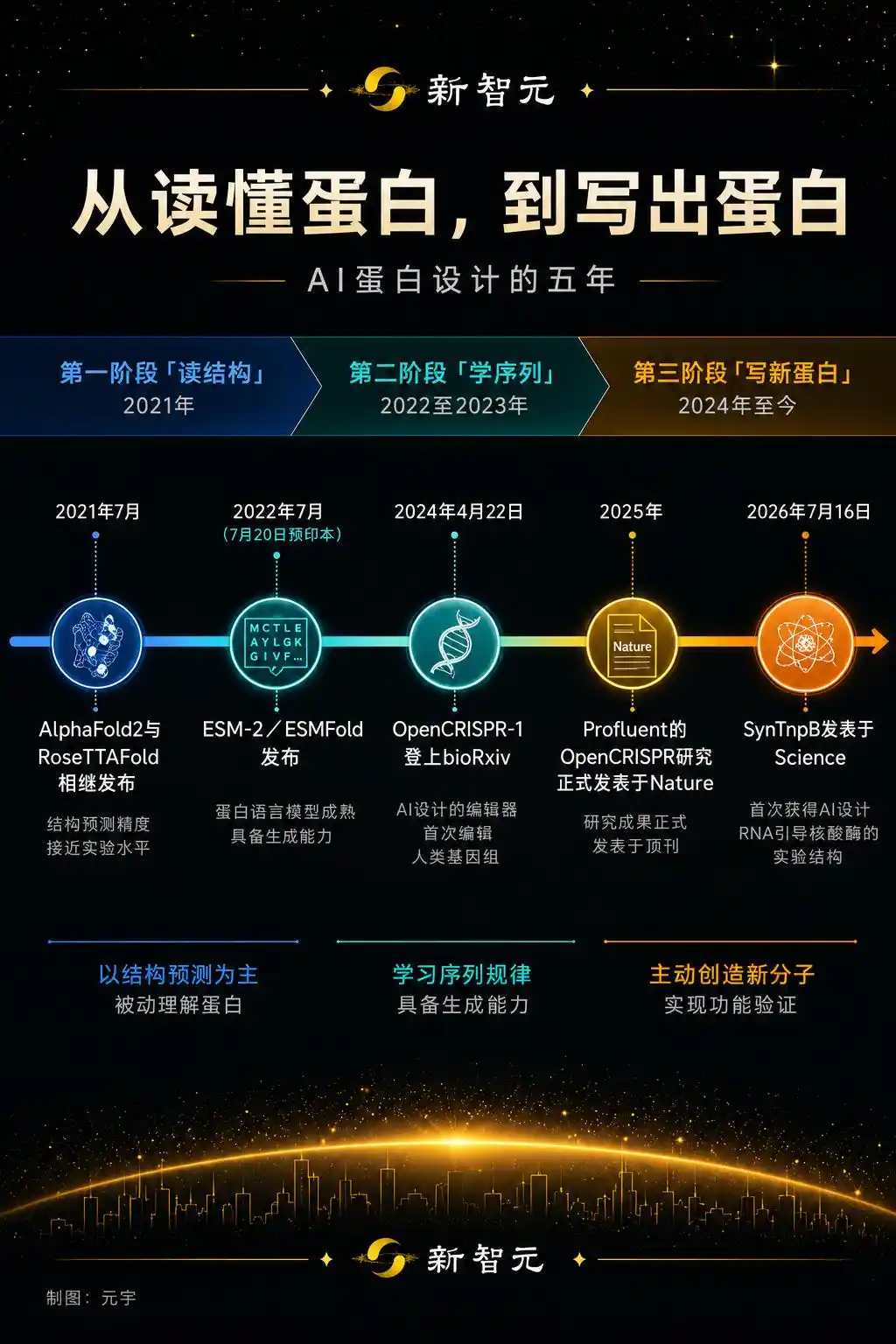
One significant meaning is that an AI-designed protein entered a more complex living system and successfully completed the entire gene-editing process.

Le Cong from Stanford University, who helped develop some of the earliest CRISPR tools for gene therapy, shares Doudna's view: basic research using natural nucleases must continue.

AI models can run so fast precisely because of the data painstakingly accumulated in labs over the past few decades. Cut off the data supply, and the models hit their limit.

Doudna says this work demonstrates the future form of AI and biology: we need AI tools to help us run faster, but to extract the maximum value from such models, we still need people who truly understand molecular mechanisms.

References:

https://x.com/Nature/status/2078829713942822983

https://www.nature.com/articles/d41586-026-02217-w

https://www.nature.com/articles/d41586-025-02135-3

https://press.airstreet.com/p/profluent-opencrispr-1-nature-magazine

https://www.iongenomics.bio/p/doudna-lab-uses-ai-to-create-new

This article is from WeChat public account "Xin Zhi Yuan", author: ASI启示录

Tiền kỹ thuật số thịnh hành

Câu hỏi Liên quan

QWhat is the main breakthrough described in the article regarding CRISPR technology?

AThe main breakthrough is that AI was used to design novel CRISPR enzymes, specifically TnpB and Cas9 variants, that do not exist in nature. These AI-generated enzymes demonstrated superior performance in gene editing, with higher on-target efficiency and significantly lower off-target effects compared to their natural counterparts.

QHow significant was the sequence alteration in the AI-designed TnpB enzyme, and why is this notable?

AThe AI-designed TnpB enzyme had approximately 30% of its amino acid sequence altered from the natural version. This is highly notable because previous AI-assisted protein engineering efforts typically achieved only 1-2% alterations. Maintaining functionality with such extensive changes was previously considered nearly impossible, demonstrating the power of the new AI approach.

QWhat were the key performance results of the AI-generated OpenCRISPR-1 Cas9 enzyme compared to the standard SpCas9?

AIn tests, the AI-generated OpenCRISPR-1 achieved a 55.7% on-target editing efficiency compared to SpCas9's 48.3%. More impressively, its off-target editing rate was 0.32%, which is about 95% lower than SpCas9's rate of 6.1%.

QWhat is the fundamental shift in scientific approach illustrated by this AI protein design work?

AThe work represents a shift from 'discovering nature' to 'creating nature.' Historically, biological tools like insulin and Cas9 were discovered by chance in nature. Now, AI enables a rational design approach: starting with a desired function and working backwards to design a molecule that performs it, exploring a vast sequence space that evolution took billions of years to navigate.

QAccording to the researchers, what is the crucial role of human expertise in this AI-driven protein design process?

AResearchers like Jennifer Doudna emphasize that while AI tools accelerate exploration, maximizing the value of these models still requires scientists who truly understand molecular mechanisms. The AI models are trained on decades of experimental data generated by traditional lab work. This foundational research must continue to feed and validate the AI systems.

Nội dung Liên quan

Điều tra thị phần toàn cầu: Doanh nghiệp Nhật Bản đứng đầu trong lĩnh vực vật liệu bán dẫn

Khảo sát thị phần toàn cầu cho thấy các doanh nghiệp Nhật Bản tiếp tục dẫn đầu trong lĩnh vực vật liệu bán dẫn vào năm 2025. Trong lĩnh vực wafer silicon, Shin-Etsu Chemical đứng đầu với 26,3% thị phần, tiếp theo là SUMCO với 17,8%. Ba công ty Nhật Bản, bao gồm Tokyo Ohka Kogyo, JSR và Shin-Etsu, chiếm ba vị trí dẫn đầu trong thị trường photoresist, với tổng thị phần đạt 60,5%. Tuy nhiên, sự hiện diện của Nhật Bản trong các lĩnh vực trọng tâm như bộ nhớ DRAM và GPU vẫn còn hạn chế. Trong khi đó, ngành công nghiệp ô tô - trụ cột khác của Nhật Bản - đang trì trệ, với Toyota chỉ tăng nhẹ thị phần lên 12,3% và không có doanh nghiệp Nhật nào lọt vào top 5 thị trường xe điện. Trong lĩnh vực đóng tàu, Imabari Shipbuilding tăng từ vị trí thứ 6 lên thứ 3 toàn cầu với thị phần 7,2%, nhờ hoàn thành các tàu container cỡ lớn. Chính phủ Nhật đặt mục tiêu tăng gần gấp đôi sản lượng đóng tàu vào năm 2035, yêu cầu đầu tư lớn và ứng dụng AI để giải quyết tình trạng thiếu lao động. Các chuyên gia nhận định, để duy trì vị thế trong ngành vật liệu bán dẫn, các công ty Nhật Bản cần mạnh dạn đầu tư quy mô lớn, tương tự như các đối thủ Hàn Quốc và Mỹ. Thị trường bán dẫn toàn cầu dự kiến tăng trưởng 90% vào năm 2026, đạt 1,5112 nghìn tỷ USD.

marsbit13 phút trước

Điều tra thị phần toàn cầu: Doanh nghiệp Nhật Bản đứng đầu trong lĩnh vực vật liệu bán dẫn

marsbit13 phút trước

Báo cáo tài chính đầu tiên sau khi STRC mất neo - Chiến lược Strategy sửa chữa bánh xe vốn như thế nào?

Ngày 31/7, công ty kho bạc Bitcoin Strategy đã công bố báo cáo tài chính quý II/2026, quý đầu tiên sau khi chứng khoán ưu tiên STRC của họ mất neo giá. Báo cáo cho thấy tổng doanh thu đạt 122 triệu USD (tăng 6.9%), nhưng công ty ghi nhận lỗ ròng 8,22 tỷ USD chủ yếu do biến động giá BTC. Dù vậy, chiến lược nắm giữ Bitcoin vẫn được duy trì, với kho dự trữ tăng lên 843.775 BTC (trị giá ~55 tỷ USD). Số Bitcoin trên mỗi cổ phiếu (Bitcoin Per Share) cũng tăng lên. Trọng tâm hiện tại của Strategy là khôi phục STRC về mệnh giá 100 USD. Ban lãnh đạo tuyên bố sẽ không phát hành STRC mới với giá chiết khấu và duy trì tỷ lệ cổ tức hàng năm ở mức 12%. Thay vào đó, họ tập trung vào việc tăng cường đệm tiền mặt (hiện ở mức 3,75 tỷ USD, đủ chi trả hơn 2 năm) và thực hiện chương trình mua lại 1 tỷ USD cho các chứng khoán STRC giao dịch dưới giá. Mục tiêu là đưa STRC trở lại vùng mệnh giá vào khoảng ngày 8/9. Báo cáo cũng đánh dấu sự chuyển đổi trong mô hình vốn của Strategy, từ vòng xoay một chiều "huy động vốn -> mua BTC" sang quản lý vốn chủ động linh hoạt. Họ hiện điều phối giữa 4 yếu tố cốt lõi: BTC (có thể linh hoạt bán ra), dự trữ tiền mặt USD, cổ phiếu phổ thông (MSTR) và công cụ tín dụng số (STRC, trái phiếu chuyển đổi). Cách tiếp cận mới này cho phép họ tối ưu hóa cơ cấu nợ và thực hiện các hoạt động mua lại/ phát hành dựa trên chênh lệch giá thị trường. Tương lai của Strategy phụ thuộc vào hai yếu tố then chốt: khả năng khôi phục STRC về mệnh giá trong ngắn hạn, và xu hướng giá Bitcoin trong dài hạn để củng cố niềm tin vào toàn bộ mô hình tăng trưởng của công ty.

marsbit57 phút trước

Báo cáo tài chính đầu tiên sau khi STRC mất neo - Chiến lược Strategy sửa chữa bánh xe vốn như thế nào?

marsbit57 phút trước

Báo cáo tài chính đầu tiên sau khi STRC mất neo, chiến lược sửa chữa bánh đà vốn như thế nào?

Ngày 31/7, công ty kho bạc Bitcoin Strategy đã công bố báo cáo tài chính quý 2 năm 2026. Báo cáo cho thấy doanh thu đạt 122 triệu USD, tăng 6.9%, nhưng công ty ghi nhận lỗ ròng 8.22 tỷ USD chủ yếu do biến động giá Bitcoin, với khoản lỗ chưa thực hiện từ tài sản kỹ thuật số lên tới 8.32 tỷ USD. Điểm quan trọng nhất là sau sự kiện STRC - công cụ huy động vốn chủ chốt - mất neo khỏi mệnh giá mục tiêu 100 USD từ tháng 5, Strategy đang chuyển đổi mô hình vốn từ việc tích lũy Bitcoin cố định sang quản lý vốn chủ động hơn. Đến cuối quý 2, công ty nắm giữ 843,775 BTC (trị giá ~55 tỷ USD), tăng khoảng 11% so với quý trước, và Bitcoin trên mỗi cổ phiếu cũng tăng lên. Nhiệm vụ cốt lõi hiện tại của Strategy là khôi phục STRC về mệnh giá. Ban lãnh đạo nhấn mạnh sẽ không phát hành STRC chiết khấu, duy trì tỷ lệ cổ tức hàng năm ở mức 12%, và tăng cường đệm tiền mặt (3.75 tỷ USD tính đến 26/7). Công ty đã triển khai kế hoạch mua lại chứng khoán tín dụng số và đặt mục tiêu đưa STRC về mệnh giá vào khoảng ngày 8/9. Báo cáo đánh dấu sự chuyển đổi từ "vòng quay vốn" một chiều (phát hành vốn -> mua BTC) sang quản lý vốn chủ động hai chiều. Strategy giờ đây có thể linh hoạt sử dụng bốn yếu tố cốt lõi: BTC, dự trữ tiền mặt USD, cổ phiếu phổ thông (MSTR) và tín dụng kỹ thuật số (STRC) để tối ưu hóa cấu trúc vốn, bao gồm chương trình biến hiện BTC (đã bán 218.4 triệu USD), mua lại nợ chuyển đổi và chứng khoán chiết khấu. Tương lai của Strategy phụ thuộc vào hai thách thức: khả năng khôi phục STRC về mệnh giá trong ngắn hạn và xu hướng giá Bitcoin trong dài hạn để củng cố lại logic tăng trưởng cơ bản.

Odaily星球日报1 giờ trước

Báo cáo tài chính đầu tiên sau khi STRC mất neo, chiến lược sửa chữa bánh đà vốn như thế nào?

Odaily星球日报1 giờ trước

AWS chiếm 60% tổng doanh thu, Amazon công bố Q2 không có điểm yếu

Ngày 30/7 (giờ Mỹ), Amazon công bố kết quả quý II với tổng doanh thu 200,6 tỷ USD, tăng trưởng so với cùng kỳ. Lợi nhuận ròng đạt 62,6 tỷ USD, một phần lớn đến từ khoản thu nhập 53,4 tỷ USD trước thuế từ khoản đầu tư vào công ty AI Anthropic, là mục phi hoạt động. Do đó, thước đo hoạt động chính cần xem xét là lợi nhuận hoạt động 27,5 tỷ USD. AWS (dịch vụ đám mây) tiếp tục là động lực lợi nhuận chính, đóng góp 60,5% tổng lợi nhuận hoạt động của tập đoàn. Doanh thu AWS tăng 36,8% so với cùng kỳ, và lợi nhuận hoạt động của bộ phận này tăng gần 2/3 lên 16,6 tỷ USD, đóng vai trò như bức tường chắn tài chính quan trọng. Mặc dù lợi nhuận hoạt động tăng, dòng tiền tự do (TTM) trong 12 tháng qua chuyển sang âm do đầu tư mạnh vào cơ sở hạ tầng (1.690 tỷ USD), chủ yếu cho các trung tâm dữ liệu và máy chủ phục vụ phát triển AI. Điều này cho thấy chiến lược đầu tư dài hạn của Amazon. Bên cạnh AWS, các nền tảng cốt lõi khác cũng tăng tốc: dịch vụ quảng cáo tăng 26,2%, dịch vụ người bán thứ ba và cửa hàng trực tuyến đều cải thiện tốc độ tăng trưởng, củng cố nền tảng bán lẻ. Báo cáo phản ánh một Amazon toàn diện: AWS dẫn đầu về lợi nhuận, trong khi các doanh nghiệp cốt lõi vững mạnh và các khoản đầu tư chiến lược vào AI được đẩy mạnh.

marsbit1 giờ trước

AWS chiếm 60% tổng doanh thu, Amazon công bố Q2 không có điểm yếu

marsbit1 giờ trước

Hai Quý Liên Tiếp Thua Lỗ, Coinbase Cần Phải Tìm Hướng Đi Mới Bên Cạnh Giao Dịch

Sàn giao dịch tiền mã hóa Mỹ Coinbase báo cáo quý II với doanh thu giảm xuống 1,22 tỷ USD và lỗ ròng theo GAAP là 359 triệu USD. Đây là quý thứ hai liên tiếp công ty chịu lỗ ròng. Dù doanh thu từ giao dịch giảm mạnh trong thị trường yếu, Coinbase lại tăng thị phần giao dịch tiền mã hóa lên kỷ lục 10,3% theo cách tính của công ty, cho thấy vị thế cạnh tranh được củng cố. Cấu trúc doanh thu đang thay đổi. Doanh thu từ giao dịch (599 triệu USD) và doanh thu đăng ký/dịch vụ (555 triệu USD) gần như ngang bằng. Trong đó, doanh thu từ stablecoin (chủ yếu USDC) lên tới 292 triệu USD, trở thành nguồn thu ổn định nhờ vào số dư USDC lớn được giữ trên nền tảng. Thanh khoản cũng dịch chuyển. Khối lượng giao dịch phái sinh duy trì ổn định (~1,03 nghìn tỷ USD) trong khi giao dịch spot giảm, cho thấy nhu cầu từ các nhà giao dịch chuyên nghiệp. Coinbase đang tập trung tích hợp các sản phẩm phái sinh để giữ chân thanh khoản. Khoản lỗ ròng GAAP chủ yếu do biến động giá trị đầu tư và chi phí cổ phiếu cho nhân viên. EBITDA điều chỉnh vẫn dương ở mức 208 triệu USD, phản ánh hoạt động kinh doanh cốt lõi vẫn tạo ra tiền mặt. Công ty cũng đang kiểm soát chi phí hiệu quả. Bài học chính: Coinbase đang cố gắng giảm sự phụ thuộc vào tính chu kỳ của thị trường giao dịch spot thông qua việc phát triển các nguồn doanh thu ổn định hơn từ stablecoin, dịch vụ đăng ký và phái sinh. Thành công trong tương lai sẽ phụ thuộc vào khả năng duy trì dòng chảy từ những "con sông" doanh thu mới này ngay cả khi thị trường ảm đạm.

marsbit1 giờ trước

Hai Quý Liên Tiếp Thua Lỗ, Coinbase Cần Phải Tìm Hướng Đi Mới Bên Cạnh Giao Dịch

marsbit1 giờ trước

Giao dịch

Giao ngay

Bài viết Nổi bật

Làm thế nào để Mua ONE

Chào mừng bạn đến với HTX.com! Chúng tôi đã làm cho mua Harmony (ONE) trở nên đơn giản và thuận tiện. Làm theo hướng dẫn từng bước của chúng tôi để bắt đầu hành trình tiền kỹ thuật số của bạn.Bước 1: Tạo Tài khoản HTX của BạnSử dụng email hoặc số điện thoại của bạn để đăng ký tài khoản miễn phí trên HTX. Trải nghiệm hành trình đăng ký không rắc rối và mở khóa tất cả tính năng. Nhận Tài khoản của tôiBước 2: Truy cập Mua Crypto và Chọn Phương thức Thanh toán của BạnThẻ Tín dụng/Ghi nợ: Sử dụng Visa hoặc Mastercard của bạn để mua Harmony (ONE) ngay lập tức.Số dư: Sử dụng tiền từ số dư tài khoản HTX của bạn để giao dịch liền mạch.Bên thứ ba: Chúng tôi đã thêm những phương thức thanh toán phổ biến như Google Pay và Apple Pay để nâng cao sự tiện lợi.P2P: Giao dịch trực tiếp với người dùng khác trên HTX.Thị trường mua bán phi tập trung (OTC): Chúng tôi cung cấp những dịch vụ được thiết kế riêng và tỷ giá hối đoái cạnh tranh cho nhà giao dịch.Bước 3: Lưu trữ Harmony (ONE) của BạnSau khi mua Harmony (ONE), lưu trữ trong tài khoản HTX của bạn. Ngoài ra, bạn có thể gửi đi nơi khác qua chuyển khoản blockchain hoặc sử dụng để giao dịch những tiền kỹ thuật số khác.Bước 4: Giao dịch Harmony (ONE)Giao dịch Harmony (ONE) dễ dàng trên thị trường giao ngay của HTX. Chỉ cần truy cập vào tài khoản của bạn, chọn cặp giao dịch, thực hiện giao dịch và theo dõi trong thời gian thực. Chúng tôi cung cấp trải nghiệm thân thiện với người dùng cho cả người mới bắt đầu và người giao dịch dày dạn kinh nghiệm.

Tổng lượt xem 636Xuất bản vào 2024.12.12Cập nhật vào 2026.06.02

Làm thế nào để Mua ONE

Thảo luận

Chào mừng đến với Cộng đồng HTX. Tại đây, bạn có thể được thông báo về những phát triển nền tảng mới nhất và có quyền truy cập vào thông tin chuyên sâu về thị trường. Ý kiến ​​của người dùng về giá của ONE (ONE) được trình bày dưới đây.

活动图片