Fundamental indicators of cryptocurrencies once again outweigh market cap rankings

cryptonews.ruXuất bản vào 2026-08-16Cập nhật gần nhất vào 2026-08-16

Tóm tắt

Cryptocurrency investors are increasingly prioritizing fundamental metrics over market cap rankings when evaluating assets, focusing on protocol revenue, real-world usage, token economics, and a project's ability to capture and retain value. Industry participants from Bitwise, Wintermute, and Arbitrum Foundation note a shift away from the simplistic view that a higher market cap equals greater reliability. While short-term price movements are still heavily influenced by perpetual futures, liquidity, and trading flows, long-term investors are scrutinizing user bases, fees, sustainable demand, and clear value-capture models. Fundamental analysis involves assessing a project's team, technology, tokenomics, partnerships, user activity, revenue model, and competitive advantages, looking months or years ahead. Technical analysis remains relevant for short-term trading. Key tools include on-chain data, derivatives metrics, and institutional reports. Market cap is no longer the primary benchmark. Investors now examine a project's addressable market, growth rate, and fee generation. Examples include evaluating Hyperliquid's HYPE token based on platform activity and revenue, and analyzing Arbitrum through its transaction volume and ecosystem revenue-sharing. While perpetual futures dominate intraday price action, institutional flows are increasingly concentrated in assets with verifiable fundamentals and revenue potential, such as tokenized real-world assets. Metrics like fee reven...

Fundamental indicators of cryptocurrencies are increasingly becoming the main filter for investors: they look at protocol revenue, real-world usage, token economics, and a project's ability to retain created value, not just its position in the market capitalization table.

Market participants from Bitwise, Wintermute, and Arbitrum Foundation note that cryptocurrency is gradually moving out of the stage where tokens were evaluated on the principle of 'the higher in the ranking, the more reliable.' In the short term, prices are still largely driven by perpetual futures, liquidity, and trading flows. But over months and years, investors are paying closer attention to whether a network has users, fees, sustainable demand, and a clear model for capturing value.
Key takeaways:

  • Investors are increasingly evaluating tokens based on the size of the potential market, actual adoption, and the project's ability to convert activity into value.
  • Capital managers who are just entering the crypto industry are not limiting themselves to CoinMarketCap rankings and are delving deeper into individual networks and applications.
  • Hyperliquid became one of the early examples of this approach: the $HYPE token is evaluated through platform activity, its revenues, and economic parameters.

What is fundamental analysis of cryptocurrencies

Fundamental analysis of cryptocurrencies, in simple terms, is an attempt to understand what makes a project valuable in the first place. An investor looks not only at the token price, but at users, fees, revenues, technology, tokenomics, and the network's ability to retain created value.

Technical analysis answers a different question: how the price behaves on the chart right now. It helps assess levels, liquidity, perpetual futures, funding rates, and trader behavior. Fundamental analysis is more suitable for evaluating a project over months and years, while technical analysis is for finding entry points and short-term trades.

Fundamental and technical analysis: a brief comparison

  • Criterion: What is studied. Fundamental analysis looks at the protocol's business logic, users, fees, and token economics. Technical analysis looks at the price chart, volumes, liquidity, and derivatives.
  • Criterion: Horizon. Fundamental analysis is more useful over a horizon of months and years. Technical analysis is more often used intraday and for short-term trades.
  • Criterion: Main question. Fundamental analysis asks why an asset should have value. Technical analysis asks where the price might go in the near future.

What to check before evaluating a token

  • Developer team: Experience, public presence, ability to deliver on promises and develop the product.
  • Technology and innovation: What problem the network or application solves and whether the project has a noticeable advantage.
  • Tokenomics: Issuance, token distribution, incentives for participants, and value accumulation mechanism.
  • Partnerships and integrations: Whether they help attract users, capital, and real-world use cases.
  • User activity: Transactions, paying users, fees, and audience retention.
  • Economic model: Whether there are revenues, demand, and a clear link between protocol activity and token value.
  • Competitors: How the project differs from other networks, exchanges, applications, or infrastructure solutions.
  • Roadmap and development plans: How realistic the plans are and whether they support the long-term growth of the ecosystem.

Tools and metrics for fundamental analysis

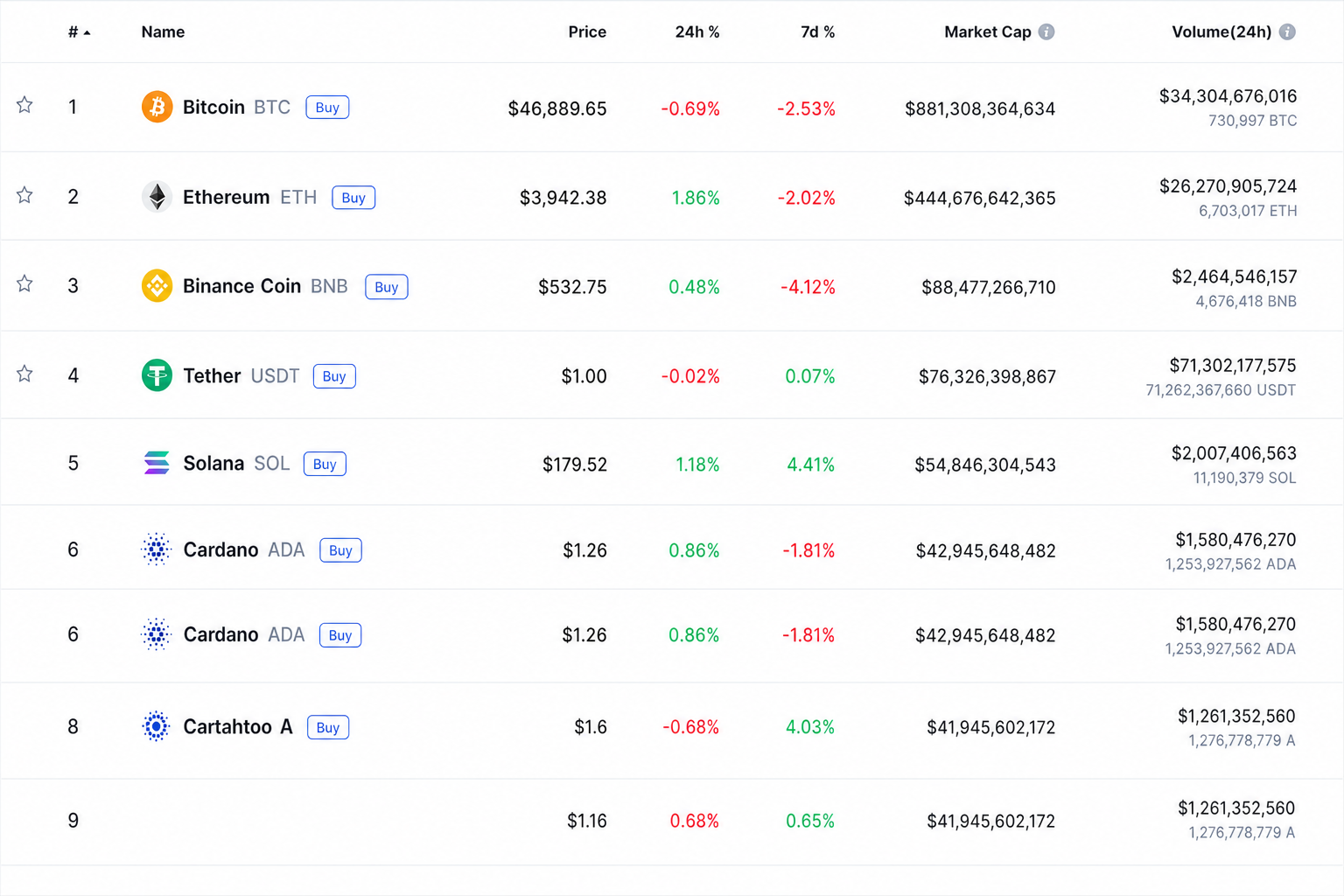
For fundamental analysis, investors use not one indicator, but a set of sources and metrics. The market capitalization ranking helps to quickly understand the scale of an asset, but by itself it no longer answers the question of how strong a project is.

  • Rankings and aggregators like CoinMarketCap help assess a token's place in the market and compare its capitalization with other assets.
  • On-chain data shows transactions, fees, user activity, and capital that remains within the network.
  • Reports and reviews from managers and market makers, including Bitwise and Wintermute, help to see institutional flows and changes in demand.
  • Data on derivatives, perpetual futures, funding rates, and liquidations help separate short-term price movements from the long-term value of a project.

Market capitalization is the token price multiplied by the number of tokens in circulation. This indicator is important because it helps compare the scale of projects, but it does not replace the analysis of revenues, users, tokenomics, and sustainability of demand.

When evaluating a team, it's worth looking at who develops the project, whether the participants have relevant experience, how they communicate with the community, and whether they fulfill stated plans. When evaluating tokenomics, token distribution, incentives, issuance, token demand, and whether part of the created value is returned to the ecosystem are important.

Government policy and regulation affect the market through rules for investor admission, requirements for exchanges and custodians, tax regime, as well as the approach to stablecoins, tokenized assets, and DeFi instruments. The clearer the rules, the easier it is for large allocators to work with digital assets; sharp uncertainty, on the contrary, increases risk and can put pressure on liquidity.

Why market cap ranking has ceased to be the main benchmark

Bitwise CEO Hunter Horsley describes what is happening as the end of the 'CoinMarketCap ranking' era. In previous market cycles, new layer-1 networks were often evaluated as a scaled-down version of the largest blockchains: if a project was lower on the list, a discount was automatically applied to it.

Now this template works less well. Fundamental analysis comes to the fore: what market a project can capture, how fast its user base is growing, what fees it collects, and how much of the created value remains within the ecosystem. Market capitalization remains a noticeable benchmark, but it no longer replaces a full-fledged evaluation of the protocol's business.

Horsley cites Hyperliquid as an example. When evaluating $HYPE, investors can look not at how similar it is to another blockchain network, but at the trading activity of the derivatives platform, its profitability, and internal economics. Over the past year, the token has risen by about 20%.

When we talk to capital managers at companies that have recently entered this sector, they often don't even know what position an asset occupies on CoinMarketCap. For them, it's just not the main thing, said Hunter Horsley.

Perpetual futures still move the price intraday

Wintermute OTC trader Jasper De Maer emphasizes: fundamental indicators and market flows are important, but they work on different timeframes. Intraday, the price is still often determined by perpetual futures, funding rates, trader positioning, and liquidations.

For most major tokens, the volume of perpetual futures remains several times higher than spot trading. Therefore, technical analysis, liquidity data, and the behavior of the derivatives market retain significance for short-term trades. But for longer-term investments, investors are increasingly returning to revenues, demand, and the quality of user activity.

According to De Maer, over the past 12-18 months, interest has noticeably shifted from pure infrastructure to applications and application-specific blockchains. Such projects are closer to the familiar logic of fintech and venture capital: they are easier to compare by clients, turnover, fees, and user retention.

Fundamental metrics become especially important in decentralized finance, on perpetual futures exchanges, and in decentralized physical infrastructure networks. Mining also falls into this category, where investors have long been accustomed to looking at the cost of production, revenue, and the sustainability of the model, not just the coin price.

Fundamental indicators form the lower boundary of valuation and help create a shortlist of assets, and then trading flows determine the specific price, noted Jasper De Maer.

He adds that revenues and real-world usage help understand which tokens will survive downturns and enter the portfolios of large allocators. But these indicators rarely determine where the price will go today.

Institutional flows are changing the market structure

Wintermute data shows that the main change is not so much a shift from spot to derivatives, but rather who exactly is trading. In the first half of 2026, institutional counterparties accounted for about 72% of the company's spot OTC flow. A year earlier, their share was approximately 59%.

These flows are concentrated in the largest cryptocurrencies and in a limited set of tokens that can generate income. De Maer calls tokenized real assets a separate new category. In this logic, a token is increasingly perceived not only as a speculative instrument, but also as an asset on the balance sheet, whose value must be based on verifiable cash flows or retained capital.

At the same time, De Maer warns: it is not always easy to understand where the market is truly rewarding strong fundamentals, and where it is simply following a fashionable narrative. Tokens with revenue attract attention precisely because the fundamental theme is currently in demand, and these two effects are difficult to separate.

The gap is also noticeable between the crypto assets themselves and public companies related to the industry. In the first half of the year, cryptocurrencies fell by 36%, while crypto company stocks rose by 23%, according to a Bitwise review. This does not mean that the stock as a financial instrument will continue to outperform tokens, but it shows that the securities market and the digital assets market can operate in different modes.

Which metrics do investors consider more reliable

Brendan Ma, Head of Investment Strategy at Arbitrum Foundation, says analysts have become better at understanding revenue structure, transactional activity, and value capture mechanisms compared to a year ago. In his opinion, the most convincing are metrics that require costs to create and are verifiable on the blockchain.

Ma includes fee revenue, users who actually pay fees, and capital remaining in the network as such indicators. These can be stablecoin balances and tokenized assets. Such data is harder to fake than a simple number of addresses or total value locked.

The number of addresses and the total value locked metric can be inflated by incentives or bots. Therefore, transaction growth becomes more important when accompanied by an increase in fees and user retention. In this sense, economics as a science helps to look at blockchain not as a price quote table, but as a system of incentives, demand, and value distribution.

Ma cites Arbitrum as an example of project-level analysis. Throughout its history, the network has processed over 2.7 billion transactions, of which more than 500 million occurred in 2026. According to the foundation, Robinhood Chain generates about $40 million in annual revenue. Under the expansion program, 10% of that network's net protocol revenue is returned to the Arbitrum ecosystem.

Which assets look stronger based on fundamentals

According to the logic of Hunter Horsley, Jasper De Maer, Brendan Ma, and Zach Pandl, assets that look stronger are not just the most prominent tokens, but those with real usage, revenues, capital within the network, and a clear model for capturing value.

  • Bitcoin remains a separate macro asset, demand for which is linked to the search for alternatives to fiat currencies.
  • Ethereum and projects beyond it will undergo stricter scrutiny of their economic model, users, and revenues.
  • $HYPE is evaluated through Hyperliquid's activity, platform profitability, and internal economics.
  • Arbitrum shows how investors can look at transactions, revenue of connected networks, and the return of part of the revenue to the ecosystem.

Bitcoin, Ethereum, and the new chapter of digital assets

Hunter Horsley believes that index products can give investors broad access to the crypto market without the need to pick individual winners. Such solutions are offered by Bitwise, as well as other asset managers, including 21Shares.

Grayscale's Head of Research, Zach Pandl, separates Bitcoin and the rest of the market. In his assessment, Bitcoin remains a macro asset, demand for which is linked to the search for alternatives to fiat currencies. Here, macroeconomics, inflation, and investor attitudes towards monetary policy are important.

Other cryptocurrencies, including Ethereum and projects beyond it, will undergo stricter scrutiny of their underlying economic model. Investors will look at whether the network has real users, sustainable revenues, and a clear logic for value accumulation. In traditional finance, financial reporting plays a similar role: it helps understand to what extent a security or business is backed by real results.

Pandl expects the sector's prospects to remain strong because stablecoins, tokenized assets, and decentralized finance instruments will support demand for digital assets beyond Bitcoin in the coming years.

A small number of tokens with a strong fundamental base will play a key role in the next stage of digital asset development. Weak projects with poor indicators will be left behind, said Zach Pandl.

The main conclusion for the market is simple: capital is increasingly less willing to pay just for a place in the ranking. As the industry matures, verifiable economics, real users, and a project's ability to convert activity into long-term value become more important for investors than a loud narrative.

end-content

Tiền kỹ thuật số thịnh hành

Câu hỏi Liên quan

QAccording to the article, why are fundamental indicators becoming more important than market cap rankings for cryptocurrency investors?

AFundamental indicators are becoming more important because investors are increasingly looking at a project's actual business metrics, such as protocol revenue, real usage, tokenomics, and its ability to capture and retain value, rather than just its position in a market cap ranking. Market cap alone no longer answers how strong a project truly is.

QWhat is the main difference between fundamental analysis and technical analysis in crypto, according to the article?

AThe main difference lies in their focus and time horizon. Fundamental analysis looks at the business logic of a protocol, its users, fees, and token economics to understand why an asset should have value, typically over months and years. Technical analysis examines price charts, volume, liquidity, and derivatives to predict short-term price movements, often used for intraday and short-term trading.

QWhat key metrics, as mentioned by Brendan Ma from Arbitrum Foundation, are considered more reliable for fundamental analysis and why?

AMetrics that require cost to create and are verifiable on-chain are considered more reliable. These include fee revenue, users who actually pay fees, and capital that stays within the network (like stablecoin balances and tokenized assets). These metrics are harder to fake compared to easily inflated ones like the number of addresses or total value locked (TVL).

QAccording to Jasper De Maer from Wintermute, what still drives intraday price movements in the crypto market?

AIntraday price movements are still largely driven by perpetual futures, funding rates, trader positioning, and liquidations. For most major tokens, the volume of perpetual futures trading remains several times higher than spot trading, making technical analysis and derivative market behavior significant for short-term trades.

QWhat shift in investor focus does Jasper De Maer note has occurred over the last 12-18 months?

AHe notes a noticeable shift in investor interest away from pure infrastructure projects towards applications and application-specific blockchains. These projects are closer to traditional fintech and venture capital logic, making them easier to compare based on customers, turnover, fees, and user retention.

Nội dung Liên quan

Không có DeFi, RWA vẫn có ý nghĩa không?

Bài viết thảo luận về mối quan hệ giữa Tài sản Thế giới Thực được mã hóa (RWA) và Tài chính Phi tập trung (DeFi), lập luận rằng việc mã hóa đơn thuần (tokenization) giống như "mã vạch trên container" – nó cung cấp danh tính nhưng không tạo ra toàn bộ hệ thống thị trường. Giá trị thực sự của RWA chỉ được mở khóa khi nó tích hợp được vào hệ sinh thái DeFi, nơi cung cấp tính thanh khoản, đòn bẩy, khả năng phòng ngừa rủi ro và các cơ chế thanh lý. Bài viết chỉ ra những thách thức chính khi kết hợp RWA với DeFi, bao gồm sự khác biệt về "đồng hồ thời gian" giữa thị trường truyền thống (đóng cửa theo giờ hành chính) và blockchain (hoạt động 24/7), sự thiếu hụt tính thanh khoản thực sự trong điều kiện thị trường căng thẳng, và những rủi ro phức tạp phát sinh từ mạng lưới các bên phụ thuộc (nhà phát hành, người giữ quỹ, oracle). Tác giả nhấn mạnh rằng đòn bẩy mới là yếu tố tạo ra tiện ích kinh tế chính, nhưng cũng làm lộ rõ điểm yếu. Do đó, các mô hình rủi ro cho RWA cần xem xét không chỉ biến động giá mà còn cả tính khả thi về mặt pháp lý, độ trễ khi mua lại và cấu trúc thị trường. Các tài sản như trái phiếu kho bạc mã hóa chỉ là bước khởi đầu; tiềm năng thực sự nằm ở các tài sản phức tạp hơn như năng lượng hoặc sức mạnh tính toán. Kết luận, bài viết cho rằng không có DeFi, RWA vẫn có ý nghĩa nhưng bị giới hạn. Tầm nhìn dài hạn không phải là "mã hóa mọi thứ", mà là xây dựng một "lớp vận hành" nơi RWA có thể trở thành một thành phần tài chính kiên cường, được quản lý rủi ro với tốc độ của thị trường. "Mã thông báo chỉ là mã vạch. Thị trường mới là cỗ máy thực sự vận hành."

marsbit20 phút trước

Không có DeFi, RWA vẫn có ý nghĩa không?

marsbit20 phút trước

Chính phủ can thiệp vào thị trường trái phiếu, điều đó thực sự có ý nghĩa gì

Chính phủ Mỹ can thiệp vào thị trường trái phiếu, điều này có ý nghĩa gì? Ngày 19/8, Bộ Tài chính Mỹ bất ngờ thông báo sẽ tăng gấp đôi quy mô mua lại trái phiếu dài hạn (từ 20 tỷ lên ít nhất 40 tỷ USD) từ ngày 9/9 đến 4/11, nhằm ứng phó tình trạng lợi suất trái phiếu dài hạn tăng vọt (lợi suất trái phiếu 30 năm chạm mức cao nhất kể từ 2007). Động thái này ngay lập tức giúp lợi suất giảm, thị trường chứng khoán và vàng phục hồi. Hoạt động mua lại trái phiếu là việc chính phủ mua lại các trái phiếu cũ, thanh khoản kém để duy trì sự vận hành trơn tru của thị trường, chứ không làm giảm tổng nợ công. Lý do chính khiến thị trường mất trật tự là do "cuộc đình công của người mua", bắt nguồn từ triển vọng tài khóa xấu đi (nợ công vượt 40 nghìn tỷ USD), áp lực lạm phát dai dẳng và cạnh tranh vốn toàn cầu gia tăng. Mặc dù biện pháp can thiệp chiến thuật này của Bộ trưởng Tài chính Scott Bessent (cựu quản lý quỹ phòng hộ) đã mang lại hiệu ứng tức thời, các chuyên gia cảnh báo nó không giải quyết được các nguyên nhân cơ cấu khiến lợi suất tăng cao. Nó chỉ hỗ trợ thanh khoản và gửi tín hiệu ổn định, chứ không thay đổi thực trạng thâm hụt ngân sách lớn hoặc thu hút lại nhu cầu từ các ngân hàng trung ương nước ngoài đang giảm dần. Đối với danh mục đầu tư, động thái này hỗ trợ tạm thời cho trái phiếu và quỹ ETF dài hạn, có lợi cho cổ phiếu tăng trưởng, và củng cố sự hấp dẫn của vàng như một nơi trú ẩn an toàn. Tuy nhiên, nó khó có thể giúp lãi suất thế chấp giảm đáng kể trong ngắn hạn. Các yếu tố then chốt cần theo dõi tiếp theo bao gồm dữ liệu việc làm, lạm phát, kết quả đấu giá trái phiếu, và liệu chính sách này có được gia hạn sau ngày 4/11 hay không.

marsbit23 phút trước

Chính phủ can thiệp vào thị trường trái phiếu, điều đó thực sự có ý nghĩa gì

marsbit23 phút trước

Sau "Phiếu bảo đảm Bessent", Mỹ còn cách việc khởi động lại QE bao xa?

**Tóm tắt: Kỳ vọng “Đáy Bessent” và câu hỏi về QE** Ngày 19/8, Bộ Tài chính Mỹ đột ngột tăng quy mô mua lại trái phiếu kho bạc dài hạn (10-30 năm) từ 2 lên 4 tỷ USD cho mỗi lần, bất chấp việc vừa công bố kế hoạch tái tài trợ hàng quý hai tuần trước đó. Động thái này được thực hiện khi lợi suất trái phiếu dài hạn (ví dụ 30 năm lên ~5,34%) đang ở mức cao kể từ 2007. Mặc dù 4 tỷ USD là nhỏ so với thị trường trái phiếu 30 nghìn tỷ USD, thời điểm công bố bất thường đã khiến thị trường suy đoán về ý định chính sách. Các nhà phân tích cho rằng đây là một tín hiệu cho thấy chính phủ Mỹ có thể không muốn để chi phí vay dài hạn tăng mất kiểm soát, gây áp lực lên chi tiêu tài khóa, chiến lược địa chính trị và hoạt động vay mượn của khu vực tư nhân. Khái niệm “Bessent Put” (Kỳ vọng Đáy Bessent) ra đời, phản ánh niềm tin rằng Bộ trưởng Tài chính Janet Yellen (thông qua Thứ trưởng phụ trách Thị trường Tài chính Josh Bessent) có thể chủ động hơn trong việc ổn định thị trường trái phiếu dài hạn. Tuy nhiên, việc mua lại này khác biệt cơ bản với Nới lỏng Định lượng (QE) của Fed. Đây là hoạt động quản lý nợ nhằm hỗ trợ thanh khoản, không phải mở rộng bảng cân đối của ngân hàng trung ương. Áp lực lên trái phiếu dài hạn xuất phát từ nhiều yếu tố cấu trúc: thâm hụt ngân sách và nguồn cung trái phiếu lớn, nhu cầu vay của doanh nghiệp cho cơ sở hạ tầng AI, và những lo ngại về khả năng các tổ chức Nhật Bản (chủ nợ lớn) có thể bán bớt trái phiếu Mỹ. Bài viết kết luận rằng động thái này chủ yếu thay đổi “hàm phản ứng chính sách” trong nhận định của thị trường, mở ra cuộc thảo luận về khả năng kiểm soát đường cong lợi suất (YCC) hoặc QE trong tương lai, nhưng điều đó chỉ xảy ra nếu điều kiện thị trường xấu đi đáng kể. Việc Mỹ có thực sự tiến gần đến QE hay không sẽ phụ thuộc vào diễn biến của lợi suất, phản ứng tiếp theo của Bộ Tài chính và sự phối hợp có thể có với Fed. Hiện tại, đây mới chỉ là một tín hiệu và một thử nghiệm ổn định thị trường ngắn hạn.

marsbit25 phút trước

Sau "Phiếu bảo đảm Bessent", Mỹ còn cách việc khởi động lại QE bao xa?

marsbit25 phút trước

Thanh toán xuyên biên giới có thực sự cần stablecoin?

Chuyển tiền xuyên biên giới có thực sự cần đến stablecoin không? Nhiều người cho rằng stablecoin lý tưởng cho chuyển tiền xuyên biên giới, đặc biệt khi người nhận muốn nhận stablecoin. Tuy nhiên, trong kịch bản chuyển đổi ngoại tệ (ví dụ: USD sang Peso Mexico), vấn đề phức tạp hơn. Hệ thống ngân hàng đại lý truyền thống sử dụng các ngân hàng trung gian và mạng lưới SWIFT, thường chậm (1-5 ngày) và đắt đỏ (chi phí ~15%), do nhiều trung gian và chênh lệch tỷ giá. Các công ty fintech hiện đại như Wise đã cách mạng hóa quy trình này bằng mô hình "đối ứng" (netting). Thay vì chuyển tiền thực tế xuyên biên giới, họ sử dụng quỹ địa phương ở cả hai quốc gia để thực hiện giao dịch, giúp chuyển tiền gần như ngay lập tức với chi phí thấp (ví dụ: Wise có tỷ lệ phí hỗn hợp khoảng 0.52%). Vậy stablecoin giải quyết vấn đề gì? Mô hình "sandwich" stablecoin (Ví dụ: USD -> USDC -> chuyển blockchain -> USDC -> Peso) tự thân không nhất thiết nhanh hơn hoặc rẻ hơn đáng kể so với các giải pháp fintech hàng đầu, đặc biệt khi tính cả phí chuyển đổi vào/ra (on/off-ramp). Giá trị thực sự của stablecoin nằm ở việc *giải phóng cạnh tranh thị trường*. Nó tách rời (decouple) các phần của quy trình chuyển tiền, biến một mạng lưới độc quyền, tích hợp dọc thành một thị trường mở. Các nhà cung cấp dịch vụ địa phương có thể cạnh tranh riêng lẻ ở khâu gửi tiền (on-ramp) hoặc đặc biệt là khâu rút tiền (off-ramp), từ đó giảm chi phí tổng thể. Lợi thế này rõ rệt nhất trên các hành lang chuyển tiền thị trường ngách (ví dụ: Mỹ sang châu Phi), nơi các công ty fintech lớn có thể không tập trung phục vụ. Bản chất mở của blockchain khiến một công ty khó độc quyền toàn bộ chuỗi giá trị. Sự cạnh tranh này cuối cùng có thể dẫn đến chi phí chuyển tiền thấp hơn cho người dùng và doanh nghiệp so với cả mô hình ngân hàng đại lý lẫn mô hình fintech truyền thống.

marsbit29 phút trước

Thanh toán xuyên biên giới có thực sự cần stablecoin?

marsbit29 phút trước

Ethereum cuối cùng đã 'hồi máu'! ETH vượt qua đường vàng trở lại, đợt phục hồi này có gì khác biệt?

Sau hơn ba tháng, giá Ethereum (ETH) đã vượt mốc 2.300 USD, phục hồi về mức của đầu tháng 5. Đợt tăng giá khoảng 25% trong một tuần này mạnh hơn Bitcoin, giúp ETH/BTC phá vỡ xu hướng giảm dài hạn. Giá tăng được thúc đẩy bởi tâm lý thị trường lạc quan hơn, kỳ vọng cải thiện quy định và việc bán tháo vị thế short. Về mặt kỹ thuật, ETH lần đầu tiên kể từ đầu chu kỳ bear market vượt lên trên đường "golden line" (EMA50 tuần), được coi là một tín hiệu quan trọng. Đồng thời, hơn 13 tỷ USD vị thế phái sinh ETH đã bị thanh lý, chủ yếu là các lệnh short. Mặt khác, quỹ ETF spot Ethereum liên tục ghi nhận dòng tiền ròng mạnh trong 4 phiên giao dịch gần đây, với mức流入 ròng một ngày cao nhất kể từ tháng 10 năm ngoái. Hiệu suất dòng tiền của ETF ETH trong tháng 7 vượt trội hơn hẳn so với ETF Bitcoin. Nhiều tổ chức tài chính lớn như Morgan Stanley, JPMorgan cũng tăng mạnh tỷ lệ nắm giữ ETH so với BTC trong quý II. Về cơ bản, lượng ETH được stake đã đạt mức cao kỷ lục, với hơn 41,1 triệu ETH (khoảng 33,7% tổng cung) đang bị khóa. Hàng đợi stake vẫn còn dài, trong khi số lượng ví nhỏ (1-10 ETH) đang tăng lên, cho thấy sự quan tâm của nhà đầu tư cá nhân. Tuy nhiên, lợi suất stake đang giảm dần và có đề xuất gây tranh cãi về việc cắt giảm phần thưởng phát hành mới khi tỷ lệ stake đạt 50%. Nhìn chung, đợt phục hồi của ETH nhận được sự hỗ trợ từ nhiều yếu tố: kỹ thuật, dòng tiền thể chế và các chỉ số on-chain. Tuy nhiên, liệu đây có phải sự bật lại bền vững hay không vẫn cần thời gian và các động lực cơ bản mới như ứng dụng token hóa và AI để xác nhận.

marsbit29 phút trước

Ethereum cuối cùng đã 'hồi máu'! ETH vượt qua đường vàng trở lại, đợt phục hồi này có gì khác biệt?

marsbit29 phút trước

Giao dịch

Giao ngay

Bài viết Nổi bật

Làm thế nào để Mua CAP

Chào mừng bạn đến với HTX.com! Chúng tôi đã làm cho mua Cap (CAP) trở nên đơn giản và thuận tiện. Làm theo hướng dẫn từng bước của chúng tôi để bắt đầu hành trình tiền kỹ thuật số của bạn.Bước 1: Tạo Tài khoản HTX của BạnSử dụng email hoặc số điện thoại của bạn để đăng ký tài khoản miễn phí trên HTX. Trải nghiệm hành trình đăng ký không rắc rối và mở khóa tất cả tính năng. Nhận Tài khoản của tôiBước 2: Truy cập Mua Crypto và Chọn Phương thức Thanh toán của BạnThẻ Tín dụng/Ghi nợ: Sử dụng Visa hoặc Mastercard của bạn để mua Cap (CAP) ngay lập tức.Số dư: Sử dụng tiền từ số dư tài khoản HTX của bạn để giao dịch liền mạch.Bên thứ ba: Chúng tôi đã thêm những phương thức thanh toán phổ biến như Google Pay và Apple Pay để nâng cao sự tiện lợi.P2P: Giao dịch trực tiếp với người dùng khác trên HTX.Thị trường mua bán phi tập trung (OTC): Chúng tôi cung cấp những dịch vụ được thiết kế riêng và tỷ giá hối đoái cạnh tranh cho nhà giao dịch.Bước 3: Lưu trữ Cap (CAP) của BạnSau khi mua Cap (CAP), lưu trữ trong tài khoản HTX của bạn. Ngoài ra, bạn có thể gửi đi nơi khác qua chuyển khoản blockchain hoặc sử dụng để giao dịch những tiền kỹ thuật số khác.Bước 4: Giao dịch Cap (CAP)Giao dịch Cap (CAP) dễ dàng trên thị trường giao ngay của HTX. Chỉ cần truy cập vào tài khoản của bạn, chọn cặp giao dịch, thực hiện giao dịch và theo dõi trong thời gian thực. Chúng tôi cung cấp trải nghiệm thân thiện với người dùng cho cả người mới bắt đầu và người giao dịch dày dạn kinh nghiệm.

Tổng lượt xem 716Xuất bản vào 2026.06.26Cập nhật vào 2026.06.26

Làm thế nào để Mua CAP

Thảo luận

Chào mừng đến với Cộng đồng HTX. Tại đây, bạn có thể được thông báo về những phát triển nền tảng mới nhất và có quyền truy cập vào thông tin chuyên sâu về thị trường. Ý kiến ​​của người dùng về giá của CAP (CAP) được trình bày dưới đây.

活动图片