# Hyperliquid Related Articles

HTX News Center provides the latest articles and in-depth analysis on "Hyperliquid", covering market trends, project updates, tech developments, and regulatory policies in the crypto industry.

Revenue Becomes This Year's Hardest Crypto Narrative

The article argues that "revenue" is becoming crypto's most durable narrative in 2026, as the industry matures and institutional allocators shift from speculation toward sustainable business models. Crypto protocols generated $11.68B year-to-date, on pace for ~$13.9B by year-end—only slightly below 2025 despite a much weaker market. The author contends the real opportunity lies not just in profitable protocols but in those with mechanisms converting business success into tokenholder value, primarily token buybacks backed by real revenue. Four criteria define a "good" buyback: revenue-funded, established product-market fit, transparent execution, and sustainable capital allocation. Context matters: Jupiter's $70M+ buyback failed amid a Solana-wide downturn, and buybacks can be swamped by new token emissions. Still, 2026 data is compelling—among the 16 top-revenue protocols with tradeable tokens, the 12 with active buybacks averaged +62.2% YTD (median +32.6%) versus −31.6% for those without, a 93.8-point gap, achieved despite crypto's total market cap falling ~19%. Buyback tokens also outperformed direct revenue-distribution tokens (190% vs 29% market-cap-weighted). The author highlights opportunities in stablecoins/RWA lending, World Liberty Financial's USD1 buyback linking stablecoin economics to WLFI, Venice's AI platform ($100M+ annualized revenue, VVV up 1,200%), Bittensor subnets using revenue for alpha-token buybacks, and Robinhood Chain's LONG 500 model combining buybacks with tokenized stock accumulation. The piece concludes the revenue narrative is still early, and in a true bull market, revenue-funded buybacks could act as accelerant rather than life raft.

marsbit3h ago

Revenue Becomes This Year's Hardest Crypto Narrative

marsbit3h ago

Podcast Notes | Wall Street Macro Veteran Jordi Visser: When Believers Give Up on Crypto, It's the Night Before the Biggest Rally

In a Convergence podcast interview, macro investor Jordi Visser argues that the current wave of capitulation among crypto believers mirrors the post-dot-com "death by a thousand cuts" period from 2003–2007—just before the iPhone era—while traditional finance billionaires quietly begin asking serious questions about tokenization and Hyperliquid. He cites Bitcoin's rare 7-sigma reversal off the 200-day moving average amid a barrage of bad news as evidence that sellers are exhausted, reiterating that "price leads narrative." Visser contends the liquidity-driven bull market is over: with Bitcoin near $2 trillion against $900 trillion in global wealth, the next leg must come from trust-based migration of dormant assets onto chains, not 5% annual liquidity growth. Using his "ghost cities" analogy from China, he argues crypto's built-out infrastructure has awaited its true residents—AI agents operating 24/7 with stablecoins—who will finally activate the machine economy. He dismisses the Fed and oil as obsolete macro variables, noting equities have shrugged off $100 oil and 5% Treasury yields, because AI-driven productivity is powerfully deflationary and rate-insensitive. Value will be taxed up the stack: Stripe, Arbitrum-based Robinhood Chain, Ethereum, and Solana capturing fees as agent-to-agent stablecoin transactions explode. Visser sees Robinhood and Hyperliquid merging old and new finance through tokenized equities and weekend price discovery, with private credit and real estate tokenization as the next frontier. Finally, he argues AI's democratization will compress mega-cap valuations while spawning millions of micro AI-native businesses, pushing growth premiums from the $70 trillion US equity market toward crypto's under-$4 trillion ecosystem.

marsbit2 days ago 16:57

Podcast Notes | Wall Street Macro Veteran Jordi Visser: When Believers Give Up on Crypto, It's the Night Before the Biggest Rally

marsbit2 days ago 16:57

Hyperliquid Strategies seeks futures registration for perps

Hyperliquid Strategies, a Nasdaq-listed HYPE treasury company, announced that its subsidiary has applied to become a futures commission merchant (FCM) in a bid to bring Hyperliquid-based perpetual futures to the US. CEO David Schamis said owning HYPE captures economics tied to the Hyperliquid protocol, while setting up an FCM is intended to help bring markets deployed on Hyperliquid onshore. Hyperliquid's HIP-3 framework lets independent operators launch custom perpetual futures markets by staking 500,000 HYPE ($38.8 million), with proposed features allowing permissioned markets restricted to approved addresses. The subsidiary would handle US customer accounts for such permissioned markets; both the FCM application and the proposed markets require regulatory approval. Separately, Intercontinental Exchange, parent of the NYSE, announced an agreement with Trade[XYZ] on Oct. 29 to bring Hyperliquid-based perpetual markets to the US, subject to approvals, and plans a dedicated market and clearing structure. During the quarter, Hyperliquid Strategies raised $911 million in equity capital, spent $785 million to acquire 9.1 million HYPE and $17 million to repurchase 2.7 million PURR shares, holding 38.5 million HYPE as of Sept. 30, valued at $3.5 billion at the time. Schamis said Hyperliquid is winning the parts of onchain finance that generate real fees, with nearly all that value flowing back to HYPE holders through programmatic buybacks. Hyperliquid Strategies' shares fell 9.6% Thursday, closing at $8.76.

cointelegraph11/06 16:51

Hyperliquid Strategies seeks futures registration for perps

cointelegraph11/06 16:51

No Need to Guess Direction: What New Strategies Does Paragon's Power Perps Bring to Volatility Trading?

The article discusses Power Perps, a new product from HIP-3 platform Paragon launching on Hyperliquid, starting with HYPE2. It lets traders get option-like payoff curves using perpetual contracts, without strikes or expiries—traders simply trade a perpetual that tracks the square of HYPE's price. The key concept is convexity. A normal perp has linear payoffs, while a squared perp's return equals 2r + r², giving roughly 2x upside plus a non-negative squared term—so longs earn more when price rises and lose less when it falls, with the effect growing with price moves. This convexity is what option buyers typically pay for. The idea builds on Paradigm's Everlasting Options and Power Perpetuals research, and Opyn's Squeeth; Paragon brings it to Hyperliquid's order book, also consolidating liquidity that is otherwise fragmented across strikes and expiries. The cost of this benefit is funding. A squared long hedged with two units of linear short yields a profit equal to the squared deviation from entry price divided by 100. Absent funding, this would be free arbitrage, so no-arbitrage requires longs to pay funding tied to variance (squared volatility) to shorts, plus order book premium/discount effects. On liquidation: a fully collateralized squared long gets ~2x initial sensitivity without being liquidated by price declines alone, but leverage changes this quickly—a 2x HYPE2 long liquidates around a 22.5% drop, and 3x around 10.6%. Squared shorts are riskier, since losses accelerate as price rises. For volatility trading, combining a squared long with a linear short creates a straddle-like payoff profiting from large moves in either direction, while the reverse (squared short plus linear long) shorts volatility and earns funding if price stays near entry—though without expiry, funding costs accumulate indefinitely. Power Perps cannot replicate all option strategies (strangles, spreads, covered calls need strikes and expiries); adjusting position ratios only approximates such structures over limited ranges. The broader trend: HIP-3 exchanges are moving from listing hot traditional assets to inventing new derivative forms, with Hyperliquid providing order books, markets and margin while Paragon designs new payoff curves.

marsbit11/05 12:41

No Need to Guess Direction: What New Strategies Does Paragon's Power Perps Bring to Volatility Trading?

marsbit11/05 12:41

Historic U.S. Approval of Stock Perpetual Futures Leaves Wall Street Giants Rattled

The CFTC, under Chairman Michael S. Selig, has approved equity perpetual futures tied to individual U.S. stocks for trading on regulated U.S. exchanges—a historic move bringing a crypto-native product into traditional markets. These contracts are classified as security futures products under the CFMA and jointly regulated by the CFTC and SEC. Only four platforms have completed the full application process: Kalshi, Coinbase Derivatives, Kraken's Bitnomial, and Crypto.com's Nadex/OG.com. They plan to offer contracts on major stocks like Apple, Nvidia, and Tesla with roughly 6.5–6.7x leverage, near-24/5 trading, and daily or hourly funding rates. Decentralized perp DEXs Lighter and Hyperliquid are also pursuing compliance paths, with Lighter planning to apply for DCM and DCO licenses and Hyperliquid exploring a regulated market through a partnership with ICE's TradeXYZ. Wall Street reacted swiftly: the Capital Markets Alliance—backed by Cboe, Citadel Securities, and others—sued in federal court to overturn the approval, arguing perpetual contracts lack expiration dates and are legally securities-based swaps under SEC jurisdiction, and that the CFTC violated the Administrative Procedure Act. SIFMA and Nasdaq also oppose the move, warning of thin overnight liquidity, manipulation risk, and retail losses. Traditional players fear losing order flow from 0DTE options and stock options. The next 60 days will determine whether the approval stands and whether crypto-native platforms can enter regulated U.S. equity derivatives.

marsbit11/04 10:21

Historic U.S. Approval of Stock Perpetual Futures Leaves Wall Street Giants Rattled

marsbit11/04 10:21

NYSE Parent Company to Build On-Chain Exchange on Hyperliquid: Is Wall Street's 25-Year 'Matching Engine Moat' Crumbling?

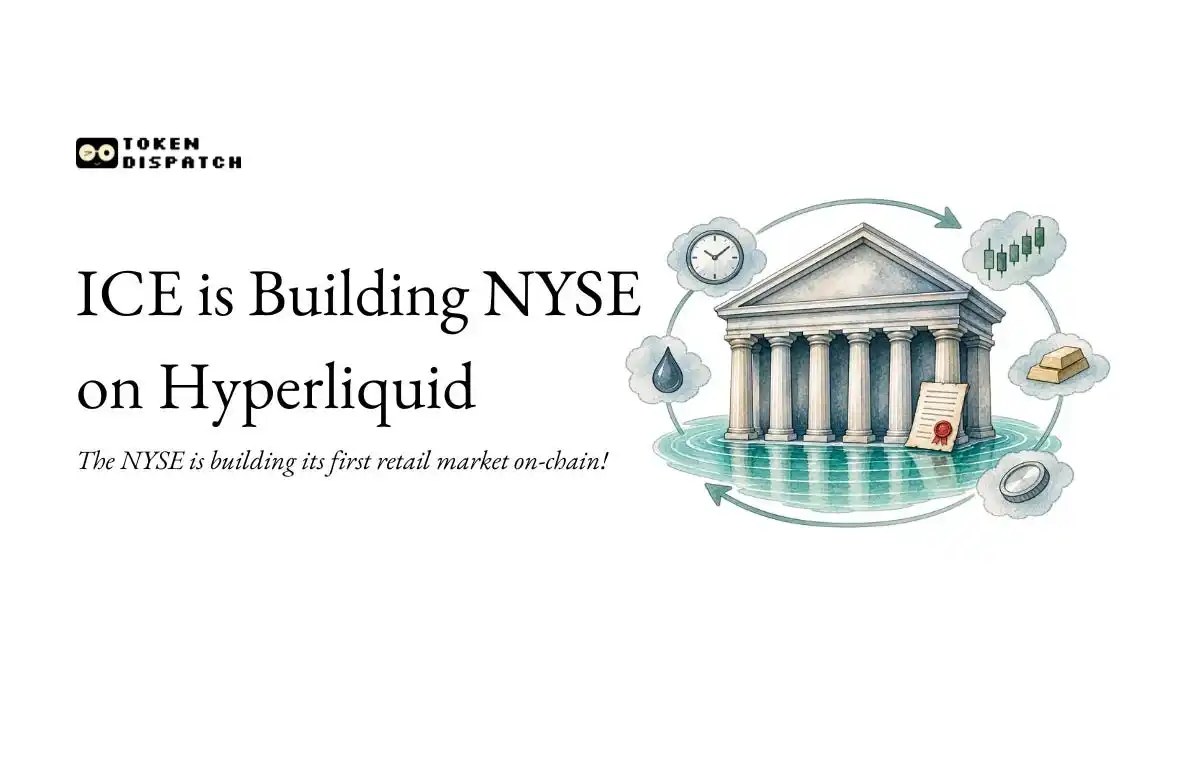
The article discusses ICE, the parent company of the NYSE, partnering with Hyperliquid to build an on-chain exchange. The author argues most observers are misreading the significance, focusing on HYPE token prices rather than the structural implications. For 25 years, traditional exchanges claimed proprietary matching engines were their moat. ICE's move effectively admits the real core assets are regulatory access and clearing guarantees, not matching code. The piece traces how exchanges like CME survived competition from superior technology (e.g., Eurex) because capital and clearing relationships, not software, drove lock-in. It compares exchanges to McDonald's, which profits from land and franchising rather than making burgers—Jeff Sprecher of ICE understood this when buying NYSE for its data business. The real disruptive force is perpetual swaps, which eliminate the rollover fees and expiry friction that underpin traditional futures exchanges' high margins and 30x P/E valuations. With perps trading $90 trillion annually, ICE chose to adopt the technology by outsourcing to a decentralized protocol rather than rebuilding it. This makes ICE effectively an application atop someone else's blockchain, echoing "fat protocol" theory where value accrues to the protocol layer. The author notes perps are a universal primitive—via Taylor series, they can synthesize virtually any financial instrument, including stablecoins, leveraged futures, and rate swaps. ICE's integration connects it to a potential universal settlement backbone. CME is flagged as most at risk since its profits rely on expiry friction. While Sprecher's tactical move is smart for a five-year horizon, the author bets it loses over fifteen years, as traditional finance's migration onto open crypto protocols becomes irreversible and exchange valuations face permanent downward revision.

marsbit11/03 11:13

NYSE Parent Company to Build On-Chain Exchange on Hyperliquid: Is Wall Street's 25-Year 'Matching Engine Moat' Crumbling?

marsbit11/03 11:13

The token issuance game is already broken: in the future, only two paths will survive for tokens

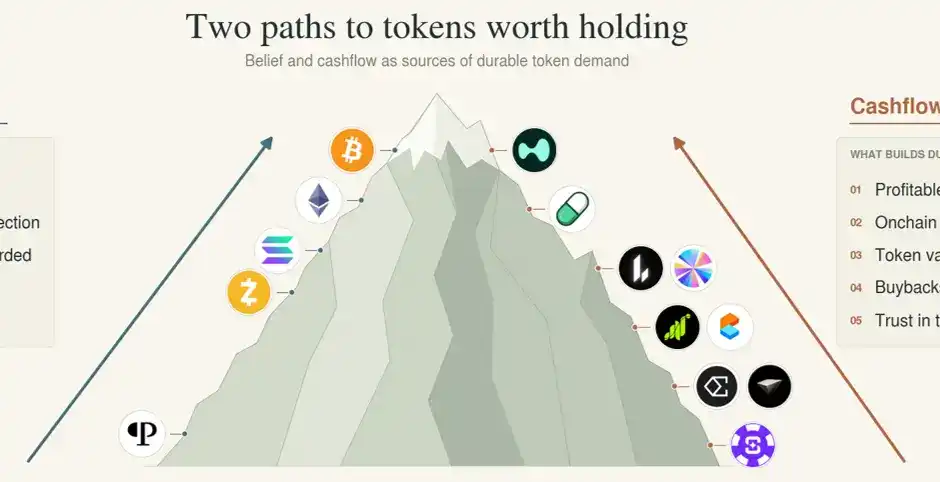
The token issuance game has been completely figured out. Pump.fun-style pump-and-dump factories are now highly automated, every launch is bot-bundled, and KOLs have mastered the art of secretly dumping through side wallets. Average token holding periods are now measured in seconds. The industry has become extremely efficient at creating new tokens, but creating an asset worth holding for over a year has never been harder. The author proposes a "two-peak endgame model" for tokens that can survive cycles and build real demand, with two distinct paths: **Faith assets (left peak):** Assets with no underlying cash flow whose value derives purely from collective belief. Durable faith assets share five traits: (1) a sacred figurehead/leader (Satoshi, Vitalik, Anatoly, Jeff); (2) a near-death experience survived (Mt. Gox, The DAO, FTX, JellyJelly); (3) early believers made rich (price appreciation is the best BD); (4) a fanatical community with insider symbols and memes ("laser eyes," ".eth," "◎," ".hl"); (5) a simple, resonant slogan ("digital gold," "world computer," "house of all finance"). ZEC recently approached these standards. These traits cannot be industrially faked. **Cash-flow assets (right peak):** Assets with verifiable real economic surplus. Five key questions: (1) Is there durable economic surplus/profit? (HYPE, PUMP earn $1–2M daily); (2) Is revenue transparently verifiable on-chain? (HYPE/PUMP yes; GRASS is off-chain); (3) Does value accrue to the token or is it siphoned by an equity entity? (SHFL is the cautionary tale—$18M dividends to a Cayman entity while token holders get lottery tickets); (4) Is value captured via enforced buybacks/dividends rather than discretionary ones? (HYPE, LIT, SKY are contract-enforced; PUMP is discretionary); (5) If dividends are deferred for growth, is the team trustworthy? (GRASS, ENA, CHIP, CARDS—similar to venture investing, with no legal protection for holders). Only HYPE, LIT, PUMP, and SKY currently satisfy all five criteria. PAPER was a promising attempt but was abandoned due to an exploit. The cash-flow token sector is on the eve of massive transformation—a Polymarket token distributing ~$20M monthly profit would be enormous. The author is watching new perp DEX tokens like VAR and XTEN, plus ARCUS, ENTROPY, and a potential POLYMARKET token. **Conclusion:** Only two narrow paths lead to lasting tokens. BTC, ZEC, and early HYPE climbed the faith mountain; HYPE, LIT, and PUMP are climbing the cash-flow mountain. HYPE offers the best holding experience, combining high-certainty cash flow with the potential to become a durable faith asset. Most other tokens—over-supplied L1s, legacy DeFi tokens with no real revenue, and shallow AI narrative coins—will inevitably fall into the abyss.

marsbit11/02 09:41

The token issuance game is already broken: in the future, only two paths will survive for tokens

marsbit11/02 09:41

活动图片