Worldcoin hits 6-month low: Will $0.20 be WLD’s next support level?

ambcryptoОпубликовано 2026-03-28Обновлено 2026-03-28

Введение

Worldcoin (WLD) has extended its bearish trend, falling 9.03% to a six-month low of $0.2701 and breaching the $0.30 support level. The decline was accompanied by significant capital outflows, with its market cap dropping to $876 million and over $4.26 million in long positions being liquidated. Adding to the selling pressure, the Worldcoin team transferred 89.65 million WLD (worth $26.17 million) to a new wallet and then to multiple centralized exchanges, a move that often signals potential token sales or liquidity provision. Market data shows strong dominance by sellers, with sell volume exceeding buy volume on Binance and futures netflow turning negative at -$18.98 million, indicating aggressive exits. Technical indicators, including the RSI nearing a bearish crossover, suggest further downside risk. A drop to the $0.20 support level appears likely unless WLD can reclaim and hold above the $0.30 resistance.

Worldcoin [WLD] has traded within a strong downtrend since it fell below $1. In fact, the altcoin has closed at lower lows since January, reflecting strong bearish pressure.

Worldcoin extended its bearish streak, breaching the $0.3 support and dropping to a 6-month low of $0.2701. At press time, WLD traded at $0.282, down 9.03% on the daily charts.

Over the same period, the altcoin’s market cap dropped from $1 billion to $876 million, indicating massive capital outflows. Following this market slip, liquidation levels soared with over $4.26 million in long positions liquidated, further stretching the downtrend.

Amid this market weakness, the Worldcoin team has moved significant funds into exchanges.

WLD team moves 89.65M tokens

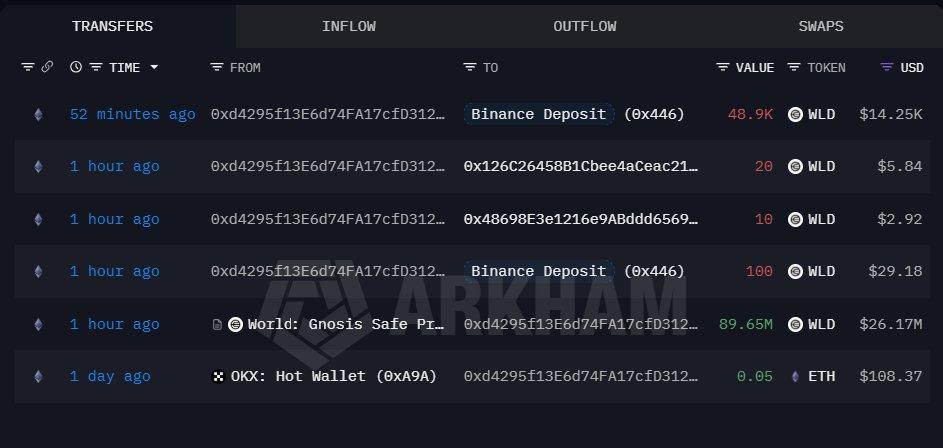
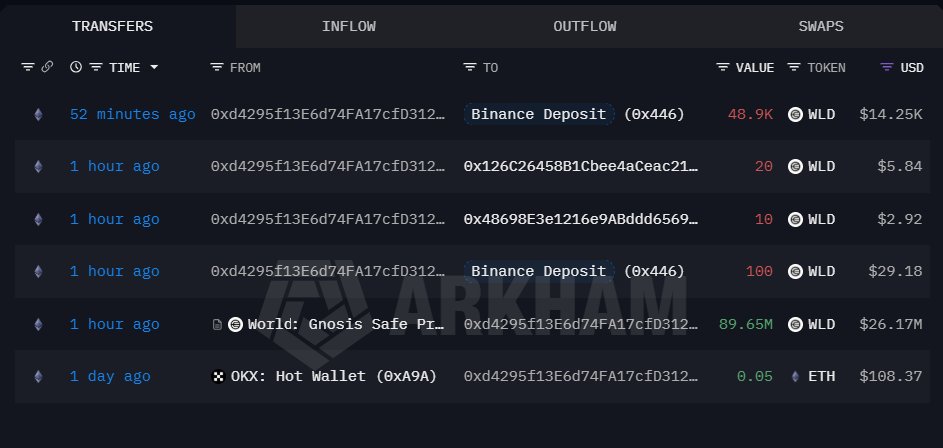
Onchain Lens reported that the WorldCoin Team sent 89.65 million WLD, worth $26.17 million, to a new wallet. After the transfer, the team later began sending funds to multiple centralized exchanges (CEXs).

Source: Onchain Lens

When a team’s wallet makes such transfers, it could mean two important things. Firstly, moving funds to exchanges could mean that tokens are being prepared for sale.

Usually, this move is inflationary, causing short-term bearish pressure and leading to a price decline. However, sometimes teams move funds to exchanges to provide liquidity, supporting market stability by avoiding higher slippage.

Although less bearish, it could also create downside pressure if the demand is weak. Combined, either move could result in bearish pressure, leading to lower prices.

WLD faces strong bearish pressure

In addition to the team’s token transfers, Worldcoin has faced significant pressure from other market participants.

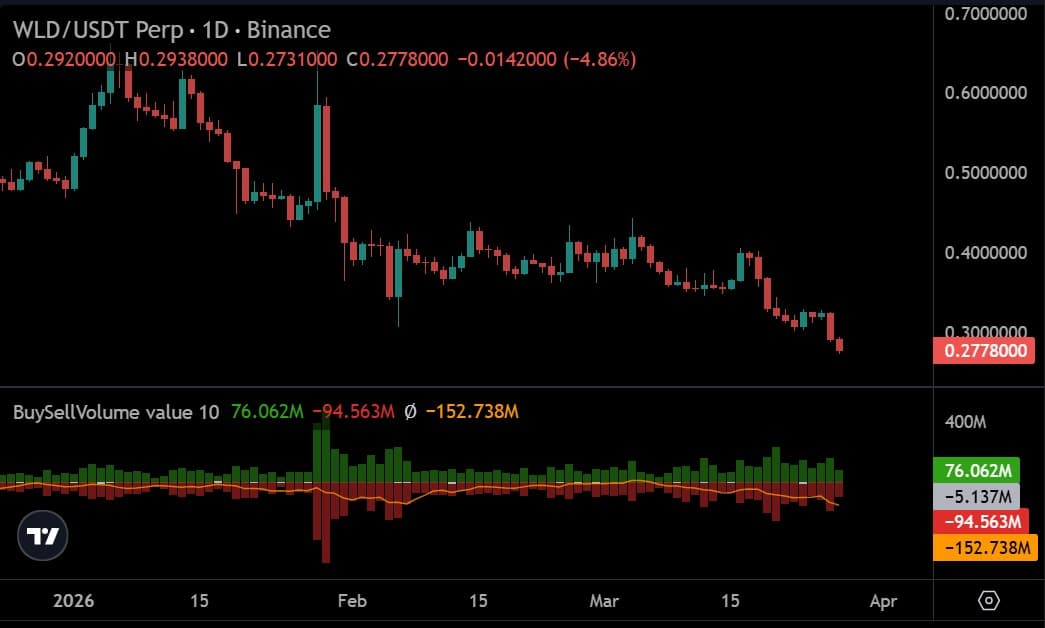
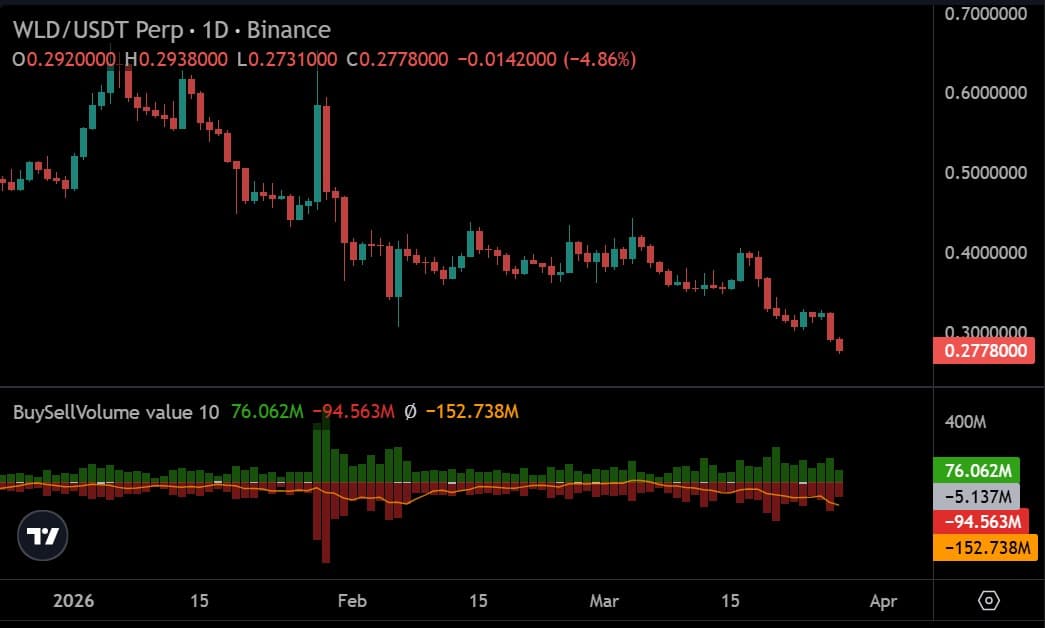
On the spot side, sellers have largely dominated the market, as evidenced by Buy Sell Volume on Binance. A the time of writing, Sell Volume rose to 94 million, while Buy Volume dropped to 76 million as of writing, with net market delta holding at -152 million.

Source: Coinalyze

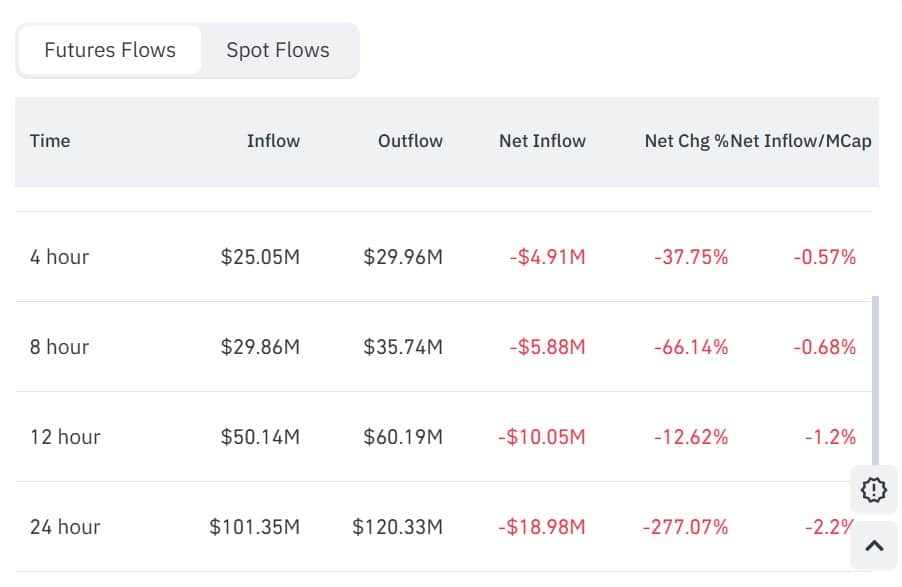
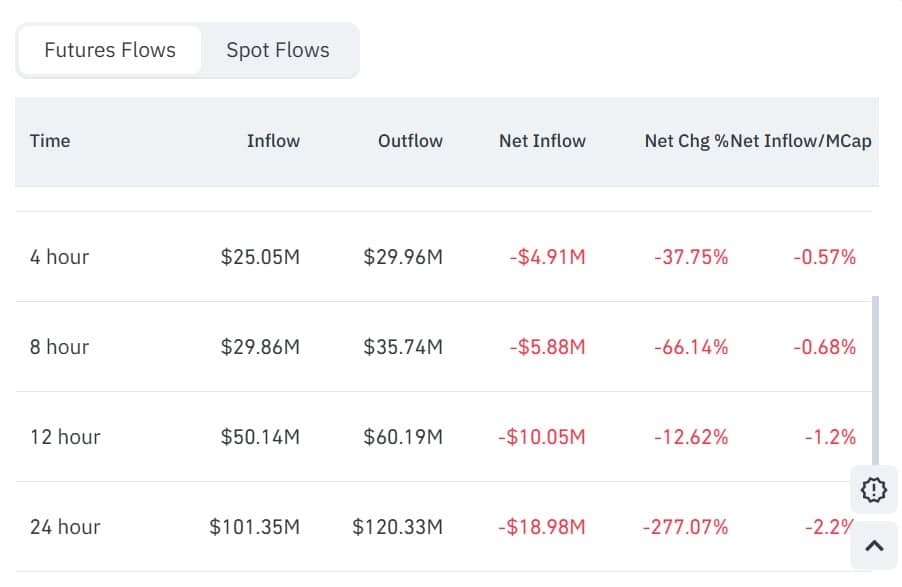
The same market behavior was observed on the Futures side. According to CoinGlass data, Futures Inflow dropped to $101 million while outflows jumped to $120.3 million.

As a result, Futures Netflow dropped 277% to -$18.98 million, a clear sign of aggressive exits in the futures market. Such market conditions suggest increased risk-off sentiment with traders reducing exposure.

Source: CoinGlass

More losses ahead for WLD?

Worldcoin has faced significant downside pressure, and the latest team’s token transfer exacerbated the downtrend.

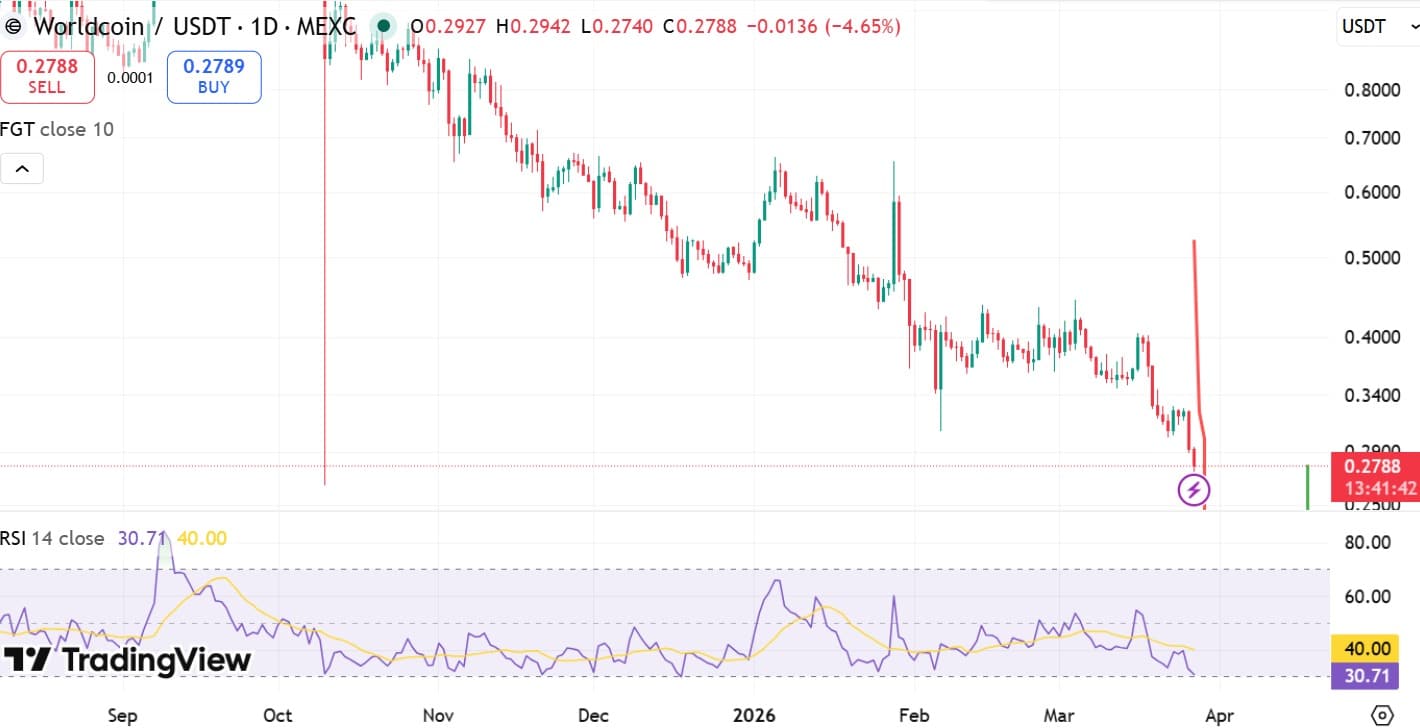
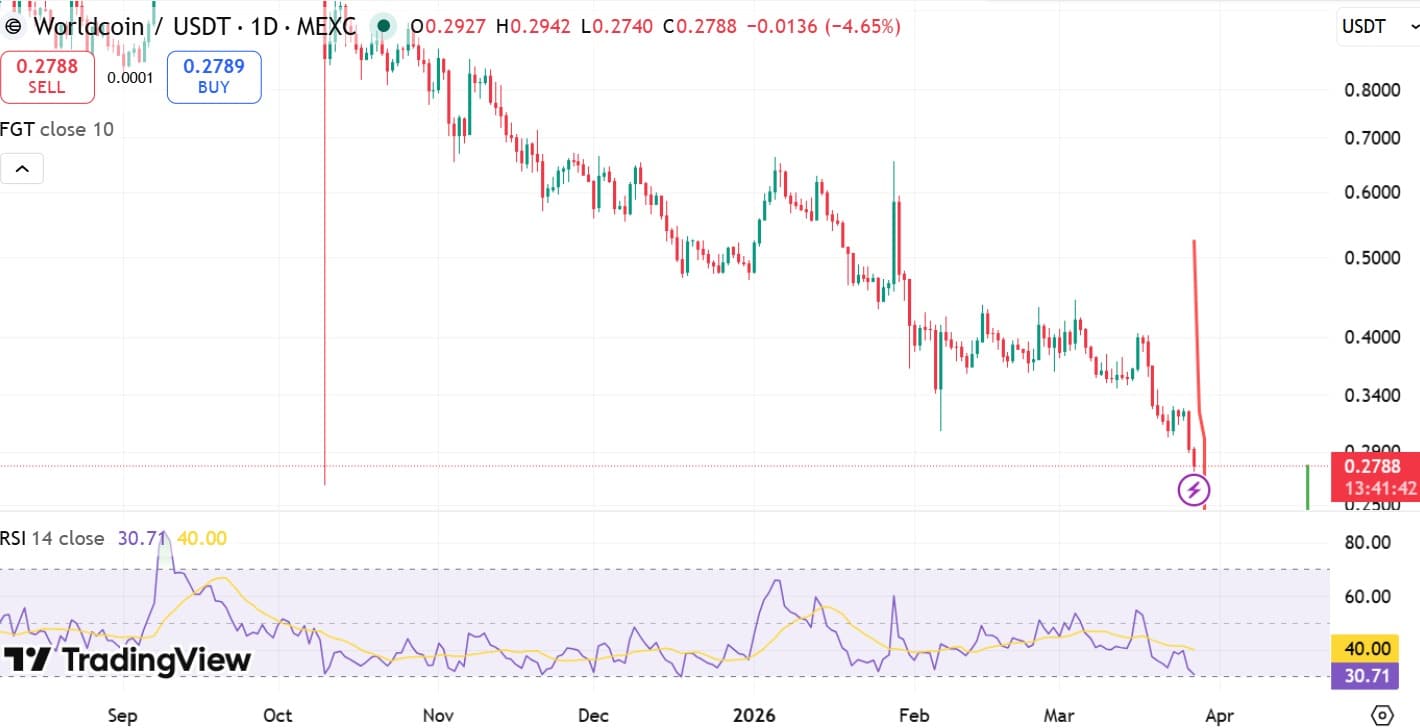
At press time, the altcoin’s Relative Strength Index (RSI) dropped deeper into the bearish zone and was nearing an bearish crossover. Often, when this momentum indicator drops to such levels, it suggests that sellers have outpaced buyers.

Source: TradingView

Traditionally, a drop into oversold territory has preceded lower prices. In fact, the Future Grand Trend indicator indicated a continued market decline, with a likelihood of dropping below the $0.2 support.

For a potential trend reversal, WLD needs to reclaim the $0.3 resistance and flip it into support.


Final Summary

  • Worldcoin team moves 89.65 million WLD, worth $26.17 million, to multiple exchanges.
  • WLD declined 9.03%, breaching the $0.3 support to a 6-month low of $0.27.

Связанные с этим вопросы

QWhat was the recent price movement of Worldcoin (WLD) and what support level did it breach?

AWorldcoin declined 9.03% and breached the $0.3 support level, dropping to a 6-month low of $0.2701.

QWhat significant action did the Worldcoin team take that contributed to the bearish pressure?

AThe Worldcoin team moved 89.65 million WLD, worth $26.17 million, to a new wallet and then began sending funds to multiple centralized exchanges (CEXs).

QWhat does the negative Futures Netflow of -$18.98 million indicate about market sentiment?

AThe -$18.98 million Futures Netflow, a drop of 277%, is a clear sign of aggressive exits in the futures market, indicating an increased risk-off sentiment with traders reducing their exposure.

QAccording to the technical analysis, what is the potential next major support level for WLD if the downtrend continues?

AThe Future Grand Trend indicator suggests a likelihood of the price dropping below the $0.20 support level if the downtrend continues.

QWhat would need to happen for a potential trend reversal in WLD's price?

AFor a potential trend reversal, WLD needs to reclaim the $0.30 resistance level and flip it into support.

Похожее

Claude Opus 4.8 Finds a $4.5 Billion Bug: The AI Era is Mass-Producing Hackers

A researcher discovered a critical "infinite mint" vulnerability in the Zcash cryptocurrency's Orchard protocol using Claude Opus 4.8, leading to a swift fix but also a 50% market drop, erasing billions in value. This incident highlights a new era where powerful, accessible AI models are dramatically lowering the barrier to finding software vulnerabilities. Previously, the security community feared specialized models like Claude Mythos Preview, capable of finding decades-old zero-day exploits. The Zcash case, however, involved a publicly available, general-purpose model. This shift makes advanced security auditing—and attack capabilities—accessible to far more people, not just experts. The mass democratization of vulnerability discovery brings a dual challenge: a flood of low-quality, AI-generated false reports that overwhelm maintainers, and the real, rapid uncovering of deep, dangerous bugs. Open-source projects, often understaffed and unfunded, are particularly vulnerable to this "attention DDoS." The article cites examples like curl shutting down its bug bounty program due to the unsustainable workload. Our perceived digital safety has often been luck, relying on the high cost and effort required to find deeply hidden flaws in complex systems, as seen with historical vulnerabilities like Heartbleed or Baron Samedit. AI changes this cost structure, effectively "mass-producing flashlights" to illuminate every corner of our codebase. While large companies operate extensive security chains involving external white-hat hackers and massive defensive operations, the global cybersecurity workforce faces a severe shortage, especially of experienced personnel capable of analyzing complex threats and coordinating fixes. The core dilemma emerges: AI makes *finding* bugs cheap and scalable, but *fixing* them remains a slow, expensive, and human-intensive process. The article concludes that AI won't destroy the internet but acts as a bright light, revealing that our digital existence is not inherently secure but is precariously maintained by ongoing human effort. The true cost in the AI era may not be discovery, but whether there will be enough people left willing and able to do the hard work of repair.

marsbit2 мин. назад

Claude Opus 4.8 Finds a $4.5 Billion Bug: The AI Era is Mass-Producing Hackers

marsbit2 мин. назад

Codex Goal Mode Usage Guide: How to Make AI Continuously Pursue a Specific Objective

"Codex Goal Mode: How to Make AI Work Continuously Toward a Specific Goal" OpenAI's Codex "goal mode" (/goal) transforms the AI from a reactive code assistant into a proactive execution agent capable of working autonomously for hours or even days to achieve a defined objective. To maximize its effectiveness, follow these key principles: 1. **Define Clear, Verifiable Exit Criteria:** The goal prompt should be a concise, measurable success condition, not a lengthy specification. Use quantifiable metrics like "reduce build time by 30%" or "achieve 100% test parity." 2. **Provide Initial Guidance and Tools:** Direct Codex toward likely problem areas and specify available tools (e.g., browsers, testing environments) to prevent it from exploring unproductive paths. 3. **Enable Progress Measurement:** Equip Codex with ways to track advancement, such as creating comparison tools for visual tasks or evaluation sets, ensuring it can gauge its own progress. 4. **Use a Realistic Execution Environment:** For tasks like performance optimization, provide access to environments that closely mimic production (e.g., similar configs, databases) to yield valid results. 5. **Be Cautious with Visual Goals:** Avoid vague "pixel-perfect" instructions. Instead, supplement visual references with functional checklists or design system specifications to prevent Codex from obsessing over minor details. 6. **Implement Progress Tracking:** For long-running tasks, have Codex commit code to draft PRs, update progress documents, or send Slack updates to maintain visibility into its work. 7. **Review and Consolidate Results:** Once the goal is met, instruct Codex to review its work, clean up ineffective experimental code, and reflect on what strategies succeeded or failed. Ultimately, using goal mode shifts the developer's role from writing prompts to managing a persistent engineering agent—defining objectives, establishing metrics, configuring environments, and conducting final reviews.

marsbit1 ч. назад

Codex Goal Mode Usage Guide: How to Make AI Continuously Pursue a Specific Objective

marsbit1 ч. назад

From Ethereum to AI's 'CROPS': What Exactly Is This 'Slow Variable' That Vitalik Has Repeatedly Emphasized?

Recently, Vitalik Buterin has frequently emphasized the concept of "CROPS," first outlined in the Ethereum Foundation's March mandate as core principles guiding its focus: Censorship Resistance, Capture Resistance, Open Source, Privacy, and Security. CROPS represents Ethereum's commitment to providing foundational capabilities for user sovereignty—enabling asset ownership, identity expression, and coordination without reliance on centralized platforms or surrendering ultimate control. This framework is gaining new urgency with the rise of AI, particularly AI agents managing digital assets and automating transactions. While AI offers convenience, it risks centralizing user data, intent, and control if dependent on opaque, centralized services. Vitalik argues for "CROPS AI"—AI that is open, privacy-preserving, secure, and capable of local execution to maintain user agency. He highlights convergence between "CROPS Ethereum access layers" and "CROPS AI," such as using zero-knowledge proofs for private remote LLM calls and Ethereum RPC reads, ensuring users can access services without exposing sensitive information. Ultimately, CROPS is not just an abstract ideal but a practical guide for Ethereum's development and AI integration. It addresses the critical long-term question: as digital systems grow more powerful, how can users retain control over their privacy, assets, and autonomy? In an AI-driven era, these principles may define Ethereum's enduring value—prioritizing verifiable, secure, and user-centric design over short-term optimizations like speed and cost alone.

marsbit1 ч. назад

From Ethereum to AI's 'CROPS': What Exactly Is This 'Slow Variable' That Vitalik Has Repeatedly Emphasized?

marsbit1 ч. назад

Торговля

Спот
Фьючерсы

Популярные статьи

Как купить WLD

Добро пожаловать на HTX.com! Мы сделали приобретение Worldcoin (WLD) простым и удобным. Следуйте нашему пошаговому руководству и отправляйтесь в свое крипто-путешествие.Шаг 1: Создайте аккаунт на HTXИспользуйте свой адрес электронной почты или номер телефона, чтобы зарегистрироваться и бесплатно создать аккаунт на HTX. Пройдите удобную регистрацию и откройте для себя весь функционал.Создать аккаунтШаг 2: Перейдите в Купить криптовалюту и выберите свой способ оплатыКредитная/Дебетовая Карта: Используйте свою карту Visa или Mastercard для мгновенной покупки Worldcoin (WLD).Баланс: Используйте средства с баланса вашего аккаунта HTX для простой торговли.Третьи Лица: Мы добавили популярные способы оплаты, такие как Google Pay и Apple Pay, для повышения удобства.P2P: Торгуйте напрямую с другими пользователями на HTX.Внебиржевая Торговля (OTC): Мы предлагаем индивидуальные услуги и конкурентоспособные обменные курсы для трейдеров.Шаг 3: Хранение Worldcoin (WLD)После приобретения вами Worldcoin (WLD) храните их в своем аккаунте на HTX. В качестве альтернативы вы можете отправить их куда-либо с помощью перевода в блокчейне или использовать для торговли с другими криптовалютами.Шаг 4: Торговля Worldcoin (WLD)С легкостью торгуйте Worldcoin (WLD) на спотовом рынке HTX. Просто зайдите в свой аккаунт, выберите торговую пару, совершайте сделки и следите за ними в режиме реального времени. Мы предлагаем удобный интерфейс как для начинающих, так и для опытных трейдеров.

606 просмотров всегоОпубликовано 2024.03.29Обновлено 2026.06.02

Как купить WLD

Обсуждения

Добро пожаловать в Сообщество HTX. Здесь вы сможете быть в курсе последних новостей о развитии платформы и получить доступ к профессиональной аналитической информации о рынке. Мнения пользователей о цене на WLD (WLD) представлены ниже.

活动图片