Why I Am Not Bullish on Ethereum at Its Current State?

marsbitОпубликовано 2026-01-19Обновлено 2026-01-19

Введение

Why I'm Not Bullish on Ethereum at Current Prices The author expresses skepticism about Ethereum's current valuation, not its long-term business growth potential (user base and transaction volume are expected to increase). The author believes the price is too high relative to its fundamentals, based on the following analysis: - Active users and transaction counts have reached new highs but are growing slower than some leading e-commerce platforms. - Monthly transaction fees are only 0.6% of the previous cycle's peak, and average fees per transaction are 0.5% of previous highs. This slow growth comes at the cost of drastically reduced service prices, which is unfavorable in any industry. - If Ethereum is viewed as a company selling block space, its price-to-fee (PF) ratio exceeds 2,000x and its price-to-sales (PS) ratio exceeds 10,000x. It has negative net profit, so no P/E ratio exists. In comparison, traditional cloud service companies have P/E ratios of 20-30 and single-digit PS ratios. - If considered a commodity (like digital oil), Ethereum faces competition from other chains and rollups offering similar services. Its value proposition may not justify such a high premium, especially as its narrative as a store of value (like Bitcoin) has faded. - There is a lack of new, product-market-fit crypto native applications this cycle, leading to oversupply of block space and stagnant growth in the public chain sector. - Grand visions of Ethereum becoming a decentralized "Wall S...

Author: Alex Xu

Not being bullish doesn't mean I am pessimistic about Ethereum's business development (referring to long-term growth in user scale and transaction volume, which I believe will continue), but rather that I am unwilling to buy at the current price because it is too expensive relative to its fundamentals.

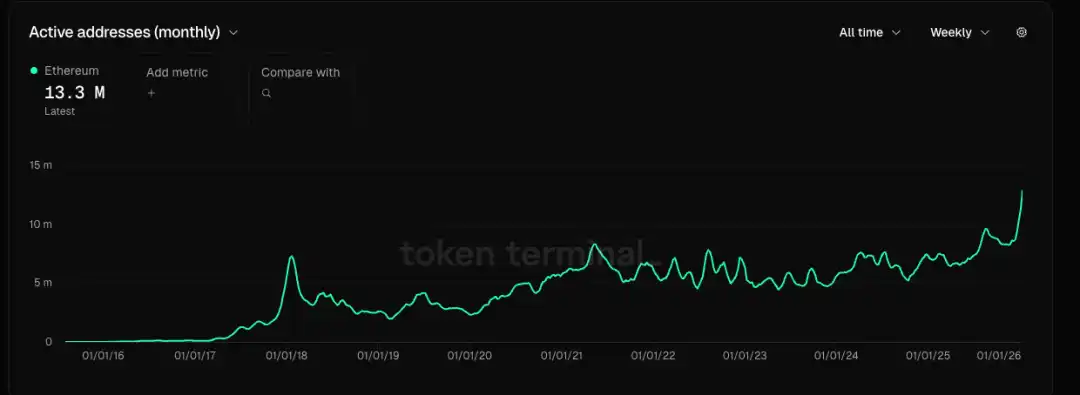
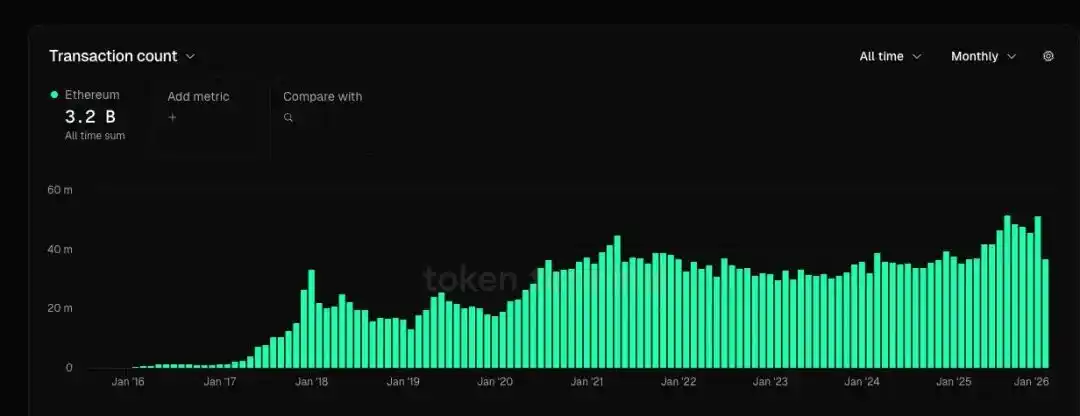
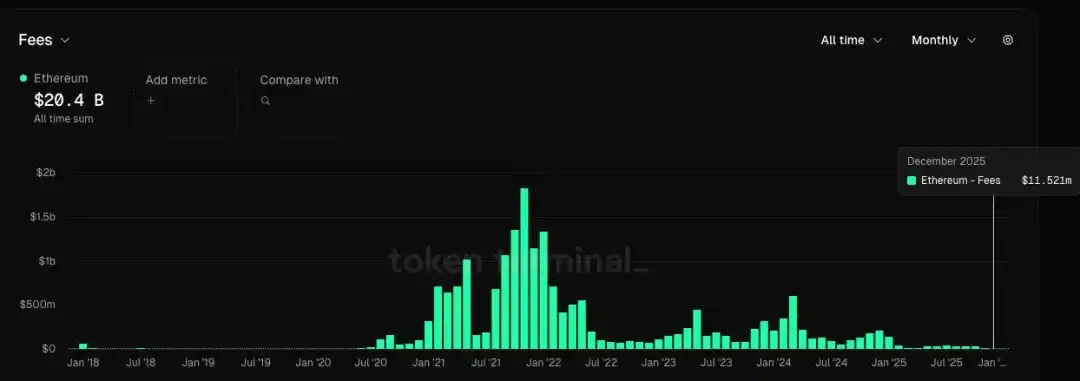
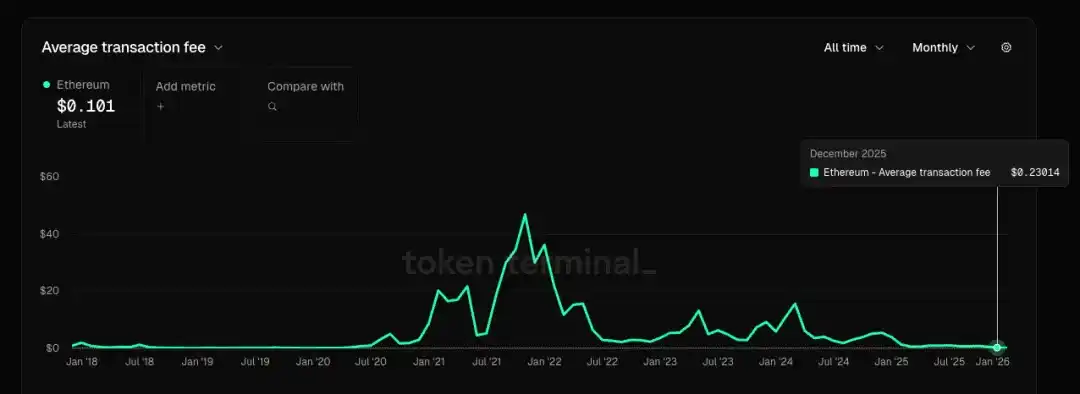
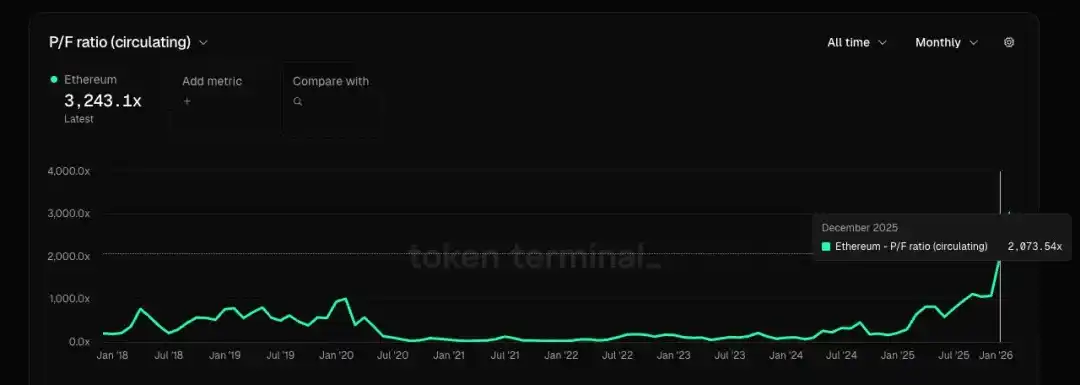
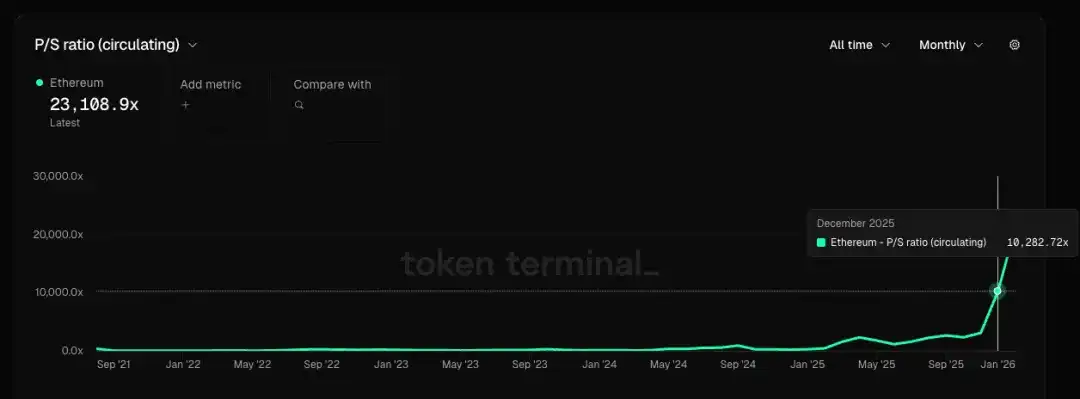
From a few charts, we can paint a picture of Ethereum's current state:

1. The number of active users has risen in waves to new highs (44% higher than the peak of the last cycle), and the number of transactions has also reached new highs (13% higher than the peak of the last cycle). However, the growth rate of these two metrics is still slower than the GMV growth of some leading e-commerce platforms.

2. The current monthly transaction fees are only 0.6% of the peak of the last cycle, and the average transaction fee per transaction is only 0.5% of the peak of the last cycle. This means that the slow growth in users and transaction volume has been achieved at the cost of a sharp decline in service prices. When growth comes at the expense of drastic price reductions for products and services, it is not a good sign for any company in any industry.

3. If we view Ethereum as a company providing block space services, based on December data, its P/F (Price-to-Fee ratio) exceeds 2,000x, and its P/S (Price-to-Sales ratio) exceeds 10,000x. Its net profit is negative, so there is no P/E ratio. In comparison, traditional cloud service companies typically have P/E ratios between 20-30 and P/S ratios in the single digits.

4. If Ethereum is considered not a company but a commodity (similar to digital oil), its challenge lies in the fact that other public chains and rollups can provide similar block space services (akin to substitutable oil). Some may argue that Ethereum's decentralization and censorship-resistant properties make it more valuable as a commodity resource, but is it really worth that much more? The previous narrative that ETH could replace BTC as a store of value has largely disappeared, as consensus has shifted: compared to BTC's status as digital gold, ETH is more like a tech company + specialized cloud service provider, and its commodity positioning is also highly substitutable.

5. Crypto-native applications with product-market fit (PMF) have almost disappeared in this cycle, with almost no high-value applications emerging. Insufficient demand and increased supply (the continued growth of rollups and public chains) have led to a severe oversupply of block space, and the public chain sector itself is experiencing sluggish growth or even contraction.

6. The grand vision painted by Tom Lee and some domestic VCs—"Ethereum is the Wall Street on-chain, and everything will eventually be on Ethereum"—lacks sufficient data and factual evidence to support this story. There is no concrete logical derivation, and it seems more like a promotional pitch. Our investment decisions should be based on rationality, not faith. I am not ready to buy into their narrative yet. If future data and facts gradually support this story, it will be time to reconsider.

Связанные с этим вопросы

QWhat is the author's main reason for not being optimistic about Ethereum at its current price?

AThe author believes the current price is too expensive relative to its fundamentals, such as its high valuation multiples and declining fee revenue, despite some growth in user base and transaction count.

QHow does the author compare Ethereum's current performance to the previous cycle's peak in terms of transaction fees?

AThe author states that the current monthly transaction fees are only 0.6% of the previous cycle's peak, and the average fee per transaction is only 0.5% of the previous high.

QWhat valuation multiples does the author use to argue that Ethereum is overvalued, and how do they compare to traditional cloud service companies?

AThe author uses a Price-to-Fees (PF) ratio of over 2000x and a Price-to-Sales (PS) ratio of over 10,000x for Ethereum, while noting that traditional cloud service companies typically have a PS ratio in the single digits and a PE ratio between 20-30.

QAccording to the author, what is a key challenge to Ethereum's 'digital oil' commodity narrative?

AThe author argues that other blockchains and rollups can provide similar block space services, making Ethereum's commodity-like resource highly substitutable and questioning if its premium valuation is justified.

QWhy does the author express skepticism about the narrative that Ethereum will become the 'Wall Street of on-chain' activities?

AThe author finds this narrative lacks supporting data and concrete logical derivation, viewing it more as promotional 'shilling' rather than a rational investment thesis based on current evidence.

Похожее

Anthropic's IPO Launch: Commercial Miracle or Valuation Bubble?

Anthropic has confidentially filed for an IPO, led by Morgan Stanley and Goldman Sachs, potentially going public by October. Following its latest $650 billion funding round, its pre-IPO valuation stands at $965 billion, with projections reaching up to $2 trillion at listing, which would make it the highest-valued private company ever. The article, written by Fu Sheng, addresses skepticism that this represents an AI bubble akin to the 2000 dot-com crash. It argues the current situation differs fundamentally. Unlike the internet bubble era, which relied on speculative narratives with little revenue, Anthropic's valuation is backed by unprecedented, measurable financial performance. Key data points include: * **Revenue Growth:** ARR skyrocketed from $10 billion in early 2025 to $470 billion by May 2026, targeting $100 billion by year-end—a growth curve unmatched in business history. * **Profitability:** It achieved operating profitability in Q2 2026 with an estimated $5.6 billion profit. * **Efficiency:** With ~3,000 employees and ~$470 billion ARR, its revenue per employee exceeds $10 million. Products like Claude Code, launched less than a year ago, already generate $25 billion in annualized revenue. * **Enterprise Adoption:** It boasts a strong enterprise client base, with 8 of the Fortune 10 and over 1,000 large firms spending over $1 million annually on Claude. The valuation is framed using a traditional SaaS model (e.g., a 10x Price-to-Sales multiple on $100 billion revenue). The author contends the core question for analysts has shifted from "How big could this be?" to "How much is it earning and will earn next quarter?" The discussion extends beyond Anthropic to a broader paradigm shift: the transition from a "carbon-based" to a "silicon-based" economy. Companies are increasingly prioritizing investment in compute and AI capabilities over human resources, as these directly scale productivity and competitive advantage. Anthropic's IPO is thus positioned not just as a corporate milestone, but as a price anchor for this new economic era.

链捕手48 мин. назад

Anthropic's IPO Launch: Commercial Miracle or Valuation Bubble?

链捕手48 мин. назад

Near Returns to the AI Stage: Transformation into a Public Chain Due to 'Payroll Difficulties,' Agent and Privacy Emerge as New Growth Narratives

NEAR Returns to AI Origins: From Payroll Struggles to Blockchain, Now Focusing on AI Agents and Privacy NEAR Protocol's journey began not with grand blockchain ambitions, but from a practical hurdle: its AI startup founders, including Transformer paper co-author Illia Polosukhin, couldn't efficiently pay international developers in 2017. This led them to pivot and build a high-performance, scalable blockchain. After years navigating various crypto narratives like sharding and cross-chain interoperability, NEAR is now leveraging its AI roots to re-enter the AI arena. A key driver is its "NEAR Intents" layer, which abstracts complex cross-chain transactions. Users simply state their goal (e.g., swap BTC for ETH), and a solver network finds the optimal route. This system has processed over $20B in cross-chain volume, generating significant fee revenue. A major growth area is private transactions via "Confidential Intents/Swaps," which hide trade details until settlement to protect against MEV and front-running. Remarkably, private swaps recently accounted for over 40% of NEAR's transaction volume, highlighting strong demand but also potential regulatory scrutiny. With its AI-founder pedigree, NEAR is positioning itself at the intersection of blockchain, AI agents, and privacy, aiming to become infrastructure for the emerging agent economy while navigating the challenges of its rapid adoption.

marsbit3 ч. назад

Near Returns to the AI Stage: Transformation into a Public Chain Due to 'Payroll Difficulties,' Agent and Privacy Emerge as New Growth Narratives

marsbit3 ч. назад

From Ethereum to AI's 'CROPS': What Exactly is This Set of 'Slow Variables' That Vitalik Repeatedly Emphasizes?

In recent discussions, Vitalik Buterin has frequently emphasized the concept of "CROPS," a framework defining core values for Ethereum's development. CROPS stands for Censorship Resistance, Capture Resistance, Open Source, Privacy, and Security. Initially outlined in the Ethereum Foundation's "EF Mandate," it represents a commitment to user sovereignty, ensuring that the network resists external control, remains open, protects privacy, and prioritizes security. The relevance of CROPS extends beyond Ethereum's foundational principles, becoming crucial in the context of AI integration. As AI agents begin handling wallet operations and automated transactions, the risk increases that users may cede control over their digital assets, privacy, and intentions to centralized AI service providers. A "CROPS AI" would therefore emphasize local execution where possible, privacy-preserving remote model calls (e.g., using zero-knowledge proofs), and transparent, verifiable processes to maintain user agency. Vitalik highlights a significant convergence between "CROPS Ethereum access layer" and "CROPS AI." Both address the same fundamental challenge: how users can access powerful services—be it blockchain data via RPCs or AI models—without exposing sensitive information or relinquishing ultimate control. This intersection points toward a future digital entry point that is more private, secure, and user-controlled. Ultimately, CROPS is not merely an abstract ideal but a practical guidepost. It steers development—from protocol resilience and wallet design to AI agent safety—towards a future where users retain self-sovereignty even as digital systems grow more complex and powerful. In an era of accelerating AI adoption, these "slow variables" of censorship resistance, openness, privacy, and security may define Ethereum's enduring value.

marsbit3 ч. назад

From Ethereum to AI's 'CROPS': What Exactly is This Set of 'Slow Variables' That Vitalik Repeatedly Emphasizes?

marsbit3 ч. назад

Торговля

Спот
Фьючерсы

Популярные статьи

Manyu: восходящая мем-звезда на Ethereum, готовая открыть новую эру культуры Shiba

Manyu - это мемтокен на Ethereum, который приносит децентрализованную культурную и развлекательную ценность через вирусное влияние в соцсетях и вовлечённость сообщества.

1.9k просмотров всегоОпубликовано 2025.11.27Обновлено 2025.11.27

Manyu: восходящая мем-звезда на Ethereum, готовая открыть новую эру культуры Shiba

Неделя обучения по популярным токенам 14: Glamsterdam — самое ожидаемое обновление Ethereum в 2026 году

Ordinals/Runes по-прежнему стимулируют доходы от комиссий за блоки и активность разработчиков, рассматриваются как отправная точка «нативной эмиссии активов» в сети.

1.5k просмотров всегоОпубликовано 2026.04.29Обновлено 2026.04.29

Неделя обучения по популярным токенам 14: Glamsterdam — самое ожидаемое обновление Ethereum в 2026 году

Обсуждения

Добро пожаловать в Сообщество HTX. Здесь вы сможете быть в курсе последних новостей о развитии платформы и получить доступ к профессиональной аналитической информации о рынке. Мнения пользователей о цене на ETH (ETH) представлены ниже.

活动图片