Author: Alex Xu
Not being bullish doesn't mean I am pessimistic about Ethereum's business development (referring to long-term growth in user scale and transaction volume, which I believe will continue), but rather that I am unwilling to buy at the current price because it is too expensive relative to its fundamentals.
From a few charts, we can paint a picture of Ethereum's current state:
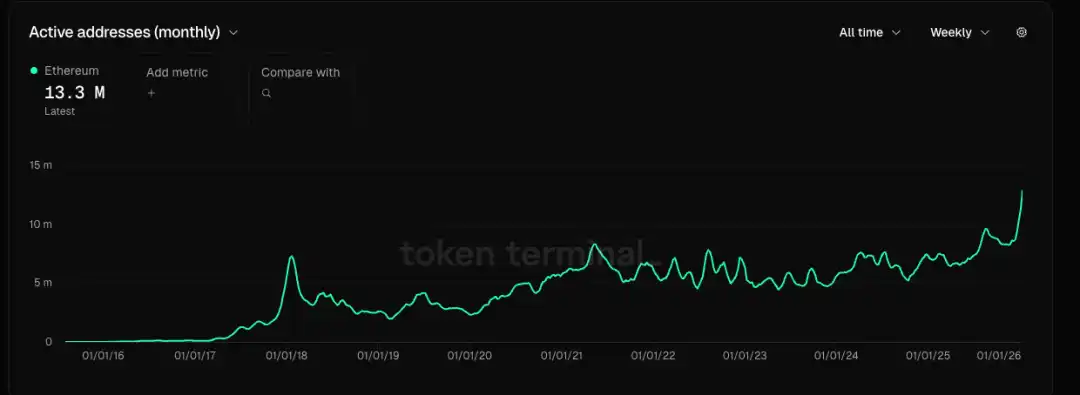
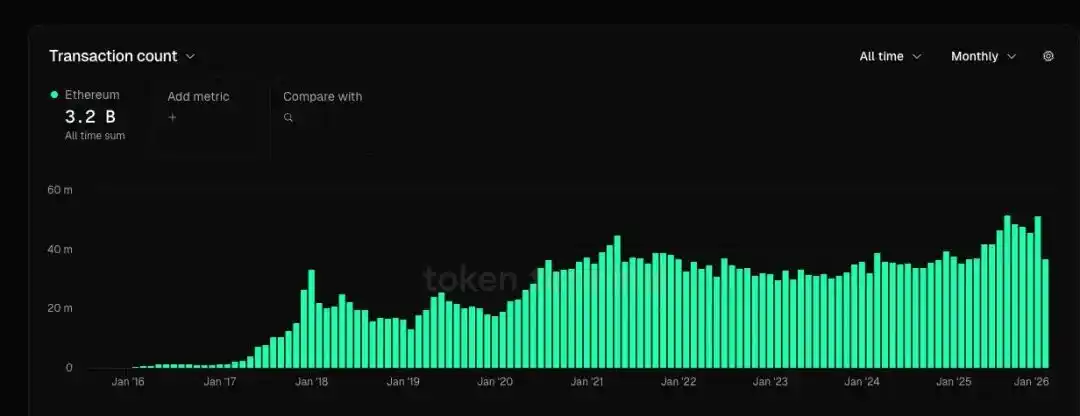
1. The number of active users has risen in waves to new highs (44% higher than the peak of the last cycle), and the number of transactions has also reached new highs (13% higher than the peak of the last cycle). However, the growth rate of these two metrics is still slower than the GMV growth of some leading e-commerce platforms.
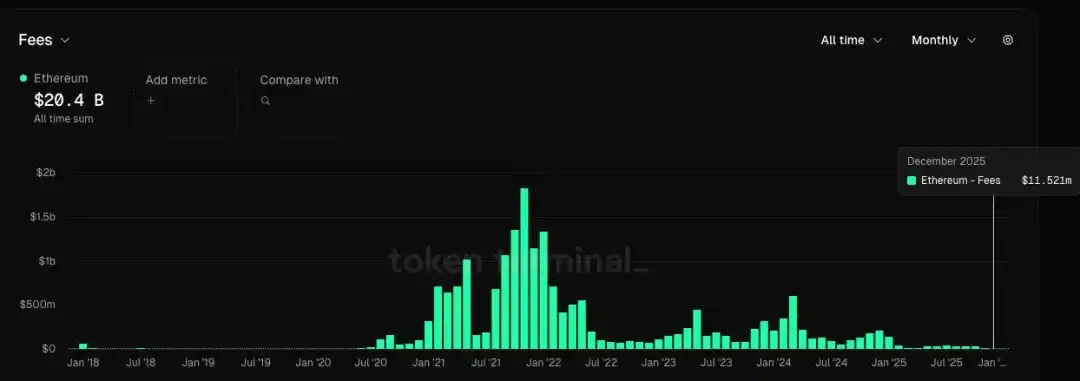
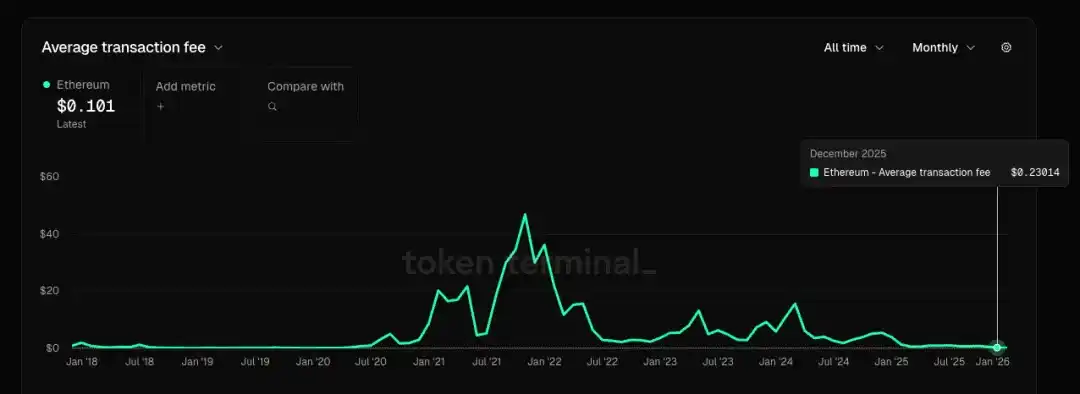
2. The current monthly transaction fees are only 0.6% of the peak of the last cycle, and the average transaction fee per transaction is only 0.5% of the peak of the last cycle. This means that the slow growth in users and transaction volume has been achieved at the cost of a sharp decline in service prices. When growth comes at the expense of drastic price reductions for products and services, it is not a good sign for any company in any industry.
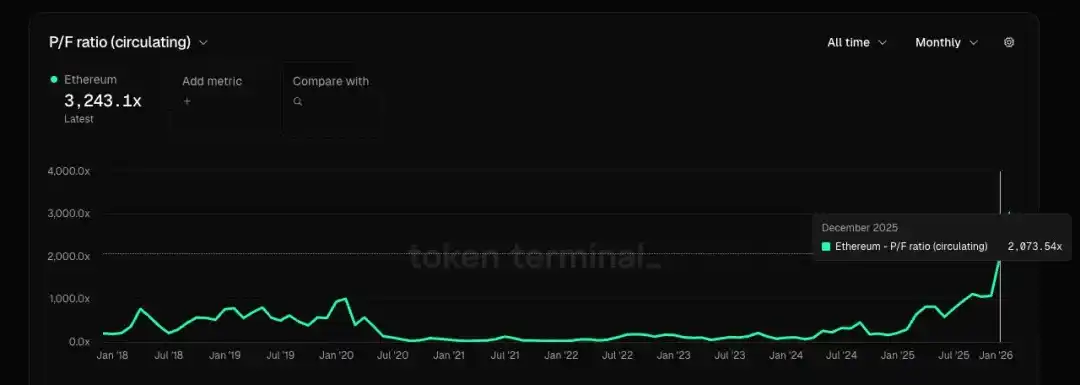
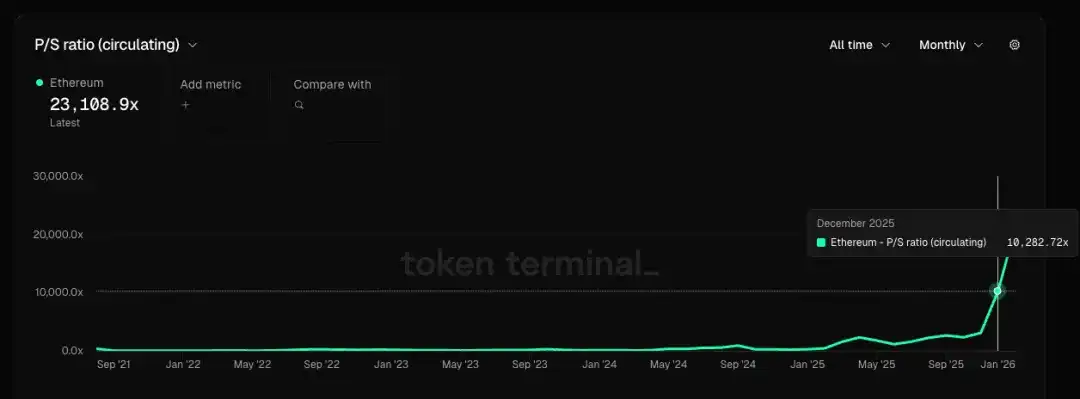
3. If we view Ethereum as a company providing block space services, based on December data, its P/F (Price-to-Fee ratio) exceeds 2,000x, and its P/S (Price-to-Sales ratio) exceeds 10,000x. Its net profit is negative, so there is no P/E ratio. In comparison, traditional cloud service companies typically have P/E ratios between 20-30 and P/S ratios in the single digits.
4. If Ethereum is considered not a company but a commodity (similar to digital oil), its challenge lies in the fact that other public chains and rollups can provide similar block space services (akin to substitutable oil). Some may argue that Ethereum's decentralization and censorship-resistant properties make it more valuable as a commodity resource, but is it really worth that much more? The previous narrative that ETH could replace BTC as a store of value has largely disappeared, as consensus has shifted: compared to BTC's status as digital gold, ETH is more like a tech company + specialized cloud service provider, and its commodity positioning is also highly substitutable.
5. Crypto-native applications with product-market fit (PMF) have almost disappeared in this cycle, with almost no high-value applications emerging. Insufficient demand and increased supply (the continued growth of rollups and public chains) have led to a severe oversupply of block space, and the public chain sector itself is experiencing sluggish growth or even contraction.
6. The grand vision painted by Tom Lee and some domestic VCs—"Ethereum is the Wall Street on-chain, and everything will eventually be on Ethereum"—lacks sufficient data and factual evidence to support this story. There is no concrete logical derivation, and it seems more like a promotional pitch. Our investment decisions should be based on rationality, not faith. I am not ready to buy into their narrative yet. If future data and facts gradually support this story, it will be time to reconsider.