Why Do Crypto Projects Keep Changing Their Names?

marsbitОпубликовано 2026-06-26Обновлено 2026-06-26

Введение

**Why Do Crypto Projects Keep Changing Names?** In the crypto world, changing a project's name is common—over 16% of projects have done so, including major ones like Polygon (formerly Matic Network). This contrasts sharply with traditional businesses, which fiercely protect brand equity. The core reason is that in crypto, brand loyalty is often weak. Users are frequently investors, airdrop hunters, or yield seekers, not traditional consumers. A name associated with price crashes, hacks, or failed narratives becomes a liability, not an asset. Renaming can be a strategic reset to shed this baggage. Name changes serve as a potent marketing tool. They can signal a genuine pivot in strategy or scope (e.g., EthSign dropping "Eth" as it expanded). However, they are often used to "narrative surf," rebranding to align with hot trends like AI, RWA, or the metaverse (e.g., Elrond → MultiversX). Critically, renaming is also a PR tactic to distance a project from past failures like security breaches (e.g., Anyswap → Multichain). The most significant risk emerges when a name change is coupled with a token migration or swap. This process can allow projects to reset exchange price charts, erase visible historical downtrends, and create an illusion of a fresh start. It often facilitates liquidity resets, where low float can be exploited for pumps. More alarmingly, migrations sometimes mask overhauls to tokenomics, introducing substantial new token supply through "ecosystem funds" or "node...

Author: Gu Yu, ChainCatcher

In the traditional business world, brand equity is a company's lifeline. Frequent name changes are almost equivalent to actively destroying its moat.

NVIDIA wouldn't change its name every few years, Apple wouldn't abandon 'Apple' because of a business pivot, and Nike wouldn't scrap its brand and start over just because of a market downturn.

But in the cryptocurrency world, the rules are often reversed. According to RootData statistics, over 16% of crypto projects have changed their names, with many well-known first-tier projects exhibiting frequent name changes.

Just yesterday, the on-chain IP ecosystem Story Protocol announced a name change to DATA, with IP tokens migrating 1:1 to the new DATA tokens. In the preceding months, Xion rebranded as Verona, Matrixport changed its name to BIT, and the TON token symbol was changed to GRAM. Even earlier, a slew of prominent projects like Klaytn, EOS, Fantom, MakerDAO, Elrond, and Matic Network have undergone name changes.
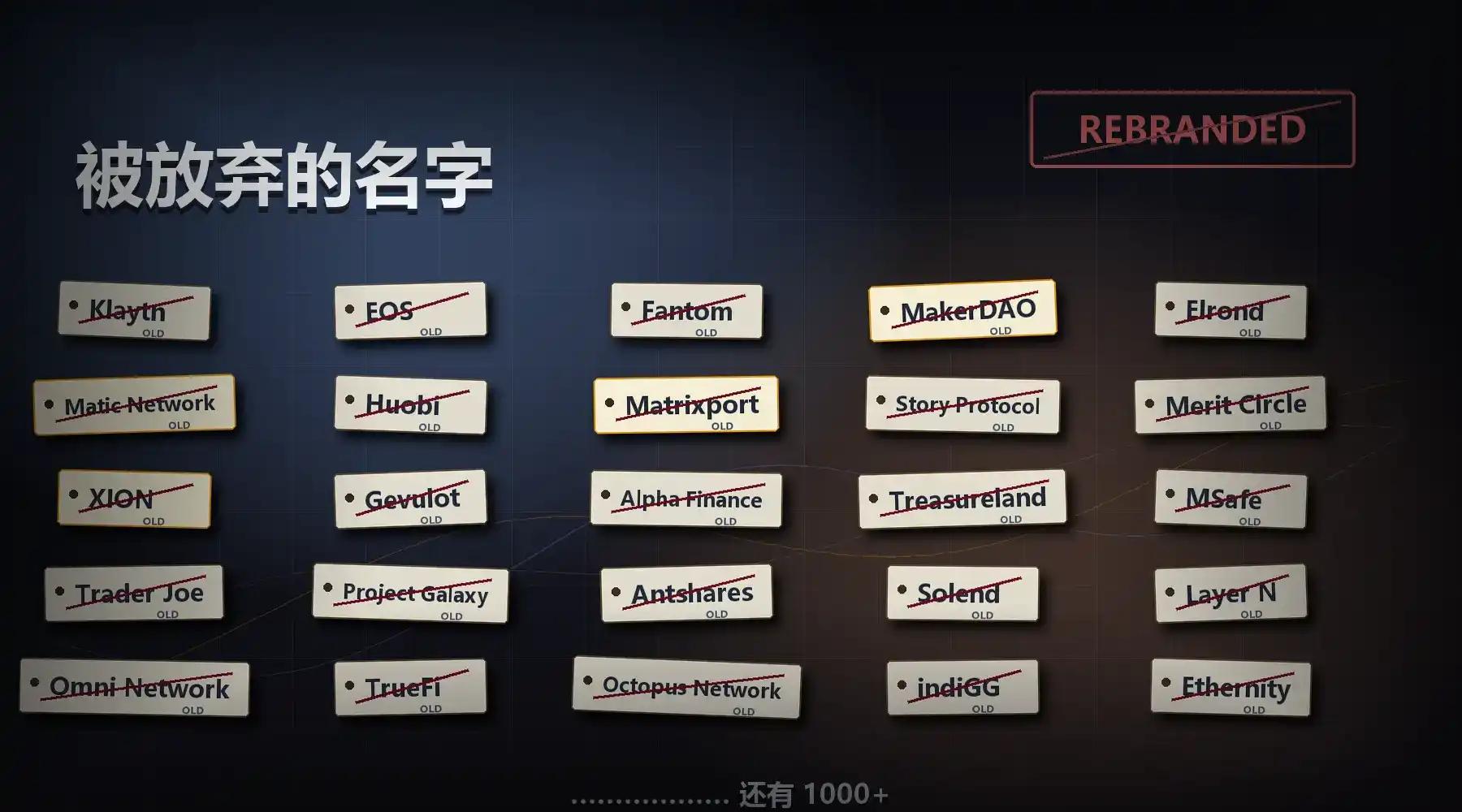
Some projects, more extreme, have changed names multiple times. For instance, MAITRIX's former names include CENTRAL, X Network, and XLD Finance; BitSafe was previously known as dlcBTC and DLC.Link; TaleX had former names Read2N and Metale Protocol; KGeN was once called indiGG and Kratos Gaming Network. The names keep changing, but most projects haven't gained new life from new names, often fading into obscurity instead.

This raises a question seldom seriously discussed in the crypto industry: Why do crypto projects keep changing their names?

The answer might not be complex: because in the crypto industry, the brand is not the most important asset; attention, narrative, token price, and liquidity are.

I. Crypto Brand Loyalty Is Too Low

Traditional brands fear name changes because user loyalty stems from long-term consumption experiences. A user who has bought iPhones for years, drunk Starbucks for years, or worn Nike for years—their brand perception isn't formed overnight and won't easily change due to a single marketing campaign.

But the user structure of crypto projects is entirely different.

Most early users aren't traditional consumers but investors, airdrop hunters, liquidity providers, node participants, and narrative traders. They use a product not necessarily because it's good, but because there might be an airdrop, potential returns, or upside.

This implies that crypto brand user loyalty is inherently weak.

In traditional industries, users ask, "Is this brand trustworthy?" In crypto, users more often ask, "Can this coin still go up?" As long as prices are stagnant long-term, narratives fail, or ecosystems die down, an old name becomes a liability.

A name associated with a crash, being trapped in losses, hacks, team controversies, or roadmap failures struggles to inspire market imagination. It carries not brand equity, but the scars of price charts and community resentment.

This is the fundamental reason crypto projects dare to change names frequently: often, the old name has no moat, only historical baggage.

II. Name Changes as a Marketing Strategy

Not all name changes should be simplistically viewed as "changing skins." Some projects rename because the original name cannot encompass the new strategic scope. As market buzzwords shift, if a name includes outdated concepts like "Social" or "DAO," or if the name's meaning is no longer fitting, a name change becomes inevitable.

For example, the decentralized social protocol OpenSocial rebranded as Eden after pivoting to AI, the decentralized e-signature platform EthSign dropped "Eth" from its name after business expansion, and the Ethereum sidechain Matic Network changed its name to Polygon (meaning polygon) after building multiple scaling solutions.

When a project's business boundaries fundamentally change, the original brand can limit external perception. A name change at this point is a necessary strategic adjustment.

Of course, there are also many projects proactively "riding the hype," gaining more attention by incorporating trending concepts into their names. During the last metaverse hype, Elrond rebranded as MultiversX, directly adding "Multiverse" to its name, clearly hoping to latch onto the metaverse and multi-dimensional digital world narrative.

Similarly, as AI, RWA, and Perp become industry hotspots, many projects will rename to quickly align with the new concepts. For instance, Vanilla Finance rebranded as Superp, and Function X changed its name to Pundi AI, reshaping their narratives.

After all, in the crypto industry, narrative itself is part of asset pricing. The closer a name aligns with a new narrative, the easier it is to be noticed again by exchanges, KOLs, retail investors, and market-making capital.

For many projects, the core reason for a name change is that the old brand has sunk into a trust abyss.

In crypto history, hacks, contract vulnerabilities, cross-chain bridge exploits, and team scandals can rapidly destroy a project's brand credibility. Once users associate a name with "hacked," "collapsed," "rugged," or "poor compensation," continuing with the old name means constantly carrying negative PR.

Thus, rebranding becomes the project team's most direct PR tool, euphemistically termed "brand repositioning."

Anyswap's rebrand to Multichain after a hack, and Alpha Finance's name change to Stella after a $37 million exploit, carry similar undertones. Superficially, they are adjusting product lines and strategic positioning; but from a market perception standpoint, the name change also serves, to some extent, the function of "cutting ties with the old memory."

III. The Gray Area of Name Changes and Token Swaps

If it were just a name change, the impact would be limited. What's truly worth being vigilant about is that many crypto project name changes often come with token swaps.

A token swap means old tokens need to migrate to new ones. Exchanges issue announcements, deposits/withdrawals are suspended, old trading pairs are delisted, and new ones are listed. For project teams, this is a rare opportunity for a "second listing."

Many projects also conduct token splits. For instance, 1:100 or 1:1000 splits, breaking higher-priced tokens into a larger quantity to make the unit price appear cheaper. Projects like SKY and BEAM have employed similar tactics. A stock split itself doesn't change company value, but a lower unit price often attracts more retail attention.

More crucially, after a name change and token swap, exchange historical price charts are often reset to zero.

For many old tokens, the historical burden is immense. Years of trapped positions, downtrends, negative news, and resistance levels are all embedded in the old price charts. After the new token launches, it superficially possesses a brand-new chart—no historical highs as resistance, no long-term bearish shadow, and no immediate memory of trapped positions.

This is extremely advantageous for project teams and market makers. When old tokens migrate to new ones, many exchanges suspend deposits/withdrawals. At this point, the actual circulating supply on secondary markets can become very light. On the few platforms where trading remains open, market-making capital might only need relatively little money to pump the new token price, creating the market illusion of a "post-upgrade surge."

Subsequently, the project team, early participants, or market makers might use the restored liquidity and user FOMO to complete distribution.

This is the most dangerous aspect of name changes with token swaps: it superficially appears as a brand upgrade but is, in essence, potentially a liquidity reset.

Going further, many projects redesign tokenomics during the swap process. Ordinary users see a 1:1 migration and think their rights aren't harmed. But the project team might simultaneously add new validator rewards, ecosystem funds, team incentives, node subsidies, and strategic reserves, thereby creating a large number of new tokens out of thin air.

FRONT's rebrand to Self Chain and TVK's change to Vanar Chain are classic cases. Both drastically increased token supply under the pretexts of node rewards and ecosystem building, diluting the value for existing token holders.

IV. The Real Problem Isn't Renaming, But Evading History

Crypto projects can certainly change their names; that in itself isn't a grave issue.

Changes in technical roadmap, expansion of product boundaries, shifts in market trends, or cutting legal risks can all bring about reasonable brand repositioning. Cases like Matic's rebrand to Polygon show that a good name can indeed help a project embrace a larger strategic vision.

But in more instances, crypto project name changes aren't about building brand equity; they're about escaping from it.

Escaping old price charts, escaping trapped positions, escaping hacks, escaping failed narratives, escaping user skepticism, escaping stories that have run their course.

This is precisely the biggest difference between the crypto industry and the traditional business world: traditional companies fear losing brand memory, while many crypto projects fear users remembering too much.

Therefore, when a project announces a name change, the market shouldn't only ask what the new name is, but should probe three questions:

What real new capabilities or strategies has it actually added? Has its tokenomics changed? What old history is it most trying to make users forget?

If behind the name change lies real products, real revenue, real users, and a clearer strategy, then it might be the start of a new chapter. But if the name change is merely accompanied by a token swap, trend-chasing, token inflation, and chart resetting, then it's likely just a repackaged old game.


Связанные с этим вопросы

QWhat is the main reason why cryptocurrency projects frequently change their names according to the article?

AAccording to the article, the main reason is that in the cryptocurrency industry, brand loyalty is not the most important asset. Instead, attention, narratives, token prices, and liquidity are paramount. Unlike traditional businesses, a project's old name can become a liability associated with past failures, price drops, or security breaches, and renaming can be a strategy to shed this negative historical baggage and renew market interest.

QHow does the user base in the crypto industry differ from traditional industries in terms of brand loyalty?

AIn traditional industries, user loyalty is built on long-term consumption experiences and product reliability. In contrast, the article states that many early users of crypto projects are not traditional consumers but investors, airdrop hunters, liquidity providers, and narrative traders. Their engagement is often driven by potential profits (like airdrops or price appreciation) rather than product quality or brand trust. Therefore, crypto brand loyalty is inherently weaker, making users more likely to abandon a project if its narrative fades or its token price stagnates.

QBeyond strategic rebranding, what other motivations for name changes are highlighted in the article?

ABeyond genuine strategic rebranding (e.g., reflecting an expanded business scope), the article highlights other motivations: 1) "Narrative-chasing" by incorporating trendy keywords like AI, RWA, or Metaverse into the new name to attract attention. 2) PR crisis management to distance a project from negative events like hacks, scandals, or failed promises. 3) A potentially exploitative tactic involving a token migration or swap, which can reset price charts (clearing negative historical K-lines), facilitate token splits to attract retail investors, and sometimes hide changes to tokenomics that dilute holder value.

QWhat is the most dangerous aspect associated with a name change that also involves a token swap/migration?

AThe most dangerous aspect, as described in the article, is that it can serve as a "liquidity reset." During the swap, trading is often halted, and the old token's trading history (K-line) is erased for the new token. This removes visible historical price resistance and negative trends. With a temporarily reduced circulating supply post-migration, market makers can more easily pump the new token's price, creating an illusion of a successful "upgrade" and potentially allowing insiders to sell at inflated prices before liquidity fully returns.

QWhat three questions should the market ask when a cryptocurrency project announces a name change, according to the article's conclusion?

AThe article concludes that the market should ask: 1) What real new capabilities or strategies has the project actually added? 2) Has the token economics changed? 3) What old history is it most trying to make users forget? If the name change is backed by genuine product improvements, revenue, users, and a clearer strategy, it can be positive. However, if it's primarily accompanied by a token swap, narrative-chasing, token dilution, and a K-line reset, it's likely just a repackaging of old problems.

Похожее

Стейблкоины становятся следующей политической проблемой ФРС в версии Уорша

Стабильные монеты становятся новой политической задачей для ФРС США, как отметил член Совета управляющих ФРС Кристофер Уоллер на конференции 22 июня. Ранее считавшиеся инструментом крипторынка, такие стейблкоины, как USDT и USDC, теперь изучаются с точки зрения их влияния на международную роль доллара. Их растущий масштаб (рыночная капитализация USDT приближается к $186 млрд, USDC — около $73,8 млрд) означает, что они превращаются в канал трансмиссии долларовой ликвидности, воздействующий на спрос на краткосрочные казначейские облигации, банковское финансирование и глобальный доступ к доллару. ФРС рассматривает стейблкоины как частный технологический слой в долларовой системе, который может либо расширять охват доллара за рубежом, либо создавать новые риски. Их резервы, размещенные в банках, фондах денежного рынка и гособлигациях, связывают их с традиционной финансовой системой. Рост стейблкоинов может оказывать давление на банковские депозиты, влиять на доходность краткосрочных гособлигаций и усложнять проведение денежно-кредитной политики. Ключевые вопросы для регуляторов: определяет ли рост стейблкоинов новый спрос на доллар или замещает банковские депозиты, и могут ли их механизмы резервирования и выкупа выдержать стресс. Таким образом, стейблкоины перешли из периферийной темы крипторегулирования в основную исследовательскую повестку ФРС о будущем доллара.

marsbit3 мин. назад

Стейблкоины становятся следующей политической проблемой ФРС в версии Уорша

marsbit3 мин. назад

Выбросив $90 млрд, Цукерберг решил открыть казино, где нельзя играть на деньги

После того как Meta потеряла 90 миллиардов долларов на метавселенной, Марк Цукерберг решил запустить прогнозную платформу Arena. Однако в отличие от таких платформ, как Polymarket или Kalshi, в Arena нельзя ставить реальные деньги — только игровые очки. Эксперты считают, что без финансовых рисков прогнозы теряют свою точность, так как участники не мотивированы серьезно анализировать события. Возможно, Arena — это просто попытка Meta создать социальную игру вокруг текущих событий, избегая регуляторных проблем. Или же Цукерберг, обжегшись на метавселенной, теперь копирует чужие идеи, но без ключевого элемента — настоящих ставок. Интересно, станет ли Arena просто развлечением для миллиардов пользователей Meta или всё же сможет составить конкуренцию настоящим прогнозным рынкам.

marsbit12 мин. назад

Выбросив $90 млрд, Цукерберг решил открыть казино, где нельзя играть на деньги

marsbit12 мин. назад

Взлет на 380%, IPO стоимостью в сотни миллиардов в Шэньчжэне уже состоялось

Акции HKC (HKC Corporation) успешно вышли на основную площадку Шэньчжэньской фондовой биржи 26 июня. После размещения по цене 10,12 юаня за акцию их стоимость на открытии резко выросла на 400%, а рыночная капитализация компании в какой-то момент превысила 500 миллиардов юаней. Компания HKC, основанная в Шэньчжэне, прошла путь от сборки дисплеев на рынке Хуацянбэй до глобального игрока в производстве панелей для дисплеев, заняв третье место в мире по поставкам телевизионных и смартфонных панелей. Выход на IPO стал результатом почти 30-летнего развития. Компания, занимающаяся разработкой, производством и продажей полупроводниковых дисплейных панелей и интеллектуальных дисплейных терминалов, демонстрирует стабильный рост. С 2023 по 2025 год ее выручка составила около 358,24, 402,82 и 408,97 миллиардов юаней соответственно, а чистая прибыль достигла 25,82, 33,20 и 38,01 миллиардов юаней. Основными клиентами являются такие известные бренды, как Samsung, TCL, Hisense, LG, Xiaomi и Skyworth. Развитие HKC тесно связано с поддержкой государственного капитала. Начиная с 2015 года, компания сотрудничала с государственными платформами Чунцина, Чучжоу, Мьянъяна и Чанши для совместных инвестиций в строительство производственных линий. Перед IPO такие инвесторы, как Miantou Group, Liuyang Urban Construction, Jingdongfang Capital, Chuzhou City Investment и Gui'an Industrial Development Company, внесли значительные средства в капитал компании. Основатель Ван Чжиюн через холдинговые компании контролирует 52,31% голосующих акций. Успешное размещение акций HKC отражает новые тенденции в инновационной экосистеме Шэньчжэня. Помимо гигантов вроде Tencent и BYD, в городе появляется все больше чемпионов в специализированных отраслях, таких как робототехника (рободолина Шэньчжэня) и производство чипов памяти («пять тигров памяти»: Jiangbolong, Dapu Micro, Biwin Storage, Demingli и Shannon Core Creation), совокупная рыночная капитализация которых достигает триллионов юаней. Эти компании, наряду с перспективными направлениями, такими как искусственный интеллект, низкоорбитальная экономика и коммерческая космонавтика, формируют новую промышленную глубину Шэньчжэня и потенциально готовят почву для появления следующей компании с триллионной капитализацией.

marsbit15 мин. назад

Взлет на 380%, IPO стоимостью в сотни миллиардов в Шэньчжэне уже состоялось

marsbit15 мин. назад

Продолжался 233 дня, падение превысило 50%. Является ли текущий медвежий рынок самым мягким за всю историю?

Анализ текущего медвежьего рынка биткоина, который длится 233 дня (на 24 июня), показывает, что это четвертый по продолжительности период с 2014 года. Текущий цикл характеризуется снижением на 51,2% от исторического максимума в $124 773, что делает его самым мягким за всю историю наблюдений. Для сравнения, предыдущие крупные медвежьи рынки (2018-2019, 2014-2015, 2022-2023 гг.) демонстрировали падение от 76,7% до 83,6%. Текущий спад связывают с макроэкономическими факторами: неопределенность в отношении процентных ставок, иссякающий импульс после халвинга и рост интереса к ИИ как к классу активов. Цена биткоина ($62 651) в настоящее время находится на 22% ниже своего 200-дневного скользящего среднего ($76 450), которое выступает ключевым уровнем сопротивления. Если дно цикла было достигнуто 7 июня ($60 861), то для возврата выше 200-дневной средней, согласно историческим данным, может потребоваться от 65 дней и более. Таким образом, потенциальное восстановление может начаться не раньше августа 2026 года. Относительно умеренный характер текущего спада может указывать на более зрелую структуру рынка и более высокое участие институциональных инвесторов.

marsbit1 ч. назад

Продолжался 233 дня, падение превысило 50%. Является ли текущий медвежий рынок самым мягким за всю историю?

marsbit1 ч. назад

Первая в стране сертификация по взрывозащите и первое в мире решение «мозга для заправки»: как им удалось достичь двух «первых»

По данным, в этом году общий объем финансирования в области воплощенного искусственного интеллекта в Китае превысил 37 миллиардов юаней, и отрасль находится на ключевом этапе коммерциализации. Основным направлением считается применение в опасных, тяжелых и повторяющихся задачах, таких как заправочные станции, нефтегазовые объекты и химические заводы. Однако первым серьезным препятствием является получение взрывозащищенной сертификации, требующей особых конструктивных решений аппаратного обеспечения. На заправочных станциях робот должен выполнять длинные последовательности точных операций (открытие крышки, заправка, закрытие) с миллиметровыми допусками, адаптируясь к разным моделям автомобилей. На объектах требуется способность к длительному автономному патрулированию, распознаванию аномалий и немедленному реагированию. В статье рассматривается новая архитектура H-GAR (Hierarchical Goal-Aware Reasoning), призванная решить проблему накопления ошибок в длинных задачах. В отличие от традиционных линейных подходов, H-GAR сначала прогнозирует целевое состояние мира после выполнения задачи, затем синтезирует промежуточные визуальные кадры и, наконец, детализирует действия. Этот метод, аналогичный планированию опытного водителя, позволяет системе «думать на несколько шагов вперед» и корректировать действия для достижения конечной цели, что значительно повышает устойчивость. Внедрение воплощенного ИИ в специальные сценарии требует долгосрочных усилий, глубокой интеграции «мозга» (алгоритмов) и «тела» (аппаратной платформы), а также создания цикла «мозг-тело-данные». Компании, которые первыми реализуют этот подход, получат преимущество в конкурентной борьбе за коммерческое внедрение.

marsbit1 ч. назад

Первая в стране сертификация по взрывозащите и первое в мире решение «мозга для заправки»: как им удалось достичь двух «первых»

marsbit1 ч. назад

Торговля

Спот
Фьючерсы
活动图片