Why Bitcoin Is Struggling Under Trump’s New Regime: Analyst

bitcoinistОпубликовано 2025-12-28Обновлено 2025-12-28

Введение

Despite initial expectations, Bitcoin's performance under President Trump's second term has been mixed. While reaching a new all-time high after his January inauguration, the market has largely consolidated with a bearish undertone. Analysis from XWIN Research Japan highlights key differences from the post-2016 election rally. Unlike 2016’s low-inflation, low-rate environment that fueled a sustained bull run, 2025 began with high interest rates and tighter financial conditions. Bitcoin’s larger market size and broader investor base have also reduced the immediate impact of political events on price. The Bitcoin SOPR Ratio (LTH-SOPR/STH-SOPR) further indicates caution: long-term holders are taking limited profits, while short-term holders are selling at a loss. This typically signals an extended period of supply-demand adjustment. Although downside may be limited if long-term holder dominance continues, significant upside appears constrained. A recovery would require steady ETF inflows and reduced selling by long-term holders. Until then, Bitcoin may remain stagnant or decline further. Currently, BTC is trading around $87,623.

Against widespread expectations, the second term of Donald Trump as the US President has yielded a positive effect on Bitcoin’s price. While the flagship cryptocurrency has recorded an all-time high since Trump’s inauguration in January, the market has mostly been in consolidation and range-bound phase, with the broader picture still taking on a bearish form. Crypto analysis page XWIN Research Japan recently offered a comparative analysis with the post-election euphoria seen in 2016, to explain why the post-2024 price action is without enthusiasm.

Analyst Explains Why Bitcoin’s Structure Differs Sharply From 2016

In the Quicktake post on CryptoQuant, the research and education institution draws a critical comparison between the 2016 and 2024 post-election periods. Just after Trump’s victory in 2016, the crypto market operated within a low-inflation and low-interest-rate environment, one that is ideal for a market with growing liquidity. Also, the crypto market’s relatively small size allowed for quick accumulation of speculative liquidity. Hence, the market was able to get sufficient capital to serve as fuel for a prolonged, yet powerful, uptrend.

However, early 2025 saw a different market environment and dynamic. The year began and extended into a high-rate period, where financial conditions increasingly became crippling. Also, the larger market size (compared to the post-2016 election market), alongside increased participation among several investors, has structurally reduced the stand-alone importance of political events on price movements. Simply put, policy implementations can barely move Bitcoin’s price alone, especially when encumbered by more liquidity constraints.

LTH-SOPR Ratio Further Reflects Caution

XWIN Research Japan also references data obtained from the Bitcoin SOPR Ratio (LTH-SOPR/STH-SOPR), which reinforces the cautious stance among investors following Trump’s second inauguration. The Bitcoin SOPR Ratio deciphers market sentiment by comparing whether long-term holders are realizing profits more aggressively than short-term holders, serving as an important indicator of whether a price trend is driven by institutional conviction or speculative trading.

According to the research team, Bitcoin’s long-term holders (LTHs) are realizing their limited profits. Short-term holders, on the other hand, are trading within red territory. Historically, this condition is typically found when the market is about to embark on a prolonged journey of demand-supply adjustments.
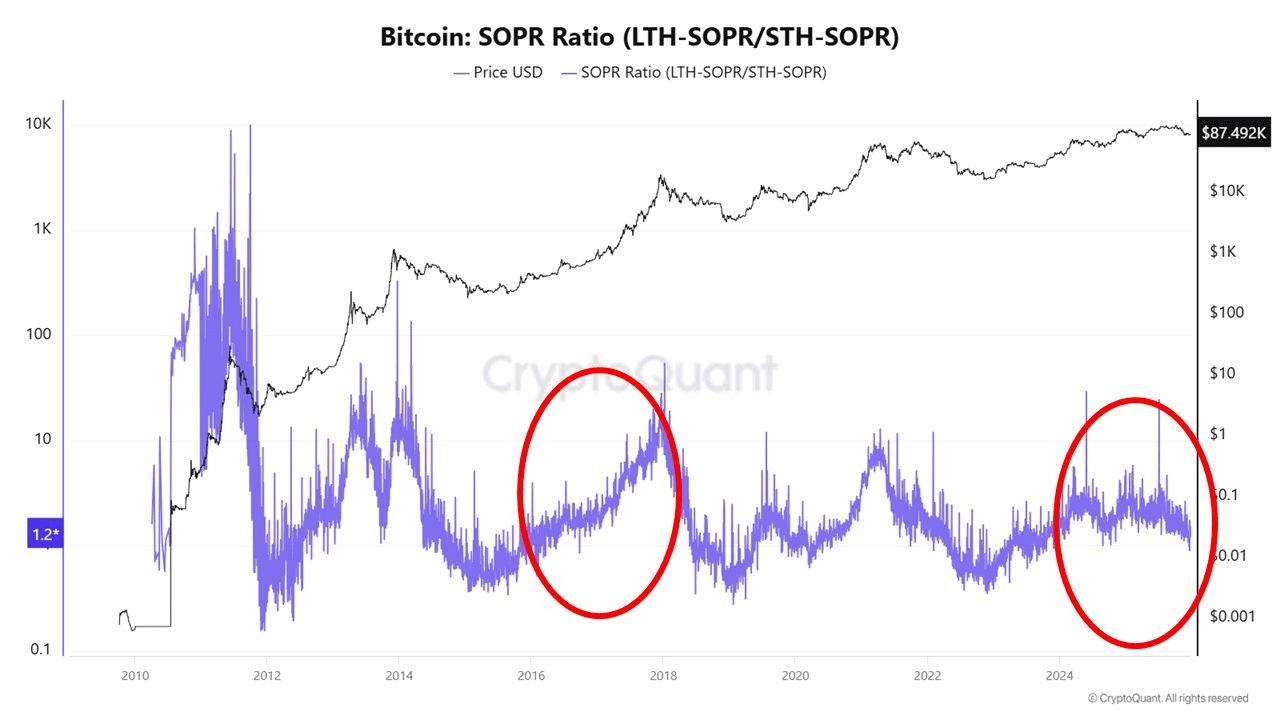
Source: CryptoQuant

Based on historical data, it becomes clear that Bitcoin is currently within a fundamentally bearish structure. Although XWIN Research elucidates that “as long as long-term holders maintain relative dominance and short-term holder selling is absorbed, downside may be supported,” but this came with a caveat that upside leadership would likely also remain restricted.

The analytics group further conjectures that a stable growth of Bitcoin ETF inflows, alongside a clear depreciation in LTH distribution, would be pivotal in rescuing BTC from its downward spiral. Until these happen simultaneously, bitcoin might remain in its current state of inertia, or — in the worst case — dive further south. At press time, Bitcoin holds a valuation of about $87,623, recording a slight 0.5% loss since the past week, and a 0.6% ascent since the last 24 hours, according to CoinMarketCap data.

BTC trading at $87,637 on the daily chart | Source: BTCUSDT chart on Tradingview.com

Связанные с этим вопросы

QAccording to the analyst, why is Bitcoin's price action after the 2024 election different from the post-2016 election euphoria?

AThe market environment is fundamentally different. In 2016, the market operated in a low-inflation, low-interest-rate environment ideal for liquidity growth, and the crypto market's small size allowed for quick speculative capital accumulation. In contrast, 2025 began in a high-rate period with crippling financial conditions, and the larger market size has structurally reduced the standalone impact of political events on price.

QWhat does the Bitcoin SOPR Ratio (LTH-SOPR/STH-SOPR) indicate about current market sentiment?

AThe ratio indicates a cautious stance among investors. It shows that long-term holders (LTHs) are realizing limited profits, while short-term holders (STHs) are trading at a loss. This condition historically occurs when the market is about to enter a prolonged period of demand-supply adjustments.

QWhat two key factors does the analytics group suggest are needed to rescue BTC from its downward spiral?

AThe two pivotal factors are a stable growth of Bitcoin ETF inflows and a clear depreciation in long-term holder (LTH) distribution. Both need to happen simultaneously for a recovery.

QWhat is the current fundamental structure of the Bitcoin market, as per the historical data presented?

ABased on historical data, Bitcoin is currently within a fundamentally bearish structure.

QWhat is the caveat to the analyst's statement that the downside may be supported?

AThe caveat is that while the downside may be supported as long as LTHs maintain dominance and STH selling is absorbed, upside leadership would also likely remain restricted.

Похожее

From Robinhood to Polymarket: Is the Era of Integrating All Assets on a Single Platform Coming?

From Robinhood to Polymarket: The Era of All-in-One Asset Platforms Is Coming Asset classes are rapidly converging. Platforms that once specialized in single categories—such as stocks, cryptocurrencies, or prediction markets—are now moving toward offering all three. Robinhood pioneered this model, starting with equities, adding crypto in 2018, and prediction markets in 2025. This strategy has proven resilient: when crypto revenues fell, other segments like options and stocks filled the gap. Now, prediction market leaders Polymarket and Kalshi are moving in the same direction, both announcing perpetual futures trading on April 21, 2026, pending regulatory approval. These futures will cover assets like Bitcoin, gold, and stocks such as Nvidia. This trend mirrors the consolidation seen in consumer tech, like smartphones replacing dedicated cameras and MP3 players. Younger users, accustomed to interacting with multiple asset types from an early age, will increasingly demand unified platforms. A key competitive advantage in prediction markets is collateral utilization—idle assets locked during betting periods. Polymarket’s move into perpetuals may be a strategy to generate yield from that capital, similar to earlier DeFi integrations like PolyAave. As the regulatory landscape evolves, traditional finance is also likely to incorporate crypto and prediction markets, further accelerating this convergence.

marsbit14 мин. назад

From Robinhood to Polymarket: Is the Era of Integrating All Assets on a Single Platform Coming?

marsbit14 мин. назад

OpenAI Goes Left, DeepSeek Goes Right

On April 24, 2026, DeepSeek released V4, a Chinese large language model offering a free "million-token context window," enabling it to process vast amounts of data like entire books or years of corporate documents in one go. In contrast, OpenAI’s GPT-5.5, released around the same time, is more powerful but significantly more expensive, charging up to $180 per million output tokens. DeepSeek’s strategy represents a shift from a pure AI research firm to a heavy-infrastructure player, building data centers in Inner Mongolia’s Ulanqab to bypass U.S. chip export restrictions. This move, supported by Huawei’s Ascend chips and China’s cheap green electricity, highlights a fundamental divergence in AI development models: U.S. firms focus on high-cost, high-margin services, while Chinese players like DeepSeek prioritize accessibility and affordability. Facing intense talent poaching from tech giants, DeepSeek is seeking a $44 billion valuation funding round to retain researchers and scale infrastructure. Meanwhile, Chinese manufacturers are compressing AI models to run on smartphones, making AI accessible offline and across the Global South. Through open-source models and localized solutions, Chinese AI is empowering non-English speakers and low-income users, driving a form of "digital equality." While Silicon Valley builds walled gardens, DeepSeek and others are turning AI into a public utility—like tap water—flowing freely to those previously left behind.

marsbit40 мин. назад

OpenAI Goes Left, DeepSeek Goes Right

marsbit40 мин. назад

$292 Million KelpDAO Cross-Chain Bridge Hack: Who Should Foot the Bill?

On April 18, 2026, an attacker stole 116,500 rsETH (worth ~$292M) from KelpDAO’s cross-chain bridge in 46 minutes—the largest DeFi exploit of 2026. The stolen assets were deposited into Aave V3 as collateral, causing $177–200M in bad debt and triggering a cascade of losses across nine DeFi protocols. Aave’s TVL dropped by ~$6B overnight. This legal analysis argues that KelpDAO and LayerZero Labs share concurrent liability, with fault apportioned 60%/40%. KelpDAO negligently configured its bridge with a 1-of-1 decentralized verifier network (DVN)—a single point of failure—despite LayerZero’s explicit recommendation of a 2-of-3 setup. LayerZero, which operated the compromised DVN, failed to secure its RPC infrastructure against a known poisoning attack vector. Both protocols’ terms of service cap liability at $200 (KelpDAO) or $50 (LayerZero), but these limits are likely unenforceable due to unconscionability, gross negligence exceptions, and potential securities law invalidation (if rsETH is deemed a security under the Howey test). Aave’s governance also faces fiduciary duty claims for raising rsETH’s loan-to-value ratio to 93%—far above competitors’ 72–75%—without adequately assessing bridge risks, amplifying the systemic fallout. Practical recovery targets include LayerZero Labs (a registered Canadian entity), KelpDAO’s founders, auditors, and identifiable Aave governance delegates. The incident underscores escalating legal risks for DeFi protocols, infrastructure providers, and governance participants.

marsbit1 ч. назад

$292 Million KelpDAO Cross-Chain Bridge Hack: Who Should Foot the Bill?

marsbit1 ч. назад

Торговля

Спот
Фьючерсы

Популярные статьи

Как купить S

Добро пожаловать на HTX.com! Мы сделали приобретение Sonic (S) простым и удобным. Следуйте нашему пошаговому руководству и отправляйтесь в свое крипто-путешествие.Шаг 1: Создайте аккаунт на HTXИспользуйте свой адрес электронной почты или номер телефона, чтобы зарегистрироваться и бесплатно создать аккаунт на HTX. Пройдите удобную регистрацию и откройте для себя весь функционал.Создать аккаунтШаг 2: Перейдите в Купить криптовалюту и выберите свой способ оплатыКредитная/Дебетовая Карта: Используйте свою карту Visa или Mastercard для мгновенной покупки Sonic (S).Баланс: Используйте средства с баланса вашего аккаунта HTX для простой торговли.Третьи Лица: Мы добавили популярные способы оплаты, такие как Google Pay и Apple Pay, для повышения удобства.P2P: Торгуйте напрямую с другими пользователями на HTX.Внебиржевая Торговля (OTC): Мы предлагаем индивидуальные услуги и конкурентоспособные обменные курсы для трейдеров.Шаг 3: Хранение Sonic (S)После приобретения вами Sonic (S) храните их в своем аккаунте на HTX. В качестве альтернативы вы можете отправить их куда-либо с помощью перевода в блокчейне или использовать для торговли с другими криптовалютами.Шаг 4: Торговля Sonic (S)С легкостью торгуйте Sonic (S) на спотовом рынке HTX. Просто зайдите в свой аккаунт, выберите торговую пару, совершайте сделки и следите за ними в режиме реального времени. Мы предлагаем удобный интерфейс как для начинающих, так и для опытных трейдеров.

1.2k просмотров всегоОпубликовано 2025.01.15Обновлено 2025.03.21

Как купить S

Sonic: Обновления под руководством Андре Кронье – новая звезда Layer-1 на фоне спада рынка

Он решает проблемы масштабируемости, совместимости между блокчейнами и стимулов для разработчиков с помощью технологических инноваций.

2.2k просмотров всегоОпубликовано 2025.04.09Обновлено 2025.04.09

Sonic: Обновления под руководством Андре Кронье – новая звезда Layer-1 на фоне спада рынка

HTX Learn: Пройдите обучение по "Sonic" и разделите 1000 USDT

HTX Learn — ваш проводник в мир перспективных проектов, и мы запускаем специальное мероприятие "Учитесь и Зарабатывайте", посвящённое этим проектам. Наше новое направление .

1.8k просмотров всегоОпубликовано 2025.04.10Обновлено 2025.04.10

HTX Learn: Пройдите обучение по "Sonic" и разделите 1000 USDT

Обсуждения

Добро пожаловать в Сообщество HTX. Здесь вы сможете быть в курсе последних новостей о развитии платформы и получить доступ к профессиональной аналитической информации о рынке. Мнения пользователей о цене на S (S) представлены ниже.

活动图片















