Why Are XRP ETF Inflows Growing While Bitcoin And Ethereum Are Bleeding?

bitcoinistОпубликовано 2026-06-02Обновлено 2026-06-02

Введение

On-chain data reveals a divergence in crypto ETF flows: XRP-focused funds are attracting steady inflows while Bitcoin and Ethereum ETFs are experiencing sustained outflows. Since May 20, U.S.-listed XRP ETFs have seen approximately $35 million in inflows, extending a streak of 17 consecutive days without outflows. In stark contrast, Bitcoin and Ethereum ETFs have faced combined outflows nearing $2 billion over the same period, with Bitcoin funds now in their 11th straight day of withdrawals. Analyst CryptoKrali suggests this shift indicates institutional capital is becoming more selective, favoring XRP due to narratives around regulatory positioning and potential treasury demand, despite XRP's price remaining muted and falling over 6% in the past week. The trend highlights a move away from broad market-cap investments toward specific asset narratives.

On-chain data shows that XRP exchange-traded funds (ETFs) have continued to attract steady inflows, while Bitcoin and Ethereum ETFs have recorded consecutive days of outflows. The difference in fund flows and investor demand suggests that institutions and large players are increasingly favoring the altcoin exposure over Bitcoin and Ethereum despite their waning price action. At the same time, a crypto analyst has offered deeper insights into why demand for the three crypto ETFs has diverged so sharply, with Bitcoin ETFs recording the highest volume of outflows among the three.

Why XRP ETFs Are Outperforming Bitcoin And Ethereum ETFs

Market analyst CryptoKrali has pointed to a growing split in crypto ETF flows. He said that XRP-focused funds are seeing steady inflows while Bitcoin and Ethereum ETFs continue to face outflows.

In a post shared on X, CryptoKrali noted that while Bitcoin and Ethereum ETFs saw heavy selling pressure through the end of May, XRP-linked products saw steady inflows. He described the trend as a clear shift in how institutional capital is being allocated across major crypto assets.

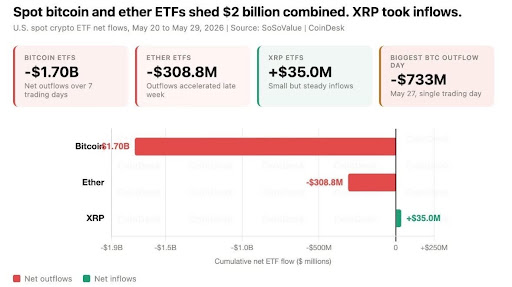
According to the analyst’s cited data, U.S.-listed XRP ETFs saw another wave of inflows over the past week, lifting total inflows since May 20 to about $35 million. In contrast, Bitcoin and Ethereum ETF products reportedly recorded combined outflows close to $2 billion over the same period.

Source: Chart from CryptoKrali on X

CryptoKrali explained that the massive gap in fund flows reflects a cooling of demand for exposure to Bitcoin and Ethereum. He added that the altcoin continues to attract significant attention from institutions due to separate market narratives tied to regulatory positioning, ETF expansion, and possible treasury-style demand, circulating among traders.

Despite recent steady inflows, the XRP price action has remained relatively muted, with the price trading flat. Not only has the cryptocurrency failed to reflect the same momentum seen in its ETF demand, but its price has also crashed below $1.3, reflecting a more than 6% decline over the past week.

Meanwhile, CryptoKrali added that market participants are also watching older speculation around a potential XRP treasury structure linked to Ripple. However, no official updates have confirmed any active development on those bullish updates.

Overall, the ETF flow patterns among XRP, Bitcoin, and Ethereum suggest that capital is becoming more selective among institutions. Investors are no longer rotating broadly into top market-cap assets. Instead, they are targeting specific narratives showing relative strength.

Latest Update On XRP, Bitcoin, And Ethereum ETFs

According to data from SoSoValue, XRP ETFs have recorded another day of inflows, extending the streak to 17 consecutive days with no outflows. The fund added about $4.13 million on June 1, bringing its cumulative total net inflow to $1.43 billion.

In contrast, Spot Bitcoin ETFs have now entered their 11th straight day of outflows. About $483.7 million in funds were raised on June 1, pushing the ETFs’ cumulative total net inflow down to $55.1 billion.

Ethereum ETFs are facing a similar trend, recording their 15th consecutive day of outflows. Around $44.4 million was withdrawn on June 1, reducing the cumulative total net inflow to $11.3 billion.

XRP trading at $1.26 on the 1D chart | Source: XRPUSDT on Tradingview.com

Связанные с этим вопросы

QAccording to the article, what is the main difference in fund flow trends between XRP ETFs and Bitcoin/Ethereum ETFs in late May and early June?

AXRP ETFs have seen steady inflows for 17 consecutive days with no outflows, while Bitcoin and Ethereum ETFs have experienced consecutive days of outflows, with Bitcoin ETFs recording the highest volume of outflows.

QWhat reasons does the analyst CryptoKrali give for the divergence in demand between XRP, Bitcoin, and Ethereum ETFs?

ACryptoKrali points to a cooling demand for exposure to Bitcoin and Ethereum, while XRP continues to attract institutional attention due to narratives around regulatory positioning, ETF expansion, and possible treasury-style demand linked to Ripple.

QWhat was the cumulative total net inflow for XRP ETFs as of June 1st, according to data from SoSoValue?

AThe cumulative total net inflow for XRP ETFs was $1.43 billion as of June 1st.

QDespite strong ETF inflows, how has the price of XRP performed recently?

AThe price of XRP has remained relatively muted and traded flat. It crashed below $1.3, reflecting a more than 6% decline over the past week, failing to reflect the same momentum seen in its ETF demand.

QWhat does the article suggest about the current behavior of institutional capital in the crypto market based on the ETF flow patterns?

AThe article suggests that institutional capital is becoming more selective. Investors are no longer rotating broadly into top market-cap assets like Bitcoin and Ethereum but are instead targeting specific narratives, like those surrounding XRP, that show relative strength.

Похожее

Can DeepSeek Save China One Trillion Dollars?

"DeepSeek and the $1 Trillion Infrastructure Question" The article examines whether DeepSeek's AI optimization breakthroughs could potentially save China $1 trillion in future AI infrastructure costs. The analysis begins with Nvidia's upcoming Vera Rubin AI platform, costing ~$7.8 million, where memory (HBM4/LPDDR5X) constitutes $2 million—a 435% cost increase in one year, highlighting how AI hardware spending is shifting toward expensive memory components. DeepSeek's approach works in the opposite direction. Through three key technical innovations showcased in DeepSeek V4, the company dramatically improves hardware efficiency: 1. **Memory Compression (MLA)**: Re-engineers the attention mechanism to compress long-context memory (KV Cache) by over 90%, drastically reducing expensive HBM usage. 2. **Selective Activation (MoE)**: Employs Mixture-of-Experts architecture where only a small fraction of parameters (e.g., 49B out of 1.6T in V4-Pro) are activated per token, allowing most parameters to reside in cheaper memory/SSD. 3. **Computation Caching**: Reuses previously computed results via cache hits, replacing expensive GPU computations with cheap memory reads. Combined, these optimizations allow the same hardware to produce approximately 4x more tokens, effectively reducing required hardware investment by 75%. DeepSeek's pricing reflects this: a 10-billion token workload costs ~$522 monthly versus ~$9,000-$10,000 for competitors. The $1 trillion savings projection stems from McKinsey's estimate that global AI infrastructure will require ~$5.2 trillion investment by 2030. As China's daily token consumption grows toward quadrillions, even marginal efficiency gains scale massively. With a conservative 4x throughput improvement, China could avoid building tens of thousands of AI data centers equivalent to ~7 trillion RMB ($1 trillion) in saved investment. Critically, this strategy shifts dependency from scarce, expensive GPU/HBM—where China lags—toward more accessible storage, caching, and systems engineering where domestic suppliers like CXMT are gaining strength. Rather than "replacing Nvidia," DeepSeek rebalances AI's value chain away from monolithic hardware dependency. Ultimately, DeepSeek's technical breakthroughs could lower the barrier to AI adoption across Chinese industries by making advanced capabilities affordable at scale—transforming who can access next-generation AI.

marsbit15 мин. назад

Can DeepSeek Save China One Trillion Dollars?

marsbit15 мин. назад

Overturning the Mainstream Approach to Hallucinations: Metacognition is the New Solution for Large Models to Break the Hallucination Barrier

This paper, "Hallucinations Undermine Trust; Metacognition is a Way Forward," proposes a paradigm shift in combating AI hallucination. It argues that the current mainstream approaches—striving for omniscience by scaling data/models or having AI abstain from uncertain answers—are fundamentally flawed. The former has inevitable knowledge gaps, while the latter imposes a crippling "utility tax," requiring the rejection of many correct answers to achieve high accuracy, due to models' poor "discrimination" (the ability to distinguish correct from incorrect answers internally). The core contribution is redefining hallucination not as "being wrong," but as "expressing false information with unwarranted certainty." The proposed solution is **Faithful Uncertainty** or **Metacognition**: enabling AI to accurately perceive its internal uncertainty and honestly express it in its language (e.g., using hedging phrases when unsure). This creates a more reliable assistant that provides useful information while signaling its confidence, minimizing harm from errors. The paper emphasizes that metacognition is critical for the era of AI Agents. Without it, Agents cannot intelligently decide when to use tools like search engines, leading to inefficiency and misuse. Key implementation challenges are highlighted: the "bootstrapping paradox" of training with static uncertainty data, the "alignment distortion signal" where human preference training suppresses internal uncertainty cues, and the difficulty of causally evaluating true metacognition vs. its superficial imitation. The paper concludes that the goal should not be an infallible AI, but one that is honest about the limits of its knowledge, thereby building user trust through transparent communication of its certainty.

marsbit19 мин. назад

Overturning the Mainstream Approach to Hallucinations: Metacognition is the New Solution for Large Models to Break the Hallucination Barrier

marsbit19 мин. назад

Hedge by Buying Gold and Oil, Chase Soaring Returns with AI. ‘Dated’ Bitcoin Enters a Bear Market

Bitcoin has recently declined, hitting a two-month low near $66,123, while Ethereum fell to a three-month low around $1,837. Analysts suggest the drop is not merely due to factors like ETF outflows or MicroStrategy's selling but reflects a deeper issue: Bitcoin is losing a broader asset competition. In a near-zero interest rate environment, Bitcoin previously thrived as an outlet for investor dissatisfaction with inflation and limited options. However, the market landscape has shifted. Bitcoin now occupies an "awkward middle ground," facing competition on three fronts. For inflation hedging, investors prefer gold, energy stocks, and commodity producers—assets with tangible backing and clearer pricing power. For growth exposure, AI-related companies with actual revenues and profits are more attractive. Even within crypto, investors can choose stablecoins, exchanges, or infrastructure firms tied directly to adoption, offering clearer business models and leverage. Thus, Bitcoin is no longer the top choice for hedging, growth, or crypto exposure. This shift is evident in market reactions: despite recent warnings about persistent inflation from a Fed official, Bitcoin did not rally as it might have in the past. Instead, capital flowed to assets with direct commodity or energy exposure. The recent ETF outflows and MicroStrategy sales are symptoms, not causes, of this new reality. Investors are becoming more selective, demanding clearer value propositions beyond mere scarcity. The emerging bear case for Bitcoin is not about it being a bubble or failed technology, but that scarcity alone is no longer sufficient.

华尔街日报22 мин. назад

Hedge by Buying Gold and Oil, Chase Soaring Returns with AI. ‘Dated’ Bitcoin Enters a Bear Market

华尔街日报22 мин. назад

Торговля

Спот
Фьючерсы

Популярные статьи

Тест по Bitcoin Биткоина

HTX Learn: Изучите Bitcoin halving и Заработаете Токены USDT

3.1k просмотров всегоОпубликовано 2024.04.16Обновлено 2024.04.16

Тест по Bitcoin  Биткоина

Что такое $BITCOIN

ЦИФРОВОЕ ЗОЛОТО ($BITCOIN): Комплексный анализ Введение в ЦИФРОВОЕ ЗОЛОТО ($BITCOIN) ЦИФРОВОЕ ЗОЛОТО ($BITCOIN) — это проект на основе блокчейна, работающий в сети Solana, который стремится объединить характеристики традиционных драгоценных металлов с инновациями децентрализованных технологий. Хотя он носит имя Биткойн, часто называемого “цифровым золотом” из-за его восприятия как средства хранения ценности, ЦИФРОВОЕ ЗОЛОТО является отдельным токеном, предназначенным для создания уникальной экосистемы в ландшафте Web3. Его цель — позиционировать себя как жизнеспособный альтернативный цифровой актив, хотя детали его применения и функциональности все еще развиваются. Что такое ЦИФРОВОЕ ЗОЛОТО ($BITCOIN)? ЦИФРОВОЕ ЗОЛОТО ($BITCOIN) — это токен криптовалюты, специально разработанный для использования в блокчейне Solana. В отличие от Биткойна, который выполняет широко признанную роль хранения ценности, этот токен, похоже, сосредоточен на более широких приложениях и характеристиках. Примечательные аспекты включают: Инфраструктура блокчейна: Токен построен на блокчейне Solana, известном своей способностью обрабатывать высокоскоростные и недорогие транзакции. Динамика предложения: ЦИФРОВОЕ ЗОЛОТО имеет максимальное предложение, ограниченное 100 квадриллионами токенов (100P $BITCOIN), хотя детали о его обращающемся предложении в настоящее время не раскрыты. Утилита: Хотя точные функциональные возможности не описаны, есть указания на то, что токен может быть использован для различных приложений, потенциально связанных с децентрализованными приложениями (dApps) или стратегиями токенизации активов. Кто создатель ЦИФРОВОГО ЗОЛОТА ($BITCOIN)? На данный момент личность создателей и команды разработчиков, стоящих за ЦИФРОВЫМ ЗОЛОТОМ ($BITCOIN), остается неизвестной. Эта ситуация типична для многих инновационных проектов в области блокчейна, особенно тех, которые связаны с децентрализованными финансами и феноменом мем-криптовалют. Хотя такая анонимность может способствовать культуре, ориентированной на сообщество, она усиливает опасения по поводу управления и ответственности. Кто инвесторы ЦИФРОВОГО ЗОЛОТА ($BITCOIN)? Доступная информация указывает на то, что у ЦИФРОВОГО ЗОЛОТА ($BITCOIN) нет известных институциональных спонсоров или значительных венчурных капиталовложений. Проект, похоже, функционирует по модели пирингового взаимодействия, сосредоточенной на поддержке и принятии сообществом, а не на традиционных путях финансирования. Его активность и ликвидность в основном сосредоточены на децентрализованных биржах (DEX), таких как PumpSwap, а не на устоявшихся централизованных торговых платформах, что еще больше подчеркивает его подход, ориентированный на grassroots. Как работает ЦИФРОВОЕ ЗОЛОТО ($BITCOIN) Операционные механизмы ЦИФРОВОГО ЗОЛОТА ($BITCOIN) можно подробно описать на основе его дизайна блокчейна и характеристик сети: Механизм консенсуса: Используя уникальный механизм доказательства истории (PoH) Solana в сочетании с моделью доказательства доли (PoS), проект обеспечивает эффективную валидацию транзакций, что способствует высокой производительности сети. Токеномика: Хотя конкретные дефляционные механизмы не были подробно описаны, большое максимальное предложение токенов подразумевает, что оно может быть предназначено для микротранзакций или нишевых случаев использования, которые еще предстоит определить. Интероперабельность: Существует потенциал для интеграции с более широкой экосистемой Solana, включая различные платформы децентрализованных финансов (DeFi). Однако детали относительно конкретных интеграций остаются неуточненными. Хронология ключевых событий Вот хронология, которая подчеркивает значимые вехи, касающиеся ЦИФРОВОГО ЗОЛОТА ($BITCOIN): 2023: Первоначальное развертывание токена происходит в блокчейне Solana, отмеченное его адресом контракта. 2024: ЦИФРОВОЕ ЗОЛОТО приобретает видимость, когда оно становится доступным для торговли на децентрализованных биржах, таких как PumpSwap, позволяя пользователям обменивать его на SOL. 2025: Проект наблюдает спорадическую торговую активность и потенциальный интерес к инициативам, возглавляемым сообществом, хотя на данный момент не зафиксировано никаких значительных партнерств или технических достижений. Критический анализ Сильные стороны Масштабируемость: Основная инфраструктура Solana поддерживает высокие объемы транзакций, что может повысить полезность $BITCOIN в различных сценариях транзакций. Доступность: Потенциально низкая цена торговли за токен может привлечь розничных инвесторов, способствуя более широкому участию благодаря возможностям дробного владения. Риски Отсутствие прозрачности: Отсутствие публично известных спонсоров, разработчиков или процесса аудита может вызвать скептицизм относительно устойчивости и надежности проекта. Волатильность рынка: Торговая активность сильно зависит от спекулятивного поведения, что может привести к значительной волатильности цен и неопределенности для инвесторов. Заключение ЦИФРОВОЕ ЗОЛОТО ($BITCOIN) является интригующим, но неоднозначным проектом в быстро развивающейся экосистеме Solana. Хотя он пытается использовать нарратив “цифрового золота”, его отход от установленной роли Биткойна как средства хранения ценности подчеркивает необходимость более четкого различения его предполагаемой утилиты и структуры управления. Будущее принятие и усвоение, вероятно, будут зависеть от решения текущей непрозрачности и более четкого определения его операционных и экономических стратегий. Примечание: Этот отчет охватывает синтезированную информацию, доступную на октябрь 2023 года, и с тех пор могут произойти события.

99 просмотров всегоОпубликовано 2025.05.13Обновлено 2025.05.13

Что такое $BITCOIN

Fractal Bitcoin: масштабирование Биткоина с помощью рекурсивной системы

Fractal Bitcoin — масштабное Layer-1-решнение, созданное на базе кода Биткоина, позволяющего достигать бесконечного масштабирования с помощью рекурсивного подхода.

2.3k просмотров всегоОпубликовано 2025.06.30Обновлено 2025.06.30

Fractal Bitcoin: масштабирование Биткоина с помощью рекурсивной системы

Обсуждения

Добро пожаловать в Сообщество HTX. Здесь вы сможете быть в курсе последних новостей о развитии платформы и получить доступ к профессиональной аналитической информации о рынке. Мнения пользователей о цене на BTC (BTC) представлены ниже.

活动图片