The information flow is too fast, and in-depth analysis articles are easily drowned out by hot topics. The 'Weekly Editor's Picks' column rescues this judgment-worthy content from the vast sea of information, filtering out the noise for you, leaving behind insights, and bringing inspiration.

Macro Situation
Has a Global Economic Recession Quietly Begun?
The author redefines recession from an 'economic outcome' to a 'strategic state.' It not only compresses growth and employment but also weakens a country's negotiating power, capital attractiveness, and external credibility, thereby losing the initiative in global games. Precisely because of this, governments are using fiscal, diplomatic, and even geopolitical means to replace monetary tools, essentially buying time for the growth slowdown and avoiding being forced to negotiate during a recession.
Under this framework, the market's core is no longer the interest rate path itself, but 'who can break free from constraints, and who remains trapped.'
This difference is first reflected in the foreign exchange and interest rate markets and further transmitted to asset prices and capital flows. When valuations continue to rise amid slowing growth, it may not be due to improved fundamentals but rather policy expectations that 'a recession will not be allowed to happen.'
Buffett's First Interview After Stepping Down: Now is Not the Time to Buy the Dip, Nuclear Weapons Will Be Used Sooner or Later
Sold Apple too early, but not buying now either.
Will not buy the dip in US stocks at this time.
The most dangerous situation is when the person with the nuclear button is about to die or is facing immense disgrace. In such a predicament, no one can predict what decision a person will make. Within the next hundred, maybe two hundred years, nuclear weapons will be used.
$700 Billion Poured into AI, Americans Taste the Bitter Fruit of Inflation First
The more AI investment, the higher the inflation, the further away rate cuts are, the higher the financing costs—but investment is still accelerating.
The arms race among big tech companies can no longer stop. One data center consumes as much electricity as an entire state.
$700 billion is pouring into AI infrastructure. Whether this money is the cause of inflation or the prelude to a productivity revolution depends on a question no one can yet answer: Will the models running in these data centers actually make the economy more efficient?
Conversation with Pantera Founder: Bitcoin Has Reached Escape Velocity, Traditional Assets Are Being Left Behind
It's not that gold hit a new high; it's that fiat currency is hitting a historic low.
The average age of first-time homebuyers in the US has already been delayed from 28 to 40.
We are facing a generational inflection point of monetary and state separation. Stablecoins are highly likely to take half of bank deposits within a decade. Bitcoin has reached escape velocity.
Investment & Entrepreneurship
Interviewing 10 Dubai Workers: Some Were Asked to Sign a "Life and Death Waiver"
On a practical level, Dubai is already in the midst of a battlefield.
Some Web3 workers are fleeing, some are holding fast, and others are signing waivers (company disclaimer) to return to Dubai, hoping to bet on high career returns amidst high risks.
The 've' Token Model 'Ebb Tide': Why Are Three Major Protocols Voluntarily Abandoning Their Former Trump Card?
The reason is not a theoretical error, but a failure in execution: low participation rates, captured governance rights, emissions flowing into unprofitable pools, token prices plummeting while usage grows.
Meanwhile, Curve's veCRV and Aerodrome's ve(3,3) are still healthy. But this model only works where the guided emissions can create real economic demand for liquidity.
Other protocols are choosing revenue-supported buybacks, deflationary supply mechanisms, or liquid governance tokens as alternatives to the ve token model.
Tiger Research: Analysis of the Current Situation of Retail Investors in Nine Major Asian Markets
Tiger Research covers 9 Asian markets with the largest user bases, analyzing barriers to entry for retail investors and exchange coping strategies. Core finding: Structural entry barrier differences exist in markets like South Korea, Japan, and Vietnam, and exchange localization strategy is a key variable for success. Valuable reference for projects looking at Southeast Asia expansion.
Also recommended: Odaily Interview with SharpLink: Ethereum's 'Productive Capitalist'.
Web3 & AI
What Exactly Are AI Agents Doing? Full Analysis of the 500k Line Claude Code Leak
The competitive moat for AI products may not be at the model layer, but at the engineering layer.
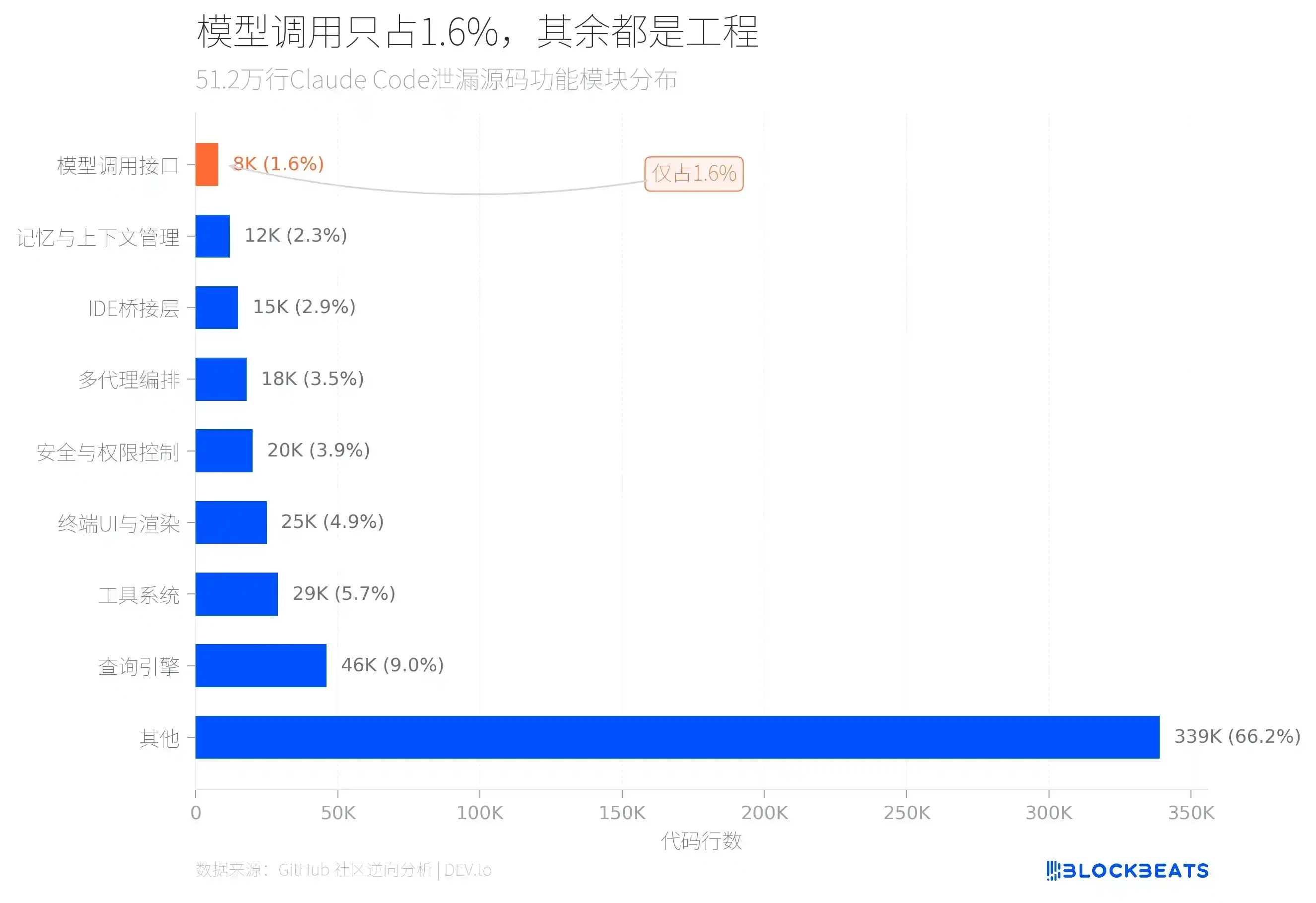
For AI products, model inference costs might not be the most expensive layer; failed cache management is.
Chased AI Tools for a Year, Zero Output: Reflections of a Serial Entrepreneur
Don't mistake 'trying new tools' for 'building something real.' When everyone can use the same models, the only moat is taste and depth, and taste can only be earned through real consequences and sustained focus.
Tiger Research: What AI Services Do Crypto Companies Offer?
Adoption motives vary by细分行业 (sub-sector): exchanges aim to prevent user churn; security companies aim to fill audit blind spots; payment infrastructure targets the emerging agent economy.
The "FOMO" and competitive pressure in the AI field are accelerating its application, far exceeding actual demand. Both real demand and competitive anxiety are at play.
Distinguishing between value-creating adoption and mere label-sticking adoption is the key question.
Prediction Markets
Only 43% Return on $1, Why Are 87% of Polymarket Players Losing Money?
"Longshot bias" is one of the most expensive mistakes in prediction markets. Traders often systematically overestimate low-probability events, paying too high a price for seemingly cheap contracts.
The traders who truly outperform prediction markets in the long run are not necessarily those with the "most accurate judgment," but those who can adjust their judgment the fastest and most reasonably when new evidence appears.
The Bayesian method essentially provides a scale for this "adjustment speed."
Stop Betting on Gut Feeling: AI is 'Picking Up Money' on Polymarket
The article introduces a method to identify arbitrage opportunities on Polymarket and execute them systematically: use Perplexity to complete research, locate the偏差 (deviation) between data and market pricing; use Claude to build trading logic, control risk, and execute automatically; finally, complete the trade and realize profits on Polymarket.
For ordinary participants, a more realistic path is to first find certainty through research, and then use systems to amplify gains.
Also recommended: Polymarket Smart Money Panorama: 26 Long-Term Trackable Addresses (Broken Down by Sector).
CeFi & DeFi
Stripe Up, PayPal Down: The New King of Payments Ascends
Stripe's judgment is straightforward: when AI Agents start making purchasing decisions for humans, whoever masters the payment channel抢先 (seizes first) masters the core lifeline of the AI economy. Stripe's超前 (forward-looking) vision puts it ahead of the entire payments industry.
PayPal, however, is步履蹒跚 (stumbling). PayPal's business model relies on "fund flow handling fees," while the stablecoin business model relies on "earning treasury interest on settled assets." There is a natural conflict between these two logics—every time PayPal promotes a PYUSD stablecoin payment, it is, to some extent, cannibalizing its own traditional fee income. This is a difficult problem to solve within PayPal's existing business framework.
BTC is Dying, Why Did HYPE Defy the Trend and Surge 20%?
The RWA trading market enabled by HIP-3 for Hyperliquid provides new value support.
Detailed Explanation of Hyperliquid HIP-4: Using Prediction Markets and Options Trading to Encroach on Traditional Finance
The market overall is in a downward trend, yet HYPE has shown极强的 (extremely strong) stability. The important reason is undoubtedly Hyperliquid's robust fundamentals, focus on generating revenue, and continuous use of profits to buy back HYPE.
HIP-3 (the perpetual contract market deployed by builders) has already shown a clear pattern: when the infrastructure is permissionless and already market-validated, liquidity tends to aggregate towards stronger teams, regardless of whether they receive additional ecosystem support.
The same logic will apply to HIP-4. HIP-4 focuses on "outcome trading," which will introduce prediction markets and certain types of options to Hyperliquid—these products can provide non-linear income outcomes without liquidation risk.
No protocol in the past was good enough to truly bring sustainable options trading into the crypto world. Hyperliquid has done it, and its approach is different from every other platform. This platform has no investors, is free from any external pressure, and Jeff can freely decide what the company wants to do. In this regard, Hyperliquid is very much like Telegram—it doesn't need to spend much money on marketing; the key is the belief itself. If the product is good enough, people will eventually come to use it.
Hyperliquid has a chance to capture the entire cryptocurrency options market.
Winners will build products truly面向 (oriented towards) the real world, embedding cryptocurrency as an underlying implementation detail; losers will continue to cling to the old narrative of "crypto for crypto's sake" and expect the world to adapt to them instead.
Airdrop Opportunities and Interaction Guides
Popular Interaction Collection | New Abstract Badge Task; Noise Beta Version Launched (April 2nd)
Meme
Post-00s Earning A7 Monthly, Trapped Between Three Screens
Odaily interviewed Meme P youngsters who still achieved great results in 2026, and former Meme diamond hands, to understand their ways of making money and their work lives.
Bitcoin
Losing $19K per Mined Coin, Bitcoin Miners Collectively Defect to AI
The latest mining report from CoinShares shows that the weighted average cost for listed mining companies to mine one Bitcoin has risen to about $80,000, while the current BTC price is $68K-70K—a loss of $19K per coin mined.
The Bitcoin mining industry is undergoing its most fundamental transformation since its inception. The clearest signal is not hash rate or difficulty adjustment, but the balance sheet, and the way out is a comprehensive shift towards AI infrastructure.
When Bitcoin Miners Fly into Space
For currently operating Bitcoin mining companies, space mining does not pose an immediate competitive threat in the short term, but a large number of startups continue to try. This also shows that the significant cost reduction space it represents still holds great attraction and imagination for the industry. This also侧面反映出 (reflects from the side) that the entire industry is under structural cost pressure.
The logic of space mining is an ultimate extrapolation of the above trend: if cheap electricity on the ground will eventually narrow due to demand competition, then go to the place with the most abundant energy, which is the universe.
Security
Major Google Quantum Computing Breakthrough, The Crypto World Needs to 'Change Locks' Early
The Google quantum research team (Google Quantum AI), led by world-renowned quantum circuit expert Craig Gidney and others, recently made two moves.
First, on March 25th, Google formally proposed its post-quantum cryptography (PQC) migration timeline, targeting 2029. Second, on March 31st, Google Quantum AI specifically released a research report aimed at the cryptocurrency industry,直言 (stating bluntly) that according to the latest research, the resources required for future quantum computers to crack the elliptic curve cryptography protecting cryptocurrencies are far less than previously thought.
The industry's past judgment about the timeline needs correction. Google has set its own migration target for 2029, and Google Quantum AI also mentioned in the article that it is working with institutions like Coinbase, the Stanford Blockchain Research Institute, and the Ethereum Foundation to responsibly advance according to the 2029 timeline plan.
For every crypto project, this意味着 (means) a new security watershed. Those who can admit the problem earlier, promote upgrades, and complete the "lock change" will have a better chance of preserving their security boundaries in the next era.
Also recommended: Odaily Interview with Yu Xian: How Does the Leak of Anthropic's Nuclear-Level New Model Affect Crypto Security Offense and Defense?.
Weekly Hotspot Recap
Policy & Macro Markets
US lawmakers' offices plan to release a stablecoin收益 (income/profit)条款 (clause) draft next week; industry preparing counter-proposal;
CFTC clarifies 5 key enforcement priorities: "Crack down" on prediction market insider trading and market manipulation;
Views & Voices
Trump: Negotiations have made significant progress; Trump threatens to attack Iranian energy facilities, oil prices continue to rise, US stock index futures fall; Iranian President: We are prepared to end the war, but want guarantees; Iran will impose tolls on ships passing through the Strait of Hormuz;
Trump: Bitcoin has an important status, the US needs to maintain leadership;
10x: Bitcoin's "safe-haven myth" fails under US-Iran conflict, ETF funds reshape pricing logic;
Trader Eugene: Has stopped loss and exited, plans to reduce trading frequency;
Institutions, Big Companies & Top Projects
SpaceX有望 (is expected to) list in June, IPO target valuation exceeds $2 trillion, plans to raise up to $75 billion; OpenAI completes $122 billion financing, valuation reaches $852 billion;
Bitfarms plans to liquidate all Bitcoin on its balance sheet, fully转向 (transition to) AI infrastructure;
Aster adjusts token economic structure, significantly reduces monthly unlock scale;
edgeX airdrop Waterloo (failure);
MagicEden: Wallet will be delisted tomorrow and enter export-only mode;
Dmail Network will gradually cease operations starting May 15th, users need to export emails before then;
Security
Drift Protocol attacked, losses至少 (at least) $200 million (Detailed explanation).
Attached is the portal to the "Weekly Editor's Picks" series. See you next issue~