Verifiable Bitcoin Accounts for Institutional Bitcoin. Your Custody, Your Terms.

TheNewsCryptoОпубликовано 2026-04-23Обновлено 2026-04-23

Введение

Threshold Network has launched Verifiable Bitcoin Accounts (VBA), a new institutional Bitcoin framework built on its existing signer infrastructure, which has processed over $5 billion with zero losses. VBA uses Bitcoin Script and PSBTs to define preauthorized spending paths, signer combinations, timelocks, and recovery routes. It allows institutions to engage in onchain lending and yield strategies while maintaining their current custody setups—including Qualified Custodians, MPC networks, or self-custody—without transferring asset title. VBA ensures consensus-enforced spending, multi-party controls, predefined recovery options, and whitelisted deployment into approved platforms like Aave and Curve. Every transaction is verifiable onchain, reducing reliance on trust and enabling institutional-scale Bitcoin adoption through enforceable, auditable operations. Available to qualified participants, VBA extends Threshold’s proven infrastructure to meet institutional standards for security and compliance.

New York, United States of America, April 23rd, 2026, Chainwire

Threshold Network today announced Verifiable Bitcoin Accounts (VBA), a new framework for institutional Bitcoin deployment built on the same signer infrastructure that has operated with Bitcoin for six years, processed over $5 billion in cumulative volume, and sustained zero losses.

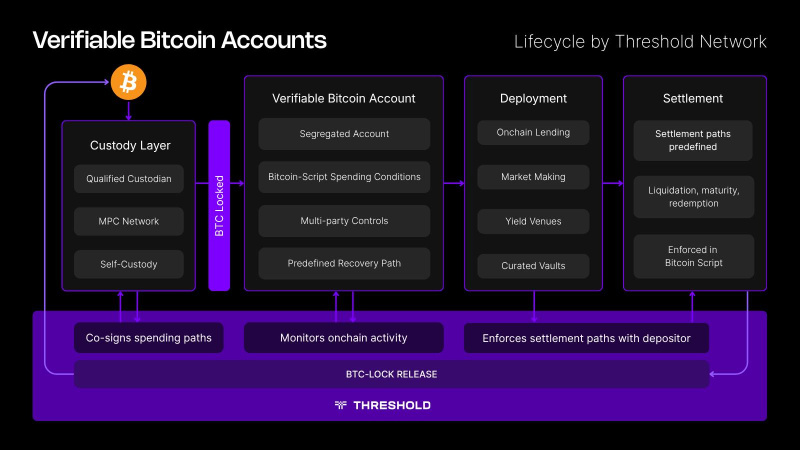
Verifiable Bitcoin Accounts are a Bitcoin Script and PSBT-based account framework for institutional Bitcoin deployment. They define preauthorized spending paths, signer combinations, timelocks, and recovery routes at account setup, allowing allocators to use Bitcoin-backed onchain strategies while preserving segregated custody workflows and verifiable settlement paths.

Your Bitcoin, Your Custody

BTC remains with the holder’s existing custody arrangement. VBA is compatible with Qualified Custodians such as Anchorage and Fireblocks Trust, MPC-based custody networks, and self-custody setups. No title transfer outside of their existing custody. Capital is held in a segregated account, not pooled, and is identifiable at all times. The custody relationship that the allocator already maintains governs every deployed position.

Built for Bitcoin Finance

Institutional Bitcoin lending is accelerating toward a projected $90B by end-of-20261, driven by stablecoin growth that reached $308B in early 2026 and is on track to exceed $1T2. While major platforms are building proprietary lending stacks to capture the demand, Verifiable Bitcoin Accounts turn any existing custody – Qualified Custodian, MPC network, or self-custody – into institutional-grade lending infrastructure.

Onchain Bitcoin lending and yield markets depend on collateral that resolves reliably across liquidation, maturity, and redemption. Verifiable Bitcoin Accounts are built for that operational reality, with every settlement route agreed at setup and enforced in Bitcoin Script.

For allocators deploying Bitcoin into onchain lending at scale, this is the guarantee that makes the product usable.
Bitcoin-Level Integration Path

The foundation of every Verifiable Bitcoin Account is the Partially Signed Bitcoin Transaction (PSBT), supported by the following features:

  • Consensus-enforced spending. Spending conditions, recovery paths, and timelocks are written in Bitcoin Script and enforced by the same consensus mechanism that secures the Bitcoin network. Every permissible outcome is pre-defined. Every state is verifiable onchain by any full node.
  • Multi-party controls. No single entity holds unilateral authority over deployed capital during the term of the agreement. Not the custodian, not Threshold, not the depositor. Every movement requires the predefined combination of parties specified for that position.
  • Predefined recovery. If the signer network is unavailable, the depositor recovers the BTC themselves after a defined timelock. No counterparty cooperation is required. The Bitcoin UTXO is the system of record.
  • Whitelisted deployment. Capital deploys only into risk-assessed, pre-approved onchain lending and yield markets such as Aave, Morpho, Curve, and Yield Basis. Every movement is constrained, auditable, and aligned with institutional compliance requirements.

The signer infrastructure, Threshold Network, the protocol behind Verifiable Bitcoin Accounts, has operated with Bitcoin for six years, with over $5 billion in cumulative volume and zero losses. Verifiable Bitcoin Accounts is the extension of this proven, existing infrastructure.

Verified, Not Just Trusted

Institutional adoption of Bitcoin in onchain markets does not scale on assurance alone. It scales on independent verification.

“Institutions don’t need additional layers of trust; they need systems where outcomes are defined, enforceable, and verifiable from the outset. By removing reliance on counterparties, we align Bitcoin onchain with the standards institutional capital actually requires.” — MacLane Wilkison, Co-Founder of Threshold Network

Verifiable Bitcoin Accounts (VBA) establish a new standard for institutional Bitcoin deployment: every component of the architecture can be verified before a single satoshi is committed.

Verifiable Bitcoin Accounts are available to qualified institutional participants. To discuss integration and explore deployment into approved onchain venues, users can contact the team via: https://threshold.network/contact

About Threshold Network

Threshold Network is the protocol behind tBTC, the trust-minimized Bitcoin bridge that has processed over $5 billion in cumulative volume across six years of mainnet operation with zero losses. Verifiable Bitcoin Accounts extend this infrastructure into institutional Bitcoin deployment, combining segregated custody, Bitcoin-enforced spending controls, and access to onchain lending markets. For more information, users can visit www.threshold.network.

Contact

PR
Threshold Labs
Threshold Labs
contact@tnetworklabs.com

Связанные с этим вопросы

QWhat are Verifiable Bitcoin Accounts (VBA) and what is their primary purpose?

AVerifiable Bitcoin Accounts (VBA) are a Bitcoin Script and PSBT-based account framework for institutional Bitcoin deployment. Their primary purpose is to define preauthorized spending paths, signer combinations, timelocks, and recovery routes at account setup, allowing allocators to use Bitcoin-backed onchain strategies while preserving segregated custody workflows and verifiable settlement paths.

QHow does VBA ensure that an institution's Bitcoin custody arrangement remains unchanged?

AVBA is compatible with the holder's existing custody arrangement, including Qualified Custodians, MPC-based custody networks, and self-custody setups. The Bitcoin remains with the holder's custodian; there is no title transfer outside of their existing custody. Capital is held in a segregated account, not pooled, and is identifiable at all times.

QWhat is the foundational technology behind every Verifiable Bitcoin Account?

AThe foundation of every Verifiable Bitcoin Account is the Partially Signed Bitcoin Transaction (PSBT), which supports consensus-enforced spending, multi-party controls, predefined recovery, and whitelisted deployment.

QWhat happens if the signer network becomes unavailable for a VBA?

AIf the signer network is unavailable, the depositor can recover the BTC themselves after a defined timelock. No counterparty cooperation is required, as the Bitcoin UTXO serves as the system of record.

QWhat proven track record does the underlying signer infrastructure, Threshold Network, have?

AThe Threshold Network signer infrastructure has operated with Bitcoin for six years, processing over $5 billion in cumulative volume with zero losses.

Похожее

AI Relay Stations Spark Heated Debate on Zhihu: Behind Cheap Tokens, What Are Users Really Worried About?

A discussion on Zhihu about "AI relay stations" shifted the niche developer topic of "cheap tokens" into broader user awareness. Users moved beyond simply questioning the legitimacy of these services to focus on practical concerns: Where do cheap tokens truly come from? Is the model being accessed the real one? Can relay stations see prompts, code, and API keys? For occasional users, are the risks worth it? The core debate centered less on price and more on trust. A primary worry is model authenticity—the risk of "model swapping," where users paying for a premium model might be routed to a cheaper one, creating an information asymmetry. Others argued that cost comparisons matter; while cheaper than official pay-as-you-go APIs, relay stations may not be the lowest-cost option versus subscriptions, domestic models, or free tiers, making user needs assessment crucial. Speculation about token sources ranged from legitimate bulk discounts to gray-area methods like account sharing or exploiting regional pricing. This opacity makes risk assessment difficult for users. Data security emerged as a critical concern, especially for enterprise use. When processing sensitive information like code, contracts, or client data, the inability to verify a relay station's data handling, retention, or access policies poses significant compliance and confidentiality risks. The evolving consensus suggests relay stations can be used cautiously for low-sensitivity, disposable tasks (e.g., summarizing public info, simple translation). However, they should not be the default for sensitive, professional, or production workflows involving proprietary data, Agents, or automated systems. Recommendations include avoiding large prepayments, not relying on a single service, using test prompts to monitor quality, anonymizing data where possible, and keeping official channels as backups. Ultimately, the discussion framed tokens not just as a billing unit but as a measure of real cost encompassing price, model integrity, data security, and service stability. The popularity of relay stations highlights user demand for affordable access, but the debate underscores a key trade-off: the savings from cheap tokens may come at the price of trust, transparency, and control over one's data and AI experience.

marsbit8 мин. назад

AI Relay Stations Spark Heated Debate on Zhihu: Behind Cheap Tokens, What Are Users Really Worried About?

marsbit8 мин. назад

In-Depth Research Report on TradFi: The Convergence Wave of Crypto and Traditional Finance

In 2026, the crypto industry is undergoing a profound infrastructure-level transformation—TradFi assets are migrating on-chain at an unprecedented pace. According to CoinGecko's Q1 2026 report, the total value locked (TVL) of tokenized real-world assets (RWA) has surpassed $31 billion, a nearly 4x increase from $7.8 billion at the beginning of 2025, with the sector’s aggregate market capitalization reaching $19.3 billion. Among these, the market cap of tokenized stocks surged from $2 million to $486 million, with Q1 spot trading volume reaching $15.1 billion—a single quarter already surpassing the entire second half of 2025. RWA perpetual contract Q1 trading volume reached a staggering $524.8 billion, far exceeding the $313 billion for all of 2025. Meanwhile, BlackRock's BUIDL fund has reached $2.3 billion in scale and has filed for two new tokenized funds, signaling that the world's largest asset manager's tokenization strategy is evolving from pilot to product suite expansion. HTX, as a core participant in the crypto exchange sector, officially launched TradFi perpetual futures products including NVDA, AAPL, MSFT, META, and SPY in 2026, enabling crypto users to gain 24/7 trading access to core U.S. equities. Boston Consulting Group predicts that global tokenized asset scale could reach $16 trillion by 2030, while McKinsey offers a conservative estimate of approximately $2 trillion. The on-chain migration of TradFi assets is no longer a "future narrative" but a structural transformation unfolding in real time, as crypto exchanges evolve from single crypto asset trading platforms toward "multi-asset-class trading infrastructure."

HTX Learn11 мин. назад

In-Depth Research Report on TradFi: The Convergence Wave of Crypto and Traditional Finance

HTX Learn11 мин. назад

Blocked Its Own Treasure, WeChat AI Steps Up

Tencent's stock surged over 10% on June 2nd amid reports that WeChat, with 1.43 billion monthly users, is finalizing tests for a native AI Agent. The reported feature, accessible by swiping right from the main interface, allows users to issue commands in natural language. The AI then decomposes tasks and automatically calls upon relevant Mini Programs within WeChat to complete actions like ordering food, booking tickets, or making payments, creating a closed-loop service execution system. This strategic shift follows the internal conflict and subsequent "blocking" of Tencent's standalone AI app, Yuanbao, by WeChat for violating sharing rules during a 2026 Spring Festival promotion. The incident highlighted a lack of internal consensus and exposed the weakness of competing in the standalone AI assistant arena against rivals like ByteDance's Doubao (345M MAU) and Alibaba's Qianwen. The new WeChat AI Agent aims to leverage WeChat's unique assets—its massive user base, standardized Mini Program APIs, WeChat Pay, and identity system—to move from simple content generation to actual task execution. Analysts note this changes the competitive landscape from model benchmarks to which AI can connect to more real-world services. However, success depends on key variables: the capability of Tencent's underlying Hunyuan model, managing massive inference costs, and redesigning incentives for Mini Program developers whose traffic might be bypassed. The move is seen as an attempt to keep user service intent within WeChat's ecosystem as AI begins to redefine how users access services.

marsbit1 ч. назад

Blocked Its Own Treasure, WeChat AI Steps Up

marsbit1 ч. назад

ByteDance Adopts Arm CPUs, Jensen Huang: So Sad I Didn't Buy Arm

**Summary:** At Computex 2026, Arm CEO Rene Haas announced that ByteDance and Oracle have adopted Arm's self-designed Arm AGI data center CPU. The company expects significant revenue growth from this product, projecting $20 billion in demand for the 2027/2028 fiscal years. Haas noted that restricting AI-capable CPUs from the US to China is nearly impossible due to their widespread applications. Arm's stock has surged dramatically this year, notably rising 16% after NVIDIA's Arm-based Vera CPU and RTX Spark announcements. A highlight was the informal, humorous on-stage conversation between Haas and NVIDIA CEO Jensen Huang. Huang joked about NVIDIA's failed attempt to acquire Arm and playfully lamented selling his Arm shares. Both executives showed a clear sense of camaraderie and shared regret over the missed merger. Key technical topics were discussed: 1. **AI PC Design:** Huang explained NVIDIA's RTX Spark superchip (with a 20-core Arm CPU) is designed for future AI agents that will autonomously run and use tools on PCs, blending local and cloud processing. 2. **Agent vs. OS:** Huang emphasized the operating system remains crucial, as AI agents rely on its APIs and tools to function. 3. **Growth Constraints:** He identified the shift to "useful AI" that generates profitable tokens as a primary driver for immense, almost limitless, computational demand. Haas outlined Arm's strategy across PC and data centers. For PCs, Arm collaborates with partners like NVIDIA and MediaTek, offering its compute subsystem (CSS) for custom SoCs. In data centers, its Arm AGI CPU (built on TSMC's 3nm process) has gained major partners including OpenAI, Meta, and now ByteDance and Oracle. Arm presented a multi-year roadmap for its in-house CPU line. The article concludes that while GPUs dominated the AI training race, the explosion of AI agents is shifting significant focus to CPUs for inference, state management, and tool orchestration. The industry is trending towards vertical integration, with companies like cloud providers designing chips and chip/IP firms offering full solutions, all competing to deliver more efficient computing per watt.

marsbit1 ч. назад

ByteDance Adopts Arm CPUs, Jensen Huang: So Sad I Didn't Buy Arm

marsbit1 ч. назад

Торговля

Спот
Фьючерсы

Популярные статьи

Тест по Bitcoin Биткоина

HTX Learn: Изучите Bitcoin halving и Заработаете Токены USDT

3.1k просмотров всегоОпубликовано 2024.04.16Обновлено 2024.04.16

Тест по Bitcoin  Биткоина

Что такое $BITCOIN

ЦИФРОВОЕ ЗОЛОТО ($BITCOIN): Комплексный анализ Введение в ЦИФРОВОЕ ЗОЛОТО ($BITCOIN) ЦИФРОВОЕ ЗОЛОТО ($BITCOIN) — это проект на основе блокчейна, работающий в сети Solana, который стремится объединить характеристики традиционных драгоценных металлов с инновациями децентрализованных технологий. Хотя он носит имя Биткойн, часто называемого “цифровым золотом” из-за его восприятия как средства хранения ценности, ЦИФРОВОЕ ЗОЛОТО является отдельным токеном, предназначенным для создания уникальной экосистемы в ландшафте Web3. Его цель — позиционировать себя как жизнеспособный альтернативный цифровой актив, хотя детали его применения и функциональности все еще развиваются. Что такое ЦИФРОВОЕ ЗОЛОТО ($BITCOIN)? ЦИФРОВОЕ ЗОЛОТО ($BITCOIN) — это токен криптовалюты, специально разработанный для использования в блокчейне Solana. В отличие от Биткойна, который выполняет широко признанную роль хранения ценности, этот токен, похоже, сосредоточен на более широких приложениях и характеристиках. Примечательные аспекты включают: Инфраструктура блокчейна: Токен построен на блокчейне Solana, известном своей способностью обрабатывать высокоскоростные и недорогие транзакции. Динамика предложения: ЦИФРОВОЕ ЗОЛОТО имеет максимальное предложение, ограниченное 100 квадриллионами токенов (100P $BITCOIN), хотя детали о его обращающемся предложении в настоящее время не раскрыты. Утилита: Хотя точные функциональные возможности не описаны, есть указания на то, что токен может быть использован для различных приложений, потенциально связанных с децентрализованными приложениями (dApps) или стратегиями токенизации активов. Кто создатель ЦИФРОВОГО ЗОЛОТА ($BITCOIN)? На данный момент личность создателей и команды разработчиков, стоящих за ЦИФРОВЫМ ЗОЛОТОМ ($BITCOIN), остается неизвестной. Эта ситуация типична для многих инновационных проектов в области блокчейна, особенно тех, которые связаны с децентрализованными финансами и феноменом мем-криптовалют. Хотя такая анонимность может способствовать культуре, ориентированной на сообщество, она усиливает опасения по поводу управления и ответственности. Кто инвесторы ЦИФРОВОГО ЗОЛОТА ($BITCOIN)? Доступная информация указывает на то, что у ЦИФРОВОГО ЗОЛОТА ($BITCOIN) нет известных институциональных спонсоров или значительных венчурных капиталовложений. Проект, похоже, функционирует по модели пирингового взаимодействия, сосредоточенной на поддержке и принятии сообществом, а не на традиционных путях финансирования. Его активность и ликвидность в основном сосредоточены на децентрализованных биржах (DEX), таких как PumpSwap, а не на устоявшихся централизованных торговых платформах, что еще больше подчеркивает его подход, ориентированный на grassroots. Как работает ЦИФРОВОЕ ЗОЛОТО ($BITCOIN) Операционные механизмы ЦИФРОВОГО ЗОЛОТА ($BITCOIN) можно подробно описать на основе его дизайна блокчейна и характеристик сети: Механизм консенсуса: Используя уникальный механизм доказательства истории (PoH) Solana в сочетании с моделью доказательства доли (PoS), проект обеспечивает эффективную валидацию транзакций, что способствует высокой производительности сети. Токеномика: Хотя конкретные дефляционные механизмы не были подробно описаны, большое максимальное предложение токенов подразумевает, что оно может быть предназначено для микротранзакций или нишевых случаев использования, которые еще предстоит определить. Интероперабельность: Существует потенциал для интеграции с более широкой экосистемой Solana, включая различные платформы децентрализованных финансов (DeFi). Однако детали относительно конкретных интеграций остаются неуточненными. Хронология ключевых событий Вот хронология, которая подчеркивает значимые вехи, касающиеся ЦИФРОВОГО ЗОЛОТА ($BITCOIN): 2023: Первоначальное развертывание токена происходит в блокчейне Solana, отмеченное его адресом контракта. 2024: ЦИФРОВОЕ ЗОЛОТО приобретает видимость, когда оно становится доступным для торговли на децентрализованных биржах, таких как PumpSwap, позволяя пользователям обменивать его на SOL. 2025: Проект наблюдает спорадическую торговую активность и потенциальный интерес к инициативам, возглавляемым сообществом, хотя на данный момент не зафиксировано никаких значительных партнерств или технических достижений. Критический анализ Сильные стороны Масштабируемость: Основная инфраструктура Solana поддерживает высокие объемы транзакций, что может повысить полезность $BITCOIN в различных сценариях транзакций. Доступность: Потенциально низкая цена торговли за токен может привлечь розничных инвесторов, способствуя более широкому участию благодаря возможностям дробного владения. Риски Отсутствие прозрачности: Отсутствие публично известных спонсоров, разработчиков или процесса аудита может вызвать скептицизм относительно устойчивости и надежности проекта. Волатильность рынка: Торговая активность сильно зависит от спекулятивного поведения, что может привести к значительной волатильности цен и неопределенности для инвесторов. Заключение ЦИФРОВОЕ ЗОЛОТО ($BITCOIN) является интригующим, но неоднозначным проектом в быстро развивающейся экосистеме Solana. Хотя он пытается использовать нарратив “цифрового золота”, его отход от установленной роли Биткойна как средства хранения ценности подчеркивает необходимость более четкого различения его предполагаемой утилиты и структуры управления. Будущее принятие и усвоение, вероятно, будут зависеть от решения текущей непрозрачности и более четкого определения его операционных и экономических стратегий. Примечание: Этот отчет охватывает синтезированную информацию, доступную на октябрь 2023 года, и с тех пор могут произойти события.

99 просмотров всегоОпубликовано 2025.05.13Обновлено 2025.05.13

Что такое $BITCOIN

Fractal Bitcoin: масштабирование Биткоина с помощью рекурсивной системы

Fractal Bitcoin — масштабное Layer-1-решнение, созданное на базе кода Биткоина, позволяющего достигать бесконечного масштабирования с помощью рекурсивного подхода.

2.3k просмотров всегоОпубликовано 2025.06.30Обновлено 2025.06.30

Fractal Bitcoin: масштабирование Биткоина с помощью рекурсивной системы

Обсуждения

Добро пожаловать в Сообщество HTX. Здесь вы сможете быть в курсе последних новостей о развитии платформы и получить доступ к профессиональной аналитической информации о рынке. Мнения пользователей о цене на BTC (BTC) представлены ниже.

活动图片