Valued at 600 Billion, NVIDIA Invests 10 Billion! How Nokia, After Selling Its Phones, Is Making a Comeback

marsbitОпубликовано 2026-05-29Обновлено 2026-05-29

Введение

Once known as its mobile phones were sold in 2013, Nokia has staged a remarkable commercial comeback, now standing as a "patent giant" and "AI infrastructure builder." In Q1 2026, its net profit surged over 200% year-over-year. Nokia retains a vast portfolio of over 26,000 patent families, including over 7,000 essential 5G patents. This creates a high-margin "licensing" business, generating €1.5 billion in 2025 with over 70% operating margin, from smartphone makers to automotive and streaming media companies. Beyond patents, Nokia is a key player in AI infrastructure. Its acquisition of Infinera made it a top supplier of high-speed optical modules for AI data centers. Its AI-RAN technology allows 5G base stations to utilize idle computing power for AI inference tasks. A strategic $1 billion investment from NVIDIA in 2025 aims to unlock this distributed edge compute potential, with their joint AI Aerial platform already in trials. Looking ahead, Nokia is actively shaping 6G standards with AI-native architecture and is transitioning toward a recurring revenue model through network automation and SaaS offerings. With strong free cash flow and dividends, Nokia has transformed from a faded mobile brand into a core technology player poised for the AI and 6G era.

If we talk about the most unexpected winner in the AI track in 2026, Nokia definitely counts as one.

Most people's memory of it still lingers on the lonely背影 of selling its mobile phone business in 2013 and the definitive conclusion of "being淘汰 by the times."

But the reality is that this company, misunderstood as having "disappeared," has quietly completed a textbook-level business rebirth.

In the first quarter of 2026, Nokia's net profit skyrocketed by over 200% year-on-year. Holding 5G Standard Essential Patents ranking among the top six globally, it received a strategic investment endorsement of $10 billion from NVIDIA. Orders for its optical networking business are in such high demand that delivery schedules are already booked until the second half of the year.

The former "King of Mobile Phones" now stands at the core track of the global technology industry once again with the dual identity of a "Patent Giant + AI Infrastructure Provider."

PART 01

The "Lying Down" Business of Nokia After the Phone Curtain Call

The public's misunderstanding about Nokia essentially equates the "failure of the mobile phone business" with "corporate failure."

Many people overlook the fact that Microsoft only bought the brand usage rights and manufacturing business of Nokia's mobile phones back then, leaving the most valuable communication technology patents, of which Nokia didn't sell a single one.

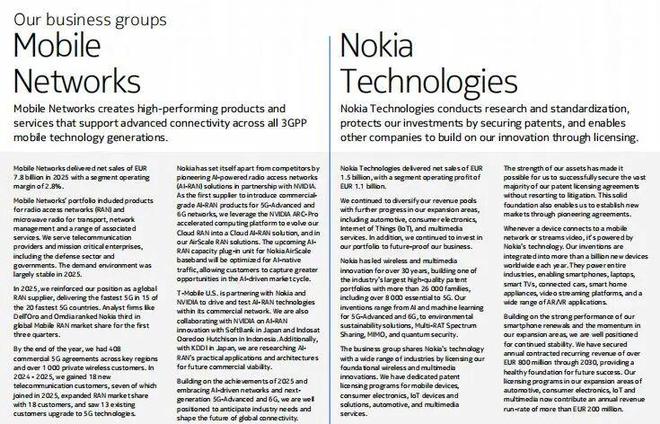
As of 2025, Nokia holds over 26,000 patent families, including more than 7,000 5G Standard Essential Patents (SEPs), with about 70% of the patent families having a remaining validity period of over ten years.

What do these patents mean?

All global mobile phone manufacturers, whether Apple, Samsung, Huawei, or Xiaomi, as long as their devices support 4G or 5G communication, cannot bypass Nokia's technical barriers and must pay it patent licensing fees.

Nokia's royalty rate for 5G phones is no more than 3 euros per unit. Although the unit price seems low, the profit margin on this revenue is extremely high, almost akin to a "rent collection" model.

The 2025 financial report shows that Nokia's patent licensing business generated annual net sales of 1.5 billion euros, with an operating profit margin exceeding 70%, of which over 800 million euros in core cellular patent revenue has been locked in until 2030.

Source: 2025 Financial Report

More notably, Nokia is systematically replicating this "patent royalty" model from the traditional mobile phone field to multiple high-growth sectors.

Riding the wave of automotive intelligence, in 2025, Nokia reached 4G/5G patent licensing agreements with automakers like Mercedes-Benz and at least four Chinese automakers. Through the Avanci patent pool, its 5G automotive patent fee is set at $32 per vehicle, and $20 per vehicle for 4G.

Furthermore, Nokia has also reached into the video streaming sector. In 2025, it completed the acquisition of 298 core video codec patents from LG Electronics. By the end of the year, it had signed licensing agreements with seven streaming platforms including Amazon and Starz.

Simultaneously, it initiated patent lawsuits against giants like Paramount and Warner Bros. in the US, Germany, and other places, accelerating the implementation of a "playback tax" across the industry.

From handheld terminals to smart cars, and further to digital content and the Internet of Things, by the end of 2025, Nokia had signed patent licensing agreements with over 250 enterprises worldwide, building a patent royalty network covering all scenarios.

PART 02


Nokia's New "Optical-Compute Integration" Engine After the AI Computing Boom

If patents are Nokia's "cash cow," then optical networks and AI-RAN are its true engines charging into the AI era.

Relying on these two core technologies, this underestimated company has long been deeply embedded in the core of AI computing infrastructure, becoming a key partner for giants like NVIDIA, Google, and Microsoft.

In June 2024, Nokia acquired the US optical communications company Infinera for $2.3 billion, thereby gaining full-chain technology from optical chips, optical modules to transmission systems, boosting its market share to second globally, only behind Huawei.

The real value of this acquisition lies in: there are very few companies worldwide capable of independently designing and manufacturing high-end optical semiconductor chips, and Infinera is one of them.

This means Nokia can directly supply high-speed optical modules of 800G and 1.6T to AI data centers, with a single optical fiber transmission rate as high as 1.6 Tbps and latency reduced to microseconds.

Performance is the most direct proof: its optical networking revenue grew 19% in 2025, and rose another 20% in Q1 2026, with an operating profit margin exceeding 15%, over five times that of its mobile networking business. The book-to-bill ratio is far greater than 1, with customers queuing for goods. Among the top ten global cloud service providers, nine use Nokia's optical networking technology.

If optical networking brings stable hardware orders for Nokia, AI-RAN earns it long-term, sustainable service revenue.

Traditional 5G base stations typically have baseband computing utilization rates below 10% during nighttime traffic troughs. Nokia's AI-RAN technology allows base stations to run AI inference tasks using idle computing power while ensuring communication quality, enabling localized processing for smart security, autonomous driving edge computing, lightweight large model inference, etc.

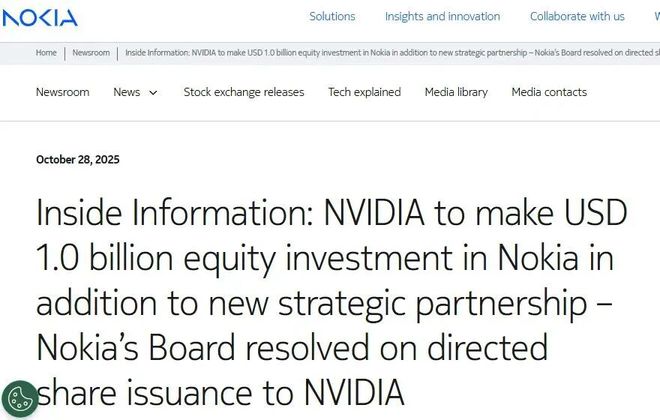
In October 2025, NVIDIA invested a whopping $10 billion in strategic funding, precisely eyeing the dormant computing power within Nokia's global millions of base stations.

Source: Company Website

The jointly launched AI Aerial platform deeply integrates NVIDIA GPUs with Nokia's base station network. It has already been piloted in Indonesia, completing Southeast Asia's first AI-driven 5G call.

Currently, AI-RAN is undergoing pilot verification with over 10 leading global operators. In Q1 2026, revenue from AI and cloud customers grew 49% year-on-year, with quarterly orders reaching about one billion euros, becoming Nokia's fastest-growing emerging business.

PART 03

Nokia's "Positioning + Subscription" Dual Springboard Before 6G Standardization

For a long time, the capital market has priced Nokia using traditional telecom equipment vendor valuation standards, resulting in a significantly lower price-to-earnings ratio compared to peers like Ericsson and Cisco.

However, this valuation discount will be completely broken with the advent of the 6G era. 2026 is a crucial year for 6G standard setting, with formal commercialization expected by 2030.

Relying on its industry-leading AI-native architecture, Nokia is expected to achieve an overtaking in the 6G era and become a core global standard-setter.

Its advantages are mainly concentrated in: being able to embed AI capabilities directly into the network's physical layer and data link layer, enabling smooth evolution on existing AirScale base stations without additional hardware; the intelligent resource optimization technology jointly tested with KDDI, which reduces base station power consumption by 40% and increases throughput fourfold, has already been verified; promoting the inclusion of non-terrestrial networks in the 6G standard to achieve global coverage.

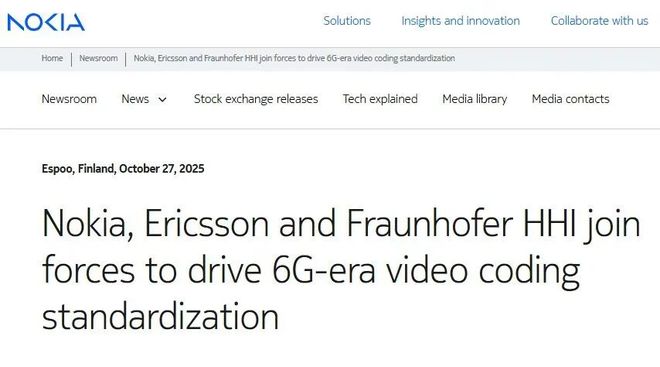
More crucially, in October 2025, Nokia and Ericsson joined hands with Germany's Fraunhofer HHI in a historic tripartite cooperation, jointly promoting the formulation of 6G video codec standards, further enhancing Nokia's influence in this field.

Source: Company Website


Simultaneously, Nokia is breaking the traditional telecom equipment vendor model of one-time sales, transitioning towards a persistent revenue technology service provider through network automation and subscription-based services.

Currently, Nokia has launched 9 SaaS products, with an addressable market size projected to reach $2.6 billion in 2026. Its MantaRay SON self-organizing network solution has been deployed and validated in the networks of over 120 global customers. The entire MantaRay product portfolio supports the TM Forum's Level 4 Autonomous Network level, significantly reducing manual intervention.

Additionally, the 2025 financial report shows that its full-year free cash flow reached 1.5 billion euros, with an FCF conversion rate of 72%, and a free cash flow yield of approximately 4.4%. The company's stable and continuous dividend payouts also provide investors with a certain level of cash return assurance.

Today's Nokia has long shed its old label of a "nostalgia brand" and transformed into a hidden giant holding core technologies, binding with the AI红利, and positioning for the future of 6G.

Market perception always lags behind industrial transformation, but as more capital begins to re-examine Nokia's true value, the curtain on a long-overdue value re-rating is just beginning to rise.

Связанные с этим вопросы

QWhat is the core reason behind Nokia's dramatic financial turnaround in 2026, as described in the article?

ANokia's dramatic turnaround is attributed to its transformation into a 'patent giant + AI infrastructure provider.' It leverages a massive patent portfolio (particularly 5G SEPs) for high-margin licensing revenue and has become a key player in AI infrastructure through its optical network business and AI-RAN technology.

QHow does Nokia's patent licensing business generate revenue, and what new markets is it expanding into beyond smartphones?

ANokia's patent licensing business generates revenue by charging fees to all manufacturers of 4G/5G devices. It is expanding into new markets like smart vehicles (charging per-car fees through the Avanci pool) and video streaming platforms (through acquired video codec patents and lawsuits to enforce 'streaming taxes').

QWhat strategic acquisition did Nokia make in 2024 to strengthen its position in the AI infrastructure market, and what key capability did it gain?

AIn 2024, Nokia acquired the US optical communications company Infinera for $2.3 billion. This gave it the crucial capability to design and manufacture high-end optical semiconductor chips, allowing it to supply high-speed optical modules (like 800G and 1.6T) directly to AI data centers.

QWhat is AI-RAN, and why did NVIDIA invest $1 billion in a strategic partnership with Nokia in this area?

AAI-RAN is Nokia's technology that allows 5G base stations to use their idle computing power during low-traffic periods to run AI inference tasks locally. NVIDIA invested $1 billion to partner with Nokia to tap into the vast, underutilized compute power within Nokia's global network of millions of base stations, integrating its GPUs with Nokia's network through the AI Aerial platform.

QHow is Nokia positioning itself for the 6G era, according to the article, and what business model shift is it undergoing?

AFor the 6G era, Nokia is positioning itself as a core standard-setter by leveraging its AI-native architecture and participating in key alliances (e.g., with Ericsson and Fraunhofer HHI). It is also shifting its business model from a traditional one-time telecom equipment seller to a technology service provider with recurring revenue through SaaS products and subscription-based network automation services.

Похожее

Three Years Later: Looking Back on My 2023 Predictions for ChatGPT

Looking Back After Three Years: Revisiting My 2023 Predictions on ChatGPT In March 2023, shortly after ChatGPT's debut and before GPT-4's release, I made over twenty predictions about AI's future based on limited information and intuition. Now, in May 2026, I revisited those forecasts using an AI-driven analysis with 41 Opus 4.8 agents to cross-reference them with the latest data. The assessment used symbols: ✅ Correct, 🟢 Mostly Correct, 🟡 Partially Correct, ❌ Incorrect. Overall, the directional judgments held up well, with only one major factual error regarding GPT-4's rumored parameter size (incorrectly cited as 100T). However, nuances and degrees of accuracy revealed more. **What Was Largely Correct:** Predictions about mechanisms and directions proved accurate. The rise of RAG (Retrieval-Augmented Generation) as the standard architecture for combating AI hallucination was confirmed, as was the transformative potential of LUI (Language User Interface) in creating a new industry layer atop GUIs. The emergence of "robot networks" (agent-to-agent communication protocols) and China's rapid catch-up in developing capable large models (closing the performance gap with top models to ~2.7%) were also on point. The analysis affirmed that LLMs lack consciousness and that the Turing Test merely measures perceived intelligence. **What Was Off Target:** Errors often involved specific numbers, over-optimistic timelines, or misjudged distributions. The prediction that value would primarily accrue to the application layer was half-right but missed NVIDIA's dominance as the profitable infrastructure layer. Forecasts about AI circumventing copyright issues and fostering a "global common ground" by averaging human viewpoints were incorrect; instead, major copyright settlements occurred and AI personalization is increasing. Estimates for model training costs ("$5-10 billion cap") were significantly off, underestimating frontier costs and overestimating replication costs. The notion that LLMs could never do complex math without tools was disproven by later models winning IMO gold. **Key Patterns from the Review:** 1. **Direction over precision:** Judgments about mechanisms and trends were more reliable than specific numbers or definitive statements. 2. **Timing bias:** There was a tendency to overestimate short-term speed but underestimate long-term magnitude and transformation. 3. **The distribution blind spot:** Aggregate-level correctness often masked uneven impacts (e.g., on young professionals' employment). 4. **The value of qualifiers:** Predictions framed with caution (e.g., "reportedly," "for now," "prototype in 2-3 years") aged better. 5. **Some debates continue:** Issues like the nature of "emergent abilities" or machine consciousness remain unresolved. This three-year review highlights that while seeing the big picture is crucial, humility regarding specifics, timelines, and disparate impacts is essential for future forecasting.

链捕手2 ч. назад

Three Years Later: Looking Back on My 2023 Predictions for ChatGPT

链捕手2 ч. назад

AI Bubble Warning: AI Investments Are Negative Returns for Most Tech Giants

The article issues a stark warning about a potential AI investment bubble. It notes that while the AI boom shares similarities with the TMT bubble of the late 1990s, its scale is vastly larger, currently driving 93% of U.S. GDP growth. Major hyperscale cloud providers like Microsoft, Alphabet, Amazon, Meta, and Oracle are planning to invest trillions in AI data centers over the coming years. However, calculations based on analyst projections for 2025-2030 reveal a concerning math problem: expected capital expenditure growth far outpaces projected revenue growth. Even under an extremely optimistic scenario of zero costs, the implied return on investment for most of these tech giants (except Amazon) is deeply negative. This suggests that the current trajectory could lead to one of history's largest shareholder value destruction events. The piece outlines two potential escapes: AI generating vastly more revenue than currently anticipated—a near-impossible task—or a significant cutback in the planned investment splurge. The latter scenario could trigger a domino effect, severely impacting the entire tech supply chain (from Nvidia to TSMC), potentially pushing the U.S. economy into recession, and causing a major stock market downturn. The author suggests upcoming high-profile IPOs by companies like OpenAI and Anthropic might represent a transfer of risk from early investors to public market participants. While the peak of the hype cycle might sustain investment through 2026, the fundamental financial dilemma remains unresolved, setting the stage for a potential market correction in 2027 or 2028, similar to the years following Alan Greenspan's "irrational exuberance" warning.

marsbit2 ч. назад

AI Bubble Warning: AI Investments Are Negative Returns for Most Tech Giants

marsbit2 ч. назад

From Tokens to Machine Labor: AI is Shifting from Tool to "Worker"

The article "From Token to Machine Labor: AI is Evolving from Tool to 'Worker'" argues that the business model for AI is shifting beyond simply selling computational resources (tokens, GPU hours) or model access. Instead, a new "machine labor market" is emerging, where the core economic transaction is the purchase of economically useful work directly performed by software. The central thesis is that AI pricing will evolve through four stages: 1) raw tokens, 2) standardized LLM capabilities (e.g., text generation), 3) industry-specific labor markets (e.g., legal review, radiology), and finally 4) a programmable results market where tasks like resolving a support ticket are bid on and priced based on outcome. In this future, buyers will care less about *which* model or GPU completes a task and more about whether the work meets specified standards for accuracy, latency, and cost. This transition reframes the impact of AI on human labor. Rather than simple replacement, it suggests a re-coordination where machines handle standardized, verifiable work, freeing humans for roles involving oversight, context management, responsibility, and final judgment. In some cases, this "last 1%" of human input becomes more valuable as it enables the other 99% to be automated. Furthermore, as AI reduces the cost of work, demand may expand, creating larger markets (e.g., 24/7 customer service) rather than just cheaper versions of existing ones. The article concludes that while infrastructure (GPUs, models, tokens) remains crucial upstream, the market is converging on a simpler, tradeable unit: machine labor that can be defined, measured, priced, and procured based on contractible specifications.

marsbit3 ч. назад

From Tokens to Machine Labor: AI is Shifting from Tool to "Worker"

marsbit3 ч. назад

Xiaomi MiMo's 99% Price Cut is Not Marketing! Luo Fuli Posts on X to Refute Critics

The price of Xiaomi's MiMo-V2.5 series API has been permanently reduced by up to 99%, specifically for the "Input (Cache Hit)" cost, which covers users re-reading historical context in long conversations. MiMo's head, Luo Fuli, published a detailed technical blog to clarify that this drastic price cut stems from genuine engineering breakthroughs, not a marketing stunt or a simple price war. The core of the achievement lies in six key engineering optimizations. First, the model architecture adopts a Hybrid Sliding Window Attention (SWA), reducing the memory footprint (KVCache) to 1/7th of a traditional model. Second, a dual-pool memory management system actually utilizes these savings, allowing a single GPU to handle over 5 times more concurrent users. Third, an upgraded prefix caching mechanism achieves a cache hit rate of 93-95% for repeated reads, meaning most such requests bypass GPU computation entirely. Fourth, a self-developed distributed cache (GCache) utilizes idle SSD space on existing GPU servers, eliminating additional storage costs. Fifth, an intelligent scheduling system (LLM-Router) efficiently routes requests to maximize cache reuse and performance. Sixth, Multi-Token Prediction (MTP) accelerates the model's text generation ("output") side. Together, these systemic optimizations dramatically lower the real computational cost per request, enabling the 99% price reduction for cached inputs while reportedly maintaining positive gross margins. Luo Fuli's disclosure aims to shift the narrative from "price war" to a demonstration of substantive AI engineering progress.

marsbit4 ч. назад

Xiaomi MiMo's 99% Price Cut is Not Marketing! Luo Fuli Posts on X to Refute Critics

marsbit4 ч. назад

$26 Billion: An 'All-Chinese Team' Backs the World's Highest-Valued AI Programming Company

Cognition AI, the company behind the AI programmer "Devin," has raised over $1 billion in new funding at a valuation of $26 billion, just eight months after reaching a $10.2 billion valuation. The round was led by Lux Capital, General Catalyst, and 8VC. Founded by three young Chinese entrepreneurs with strong competitive programming backgrounds, Cognition initially gained fame with Devin, marketed as the world's first AI software engineer capable of handling tasks from start to finish. While its early demos were impressive, real-world usage revealed reliability and cost-effectiveness issues, leading to a significant price cut for Devin in 2025. A pivotal moment came when Cognition acquired the assets of AI IDE company Windsurf after a failed acquisition by OpenAI. This move gave Cognition a crucial developer-facing tool, allowing it to pursue a two-pronged strategy: Devin for autonomous task execution and Windsurf for integrated, collaborative coding within an IDE. This shift helped the company move away from the controversial "AI replacement" narrative towards a model of augmenting human engineers, particularly for repetitive or maintenance tasks. This strategic pivot is backed by strong commercial metrics. The company reports a 10x increase in enterprise usage this year, with an annual revenue run-rate of $492 million and a 50% month-over-month growth in enterprise Devin usage over the past six months. Its client list now includes major corporations like Goldman Sachs and Mercedes-Benz, as well as government agencies like NASA and the U.S. Army. Investors are betting on Cognition becoming a foundational piece of next-generation software engineering infrastructure, positioning it at the center of a hybrid future where AI agents and human developers work in tandem.

marsbit5 ч. назад

$26 Billion: An 'All-Chinese Team' Backs the World's Highest-Valued AI Programming Company

marsbit5 ч. назад

Торговля

Спот
Фьючерсы
活动图片