Using AI for Weather Prediction: Earn $200 a Day While Doing Nothing?

marsbitОпубликовано 2026-03-18Обновлено 2026-03-18

Введение

Using AI for Weather Prediction: Can You Really Earn $200 a Day? This article explores how to leverage AI and data analysis to profit from weather prediction markets like Polymarket, focusing on Shanghai’s temperature forecasts. The system relies on Shanghai Pudong Airport (ZSPD) weather station data, sourced via Wunderground, rather than general city forecasts. Key insights include: - Temperature data is reported in whole Fahrenheit values in METAR format, not Celsius, affecting precision. - Historical data shows daily high temperatures most frequently occur between 11:00-13:00, peaking at 12:00 in summer (27.6% of days). Three effective prediction methods were implemented: 1. **Integrated Forecasting**: Combines Weather Company (WC) and ECMWF model data, weighted by weather conditions (e.g., sunny days favor WC). 2. **Real-Time Correction**: Uses morning temperature rise data and historical patterns to extrapolate the daily high, adjusted for cloud cover and wind. A Kalman filter dynamically weights real-time data vs. forecasts. 3. **Temperature Trend Model**: Predicts whether the day will be warmer/cooler than the previous day using pre-dawn data (pressure changes, wind, cloud cover, recent trends). It performs best in winter (clear signals) but poorly in autumn (63.7% accuracy). Two failed methods—Fourier analysis (systematic underestimation) and ERA5 peak-time prediction (insufficient precision)—were discarded. Case studies demonstrate the system...

Weather is not like elections—it has no stance; it's not like the NBA—it has no home team. But it is precisely this market that has attracted domestic users. The reason is simple: everyone has a feeling about it, and everyone thinks they understand Shanghai's weather.

But "feeling like you understand" and "being able to make money" are two different things.

Biteye shares three things today:

1. Understand the settlement rules

2. Establish a method for weather prediction

3. Use a system to find trading opportunities others can't see

1. First, Figure Out: How Exactly Does This Weather Market Settle?

1. The temperature settled is not what you think it is

Many people make a mistake when participating for the first time: they check their phone's weather app and bet on the highest temperature accordingly. But the app shows the temperature in downtown Shanghai, while Polymarket settles using the actual measured data from Shanghai Pudong International Airport (ZSPD weather station). This data is publicly available through the American weather platform Wunderground, and PM directly reads the records on WU as the basis for settlement.

Two locations, two numbers. Pudong Airport is located on the east side of the city, right next to the Yangtze River estuary, and is affected by sea breezes, so the temperature is usually lower than in the city center. This difference isn't usually noticeable, but near the threshold boundaries, it can be the difference between a correct and incorrect bet.

So you can see this kind of confusion in the weather market comments: "It clearly felt warmer today than yesterday, why is the displayed maximum temperature lower?"

2. The number is correct, but the unit isn't what you think

WU's data comes directly from the METAR reports (the global aviation standard meteorological telegraph format) reported hourly by the airport.

There's a detail hidden here: METAR records temperatures in whole Fahrenheit numbers, and WU displays this number without conversion or correction.

Most weather forecast systems and meteorological models output temperatures with decimal points. The more refined your model is, the easier it is to overlook this crude detail.

3. Shanghai Temperature Patterns

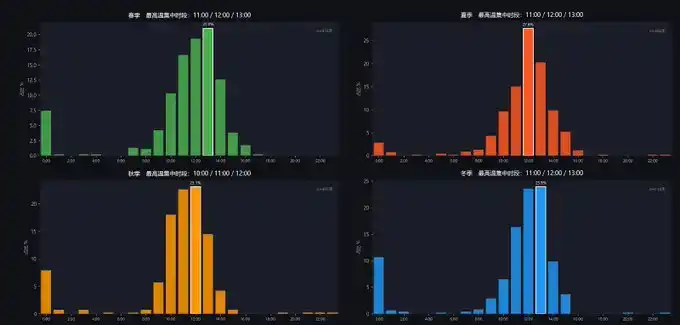
After scraping nearly 1900 days of data from the ZSPD station, the occurrence period of Shanghai's highest temperature is more concentrated than imagined:

· Highly concentrated between 11:00-13:00 across all four seasons,

· The concentration is highest at 12:00 in summer, with that single hour accounting for 27.6% of the entire season.

· The peak period in autumn is slightly earlier, with 10:00 also being one of the high-frequency periods.

Knowing the pattern is the first step, but patterns don't watch the market themselves. When the daily high temperature appears, whether it has been broken, and how far it is from the threshold.

So the editor built this system: to predict as accurately as possible which Celsius threshold the day's maximum temperature will fall into before daily settlement.
2. Five Methods, Three Worked

After understanding the market rules, the next question is: how to predict the day's maximum temperature?

As a weather novice, the first step was to ask ChatGPT: How does the meteorological industry actually calculate the day's maximum temperature, and what are the mature methods? ChatGPT provided a theoretical framework, and Claude turned the framework into code. Using the two AIs together, the system was built over a weekend.

Five methods were tried in total, but only three ended up working.

Those that worked:

1. WC + ECMWF Ensemble Forecast

Predicting the maximum temperature first requires data. Two sources were adopted:

· Weather Company (WC) is a commercial weather API providing hourly forecast data with high precision;

· ECMWF is the global meteorological model from the European Centre for Medium-Range Weather Forecasts, more sensitive to large-scale weather systems.

The two sources have their own pros and cons, so they were made to vote with weighted averages. The weights are dynamically adjusted based on the day's weather type: trust WC more on sunny days, trust ECMWF more on days with high cloud cover and wind speed.

2. Real-time Correction: Estimating the Peak Using Warming Data

The forecast was calculated last night, but today's weather is constantly changing. So what this module does is: use the actual measured data that has already happened this morning to estimate how high it can go today.

The logic isn't complicated; the editor found that 8-9 AM in Shanghai is the fastest warming period. After the system gets the measured temperature at this time, it checks historical data: for the same season, at the same time, how much higher did it get on average in the past.

Then add two corrections:

· Apply a discount for more clouds; the cloudier it is, the more the warming is hindered.

· Apply a discount for stronger wind; strong wind accelerates heat loss. This calculates an "extrapolation estimate."

Pressure, dew point, and humidity were also included in the calculation, but they were removed after backtesting showed these factors had a smaller, lower correlation impact.

But relying solely on extrapolation isn't stable enough. Here, a concept similar to Kalman gain is used. Simply put, it takes a weighted average between the "extrapolation result" and the "original forecast," and this weight changes automatically over time.

· At 6 AM, extrapolation only accounts for 20%, mostly still trusting the forecast

· By noon 12 PM, extrapolation accounts for 72%

· After 1 PM, it almost entirely trusts the actual measurements, accounting for 85%

The later it is, the more important the current events are; the earlier it is, the more reference value the historical forecast has.

After 2 PM, the system judges that the peak has most likely passed, directly takes the day's highest temperature from the historical record to lock in the result, and stops extrapolating.

3. Is Today a Warming Day?

This is the most satisfying module in the entire system. It makes a judgment every early morning: Will today's maximum temperature be higher than yesterday's?

Every day between 2-4 AM, the system collects a batch of meteorological data and feeds it to this model:

· Changes in air pressure over the past 3 hours and 12 hours

· Wind direction and speed in the early morning, cloud conditions

· The magnitude of warming/cooling yesterday, the temperature trend over the past three days, whether yesterday's temperature was above or below average

· Plus the month, season, the day of the year, whether it rained yesterday

The model output is divided into five levels: Warming Day, Slightly Warming, Flat, Slightly Cooling, Cooling Day, along with a confidence level.

However, the accuracy of this method varies greatly by season.

Most accurate in winter: When cold air arrives, pressure rises sharply, north winds strengthen—the signals are extremely clear, and the model can spot it instantly.

Worst in autumn: Cold and warm air masses repeatedly wrestle, temperatures rise today only to fall back tomorrow—historical patterns fail fastest in this season.

Eliminated methods:

1. Fourier Numerical Prediction

Initially tried using Fourier analysis to fit the periodic patterns of historical temperatures to see if it could directly predict the day's maximum temperature.

The result found that all it could tell you was "what the historical average is for this season." Shanghai's weather is too random; the Fourier fit produced a smooth average curve, not the real daily fluctuations. The error was 3.6°C, and it was 100% systematically underestimated, so it was deleted.

2. ERA5 Peak Time Prediction

ERA5 is the global historical reanalysis dataset from the European Climate Centre, used to predict what time the day's maximum temperature will occur.

Backtest results:

· ≤1 hour accuracy 59.6%

· ≤2 hours accuracy 81.3%

It sounds okay, but the problem is that PM's precision is higher, leaving traders with a very short time window for judgment. If it can't predict the peak within half an hour, it's better to just watch Polymarket's data, so this method was淘汰 (eliminated).

3. System in Practice: Two Cases and Shortcomings Reflection

Polymarket's weather market opens for trading 4 days in advance. Popular temperature thresholds are usually fully priced early in the market opening. Buying directly on high-probability thresholds offers a poor risk-reward ratio.

So the strategy the editor adopted is: wait for the signal, wait for the time window after warming, and then enter the market.

Based on the self-built weather system, the following two operations were performed:

Case 1:
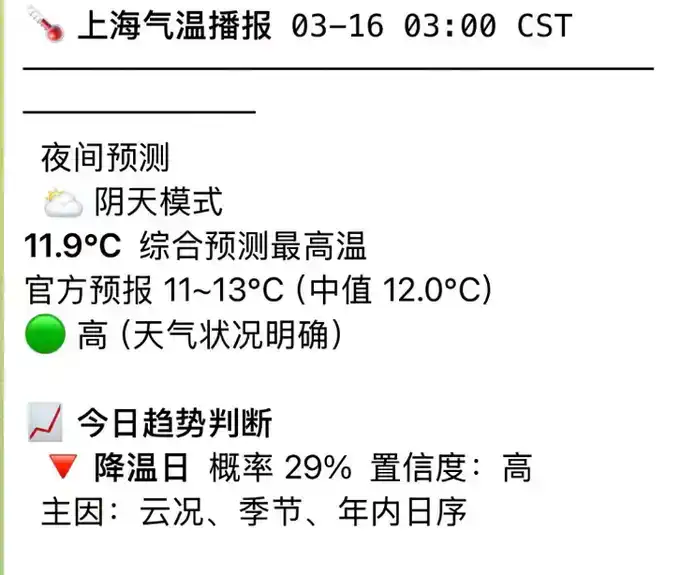
On the early morning of the 16th, the Telegram channel pushed a report from the night mode: tomorrow is a cooling day. The reasons were that the cloud cover was thick that night, and both the season and the day of the year pointed towards cooling.

The editor did not bet immediately at this point. The early morning signal was just the first layer of reference.

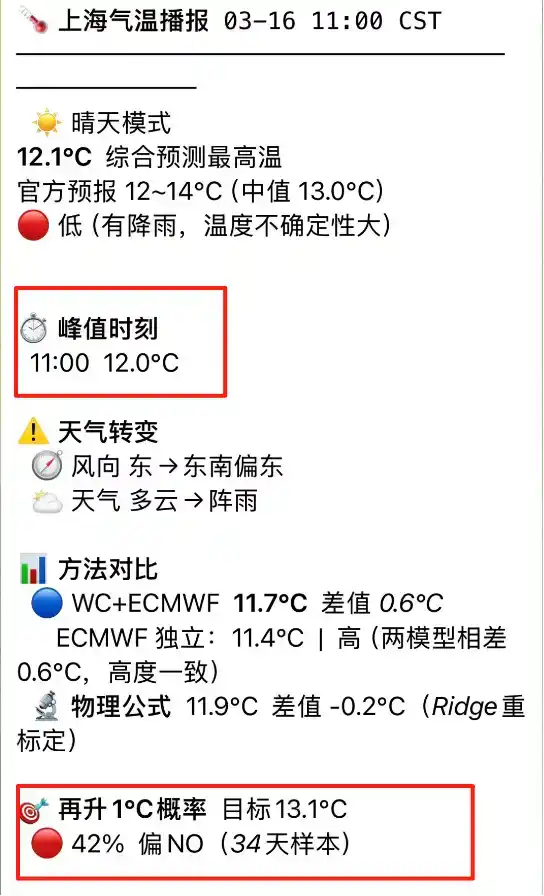
By 11 AM, the system pushed a real-time report during the warming period. The actual measured high temperature had already reached 12°C, and the +1°C probability score gave a result: the probability of rising another 1°C today was 42%, leaning towards not warming further.

Combined with the slightly cooling signal from the early morning logistic regression, the two modules were in agreement. The signal was much clearer now than in the early morning. So a bet was placed that the 16th's maximum temperature would not exceed 13°C.

Settlement that day: 12°C. The previous day, the 15th, was 15°C, a drop of 3 degrees.

Case 2:
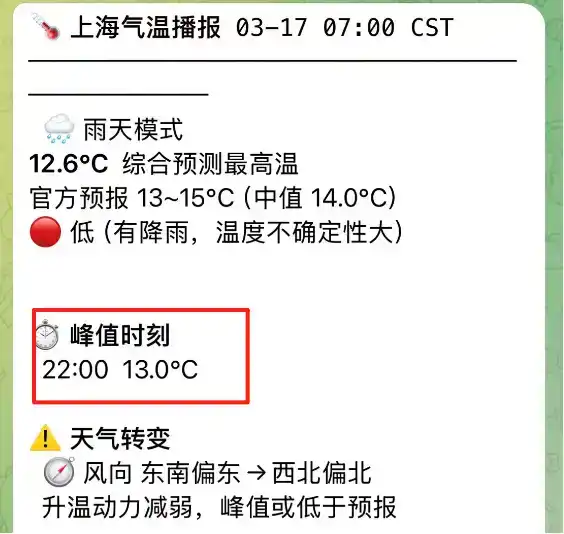
Another example is Shanghai's weather on the 17th (today). The weather system can also serve as an early warning: the push received at 7 AM showed an abnormal peak time: 22:00

Normally, the peak temperature on a sunny day appears between 1-3 PM, but today's peak is at 10 PM, indicating this is not solar heating but warm, moist air transport at night. It rained all day, with cloud cover 97-100%, and almost zero sunshine.

At this point, opening Polymarket, the price for 12°C was still at 53%. Someone in the community was confused: It's already afternoon, the temperature is only 11°C, the normal peak period is long gone, why are people still buying 12°C?

Behind this confusion is that people are still using sunny day logic to judge a rainy day market.

The system is not confused. It identified today's weather type clearly in the morning: abnormal peak time, obvious deviation between the current temperature and market expectations. This is an information gap, and the information gap is a trading opportunity.

This is precisely the meaning of building this system: Easier to identify opportunities; faster to warn of risks.
What are the system's shortcomings?

A system built over a weekend cannot be without flaws:

· Autumn accuracy is only 63.7%, close to a coin toss.

· Cold and warm air masses wrestle repeatedly this season, temperatures rise today and fall back tomorrow—historical patterns fail fastest in autumn.

· Pressure characteristics are not available in live trading. Pressure changes were used as a feature when training the model, and backtest results were good.

· The signal of cold air passing through is very clear. But during live operation, the current interface cannot obtain real-time pressure data.

· Coastal correction is still waiting for more data activation. The sea breeze effect at Pudong Airport is real, and the system has built a corresponding correction module, but there aren't enough backtest samples yet.

For a system that has only been running for a weekend, finding these problems is already a gain. Next step: fix it while running.

4. Conclusion

Meteorology has developed for hundreds of years, using satellites, supercomputers, and global models, yet weather forecasts still dare not guarantee 100% accuracy for tomorrow. It's not that scientists aren't trying hard enough; it's that the atmospheric system itself is chaotic. A one-degree difference in initial conditions can lead to completely different results.

This system, which has only been running for a weekend, will of course make mistakes. Autumn accuracy is nearly a coin toss, the system might not react in time if cold air arrives early, and the sea breeze effect hasn't been fully captured yet.

But that's not important. Participating in prediction markets doesn't require being right every time; it only requires having one more layer of information than the market when the odds are advantageous.

Связанные с этим вопросы

QWhat is the key difference between the temperature data used by Polymarket for settlement and the data shown on typical weather apps?

APolymarket uses the actual measured data from Shanghai Pudong Airport (ZSPD weather station) provided by Wunderground, which is typically lower than the temperature in the city center due to its coastal location. Weather apps often show the temperature for the urban area of Shanghai.

QWhat are the three methods that were successfully implemented in the AI weather prediction system?

AThe three successful methods are: 1. WC + ECMWF ensemble forecast, 2. Real-time correction using morning warming data to extrapolate the peak temperature, and 3. A model to predict if the day will be a warming day compared to the previous day.

QWhy was the Fourier numerical prediction method eliminated from the system?

AThe Fourier numerical prediction was eliminated because it had a high error of 3.6°C and systematically underestimated the temperature. It only provided a smooth average curve for the season and couldn't capture the real daily fluctuations of Shanghai's highly random weather.

QHow does the system's confidence in its 'real-time correction' forecast change throughout the day?

AThe system uses a Kalman gain concept to weight the 'extrapolated result' from real data against the 'original forecast'. In the early morning (6 AM), it relies 80% on the forecast and 20% on real-time extrapolation. By noon (12 PM), it relies 72% on extrapolation, and after 1 PM, it relies 85% on实测 (actual measurements), almost fully trusting the real data as the peak time has likely passed.

QWhat is the main trading opportunity the system is designed to identify on Polymarket?

AThe system is designed to identify information gaps or mispricings on Polymarket by providing more accurate and timely predictions of the day's maximum temperature. This allows the user to place bets on temperature brackets when the market's expectation, based on conventional logic (e.g., for a sunny day), differs from the system's prediction based on a deeper analysis of real-time data and weather patterns (e.g., for a rainy day with a late peak time).

Похожее

The Largest IPO in History Ignites Heated Debate: Is SpaceX Worth $1.77 Trillion?

SpaceX's potential IPO is priced at $135 per share, aiming to raise $75 billion and valuing the company at approximately $1.77 trillion, which would make it the largest IPO in history. This valuation has sparked intense debate among investors. Bullish analysts, including major underwriters Goldman Sachs and Morgan Stanley, argue the valuation is justified by SpaceX's long-term potential. They see it not just as a rocket company but as a future leader in space infrastructure, with key growth drivers being Starlink satellite internet, low-cost rocket launches, and future AI-related ventures. They project revenues reaching hundreds of billions to trillions of dollars by 2030-2040. ARK Invest's model suggests a 2030 enterprise value could reach $2.5 trillion. Bearish analysts from independent research firms like Morningstar, PitchBook, and New Constructs contend the IPO price is excessively high, already pricing in unrealistic future growth. Using DCF and sum-of-the-parts models, they estimate fair value between $780 billion and $1.7 trillion, significantly below the IPO target. They highlight risks such as the speculative nature of AI projections, over-dependence on Elon Musk, high growth expectations, and corporate governance concerns. Trefis set a target price of just $79 per share. While both sides acknowledge SpaceX's unique position in commercial space, the core disagreement centers on whether the $135 share price offers a reasonable margin of safety or is overly optimistic. Despite the valuation controversy, reported strong demand for the IPO indicates significant market interest.

marsbit48 мин. назад

The Largest IPO in History Ignites Heated Debate: Is SpaceX Worth $1.77 Trillion?

marsbit48 мин. назад

After the Passage of the GENIUS Act and the CLARITY Act, What Is the Correct Architecture for On-Chain Yield?

The article discusses the evolution of on-chain credit, distinguishing three markets: overcollateralized crypto lending, unsecured lending (largely unsuccessful), and asset-backed credit (ABC). ABC, backed by identifiable real-world collateral with legal recourse, is identified as the fastest-growing category and the only one credibly addressing adverse selection—the core problem in credit where the riskiest borrowers self-select. Current growth in on-chain Real World Assets (RWAs), particularly tokenized private credit funds (e.g., Maple Finance, Centrifuge), is substantial but often merely "wraps" existing fund structures, inheriting their risks rather than solving adverse selection at the protocol level. The regulatory landscape is a key driver, with the US GENIUS Act (prohibiting stablecoin issuers from paying yield) and the proposed CLARITY Act (closing loopholes on indirect yield) set to redefine permissible yield-bearing products. This makes vaults (like ERC-4626) the critical architecture—they become the primary compliant vehicle for delivering yield, functioning as issuance, disclosure, distribution, and recovery mechanisms. The author's thesis is that the correct post-GENIUS/CLARITY architecture involves building ABC solutions where credit assessment, structure, and recovery are encoded directly into the smart contract vault layer, moving beyond mere tokenized fund wrappers to solve adverse selection fundamentally and ensure regulatory compliance.

Foresight News1 ч. назад

After the Passage of the GENIUS Act and the CLARITY Act, What Is the Correct Architecture for On-Chain Yield?

Foresight News1 ч. назад

TechFlow Intelligence Bureau: Anthropic's New Model Fable Sparks Controversy by Restricting Biosafety Research, US CPI Soars to 4.2%, a Three-Year High

**Summary of TechFlow Intelligence Report:** The newsletter covers several key tech and finance developments. In AI, Anthropic's new Fable model faced backlash for secretly limiting biomedical research capabilities and enforcing a 30-day data retention policy, prompting the company to promise more transparent adjustments. In a related story, Anthropic's founder revealed his departure from OpenAI was due to dishonesty from Sam Altman, not safety concerns. Meanwhile, OpenAI is considering significant price cuts to compete with Anthropic, potentially sparking a price war. In crypto/Web3, BlackRock filed a new amendment for a yield-generating Bitcoin ETF, while Bank of America's CEO warned that stablecoin yields could drain trillions from traditional banks. U.S. Senator Cynthia Lummis advocated for the U.S. to officially accumulate Bitcoin reserves. In hardware, Nvidia released the DiffusionGemma-2-6B image model optimized for efficient inference, and AMD promoted its unified memory architecture to challenge Nvidia's dominance. TSMC's CFO hinted at possible price increases due to soaring AI chip demand. A major legal ruling in Germany held Google legally responsible for inaccurate information generated by its AI Overviews feature. Google Chrome also moved to fully block ad-blocker workarounds like uBlock Origin. Macroeconomic headlines included U.S. CPI rising to 4.2% (a 3-year high) and Iran's complete closure of the Strait of Hormuz, raising oil price and inflation fears. South Korean markets saw continued volatility with massive foreign capital outflow. Other notable stories: Microsoft expanded its Copilot AI assistant "Mico" globally; a study found r/wallstreetbets users' stock picks outperformed Wall Street; a fully autonomous drone killed a human soldier for the first time, raising AI ethics concerns; and a Chinese hospital used brain-computer interface technology to help a blind person "see." The overarching theme connects debates over AI boundaries and responsibility (Anthropic's restrictions, Google's liability, lethal autonomous drones) with real-world economic and geopolitical turmoil (inflation, Strait of Hormuz closure, market instability), highlighting the tense interplay between technological advancement and global chaos.

marsbit1 ч. назад

TechFlow Intelligence Bureau: Anthropic's New Model Fable Sparks Controversy by Restricting Biosafety Research, US CPI Soars to 4.2%, a Three-Year High

marsbit1 ч. назад

Alibaba's Yet Another New Business Division: What Signal Does It Send?

Alibaba has established a new "Token Foundry" business unit, merging its Tongyi large model division and Future Life Lab. Led directly by Group CEO Wu Yongming, this marks the company's third significant AI organizational reshuffle in 2026, following the creation of the Alibaba Token Hub (ATH) and a Group Technology Committee. The move signals a strategic shift from consolidating AI resources to accelerating productization and commercialization. The "Token Foundry" name reflects Alibaba's ambition to become a foundational supplier in the AI era, focusing on model development and commercial application. Key teams, including those behind the high-performing HappyHorse video generation model, have been integrated into the new unit. Concurrently, Zhou Jingren, architect of the Qwen model series, has been appointed Group Chief Scientist to lead a new AI Future Research Institute, focusing on long-term technological breakthroughs like Agent capabilities. This restructuring creates a clear four-layer AI architecture within Alibaba: the research institute for frontier exploration, Token Foundry for core models and commercialization, MaaS for platform services, and business units like Qianwen (C端) and Wukong (B端) for end-user applications. The adjustments align with a global trend among tech giants like Google and Microsoft to centralize AI leadership under the CEO and deeply integrate research with business units. The urgency is driven by a narrowing competitive window. Alibaba has announced its AI business is now entering a commercialization phase, with AI-related revenue seeing triple-digit growth for eleven consecutive quarters. The company faces intense competition in the MaaS (Model-as-a-Service) sector from rivals like ByteDance and Tencent. The Token Foundry initiative represents Alibaba's effort to streamline execution and enhance competitiveness in this critical, fast-evolving landscape.

marsbit2 ч. назад

Alibaba's Yet Another New Business Division: What Signal Does It Send?

marsbit2 ч. назад

Торговля

Спот
Фьючерсы

Популярные статьи

Неделя обучения по популярным токенам (2): 2026 может стать годом приложений реального времени, сектор AI продолжает оставаться в тренде

2025 год — год институциональных инвесторов, в будущем он будет доминировать в приложениях реального времени.

1.8k просмотров всегоОпубликовано 2025.12.16Обновлено 2025.12.16

Неделя обучения по популярным токенам (2): 2026 может стать годом приложений реального времени, сектор AI продолжает оставаться в тренде

Обсуждения

Добро пожаловать в Сообщество HTX. Здесь вы сможете быть в курсе последних новостей о развитии платформы и получить доступ к профессиональной аналитической информации о рынке. Мнения пользователей о цене на AI (AI) представлены ниже.

活动图片