USDC flows surge on Ethereum: Inside the ‘strategic’ shift driving ETH’s 20% move

ambcryptoОпубликовано 2026-03-18Обновлено 2026-03-18

Введение

Recent on-chain data indicates a significant strategic shift in Ethereum's liquidity, marked by a surge in USDC flows. Over the past month, USDC supply on Ethereum expanded by 10.13%, while USDT saw only a 1.46% increase. This nearly tenfold growth gap suggests a deliberate rotation of capital toward USDC, supported by concentrated holdings among major wallets. The top 100 USDC wallets now hold $32.71 billion, with the top six controlling over 25% of the supply. This shift aligns with Ethereum's 20% price appreciation and is reinforced by key fundamentals: Total Value Staked (TVS) reached an all-time high of 38 million ETH, and Real-World Asset (RWA) value grew 6%. The trend appears driven by Tether's strategic pivot toward Bitcoin infrastructure and Circle's strong market performance, with its market cap surpassing $80 billion and its stock rising 120%. The data suggests Ethereum's 2025 upgrades are now materializing in heightened on-chain activity, making USDC flows a critical indicator for ETH's ongoing repricing.

HODLer patience from the 2025 bear cycle finally seems to be paying off.

At the time, altcoins ended the cycle deep in double-digit losses, even though fundamentals stayed strong. Take the Fusaka upgrade. It was mainly focused on boosting Ethereum’s throughput.

The impact? Network transaction volume climbed 36% by year-end, even as ETH closed the year down 29%.

From a technical lens, that kind of volume expansion usually lines up with improving on-chain liquidity, as higher activity leads to better capital flow and stronger network usage.

In that context, Ethereum’s [ETH] 20% move over the past month looks less like a random spike and more like a strategic shift starting to play out.

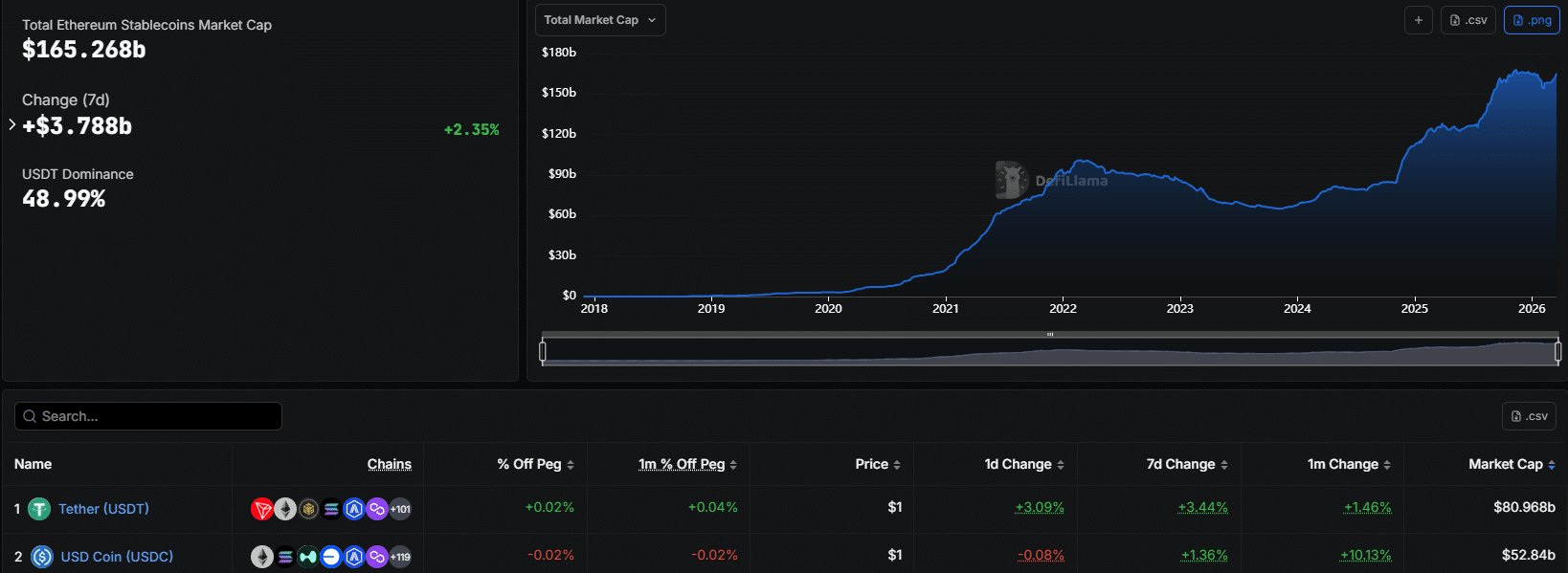
Source: DeFiLlama

As the chart above shows, Ethereum’s stablecoin flows are clearly rotating. Over the past month, USDT on-chain flow edged up just 1.46%, while USDC supply expanded by a much stronger 10.13%. That is almost a tenfold gap, suggesting liquidity is starting to favor USDC over USDT.

Backing this up, Santiment data shows the top 100 USDC wallets on Ethereum now hold $32.71 billion worth of USDC. Even more notable, the top six alone control just over 25.6% of the total supply, pointing to a high level of concentration among major holders.

Taken together, this signals a clear shift in liquidity positioning, as larger players steadily accumulate USDC and reshape how they deploy capital across the Ethereum network.

Naturally, this raises the question: Is this just a short-term rotation or a “strategic” shift that could set the stage for an ETH repricing?

USDC gains momentum as USDT shifts focus to Bitcoin

USDC flows on Ethereum have pushed its market share above 32%, while USDT has dropped below 50%.

However, this shift appears to be more than a short-term rotation. Over the past 30 days, Tether has deployed roughly $20 million into Bitcoin [BTC] Layer 1 infrastructure, reflecting a deliberate strategy to strengthen BTC’s role as a settlement layer.

Against this backdrop, the growing USDT flow on Ethereum does not look random.

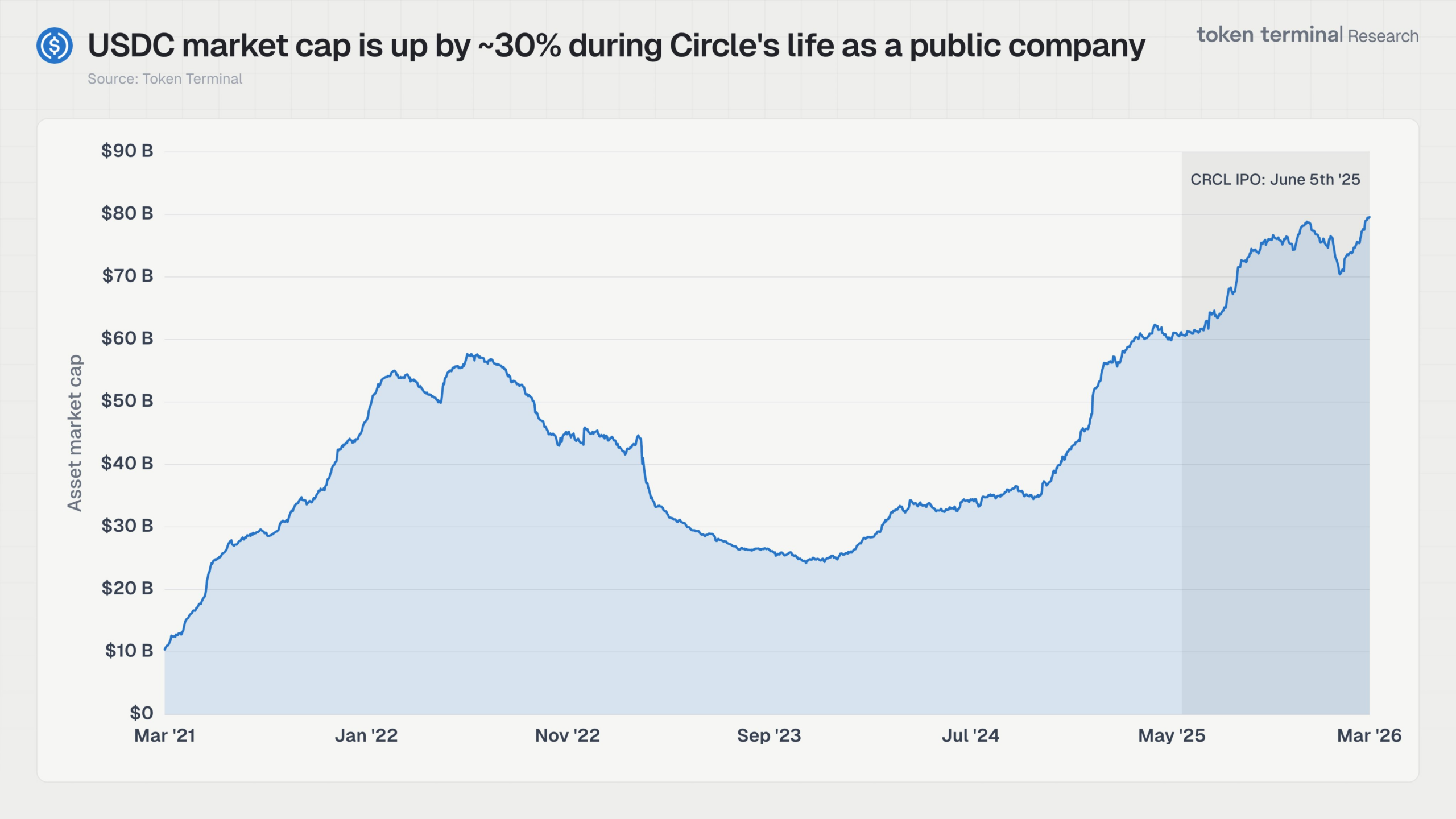
Instead, this context is reinforced by the underlying data. USDC’s market cap has jumped roughly 30%, surpassing $80 billion to reach an all-time high since Circle’s IPO in late Q2 2025.

Moreover, Circle’s stock [CRCL] has surged 120% over the past 30 days, highlighting solid technical and market performance that backs the on-chain trends.

Source: Token Terminal

Taken together, Tether’s rotation toward Bitcoin, combined with Circle’s growing market share, shows that large players are strategically shifting how they deploy stablecoins on Ethereum.

The result is clear: USDC’s roughly 10% gain over the past month aligns closely with ETH’s 20% price increase.

Notably, on-chain data reinforces this trend. CryptoQuant shows that ETH’s Total Value Staked (TVS) has climbed nearly 3% to an all-time high of 38 million ETH, while the total value of Real-World Assets (RWA) has risen about 6% over the same period.

In essence, the effects of Ethereum’s 2025 upgrades are showing up in its stablecoin activity, with USDC flows now feeding directly into on-chain activity. In this context, Ethereum’s market repricing is becoming increasingly tied to USDC flows, making it a key trend to watch.


Final Summary

  • USDC supply has surged over 10% on Ethereum in the past month, supported by large holders and on-chain activity, signaling strategic rotation rather than a short-term move.
  • ETH’s 20% price gain aligns with rising USDC flows, increased staking, and RWA growth, showing that Ethereum’s 2025 upgrades are driving stablecoin activity and influencing market repricing.

Похожее

Xiaohongshu's Second Great Voyage, This Time Sailing Towards AI

Xiaohongshu's Second Voyage: Navigating Towards AI Since ChatGPT's emergence, Xiaohongshu's founder Mao Wenchao has been acutely aware of AI's potential threat, recognizing that the life advice people seek from chatbots overlaps directly with his platform's core business. Founded in 2013 as a PDF shopping guide for Chinese tourists, Xiaohongshu evolved into a massive community where millions share authentic, personal experiences—from product reviews to travel tips. This vast repository of "I've tried this" human judgment became its most valuable asset. However, the rise of AI, which delivers instant answers, challenges the very need for users to sift through numerous personal notes. Fearing its treasure trove of lived experience could become mere training data for others, Xiaohongshu is proactively adapting. In 2026, it established a dedicated AI division (Dots), launched RED Skill to turn user experiences into usable AI tools, and acquired the AI search product "Diandian." Its investments now extend to AI firms like MiniMax and hardware startups, moving upstream to address needs before they even become search queries. The platform's commercialization strategy is also evolving. With a newly acquired payment license and tools like the AIPS model to track consumer decision journeys, Xiaohongshu aims to seamlessly integrate recommendations with transactions, embedding commerce within AI-generated answers. Yet, a critical tension remains. While building smarter machines to organize and leverage its human experiences, Xiaohongshu must prevent AI from drowning out the authentic, flawed, and trustworthy "I've tried this" voices that built its community. Its core challenge is to harness AI's power without letting the map—the machine's perfect, synthesized answer—replace the territory of genuine human experience. This balance between technological advancement and preserving human trust defines its current journey and its future.

marsbit23 мин. назад

Xiaohongshu's Second Great Voyage, This Time Sailing Towards AI

marsbit23 мин. назад

SharpLink CEO: How to Understand Ethereum Developers Just Exceeded 1 Million?

SharpLink CEO reflects on the milestone of Ethereum surpassing 1 million historical developers, emphasizing that this figure represents the largest pool of technical talent ever assembled around an open, permissionless blockchain network. While approximately 232,000 developers remain active, the key question for the crypto industry is not which chain is fastest, but where the best builders choose to build long-term. Ethereum's advantage lies in a decade-long accumulation of infrastructure, standards, tools, liquidity, and a cohesive culture, making it the default operating system for programmable finance. This developer base is tackling complex challenges: the Glamsterdam upgrade aims to enhance scalability while preserving core principles; synchronous composability seeks to unify Rollup ecosystems; and significant efforts are underway for post-quantum security. Ethereum's deeper network effects stem from composability and shared standards (like the EVM and Solidity), creating a flywheel of more developers, tools, and liquidity. Three reinforcing strengths cement Ethereum's lead: credible neutrality (secured by ~900k validators), a modular architecture with interconnected Rollups, and a culture that attracts top researchers. The ecosystem is consolidating as the trusted coordination layer for internet-native finance, favored by large institutions valuing security and liquidity. The future of Ethereum is being built by this global community of founders and architects.

链捕手37 мин. назад

SharpLink CEO: How to Understand Ethereum Developers Just Exceeded 1 Million?

链捕手37 мин. назад

A Clod of Chinese Soil Chokes Two Japanese Giants

"Chinese Soil Chokes Japanese Giants" The production of a key electronic specialty gas, tungsten hexafluoride (WF6), vital for manufacturing AI chips, was halted by two leading Japanese producers—Kanto Denka and Central Glass. Their shutdown was not due to a technological failure but a sudden, critical shortage of a raw material they had long taken for granted: ultra-high-purity (6N-grade) tungsten powder, which is almost entirely sourced from China. Following a quiet Chinese export announcement in January 2026, tungsten powder shipments to Japan dropped to zero for months. Despite frantic efforts, Japanese companies found no viable alternative; imported powder was three times more expensive and lacked the required purity. Their existing stockpiles were exhausted by mid-2026. WF6 is essential for depositing tungsten into the microscopic contact holes of High Bandwidth Memory (HBM) chips, which are crucial for advanced processors like those from Nvidia. While Japanese firms had mastered producing ultra-pure WF6 gas, their entire supply chain relied on China's 6N tungsten powder—a dependency now revealed as a fatal vulnerability. China's dominance in this "soil" results from decades of painstaking R&D by companies like Xiamen Tungsten and China Tungsten & Hightech. They overcame immense technical hurdles, such as separating chemically similar molybdenum from tungsten, to achieve mass production of the world's purest tungsten powder. With their primary suppliers gone, Kanto Denka and Central Glass announced a permanent halt to WF6 production starting July 1, 2026. This immediately created a supply crisis for major semiconductor manufacturers like Samsung and SK Hynix, forcing them to urgently seek and certify new Chinese suppliers for WF6 itself. The reversal marks a dramatic shift: China has moved from exporting low-value raw materials to controlling the high-purity foundation of a critical global tech supply chain, upending a long-established industrial hierarchy.

marsbit1 ч. назад

A Clod of Chinese Soil Chokes Two Japanese Giants

marsbit1 ч. назад

Торговля

Спот
Фьючерсы

Популярные статьи

Manyu: восходящая мем-звезда на Ethereum, готовая открыть новую эру культуры Shiba

Manyu - это мемтокен на Ethereum, который приносит децентрализованную культурную и развлекательную ценность через вирусное влияние в соцсетях и вовлечённость сообщества.

2.0k просмотров всегоОпубликовано 2025.11.27Обновлено 2025.11.27

Manyu: восходящая мем-звезда на Ethereum, готовая открыть новую эру культуры Shiba

Неделя обучения по популярным токенам 14: Glamsterdam — самое ожидаемое обновление Ethereum в 2026 году

Ordinals/Runes по-прежнему стимулируют доходы от комиссий за блоки и активность разработчиков, рассматриваются как отправная точка «нативной эмиссии активов» в сети.

1.5k просмотров всегоОпубликовано 2026.04.29Обновлено 2026.04.29

Неделя обучения по популярным токенам 14: Glamsterdam — самое ожидаемое обновление Ethereum в 2026 году

Обсуждения

Добро пожаловать в Сообщество HTX. Здесь вы сможете быть в курсе последних новостей о развитии платформы и получить доступ к профессиональной аналитической информации о рынке. Мнения пользователей о цене на ETH (ETH) представлены ниже.

活动图片