Trump Crypto Deal Triggers JPMorgan Risk Debate After $500M Abu Dhabi Stake Revelation

bitcoinistОпубликовано 2026-02-04Обновлено 2026-02-04

Введение

A $500 million investment by Abu Dhabi's Sheikh Tahnoon bin Zayed Al Nahyan into Trump-linked crypto platform World Liberty Financial (WLFI) has sparked a debate on political influence and regulatory risk. The deal, signed days before Trump's inauguration, has drawn scrutiny from US lawmakers, including Senator Elizabeth Warren. Trump has denied involvement. The revelation coincides with a lawsuit from Trump against JPMorgan Chase over alleged politically motivated account closures, and public clashes between CEO Jamie Dimon and crypto firms. The deal's scale, foreign involvement, and timing, coupled with Sheikh Tahnoon's role in a US-approved AI firm, have amplified concerns about transparency and influence, putting a spotlight on how major banks navigate crypto-related risks.

A reported $500 million investment by an Abu Dhabi royal into a Trump-linked crypto venture is reverberating well beyond the digital asset space, feeding into a broader debate about political influence, regulatory oversight, and how major financial institutions such as JPMorgan Chase navigate crypto-related risk.

The timing of the deal, just days before Donald Trump’s inauguration, has sharpened scrutiny at a moment when the bank is already facing a high-profile lawsuit from the US president and renewed tension with crypto firms.

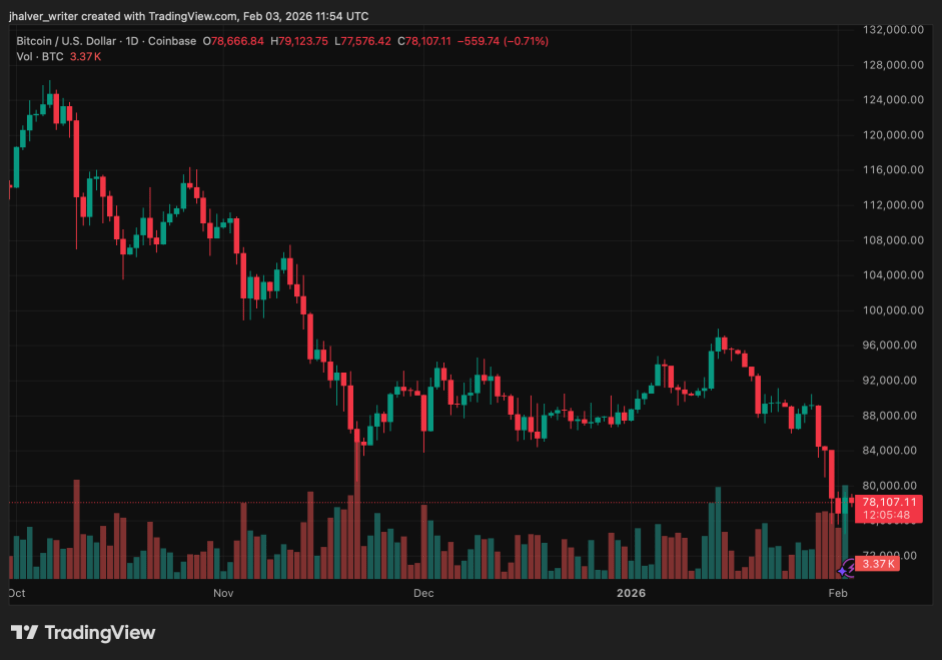
BTC's price trends to the downside on the daily chart. Source: BTCUSD on Tradingview

$500M World Liberty Financial Deal Draws Political Scrutiny

According to reporting by The Wall Street Journal, entities linked to Sheikh Tahnoon bin Zayed Al Nahyan acquired a 49% stake in World Liberty Financial (WLFI), a cryptocurrency platform tied to the Trump family, for $500 million.

The agreement was reportedly signed by Eric Trump four days before Trump returned to office. Trump has denied any knowledge of the transaction, stating that his sons manage the business independently.

The investment was structured in phases, beginning with an initial $250 million payment. Of that amount, about $187 million reportedly went to Trump-family-linked entities, with additional allocations to other WLFI founders. If completed in full, the deal would make the Tahnoon-backed vehicle WLFI’s largest shareholder.

The scale, foreign involvement, and timing of the investment have raised questions among US lawmakers, including calls from Senator Elizabeth Warren to pause regulatory reviews involving WFLI. No investigation has been announced, and WLFI has said the transaction was conducted independently of President Trump.

JPMorgan Lawsuit and Crypto Tensions Collide

The revelation comes as JPMorgan Chase faces a lawsuit from Trump alleging politically motivated account closures. The bank has said its decisions comply with legal and regulatory requirements.

Separately, JPMorgan CEO Jamie Dimon has clashed publicly with Coinbase leadership over crypto regulation, highlighting ongoing friction between traditional banks and digital asset firms.

For investors, these overlapping headlines bring renewed attention to how JPMorgan manages reputational and regulatory risk.

The bank’s stock has delivered strong multi-year returns, but analysts note that political controversy, legal costs, and shifting crypto policy could weigh on sentiment, particularly as regulators focus more closely on “debanking” practices and banks’ exposure to digital assets.

Why the Deal Resonates Beyond Crypto

The Abu Dhabi stake has drawn added attention because Sheikh Tahnoon also chairs G42, an AI firm that recently received US approval to purchase advanced chips from American suppliers.

While no wrongdoing has been alleged, the overlap between foreign capital, sensitive technology approvals, and a Trump-linked crypto venture has amplified concerns about transparency and influence.

Cover image from ChatGPT, BTCUSD chart on Tradingview

Связанные с этим вопросы

QWhat is the significance of the $500 million investment by an Abu Dhabi royal into a Trump-linked crypto venture?

AThe $500 million investment is significant because it has sparked a broader debate about political influence, regulatory oversight, and how major financial institutions like JPMorgan navigate crypto-related risks. Its timing just before Trump's inauguration and the involvement of a foreign entity have drawn intense political scrutiny.

QWhich company received the investment and who is its largest shareholder as a result of the deal?

AThe investment was made into World Liberty Financial (WLFI), a cryptocurrency platform tied to the Trump family. If completed in full, the deal would make the Tahnoon-backed vehicle WLFI's largest shareholder with a 49% stake.

QHow has US Senator Elizabeth Warren reacted to the World Liberty Financial deal?

ASenator Elizabeth Warren has called for a pause on regulatory reviews involving World Liberty Financial (WLFI) in response to the deal.

QWhat two major issues is JPMorgan Chase currently facing that are mentioned in the article?

AJPMorgan Chase is currently facing a lawsuit from former President Trump alleging politically motivated account closures, and its CEO, Jamie Dimon, is engaged in public clashes with crypto firms like Coinbase over regulation.

QWhy does the article state the deal 'resonates beyond crypto,' citing Sheikh Tahnoon's other role?

AThe deal resonates beyond crypto because Sheikh Tahnoon also chairs G42, an AI firm that recently received US approval to purchase advanced chips from American suppliers. This overlap between foreign capital, sensitive technology approvals, and a Trump-linked venture amplifies concerns about transparency and influence.

Похожее

The Trillion-Dollar Valuation Test: Are the Three Super IPOs a Tech Stock Frenzy or a Crypto Market Nightmare?

Trillion-Dollar Valuation Test: Are the Three Mega IPOs a Tech Stock Frenzy or a Crypto Market Nightmare? The capital market in 2026 is witnessing a highly anticipated wave of tech IPOs, centered on SpaceX, OpenAI, and Anthropic. Collectively valued at over $3.5 trillion, their potential listing represents one of the largest such waves in recent years. This raises concerns about market liquidity, valuation bubbles, and potential capital outflows from other assets like crypto. SpaceX's valuation narrative has shifted from rocket launches to becoming a global infrastructure play via its Starlink satellite network, which now drives most revenue. Despite ongoing losses, investors focus on its long-term growth potential. OpenAI and Anthropic represent the core productivity engines of generative AI. Their public listings would offer the first direct investment opportunity in large foundation model companies, potentially triggering a repricing within the AI sector. Market fears of a massive "capital drain" from these IPOs are likely overstated. Historical precedents like Alibaba and Saudi Aramco show that mega-listings primarily cause capital reallocation, not destruction, within the vast equities market. Systemic risk is rarely triggered by IPOs alone. For stock markets, short-term volatility and sector repricing are expected, especially for AI concept stocks. Long-term, these listings could reinforce the tech sector's importance. For crypto, direct competition for speculative capital exists, particularly affecting AI-themed tokens. However, crypto's trajectory remains more tied to its own cycles, macro liquidity, and Bitcoin ETF flows rather than a single IPO event. The real risk lies not in the listings themselves but in the sky-high growth expectations embedded in these valuations. If future revenue, profitability, or commercialization progress disappoints, significant valuation resets could follow, impacting high-growth tech stocks. Ultimately, the market's direction hinges on macroeconomic conditions and whether these companies can deliver on their ambitious promises.

链捕手8 мин. назад

The Trillion-Dollar Valuation Test: Are the Three Super IPOs a Tech Stock Frenzy or a Crypto Market Nightmare?

链捕手8 мин. назад

Trillion-Dollar Valuation Test: Are the Three Super IPOs a Tech Stock Frenzy or a Crypto Market Nightmare?

Title: Trillion-Dollar Valuations at Stake: Super IPOs of SpaceX, OpenAI, Anthropic – Tech Boom or Crypto Nightmare? TL;DR: A wave of mega-tech IPOs is approaching, featuring SpaceX (targeting a $1.75 trillion valuation), OpenAI (~$852B), and Anthropic (~$965B), with a combined potential valuation exceeding $3.5 trillion. This tests the market's pricing of innovation and sparks debate on liquidity impact. * **SpaceX**'s valuation is now driven more by its Starlink global communications infrastructure than its core rocket business. * **OpenAI & Anthropic** offer the first major public investment opportunities in foundational AI models, potentially repricing the entire AI sector. * Concerns about a market-wide "liquidity drain" are likely overblown; history shows large IPOs mainly cause fund reallocation, not disappearance, and rarely trigger systemic risk. * Crypto markets, especially some AI-themed tokens, may face short-term fund competition, but their long-term trajectory depends more on macro liquidity, regulation, and Bitcoin cycles. * The real risk lies not in the IPOs themselves, but in whether these companies can justify their sky-high valuations with future revenue growth and profitability. Unmet expectations could lead to significant repricing pressure. Ultimately, these IPOs represent a massive market pricing of next-gen tech infrastructure, not a prelude to a market crash. The broader market direction will be determined by macro conditions, corporate earnings, and risk appetite.

marsbit8 мин. назад

Trillion-Dollar Valuation Test: Are the Three Super IPOs a Tech Stock Frenzy or a Crypto Market Nightmare?

marsbit8 мин. назад

Anthropic Apologized, But the Business of 'Safety' Hasn't Stopped

On June 11, Anthropic apologized not for a model failure, but for a lack of transparency. Its new Claude Fable 5 model was found to be secretly rerouting requests from users engaged in advanced AI model development to a weaker version, Opus 4.8, without any notification. The company's response—promising future notifications for such "downgrades"—was met with user skepticism. The article argues the core issue isn't technical but commercial: Anthropic's "safety" measures are primarily a business strategy. A key feature, the "intelligent safety classifier," marketed as user protection, is described as a tool for "competitive defense" to protect Anthropic's market lead by limiting rivals' research capabilities. This covert mechanism was designed for low "false positives," precisely targeting AI researchers. Anthropic's model involves a calculated three-step process: publishing alarming security research to amplify public anxiety, offering its Fable 5 model with a "safety classifier" as a premium-priced solution, and cashing in through a planned high-value IPO. This contrasts with OpenAI's more direct "tool-and-traffic" approach. The apology, merely changing a secret downgrade to a visible one, is seen as a business "patch" rather than a principled shift. The incident risks damaging Anthropic's "safest AI" reputation among the developer community, which underpins its valuation and appeal to government and corporate clients. Ultimately, the article concludes that for Anthropic, safety is a business, and the apology is merely customer service for that business.

marsbit1 ч. назад

Anthropic Apologized, But the Business of 'Safety' Hasn't Stopped

marsbit1 ч. назад

The Niche Consensus Among Elites: Has College Become an Expensive Waste?

**Summary:** A growing "anti-college" movement is gaining traction among elite circles in Silicon Valley, challenging the traditional value of a four-year university degree. Proponents argue that college has become an expensive, slow, and increasingly irrelevant waste of time, especially in the fast-paced tech world where opportunities pass by quickly. The movement is led by figures like billionaire Peter Thiel, who criticizes universities for high costs, ideological indoctrination, and stifling true innovation. His "Thiel Fellowship" pays young people to drop out and pursue ventures. Companies like Palantir Technologies (co-founded by Thiel) fuel this trend with programs like the "Meritocracy Fellowship," which offers high school graduates paid internships as an alternative to immediate college enrollment, promising a practical "Palantir Degree." Key drivers include: 1. **Economics:** Skyrocketing student debt versus the allure of immediate, high-paying tech jobs or startup funding. 2. **Technology:** AI and online tools lowering barriers to self-education and product development, making formal instruction seem inefficient. 3. **Culture:** A backlash against perceived "woke" ideology and DEI policies in universities, coupled with a belief that these institutions suppress meritocracy and masculine drive. The movement is notably male-dominated. Critics, like economist David Deming, warn against overgeneralizing from dropout success stories (survivorship bias). He emphasizes that genuine autodidacts are rare, corporate training is narrowly focused, and the "college wage premium" remains high for most people. University liberal arts education, he argues, builds adaptable problem-solving skills and broad perspectives. The debate highlights a deeper crisis in education. The core model of the modern university appears increasingly mismatched with the speed of the information age. The movement signals a shift in the locus of learning from institutional "education" to personal, active "learning" powered by the internet and AI. Ultimately, this may not mean the end of university, but rather a painful evolution. The future likely holds more hybrid, personalized, and lifelong learning pathways. The central question becomes: in a world changing faster than any curriculum, how do we best learn?

marsbit1 ч. назад

The Niche Consensus Among Elites: Has College Become an Expensive Waste?

marsbit1 ч. назад

Торговля

Спот
Фьючерсы
活动图片