Too busy to vote? Vitalik Buterin says AI can do it for you!

ambcryptoОпубликовано 2026-02-23Обновлено 2026-02-23

Введение

Vitalik Buterin, Ethereum Co-Founder, has proposed a novel solution to address low participation and centralization in DAO governance: AI-powered voting agents. Instead of requiring users to manually vote on every proposal, each user would have a personal AI model trained on their messages, opinions, and past decisions. This AI would then vote on their behalf, exactly as the user would. Buterin highlights that the current delegation model is disempowering and leads to voting power being concentrated with a few large token holders. His proposal aims to make DAOs more scalable and truly decentralized. A key aspect is ensuring user privacy and security. These AI agents would operate within secure systems like trusted execution environments, and zero-knowledge proofs could be used to protect voter identity and prevent risks like bribery or coercion. Furthermore, AI agents could automatically handle routine votes, alerting users only for important decisions, and prediction markets could be used to filter out spam proposals. In summary, this AI voting system could fundamentally transform DAO governance by increasing participation, reducing centralization, and maintaining user privacy.

What if you never had to vote in a DAO again? That’s the future Ethereum Co-Founder Vitalik Buterin is imagining.

Instead of users showing up for every proposal, AI agents could step in and vote based on what you actually believe.

AI will vote, so you don’t have to

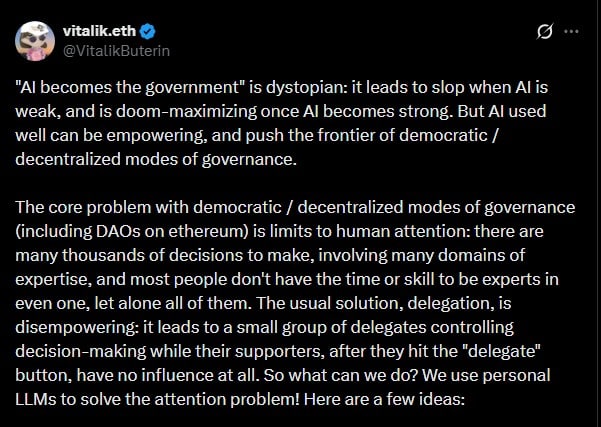
Buterin recently noted that DAO voting has a serious participation problem, and his solution sounds straight out of the future. Instead of users manually voting on every proposal, he’s proposed letting personal AI agents do the job.

The idea is that each user would have their own AI model, trained on their messages, opinions, and past decisions. This AI would then vote on DAO proposals exactly how the user would.

“Making good decisions often cannot come from a linear process of taking people’s views that are based only on their own information, and averaging them (even quadratically).”

Most people don’t have the time or expertise to vote on thousands of complex decisions. As a result, voting power often ends up concentrated with a few large token holders. Buterin stated,

“The usual solution, delegation, is disempowering”

What’s interesting is that this comes a month after Buterin ripped into DAOs for low participation and growing centralization.

A key part of the idea…

…is making sure users don’t have to give away privacy for convenience.

These AI agents would run inside secure systems, like trusted execution environments and multi-party computation. This would allow them to process sensitive information without exposing it publicly.

Source: X

To protect voter identity, Buterin suggested using zero-knowledge proofs.

This would let users prove they’re eligible to vote without revealing their wallet address or their decision. It could also reduce risks like bribery, coercion, or blindly copying large token holders.

AI agents could also automatically handle routine votes and alert users only when something important comes up.

To deal with spam proposals, prediction markets are the idea on the table. This is where AI agents would back strong proposals and ignore weak ones.


Final Summary

  • Vitalik Buterin’s AI voting proposal could change DAO governance forever.
  • If adopted widely, AI agents could make DAOs more scalable and truly decentralized.
Next: Why is Cardano’s share rising in Grayscale’s fund? Explained!
Share
  • Share
  • Tweet

Связанные с этим вопросы

QWhat problem with DAO voting does Vitalik Buterin identify, and what is his proposed solution?

AVitalik Buterin identifies that DAO voting has a serious participation problem, where most people don't have the time or expertise to vote on thousands of complex decisions, leading to centralized voting power. His solution is to have personal AI agents, trained on a user's messages, opinions, and past decisions, vote on their behalf.

QHow would the proposed AI agents protect user privacy according to the article?

AThe AI agents would run inside secure systems like trusted execution environments and multi-party computation to process sensitive information without exposing it publicly. Buterin also suggested using zero-knowledge proofs to allow users to prove they are eligible to vote without revealing their wallet address or decision.

QWhat are two potential benefits of using AI agents for DAO voting, as mentioned by Buterin?

ATwo benefits are: 1) It could reduce risks like bribery, coercion, or blindly copying large token holders. 2) AI agents could automatically handle routine votes and only alert users for important decisions, making DAOs more scalable and decentralized.

QWhat mechanism does the article suggest for dealing with spam proposals in a DAO?

AThe article suggests using prediction markets to deal with spam proposals, where AI agents would back strong proposals and ignore weak ones.

QWhat did Vitalik Buterin criticize about the 'usual solution' of delegation in DAOs?

AVitalik Buterin stated that the usual solution of delegation is 'disempowering,' as it often leads to voting power becoming concentrated with a few large token holders instead of being truly decentralized.

Похожее

MoneyGram: Why Did We Launch Our Own Stablecoin?

MoneyGram, a global leader in cross-border remittances for over 80 years, has launched its own stablecoin, MGUSD. The initiative aims to evolve from single-transaction services to becoming a more integral part of users' financial lives. By allowing customers to hold a stable US dollar balance within the MoneyGram app, MGUSD enables not only remittances but also everyday spending, currency exchange, cash access, and future financial services. Targeting the billions globally who face challenges like currency volatility or lack of bank accounts, MGUSD leverages Stellar blockchain technology with a self-custody wallet architecture. This gives users control over their assets while providing a secure, compliant experience through a trusted brand. The approach focuses on solving existing customer pain points within MoneyGram's established network, rather than competing for broad crypto market liquidity. A key advantage is MoneyGram's hybrid model, combining digital services with the world's largest physical network for crypto-to-cash conversions. The stablecoin also modernizes the company's internal infrastructure, streamlining treasury management and partner settlements, with annual forex volume via stablecoins already reaching $2 billion. The project was delivered in about a year, driven by a reorganization into agile, cross-functional teams that operate with startup-like speed while leveraging decades of institutional expertise. Partners include Stablecoin (issuance), Crossmint (wallet APIs), Fireblocks (enterprise treasury), m0 (smart contracts), and the Stellar network. MoneyGram emphasizes that enhancing direct consumer offerings strengthens its partner ecosystem. The future direction is clear: to provide users worldwide with stable value storage, better financial tools, and greater control over their funds through a trusted, existing network.

Foresight News32 мин. назад

MoneyGram: Why Did We Launch Our Own Stablecoin?

Foresight News32 мин. назад

BIP-110 Controversy Intensifies: Bitcoin May Face Its Most Divisive Hard Fork Battle in Years

Bitcoin is approaching a critical block height of 961,632, which could activate the controversial BIP-110 proposal. This proposal aims to restrict the amount of non-financial data, such as inscriptions and other large data payloads, within Bitcoin transactions. Supporters, including some node operators and Bitcoin purists, argue that BIP-110 is necessary to preserve Bitcoin's core function as a monetary settlement layer by reducing network congestion and node operational burdens caused by non-essential data. They frame it as a correction to keep the network true to its original purpose. However, critics, including prominent figures like Blockstream's Adam Back and developer Jameson Lopp, warn that the proposal's implementation mechanism is dangerously flawed. They highlight that its low 55% miner signaling threshold, coupled with a contentious enforcement mechanism allowing nodes to unilaterally reject non-compliant blocks, significantly increases the risk of a chain split. Opponents argue this sets a dangerous precedent for transaction censorship, undermines Bitcoin's protocol neutrality, and creates excessive uncertainty for developers and businesses, especially since the rule is proposed as a temporary one-year measure. Market analysts, such as those from Bitfinex, suggest a full-scale network split is unlikely due to a lack of broad economic consensus. Major mining pools remain neutral, and adoption of the new rules is minimal. They view the situation more as a governance stress test. The primary risk is operational disruption: if a minority chain persists, major exchanges and custodians may need to temporarily suspend Bitcoin deposits and withdrawals to manage security and liquidity, potentially unsettling newer institutional investors. While BIP-110 is not expected to succeed in overtaking the main chain, its approach has ignited a significant debate about Bitcoin's governance, core values, and resilience.

Foresight News1 ч. назад

BIP-110 Controversy Intensifies: Bitcoin May Face Its Most Divisive Hard Fork Battle in Years

Foresight News1 ч. назад

NEAR to Airdrop 330,000 Tokens, Betting on TVL Reaching $70 Million

On June 11th, NEAR Protocol launched the Near@3.33 Milestone Incentive Program, targeting users of its Confidential Intents privacy cross-chain execution feature. The program will distribute 333,333 milestone tokens when the Confidential Intents Total Value Locked (TVL) reaches $70 million. Users must have conducted Confidential transactions on near.com and maintain a Confidential balance above $100 in any asset to qualify, with a single wallet capped at 2% of the current airdrop pool. The milestone tokens will be locked upon receipt and cannot be sold or transferred. They can only be converted 1:1 to NEAR tokens once NEAR's Volume Weighted Average Price (VWAP) maintains $3.33 or higher for three consecutive trading days. As of the report, Confidential Intents TVL exceeds $20.69 million, needing roughly a 3x increase to trigger the airdrop. Confidential Intents, launched in February 2026, is NEAR's privacy execution layer designed to prevent MEV, front-running, and strategy leaks by building confidentiality directly into the execution environment. Its TVL has grown from zero to approximately $15 million in about three months. NEAR token price, which surged from around $1 in April to a peak of $3.08, currently trades near $2. The program aims to boost user activity for Confidential Intents, with future incentive rounds planned as community engagement increases.

Foresight News2 ч. назад

NEAR to Airdrop 330,000 Tokens, Betting on TVL Reaching $70 Million

Foresight News2 ч. назад

Crypto Market Makers Are Collectively Seeking Change as Money Becomes Harder to Earn

**Summary: Crypto Market Makers Adapt as Margins Shrink** Leading crypto market maker GSR exemplifies a broader industry shift, moving beyond traditional market-making to become a full-service "Web3 investment bank." Its recent strategic acquisitions—including an SEC-registered broker-dealer, rebranded as GSR Securities—and purchases of token advisory firms aim to create an integrated platform covering token design, fundraising, listing, liquidity provision, and asset management. This includes launching an ETF and investing in tokenization platforms like Libeara, backed by a strategic investment from Standard Chartered's SC Ventures. This transformation is not unique to GSR. Other major players like Keyrock, B2C2, Wintermute, and DWF Labs are also expanding geographically, pursuing regulatory licenses (especially under frameworks like MiCA in the EU), and diversifying into over-the-counter (OTC) trading, asset management, and real-world asset tokenization. The driving force behind this collective pivot is a rapidly changing market. Profits from traditional altcoin market-making are declining due to fewer viable projects, reduced client budgets, increased competition, and smarter, more demanding clients. Simultaneously, regulatory pressures are mounting, making compliance a baseline cost. Extreme market events further expose teams lacking robust risk controls. Consequently, the crypto market-making business model is evolving from one reliant on information asymmetry and volatility to a more institutionalized, regulated, and service-diverse industry. Survival now depends on building systemic capabilities beyond mere liquidity provision.

marsbit2 ч. назад

Crypto Market Makers Are Collectively Seeking Change as Money Becomes Harder to Earn

marsbit2 ч. назад

Торговля

Спот
Фьючерсы

Популярные статьи

Неделя обучения по популярным токенам (2): 2026 может стать годом приложений реального времени, сектор AI продолжает оставаться в тренде

2025 год — год институциональных инвесторов, в будущем он будет доминировать в приложениях реального времени.

1.8k просмотров всегоОпубликовано 2025.12.16Обновлено 2025.12.16

Неделя обучения по популярным токенам (2): 2026 может стать годом приложений реального времени, сектор AI продолжает оставаться в тренде

Обсуждения

Добро пожаловать в Сообщество HTX. Здесь вы сможете быть в курсе последних новостей о развитии платформы и получить доступ к профессиональной аналитической информации о рынке. Мнения пользователей о цене на AI (AI) представлены ниже.

活动图片