Tokens, Models, and Bubbles: The Crypto × AI Game in the Primary Market

比推Опубликовано 2026-02-12Обновлено 2026-02-12

Введение

Based on a two-year retrospective, this article analyzes the convergence of Crypto and AI from a primary market perspective. Initially, the crypto space heavily promoted "Crypto Helps AI" through three main narratives: computation power tokenization, data tokenization, and model tokenization. However, these efforts largely resulted in what the author calls a "tokenization illusion"—projects that issued tokens but lacked real product-market fit or sustainable business models. The piece critiques these approaches: decentralized compute networks often fail to meet enterprise reliability standards; tokenized data struggles with supply-demand alignment due to low user motivation and high professional requirements; and model tokenization is fundamentally flawed since AI models are non-scarce, easily replicable, and depreciate quickly. Additionally, projects focusing on verifiable inference (like ZKML or OPML) are solutions in search of a problem, as real-world AI failures are rarely due to malicious tampering but rather design errors or misconfigurations. The author references Vitalik Buterin’s updated views, which now present a more balanced perspective compared to two years ago. Buterin outlines four quadrants of Crypto × AI integration: two where crypto (especially Ethereum) provides trustless, economic layers for AI agents and private interactions, and two where AI enhances crypto—through local LLMs acting as user shields for security and AI improving market efficiency and DA...

Author: Lao Bai

Original Title: Crypto × AI from the Primary Market Perspective: An Experiment in Tokenized Illusion


After two years, V God has tweeted again, and I’ll follow up on the research report from two years ago, even the timing is exactly the same, February 10th. (Related reading: ABCDE: Sorting Out AI+Crypto from a Primary Market Perspective)
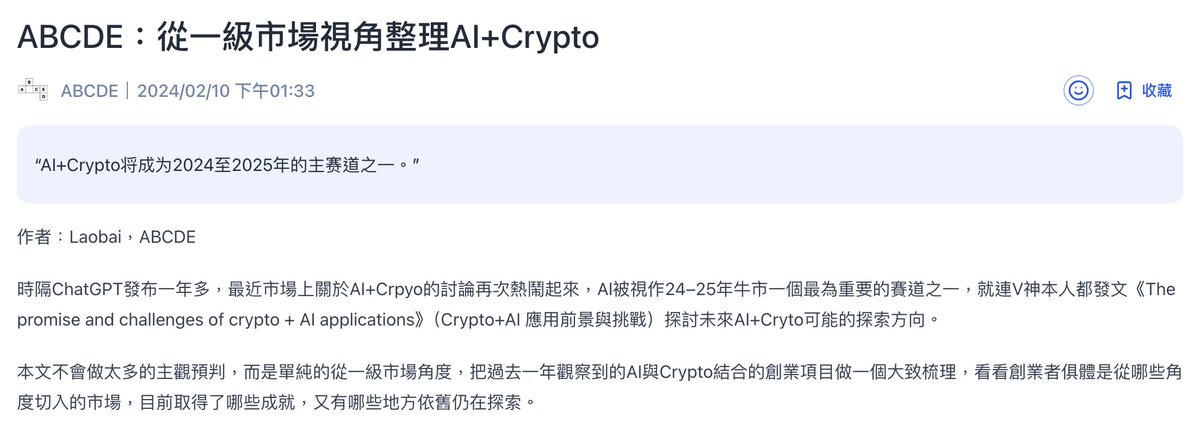
Two years ago, V God actually implicitly expressed that he wasn’t very optimistic about the various Crypto Helps AI trends that were popular at the time. The three popular narratives in the circle back then were computing power assetization, data assetization, and model assetization. My research report two years ago mainly discussed these three narratives and some observations and doubts about them from the primary market. From V God’s perspective, he was more optimistic about AI Helps Crypto.

The examples he gave at the time were:

  • AI as a participant in the game;

  • AI as the game interface;

  • AI as the game rules;

  • AI as the game objective;

Over the past two years, we have made many attempts in Crypto Helps AI, but the results have been minimal. Many sectors and projects ended up – issuing a token and that’s it, without real commercial PMF (Product-Market Fit), which I call the "Tokenized Illusion".

1. Computing Power Assetization – Most cannot provide commercial-grade SLA, are unreliable, and frequently go offline. They can only handle simple small and medium model inference tasks, mostly serving niche markets. Revenue is not linked to the token......

2. Data Assetization – High friction, low willingness, and high uncertainty on the supply side (retail users). The demand side (enterprises) needs structured, context-dependent, professional data suppliers with trust and legal liability. DAO-based Web3 project parties find it difficult to provide this.

3. Model Assetization – Models themselves are non-scarce, replicable, fine-tunable, and rapidly depreciating process assets, not final-state assets. Hugging Face itself is a collaboration and dissemination platform, more like GitHub for ML, not an App Store for models. Therefore, so-called "decentralized Hugging Face" projects aiming to tokenize models have mostly ended in failure.

Additionally, over these two years, we have tried various forms of "Verifiable Inference," which is a typical story of looking for a nail to hit with a hammer. From ZKML to OPML to Gaming Theory, etc., even EigenLayer shifted its Restaking narrative to Verifiable AI.

But it's basically similar to what happened in the Restaking sector – few AVSs (Actively Validated Services) are willing to pay continuously for extra verifiable security.

Similarly, verifiable inference is mostly verifying "things that no one really needs to be verified." The threat model on the demand side is extremely vague – who exactly are we protecting against?

AI output errors (model capability issues) far outnumber maliciously tampered AI outputs (adversarial problems). The various security incidents on OpenClaw and Moltbook some time ago showed that the real problems come from:

  • Wrong strategy design

  • Excessive permissions granted

  • Unclear boundaries

  • Unexpected interactions between tool combinations

  • ...

Almost none of the imagined nails like "model being tampered with" or "inference process being maliciously rewritten" exist.

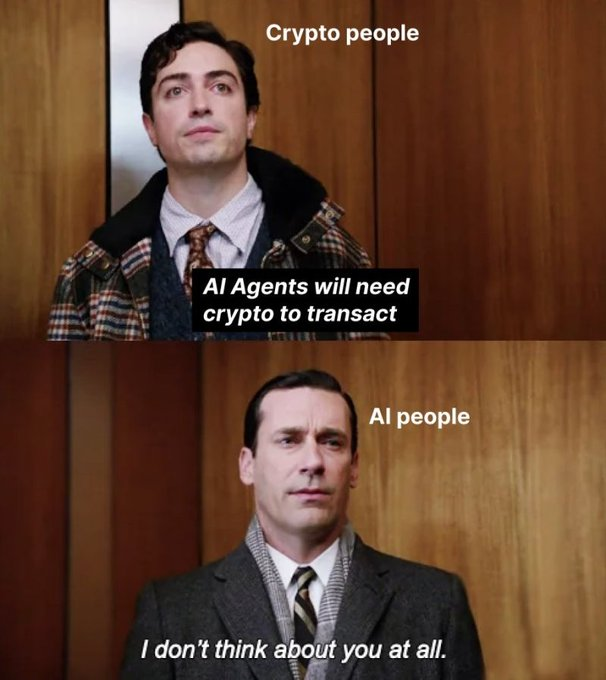
Last year I posted this picture, I wonder if any old-timers remember.
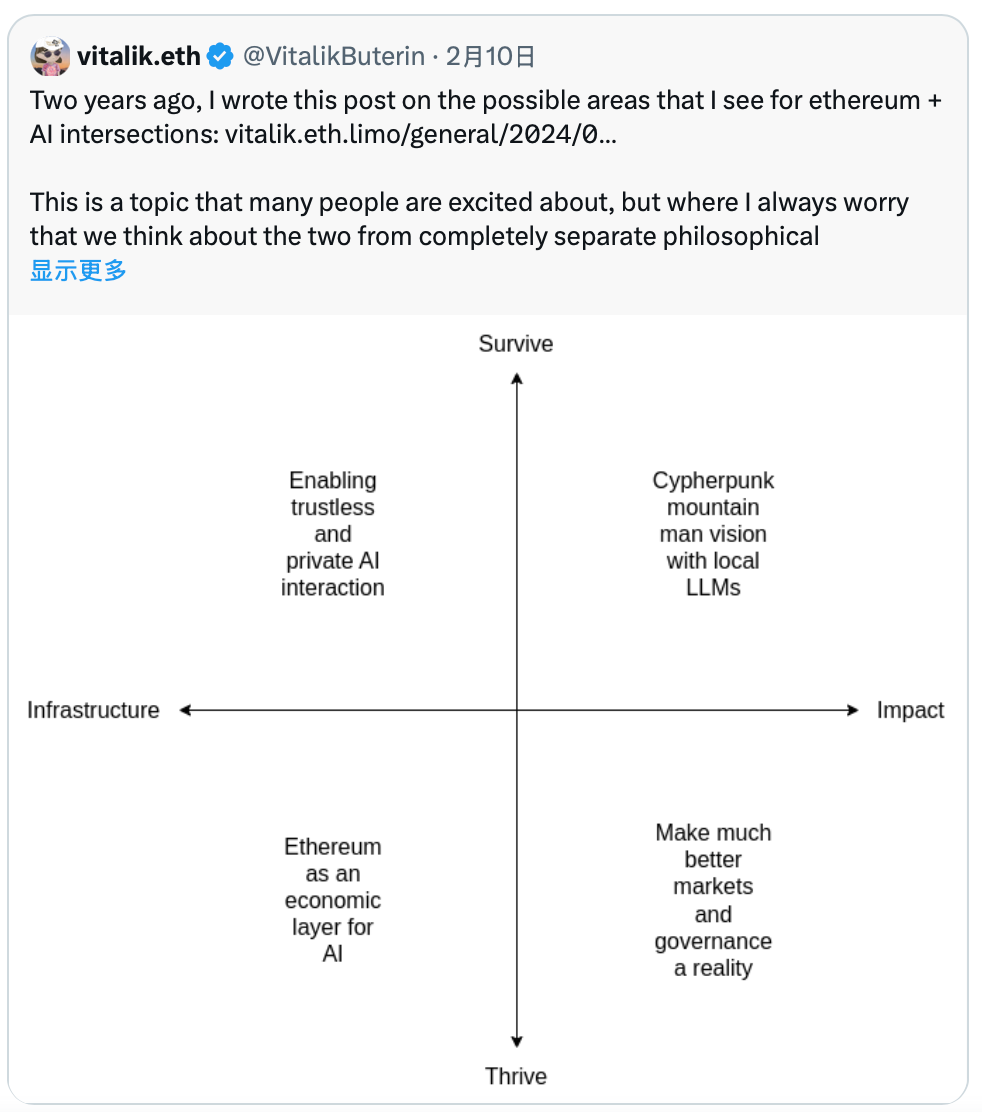
The ideas V God presented this time are clearly more mature than two years ago, also due to the progress we've made in privacy, X402, ERC8004, prediction markets, and other directions.

It can be seen that the four quadrants he divided this time, half belong to AI Helps Crypto, and the other half belong to Crypto Helps AI, no longer being clearly biased towards the former as it was two years ago.

Top left and bottom left – Utilizing Ethereum's decentralization and transparency to solve AI's trust and economic collaboration problems

1.Enabling trustless and private AI interaction (Infrastructure + Survival): Using technologies like ZK, FHE, etc., to ensure the privacy and verifiability of AI interactions (not sure if the verifiable inference I mentioned earlier counts).

2. Ethereum as an economic layer for AI (Infrastructure + Prosperity): Enabling AI agents to conduct economic payments, recruit other robots, pay deposits, or establish reputation systems through Ethereum, thereby building a decentralized AI architecture instead of being limited to a single giant platform.

Top right and bottom right – Utilizing AI's intelligent capabilities to optimize the user experience, efficiency, and governance of the crypto ecosystem:

3. Cypherpunk mountain man vision with local LLMs (Impact + Survival): AI as the user's "shield" and interface. For example, local LLMs (Large Language Models) can automatically audit smart contracts, verify transactions, reduce reliance on centralized front-end pages, and safeguard individual digital sovereignty.

4. Make much better markets and governance a reality (Impact + Prosperity): AI deeply participates in Prediction Markets and DAO governance. AI can act as an efficient participant, amplifying human judgment by processing information on a large scale, solving various market and governance problems such as insufficient human attention, high decision-making costs, information overload, and voter apathy.

Previously, we were desperately trying to make Crypto Help AI, while V God stood on the other side. Now we finally meet in the middle, though it seems unrelated to various XX tokenizations or some AI Layer1. I hope that looking back at today's post in two years, there will be some new directions and surprises.

Twitter:https://twitter.com/BitpushNewsCN

Bitpush TG Discussion Group:https://t.me/BitPushCommunity

Bitpush TG Subscription: https://t.me/bitpush

Original link:https://www.bitpush.news/articles/7611374

Трендовые криптовалюты

Связанные с этим вопросы

QWhat are the three main areas of 'Crypto Helps AI' that the author identified as largely ineffective over the past two years?

AThe three main areas are: 1) Compute Power Assetization (unstable, cannot provide commercial SLA, serves only edge markets), 2) Data Assetization (high friction for suppliers, demand for structured data from professional suppliers), and 3) Model Assetization (models are non-scarce, replicable, and rapidly depreciating assets, making tokenization attempts largely fail).

QAccording to the author, what is the fundamental issue with 'Verifiable Inference' projects like ZKML and OPML?

AThe fundamental issue is that they are a solution in search of a problem ('a typical story of using a hammer to find a nail'). The demand-side threat model is extremely vague, as there is little need to verify things that no one actually needs verified. Problems like AI output errors (model capability issues) are far more common than malicious tampering of AI output (adversarial problems).

QHow did Vitalik Buterin's (V神) perspective on the Crypto x AI intersection evolve from two years ago to the present, as described in the article?

ATwo years ago, Vitalik was more skeptical of 'Crypto Helps AI' and was more optimistic about 'AI Helps Crypto'. His current perspective, as outlined in a new quadrant model, is more balanced. It includes two quadrants for 'AI Helps Crypto' (using AI to optimize crypto UX, efficiency, and governance) and two for 'Crypto Helps AI' (using Ethereum's decentralization and transparency to solve AI's trust and economic collaboration issues).

QWhat are the two specific use cases mentioned under the 'Crypto Helps AI' quadrant in Vitalik's new framework?

AThe two use cases are: 1) Enabling trustless and private AI interaction using technologies like ZK and FHE for privacy and verifiability, and 2) Using Ethereum as an economic layer for AI, allowing AI agents to conduct economic transactions, hire other bots, post bonds, or build a reputation system to create a decentralized AI architecture.

QWhat does the author mean by the term 'Tokenization Illusion' in the context of Crypto x AI projects?

AThe term 'Tokenization Illusion' refers to the phenomenon where many projects in the Crypto x AI space simply launch a token without achieving real Product-Market Fit (PMF) or creating a sustainable business model. The author argues that these projects often lack genuine commercial viability and substance beyond the token issuance itself.

Похожее

Как стать человеком, которого искусственный интеллект никогда не сможет заменить

В статье рассматривается вопрос о том, как остаться незаменимым в эпоху искусственного интеллекта. Автор утверждает, что вместо страха перед ИИ следует сосредоточиться на развитии качеств, которые машины не смогут заменить. Он критикует «зарплатное рабство» — зависимость от работы, не приносящей удовлетворения, и предлагает путь к финансовой независимости через создание собственного дела. Ключ к успеху — развитие пяти элементов: самостоятельности (агентности), вкуса, умения убеждать, упорства и способности к итерациям. Главное — не просто создавать что-либо (сегодня это может каждый), а создавать что-то ценное, востребованное и уметь это продвигать. Автор считает, что наиболее важным навыком будущего является создание контента (медиа), а не просто написание кода, поскольку ценность контента субъективна и требует уникального человеческого вкуса и суждения. ИИ может помочь в производстве, но не заменит оригинальность мысли и связь с аудиторией. В качестве практического шага предлагается упражнение: за 15 минут ответить на вопросы, чтобы обнаружить свои уникальные знания, опыт и точку зрения, которые станут основой для личного бренда и дела жизни. Первый шаг — немедленно опубликовать свою основную идею, чтобы получить обратную связь от реального мира и начать процесс роста. Цель — стать «непригодным для найма», построив жизнь вокруг собственного творчества и экспертизы.

marsbit2 ч. назад

Как стать человеком, которого искусственный интеллект никогда не сможет заменить

marsbit2 ч. назад

Благодаря броскам кубиков ключи от биткоинов хранятся в автономном режиме, но не все будут этим заниматься

Статья посвящена практике генерации сид-фраз для биткоин-кошельков с помощью бросков кубиков в свете уязвимости, обнаруженной в аппаратных кошельках Coldcard. Подчеркивается, что физический бросок кубика (дающий около 2.6 бит энтропии за бросок) создает высококачественную случайность, поскольку предсказать результат практически невозможно из-за множества переменных. Для создания стандартной сид-фразы из 12 слов (128 бит энтропии) требуется около 50 бросков, а для повышенной безопасности рекомендуется 99 и более. В связи с инцидентом Coldcard, когда неисправный генератор случайных чисел в прошивке (2021-2026 гг.) мог создавать предсказуемые ключи, выяснилось, что сид-фразы, сгенерированные вручную через кубики, были защищены от этой уязвимости. Однако исследование показало, что другие функции устройства (создание бумажных кошельков, ключей для мультиподписи, паролей и т.д.) по-прежнему использовали скомпрометированный генератор, подвергая риску владельцев даже с безопасной основной сид-фразой. Автор отмечает, что, хотя метод с кубиками криптографически надежен, он непрактичен для массового использования из-за трудоемкости, высокой вероятности ошибок при вводе и необходимости строгой дисциплины для сохранения секретности процесса. Делается вывод, что будущее безопасности лежит в создании надежных аппаратных генераторов случайных чисел и понятных интерфейсов, а ручные методы остаются нишевым инструментом для опытных пользователей. Владельцам Coldcard рекомендуется обновить прошивку и проверить/заменить все ключи, сгенерированные уязвимыми функциями.

cryptonews.ru5 ч. назад

Благодаря броскам кубиков ключи от биткоинов хранятся в автономном режиме, но не все будут этим заниматься

cryptonews.ru5 ч. назад

Майкл Сэйлор заявил, что стало невозможно принять обновление биткойна, против которого он выступал!

Майкл Сэйлор заявил, что обновление BIP-110 для Bitcoin не сможет достичь необходимого порога в 55% добровольной поддержки майнеров в текущем цикле сложности. Согласно его данным, из 946 блоков, сгенерированных к настоящему моменту, только 24 содержали сигнал поддержки этого предложения, и все они исходили от майнеров DATUM через пул OCEAN. Сэйлор подчеркивает, что отсутствие сигналов от других майнеров означает отсутствие общего консенсуса. BIP-110 — это предложение, направленное на ограничение внесения в блокчейн Bitcoin данных, не связанных непосредственно с денежными переводами (например, изображений или текста). Сэйлор выступает против него, считая, что сеть не должна решать, какие транзакции являются «нужными», а правила не должны меняться по желанию небольшой группы. Он также утверждает, что заявленный уровень поддержки может быть искусственно завышен из-за автоматизированных процессов сигнализации.

cryptonews.ru5 ч. назад

Майкл Сэйлор заявил, что стало невозможно принять обновление биткойна, против которого он выступал!

cryptonews.ru5 ч. назад

Количество негативных комментариев о биткоине достигло исторического максимума: что это значит?

Аналитическая компания Santiment сообщает, что негативные комментарии о биткоине в социальных сетях достигли исторического максимума. Соотношение позитивных и негативных упоминаний упало до рекордно низкого уровня: на каждый негативный комментарий приходится лишь 0,58 позитивных. Основной причиной роста негатива стала уязвимость в прошивке аппаратных кошельков Coldcard, что подорвало доверие к системам холодного хранения, традиционно считающимся наиболее безопасными. В отличие от прошлых кризисов (таких как крах FTX или Mt. Gox), текущие обсуждения сфокусированы на безопасности аппаратных решений, а не на централизованных биржах. По данным Santiment, текущий уровень паники в социальных сетях даже превышает пики, зафиксированные во время событий этого года, связанных с геополитической напряженностью, и во время прошлых крупных криптовалютных кризисов. Таким образом, страх на рынке исторически значительно превосходит жадность. Компания подчеркивает, что данные пока отражают ситуацию лишь за один день.

cryptonews.ru6 ч. назад

Количество негативных комментариев о биткоине достигло исторического максимума: что это значит?

cryptonews.ru6 ч. назад

Торговля

Спот

Популярные статьи

Неделя обучения по популярным токенам (2): 2026 может стать годом приложений реального времени, сектор AI продолжает оставаться в тренде

2025 год — год институциональных инвесторов, в будущем он будет доминировать в приложениях реального времени.

1.9k просмотров всегоОпубликовано 2025.12.16Обновлено 2025.12.16

Неделя обучения по популярным токенам (2): 2026 может стать годом приложений реального времени, сектор AI продолжает оставаться в тренде

Обсуждения

Добро пожаловать в Сообщество HTX. Здесь вы сможете быть в курсе последних новостей о развитии платформы и получить доступ к профессиональной аналитической информации о рынке. Мнения пользователей о цене на AI (AI) представлены ниже.

活动图片















