Theft Is Just the Beginning: The Slow Collapse Behind Cyber Attacks

比推Опубликовано 2026-03-23Обновлено 2026-03-23

Введение

The article "Theft Is Just the Beginning: The Slow Collapse Behind Hacker Attacks" discusses the long-term impacts of cryptocurrency hacks beyond the initial financial loss. Based on Immunefi’s "2026 On-Chain Security Report," the analysis reveals that while attacks themselves are swift, the aftermath unfolds over months, causing prolonged damage such as declining token prices, reduced funding, halted hiring, and delayed development. Key findings include: - The median direct loss per attack is around $25 million, but tokens experience a median drop of 61% within six months, with 16% recovering to pre-attack levels. - Although the number of attacks remains steady (94 in 2024, 97 in 2025), the concentration of losses is alarming: the top five attacks accounted for 62% of total stolen funds. - Centralized platforms, though fewer in attack frequency, represent over half of the financial losses, highlighting persistent vulnerabilities in trusted intermediaries. The report emphasizes that the true crisis begins after the theft—projects face extended recovery periods, reputational harm, and operational disruption, making survival particularly challenging for less-resourced teams. The interconnected nature of DeFi ecosystems further amplifies risks, as single incidents can trigger broader market repercussions. Ultimately, the article underscores that resilience is not just about preventing hacks but enduring their prolonged secondary effects.

Author: Andjela Radmilac

Compiled by: Saoirse, Foresight News

Original title: Under the Shadow of Hackers, More Than Just the Demise of Funds


Cryptocurrency exploits can drain a wallet in minutes, but the full extent of the losses often takes months to fully materialize. Token prices continue to fall, project treasuries shrink, hiring freezes, and even projects that survive the theft may completely lose their future in the subsequent turmoil.

Cryptocurrency hacks never end the moment the wallet is emptied. The theft is swift and direct, followed by a slower collapse that begins to spread within the project.

Tokens continue to decline, funding pools shrink accordingly, hiring plans are cut, product development is delayed, and partners withdraw one after another. Projects that should be focusing on recovery end up spending months rebuilding credibility instead of building.

This is precisely the scene depicted in Immunefi's latest "2026 On-Chain Security Status Report." Its core argument applies to any market—whether in the crypto industry or traditional sectors: the initial loss is only part of the damage.

The more serious issue lies in the devastating impact of the exploit on the project's future. Immunefi data shows that the average direct amount stolen per attack in their sample was approximately $25 million, while the median drop in stolen tokens within six months was as high as 61%. During this period, 84% of the tokens failed to return to their pre-attack prices, and project teams spent at least three months on post-incident recovery, delaying normal development.

However, this data comes with a caveat: token declines have multiple causes, and many projects were already vulnerable before the attack—suffering from poor liquidity, overvaluation, or having already lost momentum.

Immunefi acknowledges that they cannot completely separate the impact of hacks from broader market weakness or the projects' own issues. Even so, the patterns revealed in the report are still noteworthy: hacker attacks are no longer isolated theft events but more like a long-tail corporate crisis.

The value of this report lies in its proof that, after the热点 news fades, the后续 effects of hacker attacks continue to cause long-term harm.

Median Attack Losses Are Decreasing, but Extreme Attacks Are Becoming More Dangerous

According to Immunefi's statistics, 191 crypto attacks occurred in 2024-2025, with total losses of $4.67 billion; over five years, 425 attacks累计 occurred, with total losses reaching $11.9 billion.

The number of attacks per year has hardly changed: 94 in 2024, 97 in 2025, roughly flat with 2023. This indicates that the overall security of the market has not significantly improved. Hacker attacks have become the norm in the crypto industry, and a few giant attacks are enough to define the industry's risk for an entire year.

The report reveals a core contradiction:

The median loss from attacks in 2024-2025 was $2.2 million, lower than the $4.5 million in 2021-2023. On the surface, this seems like progress. However, the average loss was still about $24.5 million, more than 11 times the median; previously, this gap was only 6.8 times. The top five attacks accounted for 62% of all stolen funds; the top ten accounted for 73%.

This is an extremely dangerous distribution pattern: the market appears stable and safe until a giant event tears it apart. The scale of ordinary attacks has become smaller, but the real致命 risk lies in the tail—a few特大 incidents absorb the vast majority of losses and冲击 the entire market in a single day.

The most typical case is Bybit. The exchange's $1.5 billion exploit became the most iconic hack of 2025, with this single incident accounting for 44% of all funds stolen that year.

It's easy to view such events as news spectacles, but they expose a deeper problem of risk concentration: a single failure at a core platform is enough to distort the annual loss structure of the entire industry, revealing that huge risks are still piled up on a few critical nodes.

The Protracted Decline Is Where the Project Truly Begins to Collapse

The data on stolen funds in the report is certainly noteworthy, but the most alarming part is the section on price impact.

In Immunefi's sample of 82 hacked tokens:

  • Within two days of the hack, the median drop was about 10%, roughly flat with the previous cycle;

  • But the real冲击 emerged later: the median drop expanded to 61% after six months, higher than the 53% in 2021-2023.

Six months later:

  • 56.5% of the hacked tokens had fallen more than 50%;

  • 14.5% had fallen more than 90%;

  • Only about 16% of tokens returned to or exceeded their pre-attack price levels.
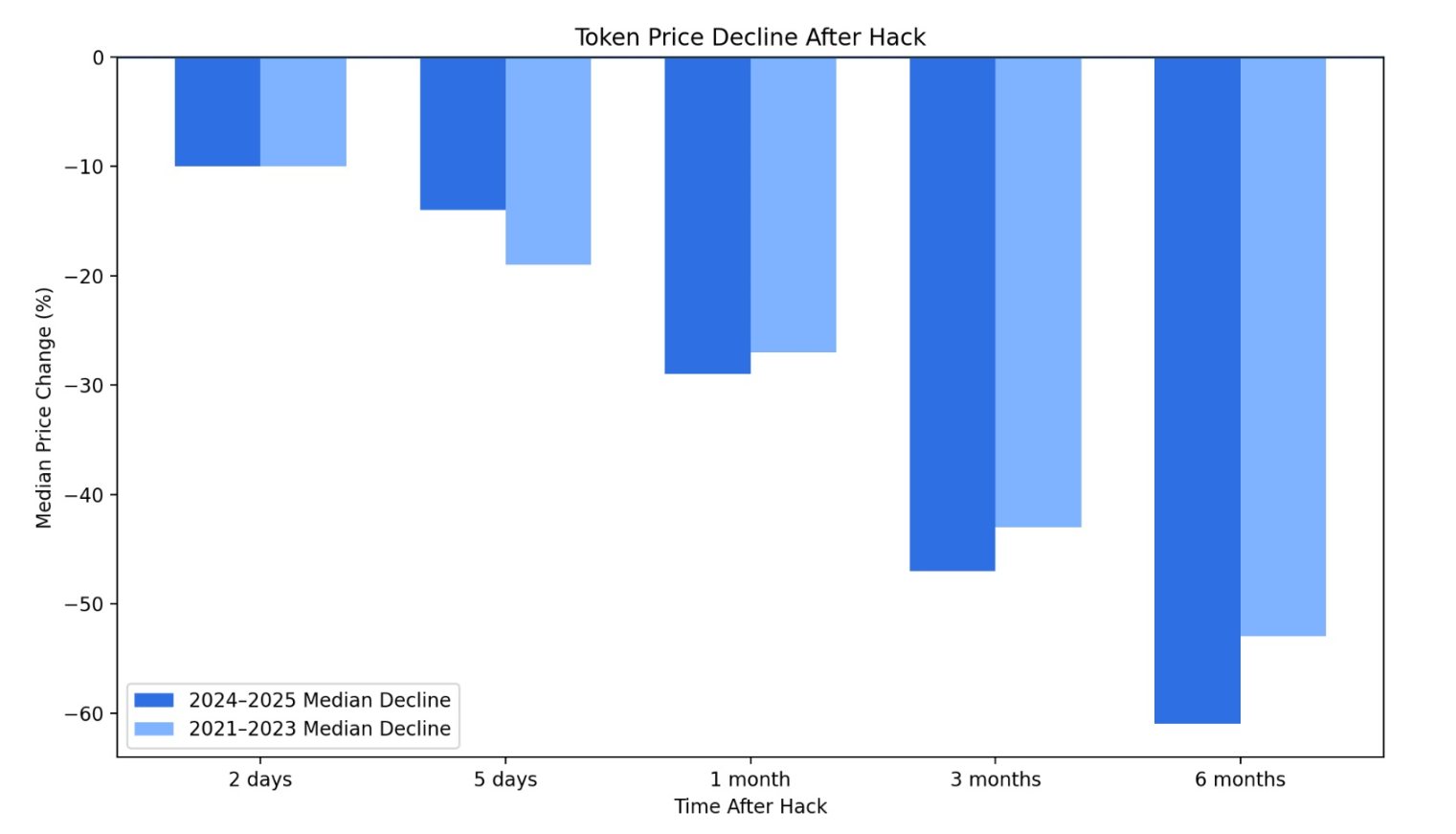
Chart shows the median token price decline for 82 hacked tokens in Immunefi's sample from 2024 and 2025 (Source: Immunefi)

To understand the full impact of a hack, we can no longer view token price as an isolated market indicator. For the vast majority of crypto projects, the token is the treasury, the foundation for fundraising, and the public report card of credibility. A prolonged暴跌 directly cripples the project's operational cycle, hiring ability, bargaining power in partnerships, and internal morale.

The report points out that projects that suffer attacks often lose their security lead within weeks and enter a recovery period of at least three months. Even if the timeline varies by project, the consequences are clear: projects with crashed tokens and damaged brands have almost no breathing room or chance for a turnaround.

Many markets can withstand a theft, a bad quarter, or even a reputation crisis. But the crypto industry often compresses all three into the same event: the attack empties the treasury → the token暴跌 publicly revalues the project → partners withdraw before the internal cleanup is even finished.

Recovery in this environment is extremely difficult, and致命 for teams that were not well-funded to begin with.

Interdependency makes the situation worse. Immunefi believes the DeFi ecosystem has become increasingly interconnected, forming longer, more fragile risk chains between cross-chain bridges, stablecoins, liquid staking, restaking, and lending markets.

Although some cases in the report require external verification, the overall trend is undeniable: today's crypto systems have more complex layers, meaning the impact of a single attack will extend far beyond the affected protocol itself.

Centralized platforms remain at the epicenter of explosions.

The report shows that out of the 191 attacks in 2024-2025, only 20 targeted centralized exchanges, but these 20 caused losses of $2.55 billion, accounting for 54.6% of the total losses.

This shifts the problem from smart contract vulnerabilities back to asset custody, key management, and over-concentrated infrastructure. For an industry that often sells itself on "decentralized risk resistance," most of the huge losses still occur on highly trusted, centralized nodes.

But this does not mean all hacked projects are doomed to fail. The industry has entered a new phase: a project's survival no longer depends on whether it can withstand an attack, but on whether it can withstand the six months *after* the attack.

Theft is just the beginning of the crisis. What truly determines whether a project has a future is the long, slow,持续的 secondary damage that follows the attack.


Twitter:https://twitter.com/BitpushNewsCN

Bitpush TG Discussion Group:https://t.me/BitPushCommunity

Bitpush TG Subscription: https://t.me/bitpush

Original link:https://www.bitpush.news/articles/7622471

Связанные с этим вопросы

QWhat is the main finding of Immunefi's '2026 On-Chain Security Status Report' regarding the impact of crypto hacks?

AThe main finding is that the initial theft is only part of the damage; the more severe problem is the devastating impact on a project's future, including prolonged token price declines, drained treasuries, halted hiring, and delayed development, which can lead to a slow, long-term collapse.

QAccording to the report, what was the median percentage drop in the price of hacked tokens after six months?

AThe median percentage drop in the price of hacked tokens after six months was 61%.

QWhat does the report reveal about the distribution of losses from crypto hacks between 2024 and 2025?

AThe report reveals a highly dangerous distribution: while the median attack loss decreased, the average loss was high, and a small number of extreme attacks accounted for the majority of the losses. The top 5 attacks represented 62% of all stolen funds, and the top 10 represented 73%.

QWhich type of platform was responsible for the majority of the financial losses from hacks in 2024-2025, despite having fewer incidents?

ACentralized exchanges were responsible for the majority of financial losses. Although only 20 attacks targeted CEXs, they resulted in losses of $2.55 billion, accounting for 54.6% of the total losses during that period.

QWhat key factor does the report suggest ultimately determines whether a project can survive a hack?

AThe report suggests that a project's survival is no longer determined by its ability to withstand the initial attack, but rather by its ability to withstand the subsequent six months of slow, prolonged secondary damage, including price collapse and reputational harm.

Похожее

Совместное вмешательство США и Японии: новое «Соглашение Плаза», начало Бреттон-Вудской системы 2.0 и конец эры йеновых арбитражей

Мероприятие по совместной поддержке иены США и Японией, впервые за десятилетия, заставляет рынки переоценить глобальные модели движения капитала, долгое время зависевшие от дешевого финансирования в иенах. Аналитики полагают, что это может означать поворотный момент для торговли на разнице процентных ставок с использованием иены (йеновый кэрри-трейд) и привести к более глубокой перестройке глобальных финансовых потоков. Министр финансов США Бессент и президент Трамп подтвердили активное участие США. Бессент заявил о готовности к дальнейшим совместным интервенциям для коррекции «серьезной недооценки» иены. Трамп подчеркнул, что это демонстрация союзнических отношений, и ожидает финансовой выгоды для Вашингтона. Интервенция вызвала резкий рост курса иены до 157,40 за доллар. Анализ рынка указывает, что действия альянса выходят за рамки обычного управления валютным курсом. Если Японии для защиты иены придется продавать свои валютные резервы (включая казначейские облигации США), это может привести к переоценке долгосрочных доходностей американских госдолга и запустить реорганизацию глобальной ликвидности. Этот сдвиг потенциально сигнализирует о конце эры йенового кэрри-трейда, которая десятилетиями поддерживала глобальную ликвидность и низкие процентные ставки. Дополнительное давление на долгосрочные ставки создает изменение роли крупных технологических компаний, которые теперь активно выпускают облигации для финансирования инвестиций в ИИ, превращаясь из поглотителей сбережений в крупных заемщиков. Некоторые наблюдатели видят в этих событиях признаки формирования нового международного порядка в духе «Бреттон-Вудс 2.0» или нового «Соглашения Плаза». США, делая ставку на экономику предложения, стремятся к ускорению роста, в то время как Япония, возможно, стоит на пороге реструктуризации своей экономической и геополитической роли. Независимо от того, окажется ли интервенция разовой мерой или началом долгосрочной координации, она уже заставляет рынки пересматривать устоявшиеся модели глобальных капиталов.

marsbit18 мин. назад

Совместное вмешательство США и Японии: новое «Соглашение Плаза», начало Бреттон-Вудской системы 2.0 и конец эры йеновых арбитражей

marsbit18 мин. назад

Насколько высока вероятность, что TradeXYZ отделится от Hyperliquid и пойдет своим путем?

С ростом доли TradeXYZ на рынке HIP-3 Hyperliquid (свыше 90%) в сообществе растут спекуляции о возможном уходе проекта для запуска собственной торговой платформы. Анализ рассматривает «за» и «против» такого сценария. Аргументы «за» самостоятельность: TradeXYZ генерирует свыше 70% общего объема торгов и 35% открытого интереса на Hyperliquid, однако получает лишь 50% комиссий. Захват полной комиссионной выручки мог бы стать сильным финансовым стимулом для создания собственной инфраструктуры. Аргументы «против»: 1) Сложность быстрого воссоздания высокой производительности Hyperliquid; 2) Hyperliquid остается ключевым каналом привлечения пользователей для TradeXYZ; 3) Между основателями проектов существуют давние отношения взаимного доверия и уважения. Вывод: Вероятность полного отделения TradeXYZ в ближайшей перспективе низка. Такой шаг привел бы к взаимным потерям: Hyperliquid лишился бы ключевого драйвера роста и нарратива, а TradeXYZ столкнулся бы с техническими сложностями, потерей пользовательской базы и репутационными рисками. Более вероятным путем для TradeXYZ представляется переговорный процесс об условиях партнерства с Hyperliquid при сохранении текущей интеграции.

marsbit29 мин. назад

Насколько высока вероятность, что TradeXYZ отделится от Hyperliquid и пойдет своим путем?

marsbit29 мин. назад

Роботы-«Телепузики» приходят убираться домой за 200 рублей в час. Настоящий человеко-автомат

Американский стартап Tau Robotics представил услугу по уборке домов с помощью человекоподобных роботов по цене $30 в час. Роботы под именами Chelsea, Elon и Tony выполняют различные задачи: уборку кухни и ванной, регулярное обслуживание и глубокую чистку. Ключевая особенность — все действия в демонстрационных видео выполняются в реальном времени, без ускорения, что редкость для подобных демо. Однако выяснилось, что роботы в текущей версии не автономны, а управляются оператором дистанционно (так называемый «teleoperation»). Основатели объясняют этот подход как стратегический: он позволяет собирать данные в реальных домашних условиях для последующего обучения автономного ИИ, аналогично «режиму тени» в беспилотных автомобилях. В статье обсуждается сложность внедрения человекоподобных роботов в домашние условия. Автор отмечает, что, несмотря на критику «дистанционного управления», такой подход может быть практичным первым шагом для сбора данных. Также подчёркивается, что человекоподобная форма упрощает дистанционное управление, так как оператору интуитивно понятны движения, и она обладает значительной эмоциональной ценностью для пользователя. Услуга в настоящее время доступна по приглашению в Сан-Франциско.

marsbit43 мин. назад

Роботы-«Телепузики» приходят убираться домой за 200 рублей в час. Настоящий человеко-автомат

marsbit43 мин. назад

Из Кореи в США: благодаря ИИ рабочие профессии становятся всё востребованнее

Искусственный интеллект меняет структуру рынка труда, повышая спрос и зарплаты квалифицированных рабочих специальностей, в то время как традиционное высшее образование теряет привлекательность. Данные из США показывают, что доходы профессиональных училищ выросли на 11.4% в 2025 году, а число увольнений из-за внедрения ИИ достигло рекордных 38 579 в мае. Молодое поколение всё чаще выбирает рабочие профессии, считая их более стабильными в эпоху автоматизации. В США зарплаты таких специалистов, как электрики и сантехники, уже сравнялись или превзошли доходы многих офисных работников. В Корее выпускники профильных школ, например, полупроводниковой, практически гарантированно получают работу в таких компаниях, как Samsung. Дефицит кадров усугубляется массовым выходом на пенсию старшего поколения и бумом строительства инфраструктуры, в том числе для дата-центров. Крупные компании, такие как Meta и JPMorgan, инвестируют миллионы в программы обучения. Несмотря на растущий интерес, преодоление стереотипов о "непрестижности" рабочих профессий остаётся ключевой задачей для полного удовлетворения рыночного спроса.

marsbit1 ч. назад

Из Кореи в США: благодаря ИИ рабочие профессии становятся всё востребованнее

marsbit1 ч. назад

От TPU к самосовершенствующимся агентам: как Джефф Дин видит следующий шаг в развитии ИИ

В статье на основе выступления Джеффа Дина на YC Startup School обсуждается эволюция ИИ от больших моделей к системам с долгосрочными агентами. Дин подчеркивает, что следующий этап ИИ — не просто более умные модели, а создание систем, способных к продолжительной автономной работе, самообучению и автоматизированным экспериментам. Ключевые темы включают смещение фокуса с размера моделей на организацию интеллекта, важность контекстной инженерии, аппаратной эффективности (особенно для вывода), а также возможности для стартапов в нишевых областях, где большие модели слабы. Он отмечает, что по мере удешевления генерации кода возрастает ценность четких спецификаций, правильной постановки задач и "вкуса" в выборе направлений. В итоге, главным становится не ответ модели, а создание надежных систем, способных выполнять сложные, многошаговые задачи.

marsbit1 ч. назад

От TPU к самосовершенствующимся агентам: как Джефф Дин видит следующий шаг в развитии ИИ

marsbit1 ч. назад

Торговля

Спот
活动图片