The Real Cost of Being One Minute in Prediction Markets — A Study on the Golden Entry Windows for Different Events

marsbitОпубликовано 2026-02-14Обновлено 2026-02-14

Введение

In prediction markets, the cost of hesitation is measured in minutes. This analysis of 2,023 on-chain trades on Polymarket reveals that the "confirmation tax"—the price paid for waiting to verify news—can be devastatingly high. The core metric is "Remaining Alpha" (1 - current price). For events that resolve to "YES" ($1), buying at $0.20 offers $0.80 in potential profit, while buying at $0.90 leaves only $0.10. The research identifies three distinct event types with their own profit decay curves: 1. **Sudden & Certain Events** (e.g., "Maduro arrested"): The golden window is the first 60 seconds, with an average entry price of $0.56 (44% Alpha). Alpha's half-life is less than 2 minutes, evaporating entirely after ~10 minutes. Strategy: Prioritize position over 100% certainty. 2. **Negotiation & Correction Events** (e.g., "SVB acquisition"): The decay is step-like. A 6-hour observation window existed with prices stable at ~$0.65, followed by a sharp price correction. Strategy: Look for confirmation signals (e.g., large smart money buys) rather than racing to be first. 3. **Priced-In Events** (e.g., "TikTok ban"): The event is highly anticipated. By the official deadline (T0), the price is already efficient (~$0.84), offering near-zero Alpha. Strategy: Avoid entering at T0; it's the finish line, not the start. The key takeaway: Time is an exponential function of money in prediction markets. A one-minute delay can mean forfeiting the vast majority of profitable alpha, t...

Author: Hubble AI

For prediction market traders, the biggest pain point is often not "not knowing," but "being too late."

When we see breaking news, our instinctive reaction is usually to first verify:"Is this news reliable?" or "Is it a rumor?" This caution is a virtue in traditional investing, but in binary options markets like Polymarket, it can be an extremely expensive hidden cost.

We call this cost the "confirmation tax."

The PolyHub team reviewed 2,023 on-chain trade-by-trade data points from Polymarket, attempting to answer a quantitative question: How much Alpha (excess return) did you actually sacrifice to obtain 100% information certainty?

The data conclusion was more brutal than we anticipated: in the most liquid突发事件 (sudden events), the first 10 minutes absorbed 96% of the information advantage. This means that when you spend 1 minute confirming the authenticity of the news, you have actually handed over the vast majority of the profits to those opponents who are willing to take risks or have faster information sources.

This article does not instill anxiety; it only uses on-chain data from three typical markets to reconstruct the "golden entry window" for different types of news events.

The conclusion is brutal and simple: In prediction markets, time is an exponential function of money. The later you enter, the smaller the remaining profit space you can capture, and this decay rate often far exceeds most people's imagination.

I. Defining the Metric: What is "Remaining Profit Space"?

To quantify the cost of "entering late," we use a simple metric:

Remaining Profit Space (Alpha) = 1 - Current Buy Price

For a contract that最终结算 (settles) at $1 (YES):

  • Entering at $0.20, your remaining space is $0.80.

  • Entering at $0.90, your remaining space is only $0.10.

This is the money still left on the table for you. Our research found that as time passes, this money doesn't decrease linearly; it evaporates exponentially.

II. On-Chain Review: Three Different "Decay Curves"

1. Sudden & Certain Type: Only "Blind Rush," No "Confirmation"

  • Case: Maduro Arrested (Maduro out by Jan 31, 2026?)

  • Characteristics: Physical event + Instant official confirmation.

  • On-Chain Data Reconstruction:

0-1 minute (Golden Window): Within 60 seconds after the information shock, the average transaction price was only $0.56, meaning the remaining profit space was as high as 0.44 (44%).

1-5 minutes: Just a few minutes later, large amounts of capital rushed in, and the remaining space quickly dropped to 0.12.

After 10 minutes: The price stabilized at $0.97, Alpha exhausted.

Trading Insight: In this type of market, the half-life of Alpha is < 2 minutes. If you try to wait for "in-depth reports" from mainstream media to confirm the information, you are essentially providing exit liquidity for those who entered in the first minute. The strategy here is only one: Sacrifice certainty for entry position, under controllable risk.

2. Game Correction Type: Compete on "Signals," Not Speed

  • Case: Silicon Valley Bank Acquisition (Will SVB be acquired?)

  • Characteristics: No single breaking news; composed of weekend negotiations, rumors, and market expectation corrections.

On-Chain Data Reconstruction:

  • First 6 hours (Observation Period): Even though it was Monday morning, the price remained at 0.61-0.64, the market was hesitating.

  • 极狐

    6-12 hours (Confirmation Period): The price showed step-like jumps, rising from 0.64 to 0.94.

Trading Insight: The decay in this type of market is "step-like." The golden window lasts 0-6 hours. You don't need to compete on speed here; what you need to look for are "confirmation signals" that can change market consensus(e.g., rumors of谈判破裂 (negotiation breakdown), large buy orders from Smart Money).

3. Already Priced-In Type: Buying Means Catching the Falling Knife

  • Case: TikTok US Ban (TikTok banned in the US)

  • Characteristics: The event itself has been highly anticipated for a long time, with huge market liquidity.

On-Chain Data Reconstruction: In the 60 minutes before and after the official生效 (enforcement) of the ban (T0), the price stabilized around 0.84, with almost no Alpha generation visible.

Trading Insight: For highly anticipated institutional events, T0 is not the starting line, but the finish line. Entering at this point offers no information advantage, only the risk of "selling the news."

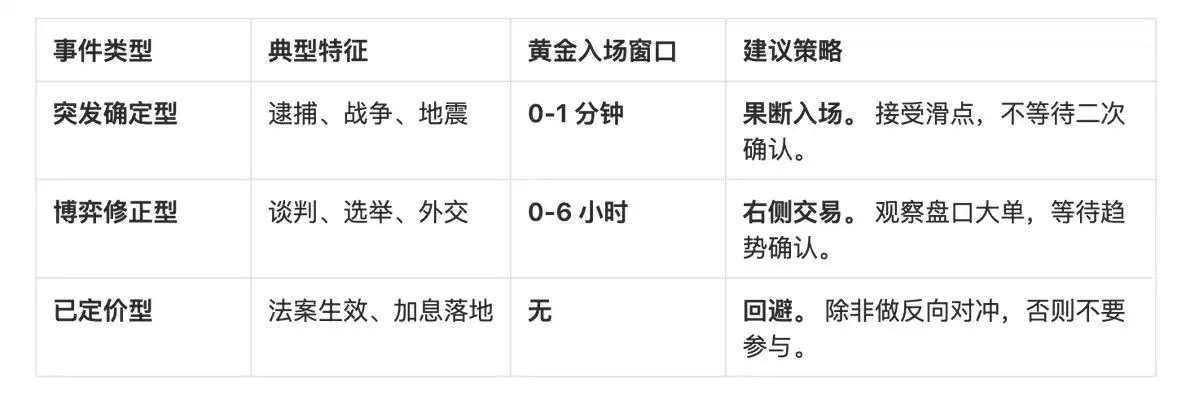
III. Practical Advice: Build Your "Entry Decision Tree"

Based on the above data, we advise traders, when seeing news, not to rush to place an order immediately, but to spend 5 seconds judging the event type, and then match the corresponding strategy:

Conclusion

In prediction markets, 1 minute of hesitation corresponds not to the passage of time, but to a violent collapse of the profit-loss ratio.

Next time you face major news, ask yourself this question:

"Am I entering now as a hunter to capture Alpha, or as prey to provide liquidity?"

Связанные с этим вопросы

QWhat is the 'confirmation tax' mentioned in the article, and why is it costly in prediction markets?

AThe 'confirmation tax' is the cost of sacrificing potential alpha (excess returns) by taking time to verify the authenticity of news before trading. In prediction markets like Polymarket, this is extremely expensive because the first few minutes after an event absorb the vast majority of the information advantage. Waiting even one minute to confirm news can mean forfeiting most of the profits to faster, risk-taking traders.

QAccording to the data, what percentage of the information advantage is absorbed within the first 10 minutes in high-liquidity突发事件 (sudden events)?

AAccording to the analysis of 2,023 on-chain trades, the first 10 minutes absorb 96% of the information advantage in high-liquidity sudden events.

QWhat are the three types of event decay curves identified in the research, and name one example for each.

AThe three types are: 1. Sudden Deterministic Events (e.g., 'Maduro out by Jan 31, 2026?'), 2. Game Theory Correction Events (e.g., 'Will SVB be acquired?'), and 3. Already Priced-In Events (e.g., 'TikTok banned in the US').

QFor a 'Sudden Deterministic' event, what is the approximate half-life of alpha, and what is the only viable strategy?

AFor a 'Sudden Deterministic' event, the half-life of alpha is less than 2 minutes. The only viable strategy is to sacrifice certainty in exchange for an entry position, acting on the news quickly within a risk-controllable framework.

QWhat is the key difference in strategy between a 'Sudden Deterministic' event and a 'Game Theory Correction' event?

AFor a 'Sudden Deterministic' event, the strategy requires extreme speed, acting within the first minute. For a 'Game Theory Correction' event, speed is less critical; the strategy focuses on identifying 'confirmation signals' that shift market consensus over a longer window (e.g., 0-6 hours), such as rumors of failed negotiations or large buys from smart money.

Похожее

RWA First Stock's Major Acquisition: Why Buy a 'Traditional' Mortgage Company?

On June 10th, Figure Technology Solutions (Nasdaq: FIGR), a blockchain-native capital markets firm, announced a $717 million acquisition of Kiavi, a leading non-bank lender for residential real estate investors. The deal involves Figure acquiring Kiavi's technology and operations for approximately $538 million, while forming a joint venture with alternative asset manager Sixth Street to purchase Kiavi's existing loan portfolio. Sixth Street also provided a $3 billion forward purchase commitment. This acquisition marks a strategic shift for Figure, known as the "RWA (Real World Asset) first stock," allowing it to expand significantly into the larger market of first-lien mortgages. Kiavi specializes in non-qualified mortgage (Non-QM) loans, such as short-term fix-and-flip (RTL) and rental property (DSCR) loans—a segment traditionally underserved by major banks. The move is expected to increase Figure's first-lien loan origination to over $7 billion annually, aiming for these to constitute about 40% of its business by 2027. Both companies leverage AI for underwriting: Kiavi uses proprietary models to value renovated properties and automate document processing, dominating the fix-and-flip lending space. Figure plans to integrate these assets onto its blockchain platform, Provenance, using its new 'Adaptor' product to standardize and tokenize the loans for institutional investors on its Democratized Prime marketplace. While the integration poses challenges—including merging different asset types, interest rate sensitivity of Kiavi's loans, and post-IPO execution risks—Figure projects the deal to be accretive to earnings with a cash payback period under four years. The transaction is seen as a major step in scaling blockchain-based capital markets, moving RWA tokenization from concept validation toward large-scale operation.

Foresight News3 мин. назад

RWA First Stock's Major Acquisition: Why Buy a 'Traditional' Mortgage Company?

Foresight News3 мин. назад

Trend in US Stocks: A Post Triggers a 930-Point Rebound, Tonight Belongs to SpaceX

On Thursday (June 11, U.S. Eastern Time), Wall Street staged a textbook V-shaped reversal. The Dow Jones surged 929.97 points (+1.86%) to close above 50,000, while the Nasdaq and S&P 500 rose 2.54% and 1.75%, respectively. The rally occurred despite the hottest PPI report in years, with May data showing a 6.5% year-on-year surge, the highest since 2022. The market ignored the inflation data, focusing instead on reports that former President Trump called off a planned strike on Iran, hinting at a potential multi-party peace agreement draft. This sparked a sharp drop in oil prices, fueling hopes that inflation may have peaked. Sector rotations were stark: previously battered AI hardware and cyclical stocks led the gains, while defensive sectors that hit record highs the prior day were sold off. Chip stocks like Micron and Intel saw sharp rebounds. In contrast, software giant Oracle plunged nearly 10% despite beating earnings, with concerns over cloud revenue and cash flow. Adobe also fell after hours despite raising guidance, as its CFO announced departure. The rally's sustainability is questioned, driven largely by social media posts about unconfirmed geopolitical developments. Inflation risks remain, with pipeline pressures still high. Meanwhile, the market's risk appetite faces a major test with SpaceX's historic IPO. Priced at $135 per share, it aims to raise ~$75 billion with a $1.75 trillion valuation, becoming the largest U.S. IPO ever. It will join the Nasdaq 100 in 15 days, triggering massive index fund buying. However, critics cite extreme valuation (88x sales) and market liquidity concerns.

marsbit26 мин. назад

Trend in US Stocks: A Post Triggers a 930-Point Rebound, Tonight Belongs to SpaceX

marsbit26 мин. назад

The Trillion-Dollar Valuation Test: Are the Three Super IPOs a Tech Stock Frenzy or a Crypto Market Nightmare?

Trillion-Dollar Valuation Test: Are the Three Mega IPOs a Tech Stock Frenzy or a Crypto Market Nightmare? The capital market in 2026 is witnessing a highly anticipated wave of tech IPOs, centered on SpaceX, OpenAI, and Anthropic. Collectively valued at over $3.5 trillion, their potential listing represents one of the largest such waves in recent years. This raises concerns about market liquidity, valuation bubbles, and potential capital outflows from other assets like crypto. SpaceX's valuation narrative has shifted from rocket launches to becoming a global infrastructure play via its Starlink satellite network, which now drives most revenue. Despite ongoing losses, investors focus on its long-term growth potential. OpenAI and Anthropic represent the core productivity engines of generative AI. Their public listings would offer the first direct investment opportunity in large foundation model companies, potentially triggering a repricing within the AI sector. Market fears of a massive "capital drain" from these IPOs are likely overstated. Historical precedents like Alibaba and Saudi Aramco show that mega-listings primarily cause capital reallocation, not destruction, within the vast equities market. Systemic risk is rarely triggered by IPOs alone. For stock markets, short-term volatility and sector repricing are expected, especially for AI concept stocks. Long-term, these listings could reinforce the tech sector's importance. For crypto, direct competition for speculative capital exists, particularly affecting AI-themed tokens. However, crypto's trajectory remains more tied to its own cycles, macro liquidity, and Bitcoin ETF flows rather than a single IPO event. The real risk lies not in the listings themselves but in the sky-high growth expectations embedded in these valuations. If future revenue, profitability, or commercialization progress disappoints, significant valuation resets could follow, impacting high-growth tech stocks. Ultimately, the market's direction hinges on macroeconomic conditions and whether these companies can deliver on their ambitious promises.

链捕手42 мин. назад

The Trillion-Dollar Valuation Test: Are the Three Super IPOs a Tech Stock Frenzy or a Crypto Market Nightmare?

链捕手42 мин. назад

Trillion-Dollar Valuation Test: Are the Three Super IPOs a Tech Stock Frenzy or a Crypto Market Nightmare?

Title: Trillion-Dollar Valuations at Stake: Super IPOs of SpaceX, OpenAI, Anthropic – Tech Boom or Crypto Nightmare? TL;DR: A wave of mega-tech IPOs is approaching, featuring SpaceX (targeting a $1.75 trillion valuation), OpenAI (~$852B), and Anthropic (~$965B), with a combined potential valuation exceeding $3.5 trillion. This tests the market's pricing of innovation and sparks debate on liquidity impact. * **SpaceX**'s valuation is now driven more by its Starlink global communications infrastructure than its core rocket business. * **OpenAI & Anthropic** offer the first major public investment opportunities in foundational AI models, potentially repricing the entire AI sector. * Concerns about a market-wide "liquidity drain" are likely overblown; history shows large IPOs mainly cause fund reallocation, not disappearance, and rarely trigger systemic risk. * Crypto markets, especially some AI-themed tokens, may face short-term fund competition, but their long-term trajectory depends more on macro liquidity, regulation, and Bitcoin cycles. * The real risk lies not in the IPOs themselves, but in whether these companies can justify their sky-high valuations with future revenue growth and profitability. Unmet expectations could lead to significant repricing pressure. Ultimately, these IPOs represent a massive market pricing of next-gen tech infrastructure, not a prelude to a market crash. The broader market direction will be determined by macro conditions, corporate earnings, and risk appetite.

marsbit42 мин. назад

Trillion-Dollar Valuation Test: Are the Three Super IPOs a Tech Stock Frenzy or a Crypto Market Nightmare?

marsbit42 мин. назад

Торговля

Спот
Фьючерсы

Популярные статьи

Как купить ONE

Добро пожаловать на HTX.com! Мы сделали приобретение Harmony (ONE) простым и удобным. Следуйте нашему пошаговому руководству и отправляйтесь в свое крипто-путешествие.Шаг 1: Создайте аккаунт на HTXИспользуйте свой адрес электронной почты или номер телефона, чтобы зарегистрироваться и бесплатно создать аккаунт на HTX. Пройдите удобную регистрацию и откройте для себя весь функционал.Создать аккаунтШаг 2: Перейдите в Купить криптовалюту и выберите свой способ оплатыКредитная/Дебетовая Карта: Используйте свою карту Visa или Mastercard для мгновенной покупки Harmony (ONE).Баланс: Используйте средства с баланса вашего аккаунта HTX для простой торговли.Третьи Лица: Мы добавили популярные способы оплаты, такие как Google Pay и Apple Pay, для повышения удобства.P2P: Торгуйте напрямую с другими пользователями на HTX.Внебиржевая Торговля (OTC): Мы предлагаем индивидуальные услуги и конкурентоспособные обменные курсы для трейдеров.Шаг 3: Хранение Harmony (ONE)После приобретения вами Harmony (ONE) храните их в своем аккаунте на HTX. В качестве альтернативы вы можете отправить их куда-либо с помощью перевода в блокчейне или использовать для торговли с другими криптовалютами.Шаг 4: Торговля Harmony (ONE)С легкостью торгуйте Harmony (ONE) на спотовом рынке HTX. Просто зайдите в свой аккаунт, выберите торговую пару, совершайте сделки и следите за ними в режиме реального времени. Мы предлагаем удобный интерфейс как для начинающих, так и для опытных трейдеров.

724 просмотров всегоОпубликовано 2024.04.12Обновлено 2026.06.02

Как купить ONE

Обсуждения

Добро пожаловать в Сообщество HTX. Здесь вы сможете быть в курсе последних новостей о развитии платформы и получить доступ к профессиональной аналитической информации о рынке. Мнения пользователей о цене на ONE (ONE) представлены ниже.

活动图片