The Next Bitcoin Bull Market May Begin with a Private Credit Crisis

marsbitОпубликовано 2026-03-13Обновлено 2026-03-13

Введение

The next major Bitcoin bull market may be triggered by a crisis in the private credit sector, according to an analysis by Jordi Visser. Although Bitcoin and other liquid assets are typically sold off first during a liquidity crisis, the core opportunity arises in the subsequent phase when governments intervene with stimulus measures. The private credit market, valued at around $3 trillion and projected to reach $5 trillion by 2029, is showing signs of stress, including redemption limits and asset write-downs. A significant risk stems from heavy exposure to software companies, whose business models are being disrupted by AI, undermining assumptions about stable cash flows and high margins. Bitcoin is currently under pressure due to its correlation with both software stocks and global liquidity conditions. However, historical patterns—such as during the March 2020 crash and the 2023 regional banking crisis—show that Bitcoin tends to decline sharply during initial panic but rebounds strongly once policymakers inject liquidity. The U.S. financial system, characterized by high sovereign debt and deep financialization, is unlikely to tolerate prolonged credit contraction. When retail and institutional funds are exposed to opaque private credit risks, government intervention becomes inevitable. Bitcoin, originally conceived as a peer-to-peer electronic cash system resistant to centralized financial control, stands to benefit from such interventions. Its underlying value is reinf...

Written by: Jordi Visser

Compiled by: Luffy, Foresight News

The next major bull run for Bitcoin might be triggered from the most unexpected area: the private credit market.

This is not because a private credit crash would immediately benefit Bitcoin. In a true liquidity crisis, highly liquid assets like Bitcoin are often among the first to be sold off alongside other assets. The first phase of a crisis is not about salvation, but about liquidation; the core logic, however, emerges in the second phase.

In a system burdened with high debt, extreme financialization, and political intolerance for prolonged credit write-downs, the 'receding tide' of liquidity rarely lasts long. And when governments reinject liquidity, Bitcoin often grasps the significance of this move faster than almost any other asset.

Warren Buffett described this scenario in the plainest terms long ago: 'Only when the tide goes out do you discover who's been swimming naked.' He also mocked private equity's 'much-admired fee structure and obsession with leverage,' and later warned that in some rare moments, 'credit vanishes in an instant, and debt becomes a fatal financial trap.'

Buffett wasn't talking about Bitcoin then; he was diagnosing a financial system built on leverage, opacity, and confidence. And this diagnosis applies perfectly to today's private credit market. When the tide recedes, hidden vulnerabilities are no longer theoretical risks but become the entire market reality.

This is precisely why private credit is so crucial right now. According to Morgan Stanley estimates, the market size was about $3 trillion in early 2025 and is expected to approach $5 trillion by 2029. Warning signs are already appearing.

This week, Morgan Stanley imposed redemption restrictions on one of its private credit funds because investor redemption requests neared 11% of the fund's total size; simultaneously, JPMorgan Chase wrote down some loans made to private credit funds, and concerns about exposure to the software sector continue to heat up.

The key is not that the entire market is in crisis, but that the pressure is no longer hypothetical—it is now tangibly reflected in redemption restrictions, asset write-downs, and changes in lender behavior.

AI is the Catalyst for the Crisis

The core risk is not just leverage itself, but leverage tied to an industry being repriced in real-time by AI.

Morgan Stanley noted in March that about 25% of Business Development Company (BDC) investment portfolios are allocated to the software sector. Given AI's impact on software business models, this proportion is remarkably high.

For years, the financing logic for the software industry has been based on the assumption that recurring revenue equals stable cash flow, strong customer stickiness, high profit margins, and robust exit paths. AI is颠覆ing all of this: pricing power is being squeezed, products are rapidly becoming commoditized features, competitive moats are narrowing, and compute power and R&D spending are becoming rigid costs.

In other words, a significant amount of private credit has been extended based on a software business model that may already be obsolete.

Bitcoin is Also in the Storm

All discussions about software valuations and private credit ultimately point to Bitcoin. The correlation is clear when overlaying Bitcoin's price action with that of software stocks and private equity stocks:
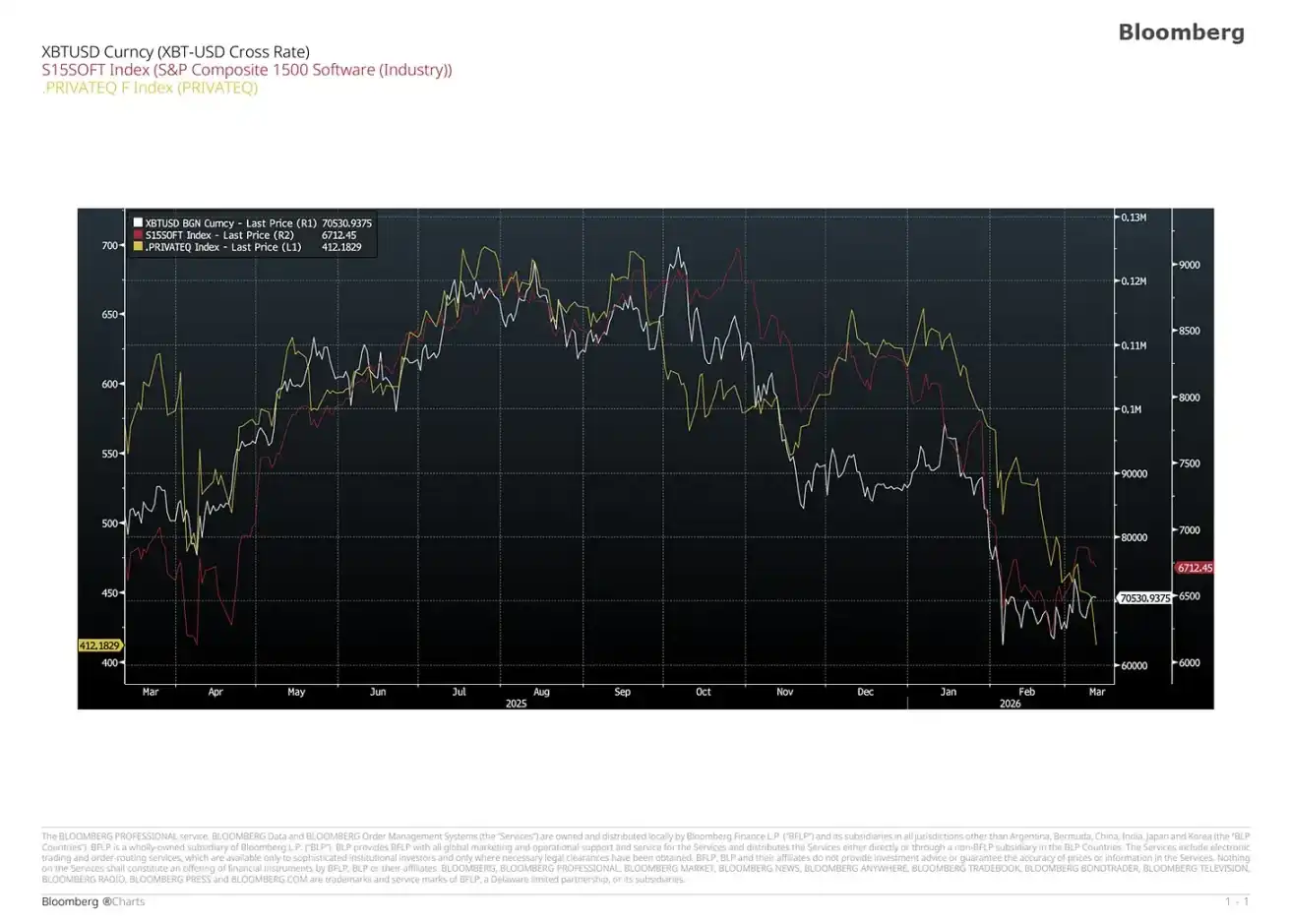
Bitcoin's price movement exhibits characteristics of both software sector Beta and liquidity Beta, and currently, both forces are suppressing it.

Back in 2025, I anticipated Bitcoin would experience strong gains, driven by increased government support and the rise of AI agents. These factors were supposed to strengthen crypto network effects, causing it to be revalued alongside the software sector as a high-growth asset class. Although stablecoin trading volume and market capitalization have risen, this optimistic expectation for Bitcoin ultimately did not materialize.

Instead, with the rollout of technologies like Opus 4.5 and OpenClaw, the market focus shifted to AI's颠覆ion of the software industry itself. Investors reassessed the sustainability of traditional software models, valuation multiples were quickly adjusted downward, and this also impacted private credit, a key funding source for the software ecosystem.

AI forced a disruptive repricing of the software industry, putting pressure on one of Bitcoin's key macro pricing logics; simultaneously, the global liquidity cycle tightening打压ed its other core characteristic: high sensitivity to global liquidity.

This is why cracks in private credit won't immediately benefit Bitcoin: in the short term, the effect is often the opposite. Bitcoin is liquid, widely held, and easy to sell. In the first phase of market stress, liquidity priority far outweighs long-term value logic.

Bitcoin Falls First in Panic, Rises First in Bailouts

History confirms this rhythm.

In the 'cash is king' panic of March 2020, Reuters reported Bitcoin plunged over 20% in a single day and over 30% over five days, as investors sold almost everything. Then, policy easing began. By January 2021, Bitcoin had risen over 900% from its March low, as governments expanded spending to counter the pandemic shock, and investors feared inflation and currency devaluation. Bitcoin fully reflected this expectation.

Bitcoin isn't immune to panic; it just reflects the subsequent policy-induced rally earlier and more sharply than other assets.

The same script played out during the 2023 US regional banking crisis: Silicon Valley Bank saw $42 billion in depositor withdrawals in one day, with another $100 billion in withdrawal requests queued for the next day. Subsequently, authorities guaranteed all depositors, and the Fed launched the Bank Term Funding Program, offering loans at par against eligible collateral. Following that turmoil, Bitcoin's price climbed to a nine-month high and more than doubled by year-end.

The core pattern remains consistent: Bitcoin often suffers during cash scrambles, then turns around to price in the benefits of policy rescue.

Why Redemption is Inevitable

This mechanism is particularly critical now because the US financial system cannot withstand prolonged liquidity tightening.

In February 2026, the US Congressional Budget Office stated the federal deficit for FY2026 would reach $1.9 trillion, with publicly held debt at 101% of GDP. Meanwhile, the Buffett Indicator (total US stock market cap / GDP) was around 219% in early March.

This is the reality of financialization: high sovereign debt, and an asset market size far exceeding the real economy. In this structure, policymakers have no room to let liquidation proceed purely organically. The modern economy is too linked to asset prices, and the state and economic growth are too tied to market functioning for pure liquidation to be sustainable.

The Fed has long shown this reflex. In March 2025, it slowed quantitative tightening (QT), decided on October 1st to stop running off its securities portfolio by December 1st, and initiated Reserve Management Purchases in December to maintain ample reserves. Even without a full-blown crisis, the system was already moving back towards easing.

Once you understand that the financial system itself requires liquidity restarts, it's not hard to judge: policymakers are almost certain not to stand idly by when the next private credit crisis hits.

This is even more true politically. In September 2025, the US SEC Investor Advisory Committee noted that despite expanded public access through registered products, private market assets are less transparent and riskier. Morningstar reported that Q3 2025 net assets in semi-liquid funds had reached $493 billion.

When retail money and wealth channel funds are packaged into illiquid credit exposures, private credit ceases to be a niche institutional issue and becomes a public concern. When opaque risks morph into public problems, government intervention becomes inevitable.

Bitcoin Returns to Its Original Logic

The Bitcoin whitepaper proposed a peer-to-peer electronic cash system allowing direct transfers between parties without financial institutions. The famous inscription on the genesis block—'The Times 03/Jan/2009 Chancellor on brink of second bailout for banks'—speaks to its political undertone.

The whitepaper provided the technical architecture; the genesis block carried the political metaphor. Bitcoin was born from a rebellion against bailout culture, intermediary reliance, and arbitrary market rescues.

Therefore, whenever governments step in to save fragile systems built on hidden leverage, Bitcoin's original logic becomes more potent.

Meanwhile, financial infrastructure is moving towards 24/7 operation. In October 2025, the Fed announced plans for Fedwire and the National Settlement Service to operate on Sundays and holidays by 2028 or 2029. This isn't official adoption of Bitcoin, but it signals the system's acknowledgment of an important fact: the economy is increasingly digital and continuous, becoming less compatible with traditional banking hours.

If AI agents become genuine economic participants, funds and collateral will need to move at software speed. This doesn't mean every transaction must settle in Bitcoin, but it does mean that scarce, neutral, digital collateral will become more important.

The tide Buffett spoke of is receding in the private credit market. AI is first exposing the most vulnerable credit assets, especially those that mistook software revenue for permanent cash flow. Bitcoin is suffering in the first wave because it is perceived as both a software and liquidity double Beta.

But US debt is too high, the economy too financialized, and retail money too intertwined with private assets for policymakers to tolerate prolonged disorderly liquidation. Liquidity will eventually return. And whenever liquidity is restarted, Bitcoin is often one of the first assets to react.

This is why private credit is so crucial in the current environment.

It is deeply ironic that Bitcoin was made for precisely such moments: a world of shadow banking, hidden leverage, high government debt, and crisis responses reliant on liquidity injections. Private credit isn't just a risk sector within the market; it's a convergence point for rigid valuations, embedded leverage, AI颠覆ion, retail fund involvement, and policy reflex reactions.

Recent private credit redemption restrictions and asset write-downs suggest the adjustment process may have already begun. If private credit becomes the epicenter of the next liquidity receding tide, Bitcoin's next major bull market won't start with halving narratives or perfect macro conditions, but with risk exposure, policy rescue, and the market's eventual realization: the financial system still runs on liquidity injections.


Связанные с этим вопросы

QWhy might the next Bitcoin bull market be triggered by a private credit crisis, according to the article?

AThe article argues that a private credit crisis would expose systemic fragility, leading to government liquidity injections. Bitcoin, being highly sensitive to liquidity shifts, would rally strongly once policymakers intervene to stabilize the market, as it historically reacts faster to monetary easing than other assets.

QHow does AI act as a catalyst for the private credit crisis mentioned in the article?

AAI disrupts the software industry's business model, which underpins much of private credit lending. It erodes pricing power, narrows competitive moats, and increases costs, forcing a repricing of software assets. This devalues the collateralizing loans, exacerbating risks in the credit market.

QWhat historical pattern does Bitcoin exhibit during financial crises, as described in the article?

ABitcoin initially sells off alongside other liquid assets during panic phases (e.g., March 2020 or the 2023 regional bank crisis) as investors seek cash. However, it rebounds sharply and earlier than most assets once policymakers inject liquidity, pricing in the implications of monetary expansion and fiscal rescue measures.

QWhy does the article claim policymakers will inevitably intervene in a private credit crisis?

AThe U.S. financial system is highly leveraged and interconnected, with public debt at 101% of GDP and heavy retail exposure to private credit. Policymakers cannot tolerate prolonged, disorderly liquidation due to the risk of broad economic contagion, making government liquidity support a political and economic necessity.

QHow does Bitcoin's foundational logic align with the scenario of a private credit crisis and government bailouts?

ABitcoin was created as a peer-to-peer electronic cash system to bypass financial intermediaries and resist bailout culture. Its genesis block explicitly criticized bank rescues. Thus, when governments intervene to save over-leveraged, opaque systems like private credit, it reinforces Bitcoin's value proposition as a decentralized, neutral alternative to state-backed liquidity solutions.

Похожее

SpaceX Ties Up with Cursor: A High-Stakes AI Gambit of 'Lock First, Acquire Later'

SpaceX has secured an option to acquire AI programming company Cursor for $60 billion, with an alternative clause requiring a $10 billion collaboration fee if the acquisition does not proceed. This structure is not merely a potential acquisition but a strategic move to control core access points in the AI era. The deal is designed as a flexible, dual-path arrangement, allowing SpaceX to either fully acquire Cursor or maintain a binding partnership through high-cost collaboration. This "option-style" approach minimizes immediate regulatory and integration risks while ensuring long-term alignment between the two companies. At its core, the transaction exchanges critical AI-era resources: SpaceX provides its Colossus supercomputing cluster—one of the world’s most powerful AI training infrastructures—while Cursor contributes its AI-native developer environment and strong product adoption. This synergy connects compute power, models, and application layers, forming a closed-loop AI capability stack. Cursor, founded in 2022, has achieved rapid growth with over $1 billion in annual revenue and widespread enterprise adoption. Its value lies in transforming software development through AI agents capable of coding, debugging, and system design—positioning it as a gateway to future software production. For SpaceX, this move is part of a broader strategy to evolve from a aerospace company into an AI infrastructure empire, integrating xAI, supercomputing, and chip manufacturing. Controlling Cursor fills a gap in its developer tooling layer, strengthening its AI narrative ahead of a potential IPO. The deal reflects a shift in AI competition from model superiority to ecosystem and entry-point control. With programming tools as a key battleground, securing developer loyalty becomes crucial for dominating the software production landscape. Risks include questions around Cursor’s valuation, technical integration challenges, and potential regulatory scrutiny. Nevertheless, the deal underscores a strategic bet: controlling both compute and software development access may redefine power dynamics in the AI-driven future.

marsbit41 мин. назад

SpaceX Ties Up with Cursor: A High-Stakes AI Gambit of 'Lock First, Acquire Later'

marsbit41 мин. назад

Торговля

Спот
Фьючерсы

Популярные статьи

Тест по Bitcoin Биткоина

HTX Learn: Изучите Bitcoin halving и Заработаете Токены USDT

3.0k просмотров всегоОпубликовано 2024.04.16Обновлено 2024.04.16

Тест по Bitcoin  Биткоина

Что такое $BITCOIN

ЦИФРОВОЕ ЗОЛОТО ($BITCOIN): Комплексный анализ Введение в ЦИФРОВОЕ ЗОЛОТО ($BITCOIN) ЦИФРОВОЕ ЗОЛОТО ($BITCOIN) — это проект на основе блокчейна, работающий в сети Solana, который стремится объединить характеристики традиционных драгоценных металлов с инновациями децентрализованных технологий. Хотя он носит имя Биткойн, часто называемого “цифровым золотом” из-за его восприятия как средства хранения ценности, ЦИФРОВОЕ ЗОЛОТО является отдельным токеном, предназначенным для создания уникальной экосистемы в ландшафте Web3. Его цель — позиционировать себя как жизнеспособный альтернативный цифровой актив, хотя детали его применения и функциональности все еще развиваются. Что такое ЦИФРОВОЕ ЗОЛОТО ($BITCOIN)? ЦИФРОВОЕ ЗОЛОТО ($BITCOIN) — это токен криптовалюты, специально разработанный для использования в блокчейне Solana. В отличие от Биткойна, который выполняет широко признанную роль хранения ценности, этот токен, похоже, сосредоточен на более широких приложениях и характеристиках. Примечательные аспекты включают: Инфраструктура блокчейна: Токен построен на блокчейне Solana, известном своей способностью обрабатывать высокоскоростные и недорогие транзакции. Динамика предложения: ЦИФРОВОЕ ЗОЛОТО имеет максимальное предложение, ограниченное 100 квадриллионами токенов (100P $BITCOIN), хотя детали о его обращающемся предложении в настоящее время не раскрыты. Утилита: Хотя точные функциональные возможности не описаны, есть указания на то, что токен может быть использован для различных приложений, потенциально связанных с децентрализованными приложениями (dApps) или стратегиями токенизации активов. Кто создатель ЦИФРОВОГО ЗОЛОТА ($BITCOIN)? На данный момент личность создателей и команды разработчиков, стоящих за ЦИФРОВЫМ ЗОЛОТОМ ($BITCOIN), остается неизвестной. Эта ситуация типична для многих инновационных проектов в области блокчейна, особенно тех, которые связаны с децентрализованными финансами и феноменом мем-криптовалют. Хотя такая анонимность может способствовать культуре, ориентированной на сообщество, она усиливает опасения по поводу управления и ответственности. Кто инвесторы ЦИФРОВОГО ЗОЛОТА ($BITCOIN)? Доступная информация указывает на то, что у ЦИФРОВОГО ЗОЛОТА ($BITCOIN) нет известных институциональных спонсоров или значительных венчурных капиталовложений. Проект, похоже, функционирует по модели пирингового взаимодействия, сосредоточенной на поддержке и принятии сообществом, а не на традиционных путях финансирования. Его активность и ликвидность в основном сосредоточены на децентрализованных биржах (DEX), таких как PumpSwap, а не на устоявшихся централизованных торговых платформах, что еще больше подчеркивает его подход, ориентированный на grassroots. Как работает ЦИФРОВОЕ ЗОЛОТО ($BITCOIN) Операционные механизмы ЦИФРОВОГО ЗОЛОТА ($BITCOIN) можно подробно описать на основе его дизайна блокчейна и характеристик сети: Механизм консенсуса: Используя уникальный механизм доказательства истории (PoH) Solana в сочетании с моделью доказательства доли (PoS), проект обеспечивает эффективную валидацию транзакций, что способствует высокой производительности сети. Токеномика: Хотя конкретные дефляционные механизмы не были подробно описаны, большое максимальное предложение токенов подразумевает, что оно может быть предназначено для микротранзакций или нишевых случаев использования, которые еще предстоит определить. Интероперабельность: Существует потенциал для интеграции с более широкой экосистемой Solana, включая различные платформы децентрализованных финансов (DeFi). Однако детали относительно конкретных интеграций остаются неуточненными. Хронология ключевых событий Вот хронология, которая подчеркивает значимые вехи, касающиеся ЦИФРОВОГО ЗОЛОТА ($BITCOIN): 2023: Первоначальное развертывание токена происходит в блокчейне Solana, отмеченное его адресом контракта. 2024: ЦИФРОВОЕ ЗОЛОТО приобретает видимость, когда оно становится доступным для торговли на децентрализованных биржах, таких как PumpSwap, позволяя пользователям обменивать его на SOL. 2025: Проект наблюдает спорадическую торговую активность и потенциальный интерес к инициативам, возглавляемым сообществом, хотя на данный момент не зафиксировано никаких значительных партнерств или технических достижений. Критический анализ Сильные стороны Масштабируемость: Основная инфраструктура Solana поддерживает высокие объемы транзакций, что может повысить полезность $BITCOIN в различных сценариях транзакций. Доступность: Потенциально низкая цена торговли за токен может привлечь розничных инвесторов, способствуя более широкому участию благодаря возможностям дробного владения. Риски Отсутствие прозрачности: Отсутствие публично известных спонсоров, разработчиков или процесса аудита может вызвать скептицизм относительно устойчивости и надежности проекта. Волатильность рынка: Торговая активность сильно зависит от спекулятивного поведения, что может привести к значительной волатильности цен и неопределенности для инвесторов. Заключение ЦИФРОВОЕ ЗОЛОТО ($BITCOIN) является интригующим, но неоднозначным проектом в быстро развивающейся экосистеме Solana. Хотя он пытается использовать нарратив “цифрового золота”, его отход от установленной роли Биткойна как средства хранения ценности подчеркивает необходимость более четкого различения его предполагаемой утилиты и структуры управления. Будущее принятие и усвоение, вероятно, будут зависеть от решения текущей непрозрачности и более четкого определения его операционных и экономических стратегий. Примечание: Этот отчет охватывает синтезированную информацию, доступную на октябрь 2023 года, и с тех пор могут произойти события.

99 просмотров всегоОпубликовано 2025.05.13Обновлено 2025.05.13

Что такое $BITCOIN

Fractal Bitcoin: масштабирование Биткоина с помощью рекурсивной системы

Fractal Bitcoin — масштабное Layer-1-решнение, созданное на базе кода Биткоина, позволяющего достигать бесконечного масштабирования с помощью рекурсивного подхода.

2.2k просмотров всегоОпубликовано 2025.06.30Обновлено 2025.06.30

Fractal Bitcoin: масштабирование Биткоина с помощью рекурсивной системы

Обсуждения

Добро пожаловать в Сообщество HTX. Здесь вы сможете быть в курсе последних новостей о развитии платформы и получить доступ к профессиональной аналитической информации о рынке. Мнения пользователей о цене на BTC (BTC) представлены ниже.

活动图片