The Most Crowded Short in History Is Paving the Way for a Bull Market in U.S. Bonds

marsbitОпубликовано 2026-01-20Обновлено 2026-01-20

Введение

An experienced macro trader presents a contrarian thesis that 2026 will be the "year of the bond," with long-duration U.S. Treasuries (TLT/TMF) poised to outperform stocks. The core argument is built on several pillars: gold's 200% rally historically signals deflationary risk, not sustained inflation; the U.S. faces a crushing $1.2 trillion annual interest bill, creating a fiscal doom loop; Treasury issuance is dangerously short-term, amplifying refinancing risk; and long bond short interest is at extreme, crowded levels. Additional factors include cooling inflation, weak economic indicators, deflationary trade war risks, and the high probability of Fed intervention (QE/Yield Curve Control) to lower long-term yields if stress emerges. The trade offers asymmetric upside: TLT yields ~4.5% while waiting, and a 200bps drop in yields could trigger a 35-45%+ price surge, accelerated by a short squeeze. The author has allocated 60% of their portfolio to this thesis, betting on a policy and macro regime shift.

Author: Common Sense Investor (CSI)

Compiled by: Deep Tide TechFlow

Deep Tide Guide: With the dramatic changes in the macroeconomic environment in 2026, market logic is undergoing a profound shift. Veteran macro trader Common Sense Investor (CSI) presents a contrarian view: 2026 will be the year bonds outperform stocks.

Based on the U.S. government's heavy interest payment pressure, the deflationary signals released by gold, the extremely crowded bond short positions, and the imminent trade conflicts, the author believes that long-duration U.S. Treasuries (such as TLT) are at an inflection point with an "asymmetric game" advantage.

At a time when the market generally considers bonds "uninvestable," this article, through rigorous macro mathematical deduction, reveals why long bonds could become the highest-returning asset in 2026.

The main text is as follows:

Why I Am Overweight TLT and TMF — and Why Stocks Will Underperform in 2026

I do not write these words lightly: 2026 is destined to be the year bonds outperform stocks. This is not because bonds are "safe," but because macro mathematics, positioning, and policy constraints are converging in an unprecedented way—and this situation rarely ends with "Higher for Longer."

I have put my money where my mouth is.

TLT (20+ Year Treasury ETF) and TMF (3x Leveraged Long 20+ Year Treasury ETF) currently make up about 60% of my investment portfolio. This article compiles data from my recent posts, adds new macro context, and outlines a bullish scenario for long-duration bonds, especially TLT.

Core Arguments at a Glance:

  • Gold's Movement: Gold's historical performance does not signal sustained inflation—it signals deflation/deflation risk.

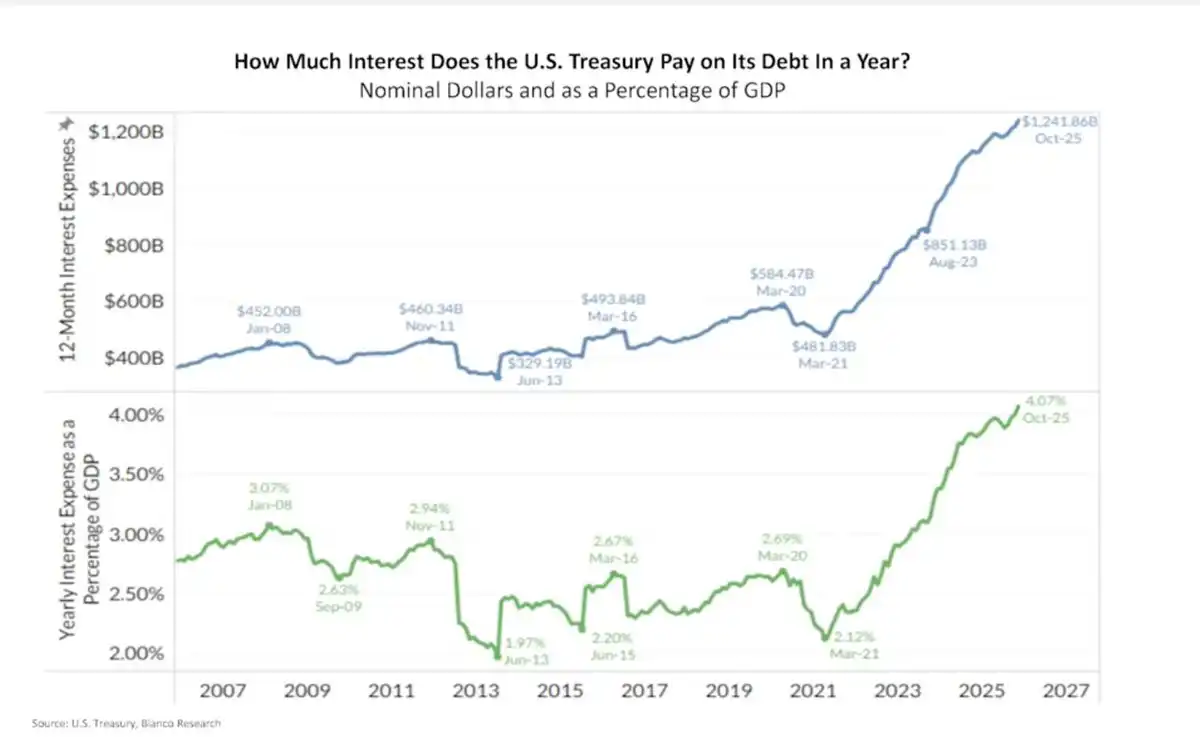
  • Fiscal Deficit: U.S. fiscal math is collapsing: approximately $1.2 trillion in annual interest expenses, and rising.

  • Issuance Structure: Treasury bond issuance is skewed short-term, quietly increasing systemic refinancing risk.

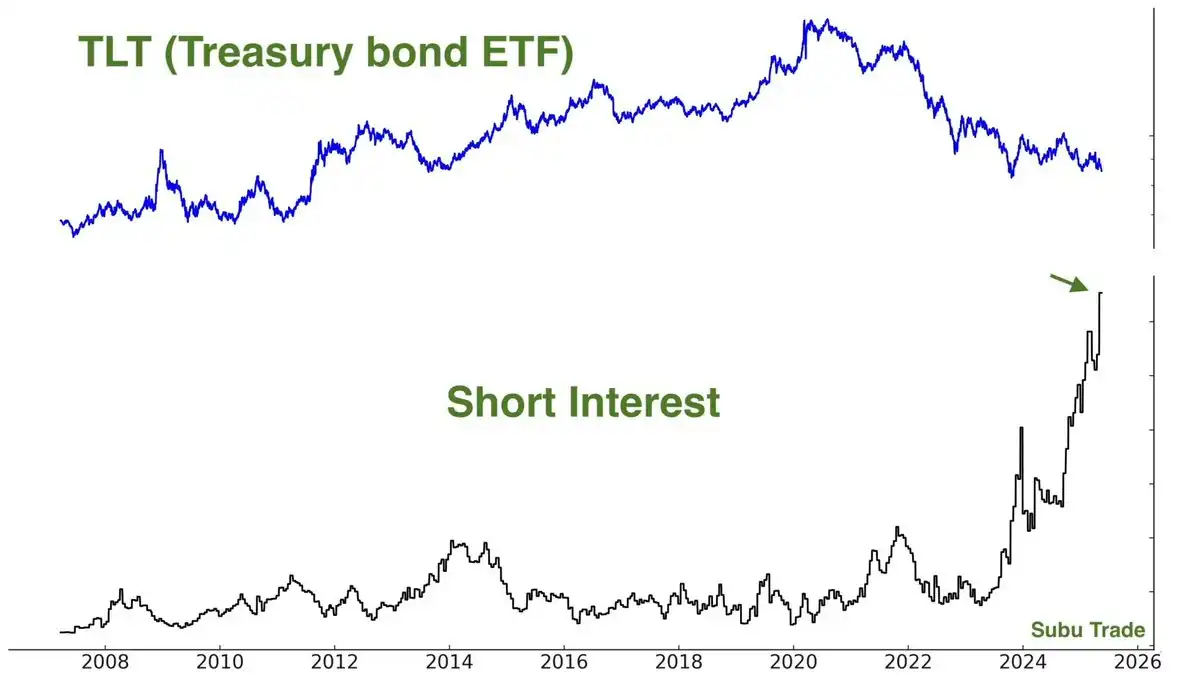
  • Short Squeeze: Long bonds are one of the most crowded short positions in the market.

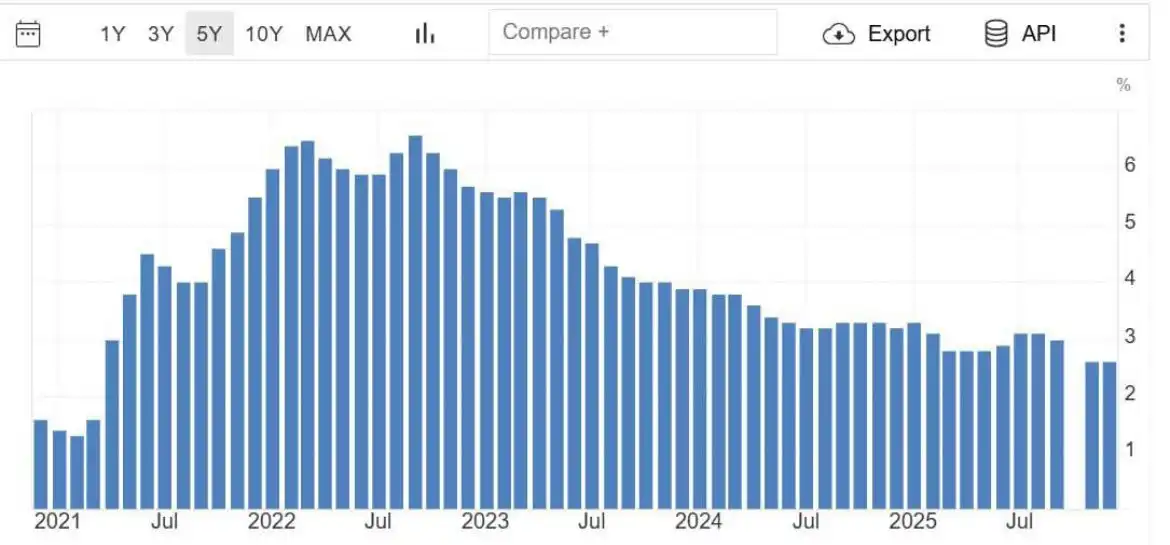
  • Economic Indicators: Inflation data is cooling, sentiment is weak, labor market pressures are rising.

  • Geopolitics: Geopolitical and trade headlines are turning "risk-off," not "reflationary."

  • Policy Intervention: When something breaks, policy always turns to lowering long-end rates.

This combination has historically been rocket fuel for TLT.

Gold Is Not Always an Inflation Warning Bell

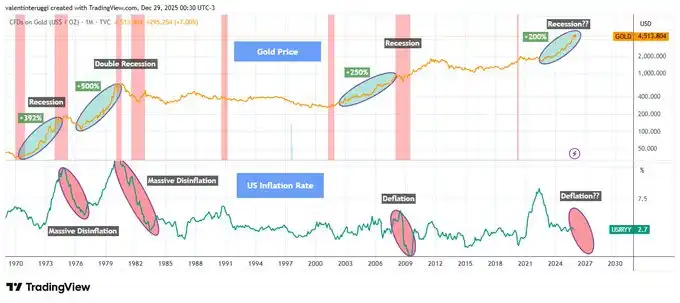
Whenever gold rises more than 200% in a short period, it signals not runaway inflation but economic stress, recession, and falling real rates (see Chart 1 below).

Historical experience shows:

  • The gold surge in the 1970s was followed by recession + disinflation.

  • The early 1980s surge was followed by a double-dip recession, breaking inflation.

  • The early 2000s gold rise foreshadowed the 2001 recession.

  • The 2008 breakout was followed by a deflationary shock.

Since 2020, gold has risen about 200% again. This pattern has never ended in lasting inflation.

When growth flips, gold acts more like a safe-haven asset.
U.S. Interest Expenses Are Exploding Compounded

The U.S. currently has annual interest expenses of about $1.2 trillion, roughly 4% of GDP (see Chart 2 below).

This is no longer a theoretical issue. This is real money flowing out—and interest compounds rapidly when long-term yields stay high.
This is so-called "Fiscal Dominance":

  • High rates mean higher deficits

  • Higher deficits mean more debt issuance

  • More debt issuance leads to higher term premium

  • Higher term premium leads to higher interest expenses!

This doom loop won't resolve itself with "Higher for Longer." It must be resolved through policy intervention!

The Treasury's Short-Term Trap

To ease immediate pain, the Treasury has drastically cut long-bond issuance:

  • 20/30-year bonds now make up only about 1.7% of total issuance (see Chart 3 below).

  • The rest is all pushed into short-term T-bills.

This doesn't solve the problem—it just kicks the can down the road:

  • Short-term debt constantly rolls over.

  • Refinancing will happen at future rates.

  • The market sees the risk and demands a higher term premium.

Ironically, this is why long-end yields stay high... and why they will collapse violently if growth cracks.

The Fed's Trump Card: Yield Curve Control

The Fed controls the short end, not the long end. When long-end yields:

  • Threaten economic growth

  • Trigger exploding fiscal costs

  • Disrupt asset markets

...the Fed has historically only done two things:

  • Buy long bonds (QE)

  • Cap yields (Yield Curve Control)

They won't act preemptively. They only act after stress appears.

Historical references:

  • 2008–2014: 30-year yield fell from ~4.5% to ~2.2% → TLT surged +70%

  • 2020: 30-year yield fell from ~2.4% to ~1.2% → TLT surged +40% in under 12 months

This isn't just theory—this has happened before!

Inflation Is Cooling, Economic Cracks Appearing

Recent data shows core inflation falling back to 2021 levels (see Chart 4).

  • CPI momentum is fading.

  • Consumer confidence is at a decade low.

  • Credit stress is building.

    Labor market is starting to crack.
Markets are forward-looking. The bond market is already starting to smell this.

Extremely Crowded Short Positions

TLT's short interest is very high:

  • Approximately 144 million shares sold short.

  • Days to cover exceeds 4 days.

Crowded trades don't unwind slowly. They reverse violently—especially when the market narrative shifts.

And importantly:

"Shorts piled in AFTER the move, not before."

This is classic late-cycle behavior!

Smart Money Is Moving In

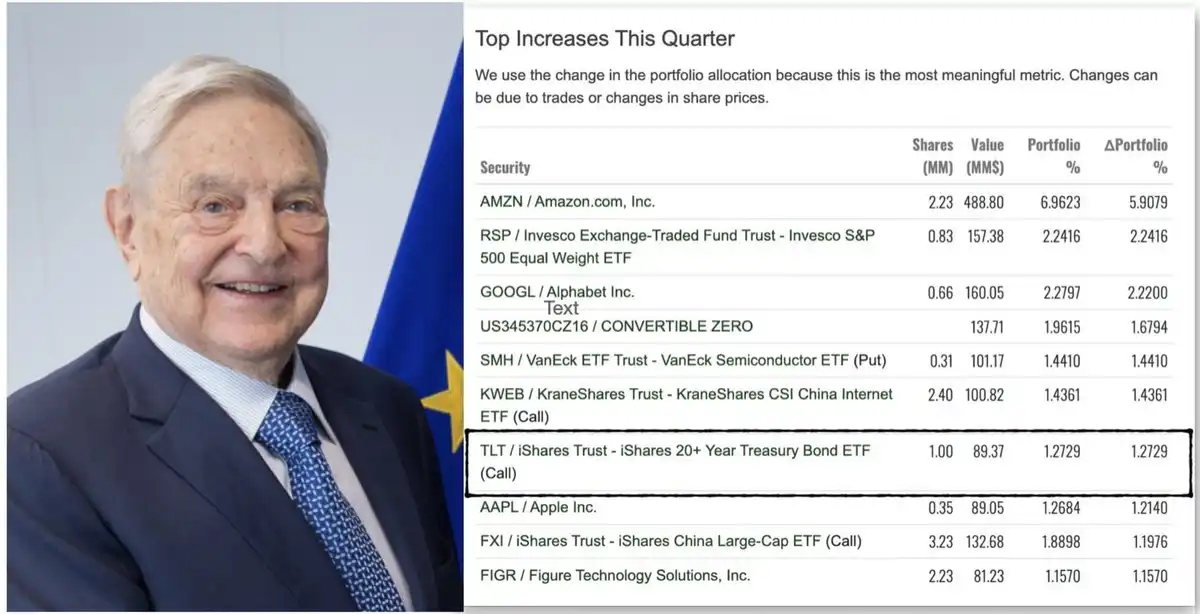
Recently, widely circulated 13F institutional holding reports showed a large fund's top quarterly additions included a significant number of TLT call options.

Regardless of who gets the credit, the message is simple: Sophisticated capital is starting to reposition for duration. Even George Soros's fund held TLT call options in the latest 13F disclosure.
Deflationary Shock from Tariff Frictions

The latest news is reinforcing the "risk-off" logic. President Trump announced new tariff threats targeting the Denmark/Greenland dispute, and European officials are now openly discussing freezing or suspending participation in the EU-US tariff agreement in response.

Trade friction will:

  • Hurt growth

  • Squeeze margins

  • Reduce demand

  • Push capital into bonds over stocks

This is not an inflationary impulse; it is a deflationary shock.

Valuation Mismatch: Stocks vs. Bonds

Today's stock pricing reflects:

  • Strong growth

  • Stable margins

  • Benign financing conditions

While bond pricing reflects:

  • Fiscal stress

  • Sticky inflation fears

  • Permanently high yields

If just one of these narratives is wrong, returns will diverge violently.

Long-duration bonds have "convexity"; stocks do not.

Upside Case Analysis for $TLT

TLT has:

  • An effective duration of ~15.5 years

  • You earn ~4.4–4.7% yield while you wait

Scenario Analysis:

  • If long-end yields fall 100 basis points (bps), TLT price return is +15–18%.

  • Fall 150 bps, TLT return is +25–30%.

  • Fall 200 bps (not extreme historically),意味着 it could surge +35–45% or more!

This doesn't include interest income, convexity bonuses, or the acceleration effect of short covering. This is why I see "asymmetric upside."

Conclusion

Honestly: After the carnage of 2022, I swore I'd never touch long bonds again. Watching duration assets get crushed was a deeply frustrating experience.

But the market doesn't care about your psychological trauma—it only cares about probabilities and prices.

When everyone agrees bonds are "uninvestable," when sentiment bottoms, when shorts pile up, when yields are high and growth risks are rising...

That's when I start buying!

  • TLT + TMF currently make up ~60% of my portfolio. I made 75% returns in the 2025 stock market and redeployed most of it into bond ETFs in November 2025.

  • I am "getting paid to wait" (earning over 4% yield).

  • My position is based on policy and growth shifts, not flimsy narratives.

2026 will finally be the "Year of the Bond."

Связанные с этим вопросы

QAccording to the article, why does the author believe that 2026 will be the year bonds outperform stocks?

AThe author believes 2026 will be the year bonds outperform stocks due to a convergence of macro mathematics, positioning, and policy constraints. Key reasons include the U.S. government's exploding interest expense burden, gold signaling deflationary risks, extremely crowded short positions in long bonds, cooling inflation, weakening economic indicators, and imminent policy intervention to lower long-end yields.

QWhat historical pattern does the author cite regarding gold's performance and what it signals for the economy?

AThe author cites a historical pattern where whenever gold rallies over 200% in a short period, it has not signaled runaway inflation but instead foreshadowed economic stress, recession, and falling real rates. Examples given are the 1970s (followed by recession/disinflation), early 1980s (double-dip recession), early 2000s (2001 recession), and 2008 (deflationary shock).

QWhat is 'Fiscal Dominance' as described in the article, and why is it a problem for the U.S.?

A'Fiscal Dominance' is described as a vicious cycle where high interest rates lead to higher deficits, which require more debt issuance. This increased issuance leads to a higher term premium, which in turn causes even higher interest expenses. This is a problem because the U.S. is already spending ~$1.2 trillion annually on interest, creating a compounding fiscal burden that cannot be solved by 'higher for longer' rates and necessitates policy intervention.

QHow does the extremely crowded short interest in long-term bonds (like TLT) create a potential opportunity?

AThe extremely crowded short interest in TLT (approx. 144 million shares short) creates a potential for a violent short squeeze. Crowded trades like this do not unwind slowly; they reverse sharply, especially when the market narrative shifts. This positioning provides 'rocket fuel' for a rapid price increase in long bonds as shorts are forced to cover their positions.

QWhat specific policy tools does the author suggest the Federal Reserve will use if long-end yields threaten the economy, and what historical examples are given?

AThe author suggests the Federal Reserve will use Quantitative Easing (QE - buying long bonds) and Yield Curve Control (YCC - capping yields) if long-end yields threaten growth, cause fiscal costs to explode, or disrupt asset markets. Historical examples given are from 2008-2014 (30-year yield fell from ~4.5% to ~2.2%, TLT surged +70%) and 2020 (30-year yield fell from ~2.4% to ~1.2%, TLT surged +40% in under 12 months).

Похожее

Неправомерно пострадавшие A-акции: Устойчивость, ожидания и основание

В июле глобальные технологические акции столкнулись с коррекцией, начавшейся с распродаж в Южной Корее и затронувшей рынки США, Японии и Китая (A-shares). Однако китайский рынок продемонстрировал устойчивость благодаря нескольким факторам. Во-первых, базовые показатели технологического сектора Китая остаются прочными. Такие подотрасли, как оптические модули и оптическое волокно, показывают высокий рост прибыли (например, New Eastsoft, Changfei Optical Fiber). В отличие от южнокорейского рынка, сильно зависящего от полупроводников памяти, китайский технологический сектор диверсифицирован (компьютеры, связь, электроника) и опирается как на глобальные цепочки поставок (например, для NVIDIA), так и на политику импортозамещения. Во-вторых, государственные институты («команда страны») активно поддерживают рынок, выделив сотни миллиардов юаней на выкуп акций и ETF через такие компании, как China Reform Holdings и China Chengtong. Этот шаг направлен на стабилизацию ликвидности и формирование позитивных ожиданий, сигнализируя о возможном достижении локального дна. В-третьих, другие ключевые секторы A-shares демонстрируют внутренний потенциал для восстановления: * **Потребительский сектор:** CPI стабильно превышает 1%, указывая на улучшение маржи. Ключевые игроки, такие как Kweichow Moutai, повышают цены, а розничные продажи алкоголя растут. * **Сырьевой сектор (например, алюминий):** Высокая рентабельность, сохраняющийся дефицит предложения и низкие оценки создают потенциал для роста. * **Финансовый сектор:** Банки предлагают высокие дивиденды, а брокеры и страховщики выигрывают от оживления на рынке капитала. Таким образом, текущая коррекция в основном вызвана внешними факторами, а не ухудшением фундаментальных показателей. При поддержке государства и наличии внутренних драйверов роста в нескольких секторах рынок A-shares обладает значительной устойчивостью для возвращения к стабильности.

marsbit29 мин. назад

Неправомерно пострадавшие A-акции: Устойчивость, ожидания и основание

marsbit29 мин. назад

Квантовые компьютеры ещё не пришли, а 1,1 миллион биткоинов Сатоши Накамото уже стали проблемой

**Квантовые компьютеры еще не прибыли, а 1,1 миллион биткоинов Сатоши уже стали проблемой** Инструмент на основе доказательств с нулевым разглашением (ZK) от Project Eleven обещает помочь владельцам современных кошельков (после 2012 года) безопасно мигрировать активы перед квантовой атакой. Однако для ранних биткоинов, включая примерно 1,1 миллион монет, добытых Сатоши Накамото и хранящихся в устаревших адресах P2PK, этот инструмент бесполезен. У этих «старых» монет нет иерархической структуры ключей (HD), что делает их криптографически незащищенными. Сообщество Bitcoin столкнулось с политической, а не технической дилеммой: как защитить сеть, не нарушая ее основные принципы? Предлагается четыре спорных пути, каждый со своими последствиями: бездействие (риск массовой кражи), принудительная заморозка старых монет (нарушение прав собственности), ограничение их расходования («песочные часы») или принудительное перераспределение (разрушение неизменности реестра). Рынок уже реагирует на этот кризис управления. Например, Jefferies сократил свои биткоин-холдинги, ссылаясь именно на неопределенность в вопросе уязвимых монет. Угроза не только в будущих атаках, но и в «отложенном» взломе: злоумышленники уже сейчас сохраняют данные блокчейна для последующей расшифровки. Ключевой вопрос остается без ответа: как Bitcoin может пережить смену технологических эпох, не отказавшись от своих фундаментальных основ? Квантовый вызов уже породил кризис доверия.

marsbit38 мин. назад

Квантовые компьютеры ещё не пришли, а 1,1 миллион биткоинов Сатоши Накамото уже стали проблемой

marsbit38 мин. назад

Где будет главное поле битвы следующего бычьего рынка? Ответ скрыт в этих двух классах активов

Крипторынок показывает признаки достижения дна. С 1 июля биткойн вырос на 9%, тогда как индекс Nasdaq 100 упал на 6%. Вопрос о том, какие активы возглавят следующий бычий цикл, становится актуальным. По мнению Мэтта Хоугена, главным нарративом следующего бума криптовалют станет слияние традиционных финансов (TradFi) и ончейн-финансов (DeFi). Это будет включать стейблкоины, токенизацию активов, круглосуточную торговлю, мгновенные расчеты и рост институционального DeFi до масштаба в триллионы долларов. Два ключевых направления для инвестиций выделяются в этой тенденции: 1. **Нативные криптопроекты с реальными доходами и качественной токеномикой**, такие как Hyperliquid (HYPE). Эта L1-сеть для деривативов привлекает пользователей удобством и быстро расширяется на торговлю традиционными активами (нефть, индексы). Платформа генерирует значительные доходы, 99% из которых направляются на выкуп и сжигание токена HYPE. 2. **Устоявшиеся традиционные компании, активно внедряющие криптоинфраструктуру**, такие как Robinhood (HOOD). Брокер не только предлагает торговлю криптовалютами, но и запустил собственную L2-сеть Robinhood Chain для круглосуточной торговли токенизированными акциями и использования DeFi-протоколов в 120 странах, демонстрируя серьезные намерения. Автор считает, что будущий бычий рынок, движимый реальной полезностью и нацеленный на глобальные финансы, может стать крупнейшим в истории. Инвесторам стоит обратить внимание на проекты и компании, которые уже сегодня активно строят мосты между двумя мирами финансов.

Foresight News42 мин. назад

Где будет главное поле битвы следующего бычьего рынка? Ответ скрыт в этих двух классах активов

Foresight News42 мин. назад

Путь к принятию закона Clarity: Дорога двухпартийных компромиссов в США усыпана терниями

Закон о регулировании крипторынка Clarity сталкивается со значительными трудностями на пути к принятию в Конгрессе США. Несмотря на двухпартийное согласие о необходимости законодательства, ключевые разногласия по этическим нормам для избранных лиц, вопросам «доходности» и защите разработчиков блокируют прогресс. В мае законопроект прошел комитет Сената по сельскому хозяйству без поддержки демократов, которые настаивают на строгих этических гарантиях. К июлю давление возросло: республиканцы стремятся к голосованию, а демократы и некоторые республиканцы, а также правоохранительные органы выражают озабоченность по поводу потребительских рисков и отмывания денег. Хотя работа над поиском компромисса продолжается, включая переговоры с Белым домом, сенаторы-демократы четко дают понять, что без приемлемых этических положений их поддержки не будет. Несмотря на оптимизм в отрасли, путь к принятию закона остается крайне сложным и зависит от способности сторон найти взаимоприемлемое решение по спорным вопросам.

marsbit50 мин. назад

Путь к принятию закона Clarity: Дорога двухпартийных компромиссов в США усыпана терниями

marsbit50 мин. назад

Основатели Kalshi и Polymarket враждуют? Эта бизнес-война оказалась гораздо ожесточеннее, чем можно представить

В 2024 году основатель Polymarket Шейн Коплан столкнулся с обыском ФБР, который, по мнению его команды, мог быть инициирован его главным конкурентом — CEO Kalshi Тареком Мансуром. Два основателя предсказательных рынков, оба ставшие миллиардерами, ведут ожесточенную борьбу, выходящую далеко за рамки обычной бизнес-конкуренции и переходящую в личную вражду. Их противостояние основано на разных подходах: Kalshi делает ставку на полное соблюдение правил США, в то время как Polymarket долгое время работал через офшорную платформу, доступную американским пользователям через VPN. Мансур публично осуждает методы Polymarket как «незаконные и неэтичные». Конфликт проявляется во всем: в попытках сорвать сделки друг друга (как в случае с переговорами о финансировании от Intercontinental Exchange), в переманивании сотрудников, в публичных нападках и даже в предположениях о слежке. Kalshi неоднократно жаловалась регуляторам на Polymarket. Несмотря на давление, Polymarket, получившая крупные инвестиции и купившая лицензированную платформу, вернулась на рынок США. Сейчас Kalshi лидирует по объему торгов и оценке, но война за доминирование на быстрорастущем рынке предсказаний продолжается, привлекая все больше внимания регуляторов.

marsbit58 мин. назад

Основатели Kalshi и Polymarket враждуют? Эта бизнес-война оказалась гораздо ожесточеннее, чем можно представить

marsbit58 мин. назад

Торговля

Спот
活动图片