The Day CZ Missed the Best Investment of His Life, Crypto Missed AI

marsbitОпубликовано 2026-02-09Обновлено 2026-02-09

Введение

In 2014, CZ sold his Shanghai apartment to buy 1,500 BTC—a legendary investment in crypto history. But years later, he missed an even bigger opportunity: acquiring FTX in 2021. During FTX liquidity crisis negotiations, Binance signed a non-binding LOI to acquire the exchange but backed out within a day, citing issues “beyond control.” Unbeknownst to many, FTX held a hidden gem: a $500 million investment in AI startup Anthropic, acquired in 2021 for a 13.56% stake (later diluted to 7.84%). Post-ChatGPT, Anthropic’s valuation soared. It’s nearing a new funding round at a potential $350 billion valuation. FTX’s stake would now be worth ~$27.4 billion—enough to cover its collapse losses multiple times. Instead, FTX’s bankruptcy estate sold the shares for over $1.3 billion to traditional investors like Jane Street and Fidelity—not crypto firms. This missed chance represents what could have been a powerful intersection of Crypto and AI, with potential innovations lost as the opportunity moved entirely into traditional finance hands.

Original | Odaily Planet Daily (@OdailyChina)

Author | Azuma (@azuma_eth)

In 2014, just one year after being introduced to the concept of cryptocurrency, CZ made the most daring investment of his life — he sold his apartment in Shanghai and "all-in" bought about 1,500 BTC at a three-digit price. 12 years later, if CZ had never sold, this investment could have yielded hundreds of millions of dollars in profits (peak return about $189 million).

Compared to his subsequent achievements of founding Binance and becoming an industry leader, the returns from this investment are insignificant to CZ. But from an external perspective, this idealistic "all-in" move remains CZ's most talked-about operation.

Yet, it is lamentable that even someone as resolute and decisive as CZ once missed an investment with potential profits a hundred times greater than "selling a house to buy coins" in a highly dramatic way.

Rewind 1555 Days: That Aborted Acquisition

November 9, 2021, was a sleepless night for the cryptocurrency industry.

Just the day before, the then high-flying FTX suspended withdrawals due to a liquidity crisis, causing panic to spread rapidly through the community. The musty smell before a storm was already permeating the market... The rest of the story is well-known: FTX collapsed, triggering a domino effect that plunged the market into a prolonged winter lasting years.

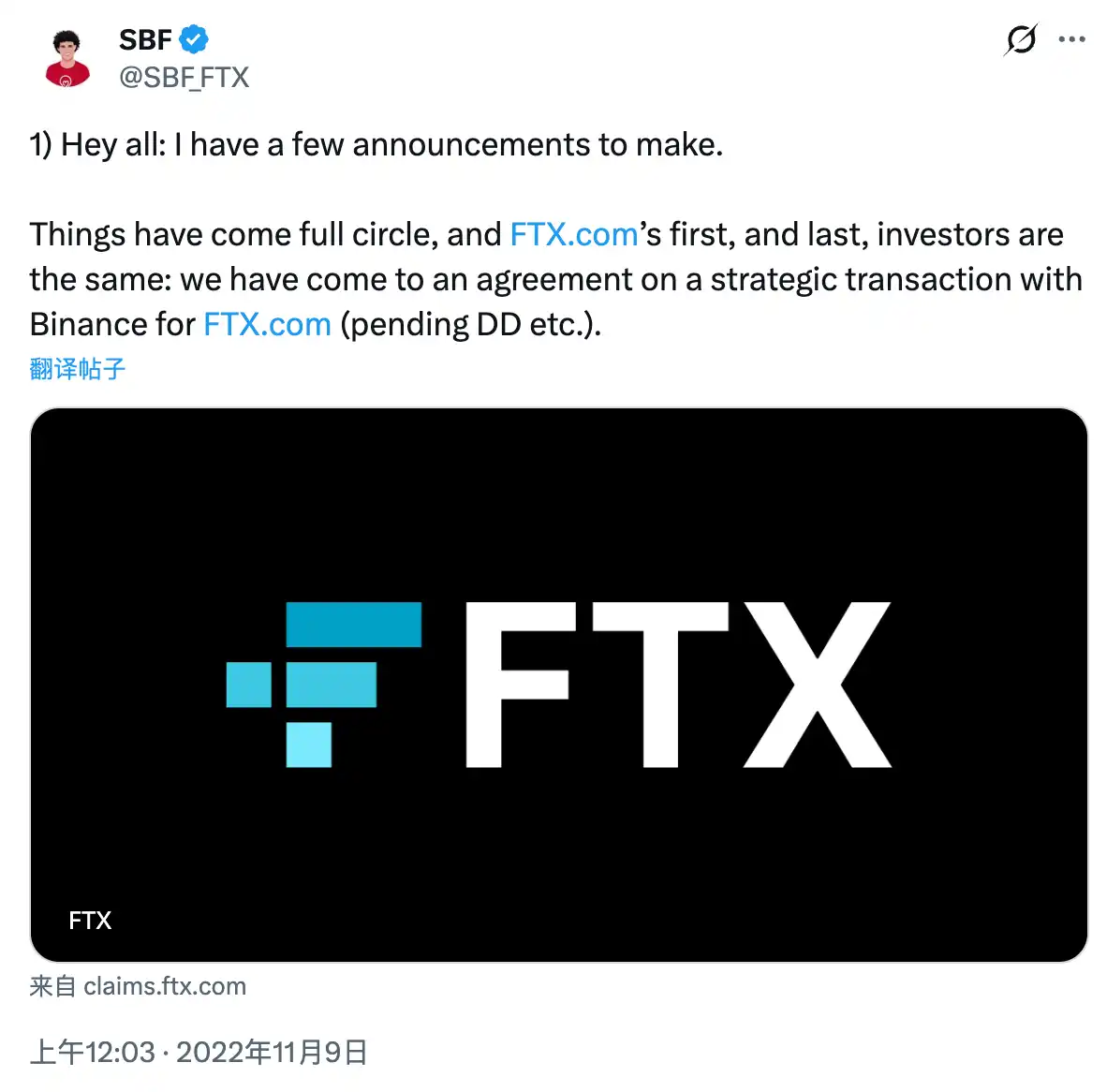
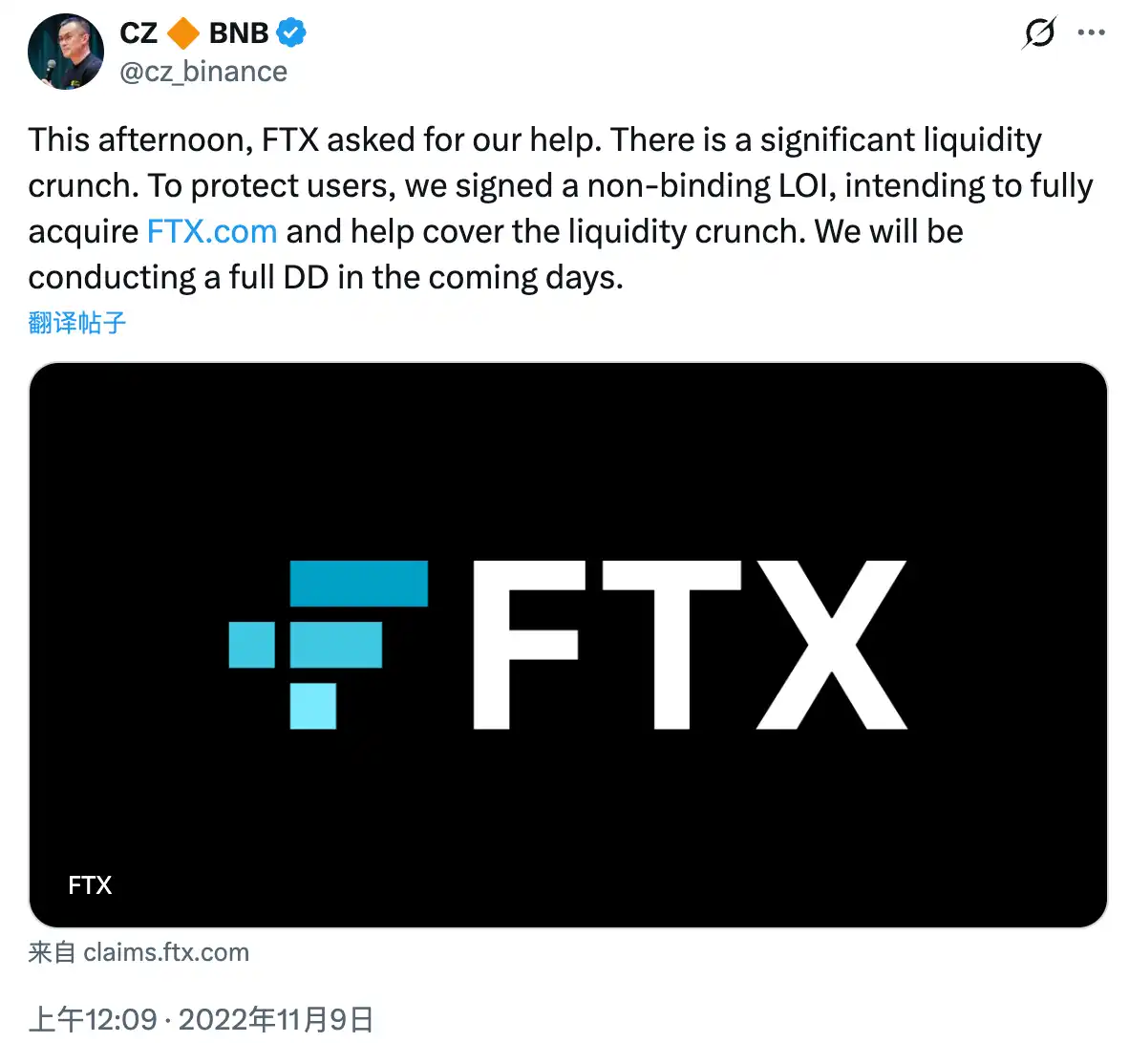
In a parallel universe, the story could have taken a different turn. In the early hours of November 9, SBF and CZ had issued statements indicating that FTX had preliminarily reached an acquisition agreement with Binance.

SBF: Hey everyone, I have an announcement. Things have come full circle. FTX's first and last investors are the same — we have reached a strategic transaction agreement with Binance (pending due diligence).

CZ: This afternoon, FTX asked us for help. The exchange is currently facing a severe liquidity crunch. To protect users, we signed a non-binding Letter of Intent, intending to fully acquire FTX to help alleviate the liquidity crisis. We will conduct full due diligence in the coming days.

However, the acquisition ultimately fell through. Just one day later, Binance officially announced the abandonment of the acquisition, citing "issues beyond our control", which became the final straw that broke FTX's back.

Did CZ ever seriously consider acquiring FTX? Was the hastily concluded acquisition farce a genuine attempt to help or merely a ploy to gauge the opponent's "health bar"? This may forever remain a mystery. From the outcome, CZ personally defeated his biggest competitor at the time, consolidating Binance's position as the industry's top dog.

But no one could have predicted that a seemingly insignificant "side bet" in FTX's asset portfolio at the time would rapidly appreciate in value over the next few years, its worth now even far exceeding the total value of the remaining assets involved in that unfinished acquisition.

Once a "Side Bet", Now an AI Focus

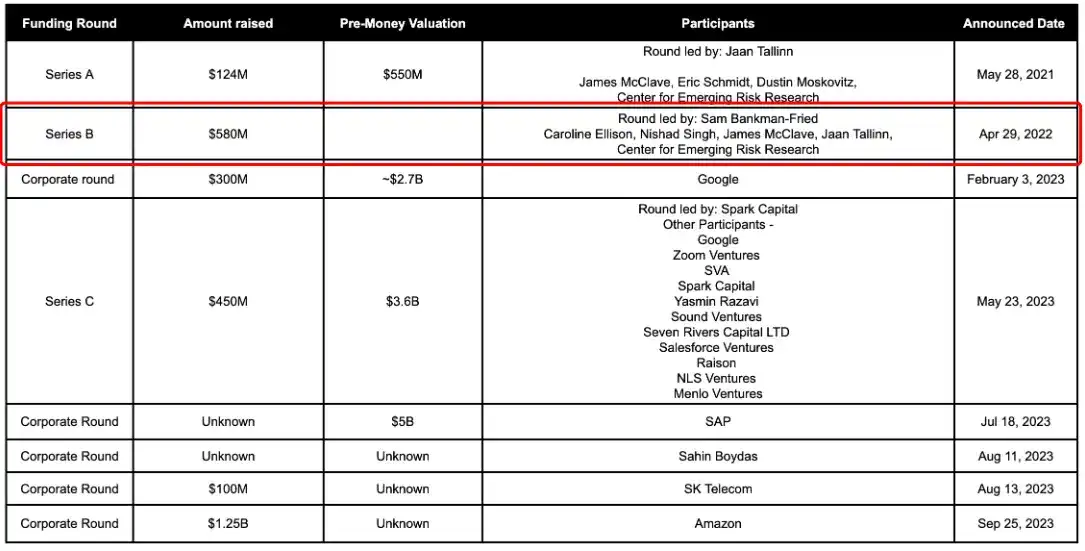
In April 2022 (this is the official announcement date; the deal was actually completed in 2021), FTX made its most important investment in the AI field — leading a $580 million funding round for AI startup Anthropic with a $500 million investment, initially acquiring a 13.56% equity stake, which was later diluted to 7.84% as Anthropic completed subsequent funding rounds.

That was an era when AI's potential had not yet exploded. Just half a year later (late November 2022, the month FTX collapsed), OpenAI's ChatGPT burst onto the scene, irreversibly ushering the world into the "Age of Exploration" for AI. Anthropic, with its Claude series of products (especially the programming-oriented Claude Code), repeatedly amazed the world, gradually becoming one of the most dazzling star companies.

As Claude continuously iterated, Anthropic's valuation also kept rising. Capital frantically waved banknotes, desperate to secure a berth on Anthropic's ship sailing towards IPO. The latest market rumor is that Anthropic is in the final stages of a new massive funding round, expected to exceed $20 billion (originally planned to raise $10 billion, but investor demand far exceeded expectations, potentially doubling the final amount), with a valuation possibly as high as $350 billion. The deal could be completed as early as this week.

Calculated at the latest valuation of $350 billion, the value of the Anthropic equity once held by FTX would be approximately $27.44 billion, enough to cover the reserve shortfall that led to its bankruptcy several times over... But history has happened, and the outcome is settled.

It's hard not to marvel at SBF being a rare venture capital genius (besides Anthropic, he also invested in the now-hot Cursor in its seed round), but clearly he was not a qualified business operator, especially lacking in risk control. CZ's profile is the complete opposite; he is an absolute master at operating a business. Binance's dominance is inseparable from his多次正确的战略决策 (many correct strategic decisions). But CZ also often positions himself not as a traditional investor solely pursuing returns; he doesn't trade coins and prefers to be a builder of the industry.

A Messy Ending: This Should Have Been the Best Intersection of Crypto and AI

You might wonder, what happened to those FTX equity shares?

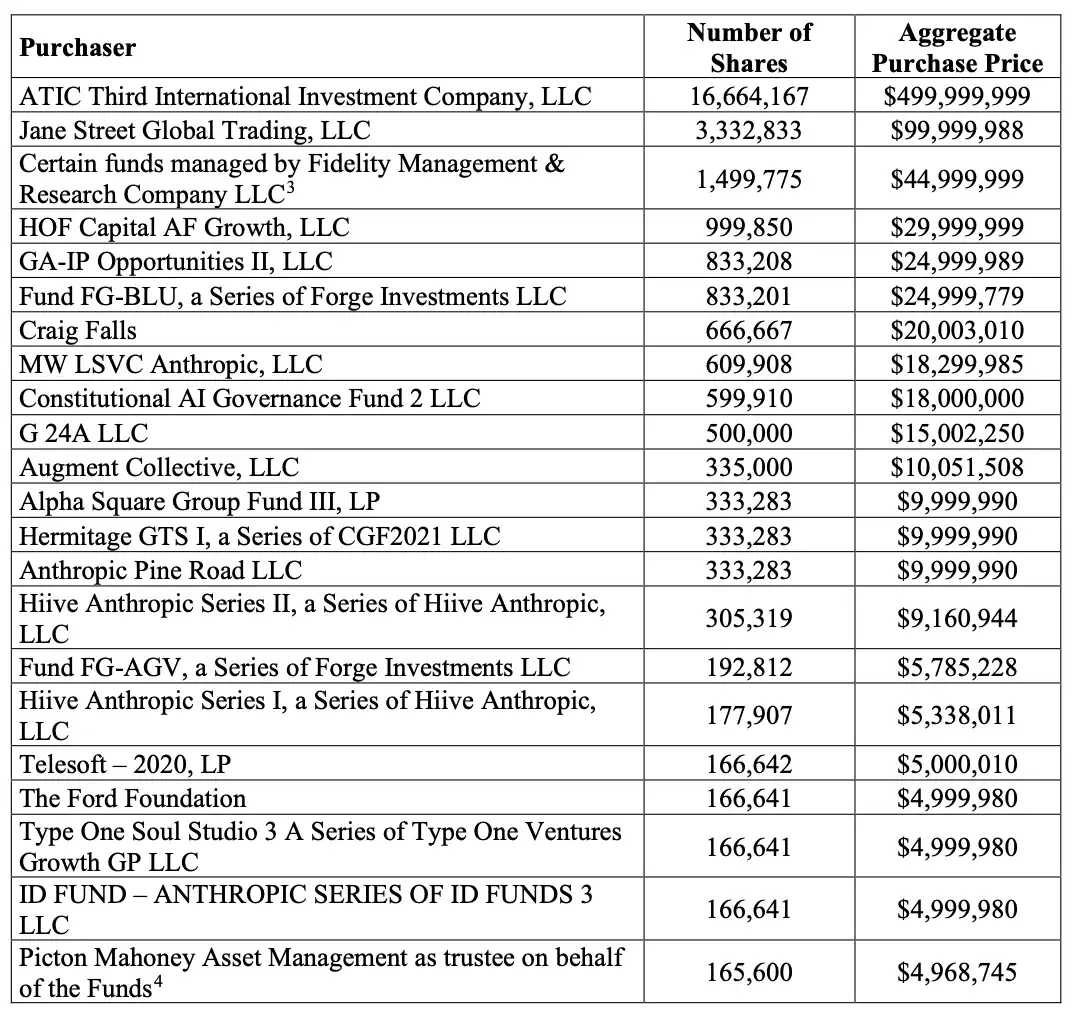
The ending is not complicated. After FTX's bankruptcy, all assets, including the Anthropic equity, were handled by the FTX bankruptcy estate management team. In February 2024, the court approved the team's request to sell these shares; in March and June of the same year, the FTX bankruptcy team sold 29.5 million shares for $884 million and 15 million shares for $450 million respectively, totaling over $1.3 billion sold.

As for the buyers of these shares, they were primarily ATIC Third International Investment from Abu Dhabi, and traditional financial institutions from Wall Street like Jane Street and Fidelity. In other words, no crypto companies got a share of the pie.

Whether these shares were deliberately sold cheaply, or whether there was利益输送 (benefit transfer) under the guise of bankruptcy liquidation, is no longer important for the crypto industry.

This should have been the best intersection of Crypto and AI. In another worldline, whether these shares were in the hands of SBF or CZ, if leading companies in the crypto world had some say in the development of one of AI's most successful companies, there could have been more innovative attempts around Crypto + AI, potentially yielding unexpected fruits.

It's not just CZ who is slapping his thigh in regret.

Связанные с этим вопросы

QWhat was the potential return on CZ's investment in BTC if he had not sold his apartment in Shanghai?

AIf CZ had not sold his BTC, the peak return on his investment would have been approximately $189 million.

QWhy did Binance ultimately decide not to acquire FTX in November 2021?

ABinance announced it was abandoning the acquisition because the issues at FTX were 'beyond their control or ability to help' after conducting initial due diligence.

QWhat was the significance of FTX's investment in Anthropic, and how much was it worth at its peak potential valuation?

AFTX invested $500 million in Anthropic, acquiring a 13.56% stake, which was later diluted to 7.84%. At a rumored $350 billion valuation, this stake would be worth approximately $27.44 billion.

QHow did the FTX bankruptcy estate handle its Anthropic shares, and who were the main buyers?

AThe FTX bankruptcy estate sold its Anthropic shares in two batches for a total of over $1.3 billion. The main buyers were ATIC Third International Investment from Abu Dhabi and traditional financial institutions like Jane Street and Fidelity.

QAccording to the article, what was the missed opportunity for the Crypto industry with the sale of FTX's Anthropic stake?

AThe missed opportunity was that no crypto companies acquired the Anthropic stake. If a crypto leader like SBF or CZ had retained influence over this leading AI company, it could have fostered more innovation at the intersection of Crypto and AI.

Похожее

Breaking: OpenAI Undergoes Major Reorganization, President Brockman Assumes Command

OpenAI has announced a major internal reorganization just months before its anticipated IPO. The company is merging its three flagship product lines—ChatGPT, Codex, and the API platform—into a single, unified product organization. The most significant leadership change involves co-founder and President Greg Brockman moving from a background technical role to take full, permanent control over all product strategy. This follows the indefinite medical leave of AGI Deployment CEO Fidji Simo. Additionally, ChatGPT's longtime lead, Nick Turley, has been reassigned to enterprise products, with former Instagram executive Ashley Alexander taking over consumer offerings. The consolidation, internally framed as a strategic move towards an "Agentic Future," aims to break down internal silos and create a cohesive "Super App." This planned desktop application would integrate ChatGPT's conversational abilities, Codex's coding power, and a rumored internal web browser named "Atlas" to autonomously perform complex user tasks. The reorganization occurs amid significant internal and external pressures. OpenAI has recently seen a wave of high-profile departures, including Sora co-lead Bill Peebles and other senior technical leaders, leading to concerns about a thinning executive bench. Externally, rival Anthropic recently secured funding at a staggering $900 billion valuation, surpassing OpenAI's own. Google's upcoming I/O developer conference also poses a competitive threat. Analysts suggest the dramatic restructure is a pre-IPO move to present a clearer, more focused narrative to Wall Street—streamlining operations and demonstrating decisive leadership under Brockman to counter internal turbulence and intense market competition.

marsbit3 ч. назад

Breaking: OpenAI Undergoes Major Reorganization, President Brockman Assumes Command

marsbit3 ч. назад

Two Survival Structures of Market Makers and Arbitrageurs

Market makers and arbitrageurs represent two distinct survival structures in high-frequency trading. Market makers primarily use limit orders (makers) to profit from the bid-ask spread, enjoying high capital efficiency (nominally 100%) but bearing inventory risk. This "inventory risk" arises from passive, fragmented, and discontinuous order fills in the limit order book (LOB). This risk, while a potential cost, can also contribute to excess profit if managed within control boundaries, allowing for mean reversion. Market makers essentially sell "time" (uncertainty over execution timing) to the market for price control and low fees. In contrast, cross-exchange arbitrageurs typically use market orders (takers) to exploit price differences or funding rates, resulting in lower nominal capital efficiency (requiring capital on both exchanges) and higher transaction costs. Their risk exposure stems from asymmetries in exchange rules (e.g., minimum order sizes), execution latency, and infrastructure risks (e.g., ADL, oracle drift). These exposures are active, exogenous gaps that primarily erode profits rather than contribute to them. Arbitrageurs essentially sell "space" (capital sunk across venues) for localized, immediate certainty. Both strategies engage in a trade-off between execution friction and residual risk. Optimal systems allow for temporary, controlled risk exposure rather than enforcing zero exposure at all costs. Their evolution converges towards hybrid models: arbitrageurs may use maker orders to reduce costs, while market makers may use taker orders or hedges for risk management. Ultimately, both use different forms of risk exposure—market makers exposing inventory, arbitrageurs immobilizing capital—to extract marginal, hard-won certainty from the market.

链捕手3 ч. назад

Two Survival Structures of Market Makers and Arbitrageurs

链捕手3 ч. назад

Who Will Define the Rules of the AI Era? Anthropic Discusses the 2028 US-China AI Landscape

This article, based on Anthropic's analysis, outlines the intensifying systemic competition between the U.S./allies and China for AI leadership by 2028. It argues that access to advanced computing power ("compute") is the critical bottleneck, where the U.S. currently holds a significant advantage through chip export controls and allied innovation. However, China's AI labs remain competitive by exploiting policy loopholes—via chip smuggling, overseas data center access, and "model distillation" attacks to copy U.S. model capabilities—keeping them close to the frontier. The piece presents two contrasting scenarios for 2028. In the first, decisive U.S. action to tighten compute controls and curb distillation locks in a 12-24 month AI capability lead, cementing democratic influence over global AI norms, security, and economic infrastructure. In the second, policy inaction allows China to achieve near-parity through continued access to U.S. technology, enabling Beijing to promote its AI stack globally and integrate advanced AI into its military and governance systems, altering the strategic balance. Anthropic contends that maintaining a decisive U.S. lead is essential for shaping safe AI development and governance. The core recommendation is for U.S. policymakers to urgently close compute and model access loopholes while promoting global adoption of the U.S. AI technology stack to secure a lasting strategic advantage.

marsbit5 ч. назад

Who Will Define the Rules of the AI Era? Anthropic Discusses the 2028 US-China AI Landscape

marsbit5 ч. назад

Торговля

Спот
Фьючерсы

Популярные статьи

Неделя обучения по популярным токенам (2): 2026 может стать годом приложений реального времени, сектор AI продолжает оставаться в тренде

2025 год — год институциональных инвесторов, в будущем он будет доминировать в приложениях реального времени.

1.8k просмотров всегоОпубликовано 2025.12.16Обновлено 2025.12.16

Неделя обучения по популярным токенам (2): 2026 может стать годом приложений реального времени, сектор AI продолжает оставаться в тренде

Обсуждения

Добро пожаловать в Сообщество HTX. Здесь вы сможете быть в курсе последних новостей о развитии платформы и получить доступ к профессиональной аналитической информации о рынке. Мнения пользователей о цене на AI (AI) представлены ниже.

活动图片