# Сопутствующие статьи по теме Trading Platform

Новостной центр HTX предлагает последние статьи и углубленный анализ по "Trading Platform", охватывающие рыночные тренды, новости проектов, развитие технологий и политику регулирования в криптоиндустрии.

Why is HYPE Still Surging? Has It Topped Out?

The article analyzes the reasons behind the continued surge of the HYPE token, despite the current market conditions. The primary drivers identified are: 1. **ETF Inflows and a New Buyback Mechanism:** The launch of two ETFs (THYP by 21Shares and BHYP by Bitwise) has opened a channel for traditional capital. Crucially, Bitwise announced it will allocate 10% of BHYP's management fee income to acquire and stake HYPE, creating a potential source of recurring buy pressure linked to the ETF's growth. 2. **USDC Integration and New Revenue Stream:** The return of USDC to Hyperliquid, facilitated by Coinbase and Circle, is significant. It establishes a protocol revenue-sharing model from USDC reserve yields. Community estimates suggest this could generate substantial daily income (approx. $440k), which could be used for HYPE buybacks, decoupling token demand from just trading fees and linking it to the platform's stablecoin deposits. 3. **Expansion into New Markets:** Hyperliquid is broadening beyond being just a Perp DEX. Its HIP-4 feature launches it into the prediction market space, already showing high volume. This requires HYPE staking for market creation, directly increasing token utility and staking demand. Furthermore, the platform's Real-World Asset (RWA) trading has seen Open Interest hit a new high of $2.6B, indicating growth in trading traditional assets like stocks and commodities. 4. **Regulatory Tailwinds for RWA:** Potential SEC exemptions for tokenized stock trading could further accelerate Hyperliquid's RWA business, turning a niche into a major battleground for on-chain trading. In summary, the market is re-rating HYPE as Hyperliquid evolves from a single-purpose DEX into a comprehensive on-chain trading system with multiple growing revenue streams (trading fees, reserve yields, prediction markets) and expanding asset classes (crypto, RWAs). However, the article notes that despite the strong long-term fundamentals, short-term price action is currently volatile due to a large-scale showdown between whale long and short positions exceeding $60 million.

marsbit05/20 01:42

Why is HYPE Still Surging? Has It Topped Out?

marsbit05/20 01:42

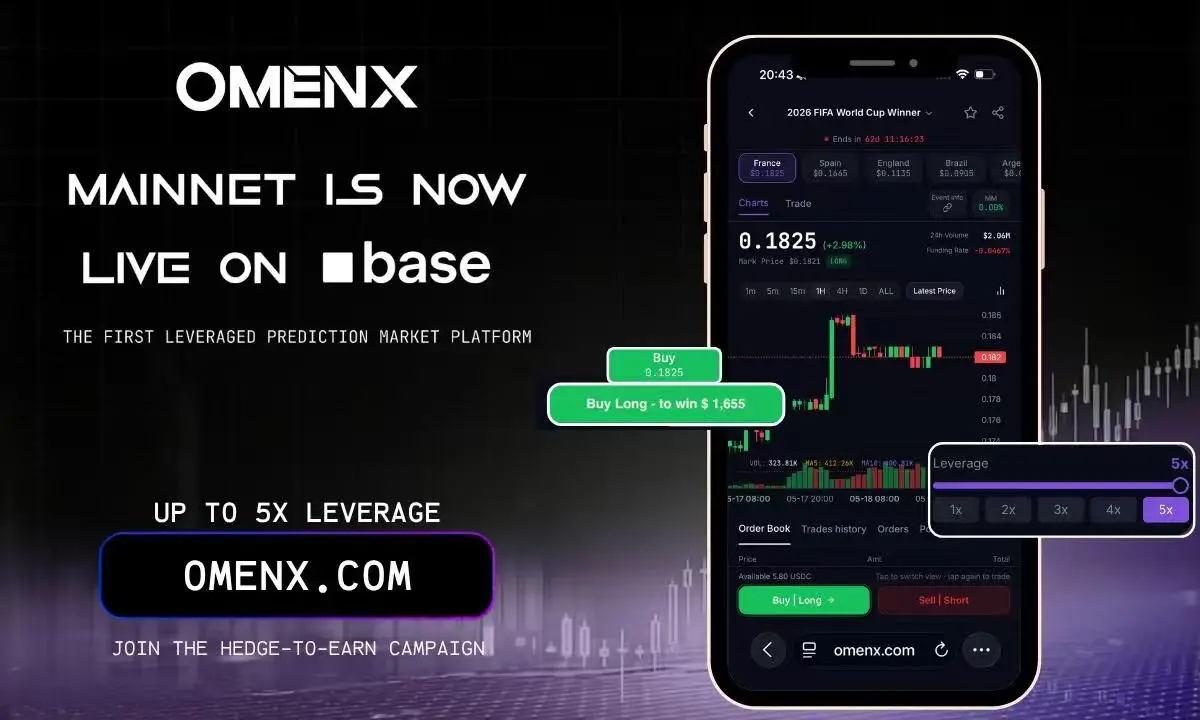
Base Native Leveraged Prediction Market OmenX Officially Launches on Mainnet

Base-native leveraged prediction market platform OmenX has officially launched on mainnet. It currently supports up to 5x leverage, with plans to increase to 10x based on platform liquidity and market conditions. Unlike traditional prediction markets where users fully collateralize YES/NO positions and wait for settlement, OmenX aims to create a trading platform-like experience. Users can open leveraged positions on event outcomes, and actively trade, adjust, or hedge these positions before the event concludes for greater capital efficiency. Alongside the mainnet launch, OmenX introduced a "Hedge-to-Earn" campaign targeting existing users of other prediction markets (initially Polymarket). This initiative allows users to claim incentives or hedging benefits on OmenX based on their existing positions, aiming to introduce them to leveraged trading and active risk management. OmenX positions itself as a derivatives trading platform for prediction market assets. The team believes that as platforms like Polymarket mainstream prediction markets, event outcomes are becoming a new tradable asset class. The next phase of demand will focus on leverage, liquidity, and advanced trading tools. Post-launch, OmenX plans to expand supported market types, optimize liquidity, and develop APIs and additional trading tools. The team is also in discussions with investors and partners to secure resources for further development.

链捕手05/19 13:35

Base Native Leveraged Prediction Market OmenX Officially Launches on Mainnet

链捕手05/19 13:35

Crypto Bear Market Startup Guide Part 1: Pre-Market Price Spread Market for Tokenized Stocks

"Encrypted Bear Market Startup Guide Part 1: Pre-IPO Stock Price Arbitrage Market" Despite the challenges of a crypto bear market, over 80% of startups that raised seed rounds in 2022 are still building. This period can foster focus on product development and survival skills. This series explores potential business opportunities, starting with the pre-IPO stock price arbitrage market. This market bridges crypto and traditional finance, with major stock exchanges and crypto platforms participating. The upcoming 2026 "IPO boom," featuring companies like OpenAI, Anthropic, SpaceX(xAI), and crypto exchanges, is driving demand for pre-IPO trading. Platforms like PreStocks, Jarsy, and Tessera have emerged, offering more flexible trading than traditional venues like Hiive. Significant price discrepancies exist for the same stock across different pre-IPO platforms. For example: - Kalshi shows a $148 (37%) difference between PreStocks ($397) and Jarsy ($545). - Polymarket has a $94 (50.5%) spread between PreStocks ($186) and Jarsy ($280). - SpaceX(xAI) has a $75 (12.7%) gap between PreStocks ($666) and Tessera ($591). This creates an opportunity for a new platform to act as an arbitrage marketplace for these price differences. The potential business model could include trading fees, LP fees, and profiting from the platform's own arbitrage positions, though current market liquidity remains in the millions.

marsbit03/16 02:16

Crypto Bear Market Startup Guide Part 1: Pre-Market Price Spread Market for Tokenized Stocks

marsbit03/16 02:16

Crypto Bear Market Startup Guide Part 1: Pre-Market Price Spread Market for Tokenized Stocks

The article "Crypto Bear Market Startup Guide Part 1: Pre-IPO Stock Price Difference Market" discusses entrepreneurial opportunities during a crypto bear market, focusing on the emerging niche of pre-IPO stock price difference markets. It begins by challenging the notion that bear markets are beneficial for building, citing data showing over 80% of crypto startups from the 2022 bear market are still active, suggesting that focused development and survival skills can thrive in downturns. The core analysis highlights the significant price discrepancies for pre-IPO stocks of companies like Kalshi, Polymarket, and SpaceX(xAI) across different crypto-based trading platforms such as PreStocks, Jarsy, and Tessera. For instance, Kalshi's pre-IPO price shows a $148 (37%) difference between PreStocks ($397) and Jarsy ($545). Polymarket's price gap is $94 (over 50%), and SpaceX has a $75 (12.7%) difference. The author argues this demonstrates a clear market need for a unified platform that bridges these price gaps across traditional and crypto pre-IPO markets, acting as a liquidity bridge. The proposed business model for such a "pre-IPO price difference market" would likely generate revenue through trading fees, LP fees, and arbitrage on the platform's own capital. The piece positions this as a promising venture for the anticipated 2026 IPO boom.

Odaily星球日报03/16 02:10

Crypto Bear Market Startup Guide Part 1: Pre-Market Price Spread Market for Tokenized Stocks

Odaily星球日报03/16 02:10

活动图片