The logic of entrepreneurship is being fundamentally reshaped by AI.
On May 14th, Anthropic released a significant publication titled "The Founder's Playbook: Building an AI-Native Startup," targeting entrepreneurs who aim to integrate AI as the company's foundational infrastructure.
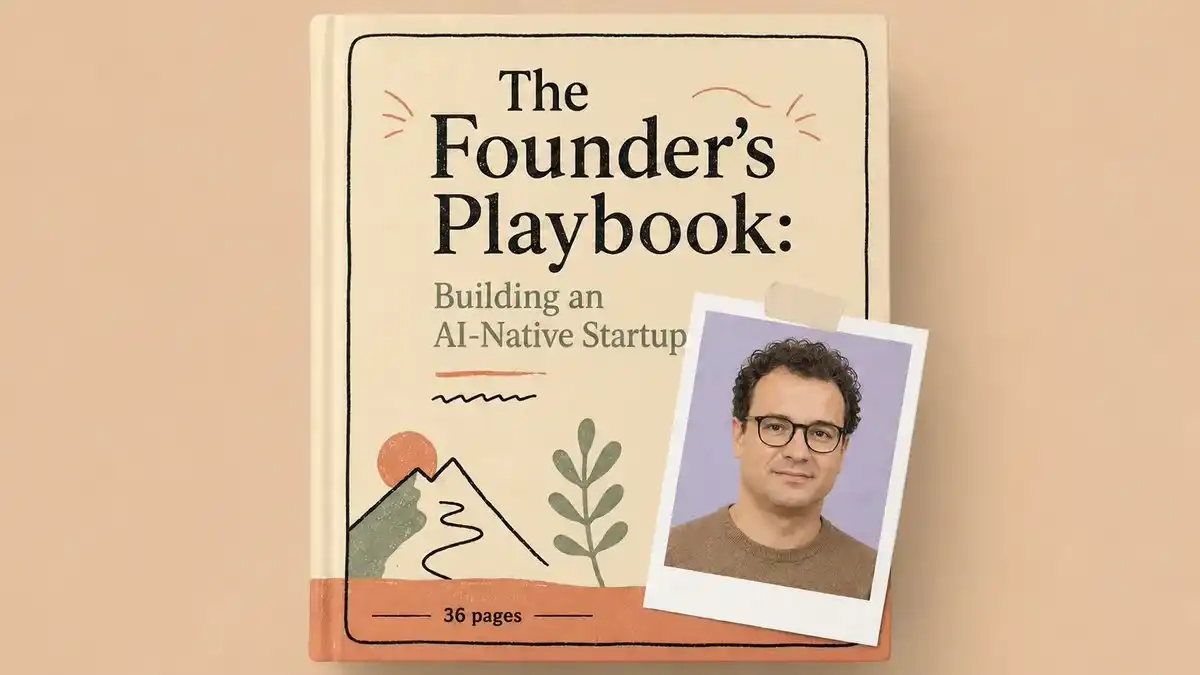
The playbook defines an AI-native startup as a completely new species: not a traditional company with a few AI tools tacked on, but one that is driven by AI in its operations from day one.
In Anthropic's description, AI is now capable of writing production-grade code, conducting market research, drafting fundraising materials, and automating operational processes. A lean team of 10 people can independently deliver production-ready applications with the aid of AI.
The founder's role is also transforming accordingly: becoming more like a conductor, orchestrating AI Agents to handle execution-layer work, while the founder focuses on higher-order judgment and decision-making.
The playbook divides the startup lifecycle into four stages: Idea → MVP → Launch → Scale, and provides a detailed showcase of AI applications at each stage, offering practical implementation guidance and best practices for entrepreneurs.
TinTinLand has compiled the key takeaways to help you grasp the core logic of AI-native entrepreneurship.
📖 Original Playbook: https://claude.com/blog/the-founders-playbook
The Evolving Role of the Founder
The playbook emphasizes that in 2026, AI large models and AI Agents have completely dismantled the high wall between the "code builder" and the "idea generator."
In the past, technical founders handled coding, while business founders managed operations; now, even those without an engineering background can productize ideas using AI. Founders no longer need to micromanage everything. Instead, they design solutions, make product direction decisions, and delegate repetitive tasks to AI.
👉 This implies: In the AI era, experience and business judgment will be more valuable than pure technical skills. Founders will increasingly take on the roles of system architects and curators.
Claude's Three Core AI Tools
Anthropic presents a three-tier productivity product matrix for Claude:
-
Claude Chat: Used for interactive dialogue and research-style queries. It responds instantly to natural language questions, suitable for quick Q&A, brainstorming, and knowledge retrieval.
-
Claude Code: Used for automatically generating and iterating on production-grade code. It supports codebase access, Git integration, and plan mode, suitable for implementing and testing business features.
-
Claude Cowork: Focuses on automating knowledge-intensive workflows, such as document processing, cross-system integration, and team collaboration. It can be used for automating operational tasks, information organization, etc.
These tools are based on the same underlying model and function through different workspaces and process designs.
Founders can choose the appropriate tool based on the needs of each stage: for example, mainly using Chat during the research phase, Code during the coding phase, and Cowork when building operational systems.
The Four-Stage Startup Lifecycle
The playbook segments the entrepreneurial process into four stages (Idea, MVP, Launch, Scale), and for each stage defines core objectives, exit criteria, common pitfalls, and AI practice recommendations.
1️⃣ The Idea Stage
Core Question
Is this product worth building? Before writing the first line of code, one must validate whether the problem is real, not just validate their own ability to develop a solution.
Stage Success Criterion
Problem-Solution Fit.
The founder needs to answer key questions: Is the problem specific and widespread? Who is experiencing this problem? How do existing solutions perform? Does your solution genuinely address the validated problem?
Common Challenges
AI makes prototyping extremely easy, but a functioning prototype does not equate to genuine market demand.
The playbook points out that even before AI's emergence, 42% of startup failures were due to "building something nobody wants"; AI will further amplify this risk. Another trap is confirmation bias: asking AI to "prove" your idea—it will always find supporting evidence.
AI Practices
Use Claude as a "structured devil's advocate": Have the AI challenge your assumptions and help refine your problem statement.
Utilize Claude Chat or Cowork for market and competitor research: Map the competitive landscape (including why competitors only solve half the problem), distill insights from industry reports and user interviews.
Use Claude Cowork to aggregate user interview transcripts and extract key insights, compare supporting and opposing evidence to uncover real needs or refine the solution.
2️⃣ The MVP Stage
Core Question
What should be built? The core objective is still gathering evidence, but the focus shifts from the problem to the solution: Are there clear users willing to use the product, retain, pay, or recommend it?
Stage Success Criterion
Early signals of Product-Market Fit (PMF).
The "40% rule" by Sean Ellis can be applied: If over 40% of active users say they would be "very disappointed" without the product, PMF may be achieved.
Common Challenges
Technical debt and scope creep. AI-accelerated development can lead founders to neglect architectural design and specifications: unstructured AI-generated code might collapse as user numbers grow. The playbook stresses designing the architecture first before coding, not generating the entire codebase at once.
Additionally, the "zero friction" of feature development makes founders prone to scope creep, constantly adding features.
AI Practices
Establish persistent project "memory" documents (e.g., CLAUDE.md): Use Claude to record architectural principles, design trade-offs, and to-do items, providing context for all subsequent development sessions.
Use Claude Code for coding tasks: Have it generate module frameworks first, then fill in functionality to keep the code structure clear.
Leverage Claude Cowork to automate the user interview process: from research to feedback, recording and analyzing data throughout.
The focus in this stage is using AI to replace repeatable work in the development process, while founders maintain control over product direction.
3️⃣ The Launch Stage
Core Question
Can the business grow? This stage focuses on marketing, operations, and compliance.
Stage Success Criterion
Three elements are in place: Growth channels are replicable and measurable (clear CAC, LTV, and payback period), the product supports production loads (infrastructure and security compliance are set), and system reliability has been tested in real-world conditions.
Common Challenges
Accelerating accumulation of technical debt, the founder becoming a bottleneck, and premature scaling.
As features become more complete, hidden flaws and dependencies surface when traffic increases. Meanwhile, blindly expanding into new markets before user feedback dilutes can disrupt original metrics.
AI Practices
Build a Launch Stage "Operating System," using AI workflows to replace routine operations:
For example, use Claude Cowork to automate scheduling, update CRMs, generate reports, and create promotional content. Use Claude Code to audit the product and architecture: Have it detect potential vulnerabilities and prioritize issues requiring fixes.
Allow founders to focus on important matters (product decisions, customer negotiations, fundraising planning), delegating repetitive work to AI Agents for execution.
4️⃣ The Scale Stage
Core Question
Is the company sustainable? Ensure the business can run stably even as the founder gradually steps back.
Stage Success Criterion
The company reaches a state of sustainable operation: e.g., consistent profitability, IPO-readiness, or acquisition potential.
At this point, the organizational structure needs refinement around different business units, and data-driven decision-making and operational automation become the norm.
Common Challenges
Delegating operational control. Founders must overcome the psychological barrier of "letting go," entrusting more daily operations to AI and the team.
AI eliminates traditional assumptions about team size: Previously, entering a new startup phase required larger teams and more funding. But with AI, a 10-person team can achieve output comparable to a large corporation.
AI Practices
Utilize AI technology to continuously strengthen product competitiveness and the business model: Use AI for differentiated marketing (strategizing for different audience groups), optimizing operational efficiency, and building user retention mechanisms (e.g., leveraging data network effects to create barriers).
In this stage, Claude Chat is used for insights into new market opportunities, Claude Code supports system optimization for large-scale usage, and Claude Cowork continues to assist in automating various processes.
Conclusion: The New Rules of AI Entrepreneurship
At the end of this playbook, Anthropic summarizes with extremely concise language:
"Whether it can be built" is no longer the boundary; "whether it should be built" is the key question.
When everyone can build quickly, the ability to build quickly itself ceases to be an advantage. The advantage returns to older, more fundamental sources—insight, judgment, and a genuine understanding of a problem and the people it affects.