# Сопутствующие статьи по теме IPO

Новостной центр HTX предлагает последние статьи и углубленный анализ по "IPO", охватывающие рыночные тренды, новости проектов, развитие технологий и политику регулирования в криптоиндустрии.

Racing to Be the First Stock: The Substance, Capabilities, and Ambition of China's Largest Independent Model Company

Zhipu AI, China's largest independent large language model (LLM) company by revenue, has passed its listing hearing on the Hong Kong Stock Exchange with a valuation of RMB 24.377 billion. Its IPO filing provides the first clear look at the financials of a major Chinese LLM player. From 2022 to 2024, Zhipu's revenue grew at a 130% CAGR, reaching RMB 310 million in 2024. Nearly 85% of its revenue comes from on-premise model deployments for enterprise clients, with the remainder from its MaaS (Model-as-a-Service) platform. Despite rapid revenue growth, the company reported significant adjusted net losses, driven overwhelmingly by R&D expenses which reached RMB 1.59 billion in H1 2025. A major portion of these costs is attributed to computing power, essential for training its flagship models. A key part of Zhipu's strategy is a "land and expand" approach: using strategic price cuts on its MaaS platform to attract a large user base (over 1.2 million enterprise developers) and then converting them into high-value on-premise clients. The release of its powerful open-source base model, GLM-4.5/4.6, which ranks among the top global models in several benchmarks, led to an exponential increase in API calls and token consumption. The company is betting that continued heavy R&D investment is necessary to stay at the forefront of the intensely competitive global AI market. Its leadership believes that possessing a superior base model is the ultimate product and the key to long-term growth, even if it requires substantial short-term losses. As one of the first Chinese LLM firms to file for an IPO, Zhipu's market debut is poised to be a major test for valuing China's independent AI industry.

marsbit12/23 11:13

Racing to Be the First Stock: The Substance, Capabilities, and Ambition of China's Largest Independent Model Company

marsbit12/23 11:13

Average Age 'Post-95s', Over a Billion USD in the Books: MiniMax Knocks on Hong Kong Stock Exchange's Door

MiniMax, a leading Chinese AI startup founded in December 2021 by former SenseTime executives, has filed for an IPO in Hong Kong, potentially becoming one of the fastest AI companies to go public. Specializing in full-spectrum AGI technologies—spanning text, voice, video, and music—MiniMax operates on a dual-strategy of "large model + AI-native applications." As of September 2025, it serves over 212 million individual users across more than 200 countries and regions, along with 100,000+ enterprise clients. Notably, over 70% of its revenue comes from overseas markets. Its AI-native products, including Haiduo AI, Xingye/Talkie, and MiniMax Voice, saw average monthly active users grow sharply to 27.6 million in the first nine months of 2025. Financially, MiniMax reported revenue of $53.4 million for the first three quarters of 2025, a 174.7% year-on-year increase. Despite an adjusted net loss of $186 million during the same period, the company demonstrated improved operational efficiency, with R&D expenses growing only 30% while sales and marketing costs fell 26%. Technologically, MiniMax has released several cutting-edge models: the voice model Speech 02, video generator Video 01 (and its upgrade Hailuo 02), and the open-source MiniMax-M2 text model—ranked among the top five globally. Its M2 model incorporates "Interleaved Thinking" for enhanced reasoning and agentic capabilities. The company is highly R&D-focused, with nearly 80% of its 385 employees in technical roles. The executive team is notably young, with an average age of 32. MiniMax plans to allocate 70% of IPO proceeds to R&D over the next five years to further advance its models and AI-native products.

深潮12/22 02:45

Average Age 'Post-95s', Over a Billion USD in the Books: MiniMax Knocks on Hong Kong Stock Exchange's Door

深潮12/22 02:45

Looking Back at 2025: The Top Ten Influential Figures of the Year in the Crypto Industry

Reflecting on 2025: Top 10 Influential Figures in the Crypto Industry In 2025, the crypto industry saw clearer regulations, deeper traditional finance integration, and rapid tech advancements. Key figures driving these changes include: 1. **Donald Trump**: As U.S. President, he issued pro-crypto executive orders, promoted dollar-backed stablecoins, banned CBDCs, and launched his meme coin TRUMP and DeFi project WLFI, though both saw significant price drops. 2. **SEC Chair Paul Atkins**: Introduced Project Crypto, clarifying that most digital assets are not securities, ending investigations into firms like Coinbase, and fostering a pro-crypto regulatory approach. 3. **Vitalik Buterin**: Led Ethereum’s Pectra and Fusaka upgrades, enhancing scalability and efficiency, and focused on privacy with tools like Kohaku and donations to decentralized messaging apps. 4. **Michael Saylor**: Strategy acquired over 224,868 BTC, raising holdings to 671,268 BTC. He defended the company against MSCI index removal risks and advocated for Bitcoin-backed digital banking systems. 5. **Paolo Ardoino (Tether CEO)**: Attempted to acquire Juventus FC, expanded USDT as a fiat-referenced token in Abu Dhabi, launched mobile payment app Oobit, invested in digital lending platform Ledn, and supported AI and robotics ventures. 6. **Larry Fink (BlackRock CEO)**: BlackRock’s Bitcoin ETF (IBIT) led the market with $70.84 billion AUM, strengthening crypto-traditional finance integration. 7. **Tom Lee (BitMine Chairman)**: Pushed BitMine to hold 3.97 million ETH, aiming to become "the MicroStrategy of Ethereum" and generate significant staking income. 8. **Changpeng Zhao (CZ)**: Received a pardon from Trump, ending legal challenges and pledging to advance crypto adoption in the U.S. and globally. 9. **Jeremy Allaire (Circle CEO)**: Circle’s successful NYSE IPO surged 168% on debut, highlighting stablecoin utility and potential for programmable digital dollars. 10. **Xiao Feng (HashKey Chairman)**: Led HashKey to a landmark IPO on the Hong Kong Exchange, marking a key step in crypto compliance and mainstream capital market acceptance.

marsbit12/21 23:33

Looking Back at 2025: The Top Ten Influential Figures of the Year in the Crypto Industry

marsbit12/21 23:33

From Four Failures to a Trillion-Dollar Valuation: Musk and SpaceX's Epic Comeback

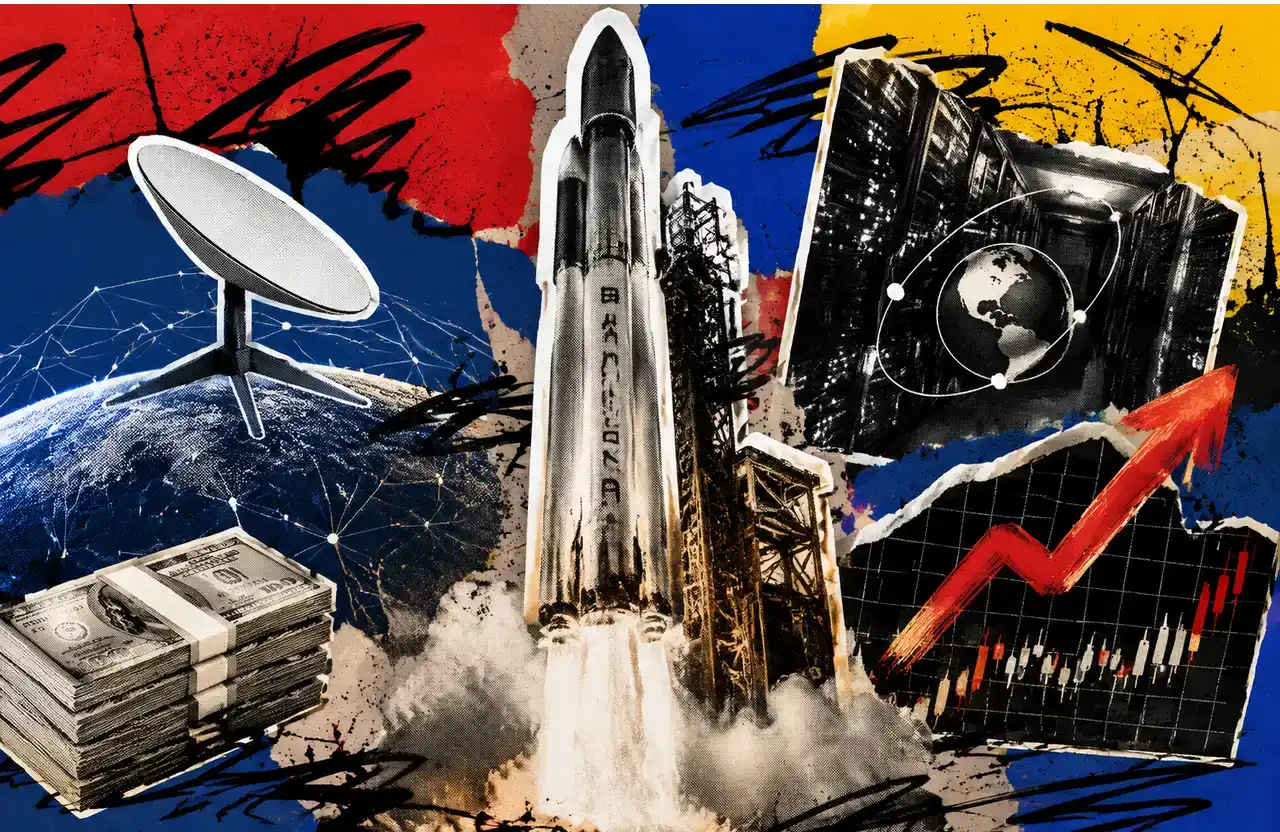
From Four Failures to Trillion-Dollar Valuation: Musk and SpaceX's Ultimate Comeback In 2002, Elon Musk invested $100 million from his exit of PayPal to found SpaceX, aiming to revolutionize space travel. The journey began with humiliation when Russian engineers dismissed his ambitions during a failed rocket purchase attempt. Undeterred, Musk decided to build rockets himself. SpaceX faced near-catastrophic failures with its first three Falcon 1 launches (2006-2008), coinciding with the 2008 financial crisis, Tesla’s near-bankruptcy, and personal struggles. After the third explosion, funds were nearly exhausted, and critics, including Musk’s idol Neil Armstrong, openly doubted him. The fourth launch in September 2008 succeeded, saving SpaceX from collapse and securing a $1.6 billion NASA contract for ISS resupply missions. Driven by first principles, Musk pursued reusable rockets despite industry skepticism. In 2015, Falcon 9’s first stage successfully landed vertically, slashing costs and disrupting the aerospace industry. For Starship, Musk opted for stainless steel over carbon fiber, reducing material costs by 40x while maintaining performance. SpaceX’s valuation soared from $13 billion (2012) to $800 billion (2025), largely fueled by Starlink. With 7.65 million subscribers and revenue projected to reach $22-24 billion in 2026, Starlink dominates as a global telecom provider. Preparing for a 2026 IPO targeting $30 billion raised at a $1.5 trillion valuation, SpaceX aims to surpass Saudi Aramco’s record. For Musk, this funds his ultimate goal: making humanity a multi-planetary species by colonizing Mars. The IPO represents not an exit but a critical step toward interplanetary civilization.

比推12/19 13:26

From Four Failures to a Trillion-Dollar Valuation: Musk and SpaceX's Epic Comeback

比推12/19 13:26

Before Soaring to a $1.5 Trillion IPO, Musk Almost Lost Everything

Elon Musk's SpaceX is on the verge of a historic $150 billion IPO, targeting a $1.5 trillion valuation, which could make Musk the world's first trillionaire. This marks a dramatic turnaround from the company's near-collapse in 2008. Founded in 2002, SpaceX faced immense skepticism and technical failures. Its first three Falcon 1 rocket launches ended in explosions, nearly bankrupting the company and coinciding with Musk's personal crises during the 2008 financial meltdown. The fourth launch succeeded, saving the company and securing a crucial $1.6 billion NASA contract for space station resupply. SpaceX's breakthrough came from applying first-principles thinking. Musk challenged industry norms by insisting on reusable rockets, achieved in 2015 when the Falcon 9 first stage successfully landed. This drastically reduced costs. The same logic led to building Starship from stainless steel instead of expensive carbon fiber, slashing material costs by 40x. The key driver of its $800 billion pre-IPO valuation is Starlink. With over 7.65 million subscribers and covering 24.5 million users, it provides over 80% of SpaceX's revenue, transforming the company into a global telecom giant. Musk, who long resisted going public to avoid distractions, now sees the IPO as essential to fund his ultimate goal: making humanity a multi-planet species. The raised capital will fuel the development of Starship and the ambitious mission to establish a city on Mars.

marsbit12/19 10:01

Before Soaring to a $1.5 Trillion IPO, Musk Almost Lost Everything

marsbit12/19 10:01

活动图片