# Сопутствующие статьи по теме Due Diligence

Новостной центр HTX предлагает последние статьи и углубленный анализ по "Due Diligence", охватывающие рыночные тренды, новости проектов, развитие технологий и политику регулирования в криптоиндустрии.

Tokens Not Selling? 90% of Crypto Projects Overlook Investor Relations

The article argues that effective Investor Relations (IR) is a critical yet often neglected function for crypto projects, with 90% failing at it and struggling to sell their tokens. Good IR acts as a bridge between a project and the market, broadening the buyer base and improving holder quality. The core of a successful IR strategy is distribution: maximizing the number of target investors who know about the token and converting them into buyers. The two primary buyer types are active crypto funds (requiring clear narratives and data for value reassessment) and large strategic institutions (requiring a long B2B sales cycle). The author emphasizes the necessity of proactively controlling the project's narrative with honesty and context, rather than remaining silent. A major tactical error is poor planning for token unlocks; teams should start 30-50 weeks in advance to manage supply and demand. Data is presented as the best ally for building a compelling story, providing context and comparisons for investors. The author contends that crypto IR should not be a dry, compliance-driven task but an engaging, interactive process similar to modern marketing. To lower the barrier to entry, projects must provide ample public data and research, making it easier for funds to conduct due diligence. Furthermore, the article highlights the power of on-chain data for deep investor analysis and argues that greater transparency, not less, actually expands the market by reducing uncertainty. Success should be measured by improvements in investor base quality and breadth—such as growth in target investors and holder diversification—rather than just token price. The future of IR is envisioned as dynamic, multimedia-rich, and proactive, leveraging the inherent transparency of crypto to build a larger, more engaged investor community.

marsbit03/17 13:39

Tokens Not Selling? 90% of Crypto Projects Overlook Investor Relations

marsbit03/17 13:39

Behind RedotPay's Potential US Listing: The Structural Logic and Regulatory Boundaries of a Stablecoin Payment Platform

RedotPay, a Hong Kong-based stablecoin payment platform, is reportedly considering a U.S. IPO with a potential valuation exceeding $4 billion. This move highlights broader questions about how such platforms structure their operations across regulatory boundaries. Beyond functioning as a simple payment card, RedotPay operates as an integrated financial account system offering services including custody, crypto swaps, lending, remittances, and yield-earning products. Its legal structure involves multiple entities across jurisdictions (Hong Kong, Panama, Argentina, and the U.S.), each handling specific services under distinct regulatory frameworks. For instance, its Crypto Earn service is explicitly not offered to Hong Kong residents and is managed by its Panama entity. The platform’s terms of service clearly define fund usage—such as pooled and non-segregated assets in its Earn product—and acknowledge credit functions, aligning with credit card logic in certain regions. While RedotPay explicitly disclaims being a bank or a stored value facility, regulatory scrutiny will likely focus on functional realities rather than contractual disclaimers. An IPO would subject RedotPay to intense scrutiny regarding legal structure consistency, customer asset handling, risk disclosure, and alignment between growth narratives and compliance practices. The company’s emphasis on detailed legal terms and jurisdictional clarity may strengthen its position, but the key challenge remains demonstrating that its multi-entity framework can withstand regulatory and investor due diligence. Ultimately, RedotPay’s a trend in PayFi where success depends not only on product innovation but also on the ability to maintain legally robust and explainable operational structures across diverse regulatory environments.

marsbit03/01 01:32

Behind RedotPay's Potential US Listing: The Structural Logic and Regulatory Boundaries of a Stablecoin Payment Platform

marsbit03/01 01:32

Stop Paying Attention to These Zombie Projects

The crypto market in 2025 is marked by extreme contradictions: while over 20 million tokens have been launched, more than 57% have failed. A new wave of "zombie projects"—backed by top VCs and listed on major exchanges—continues to operate with minimal product development or real-world utility. This analysis highlights several疑似僵尸化 projects: - **Sleepless AI**: Once a Binance Labs incubator star, its token fell 99% from its peak. It promises AI-driven emotional companions but shows no substantial technical updates or iOS/Android app launches, raising suspicions of being a repackaged Web2 product. - **Hooked Protocol**: Its Learn-to-Earn model initially attracted users through subsidies, but token value collapsed 99% after incentives faded. Its shift to "AI-powered education" appears more like marketing than tangible tech progress. - **Saga**: Positioned as a "one-click chain launch" solution, it pivoted repeatedly between gaming and AI narratives due to lack of adoption. A $7M security breach and 99% token drop further eroded trust. - **Dymension**: Despite claiming 10,000+ RollApps, most show no activity. TVL remains low at $1.3M, and the token price dropped 99%, reflecting a ghost ecosystem. Zombie projects persist due to: 1. Capital-driven listings prioritizing narrative over substance. 2. Opaque team backgrounds enabling low-exit accountability. 3. "Narrative parasitism"—rebranding to chase trends without real development. In 2026, investors must prioritize verifiable deliverables, organic user retention beyond subsidies, and teams with consistent focus—not frequent pivots. Real value comes from projects solving actual problems, not exploiting hype.

marsbit02/11 14:43

Stop Paying Attention to These Zombie Projects

marsbit02/11 14:43

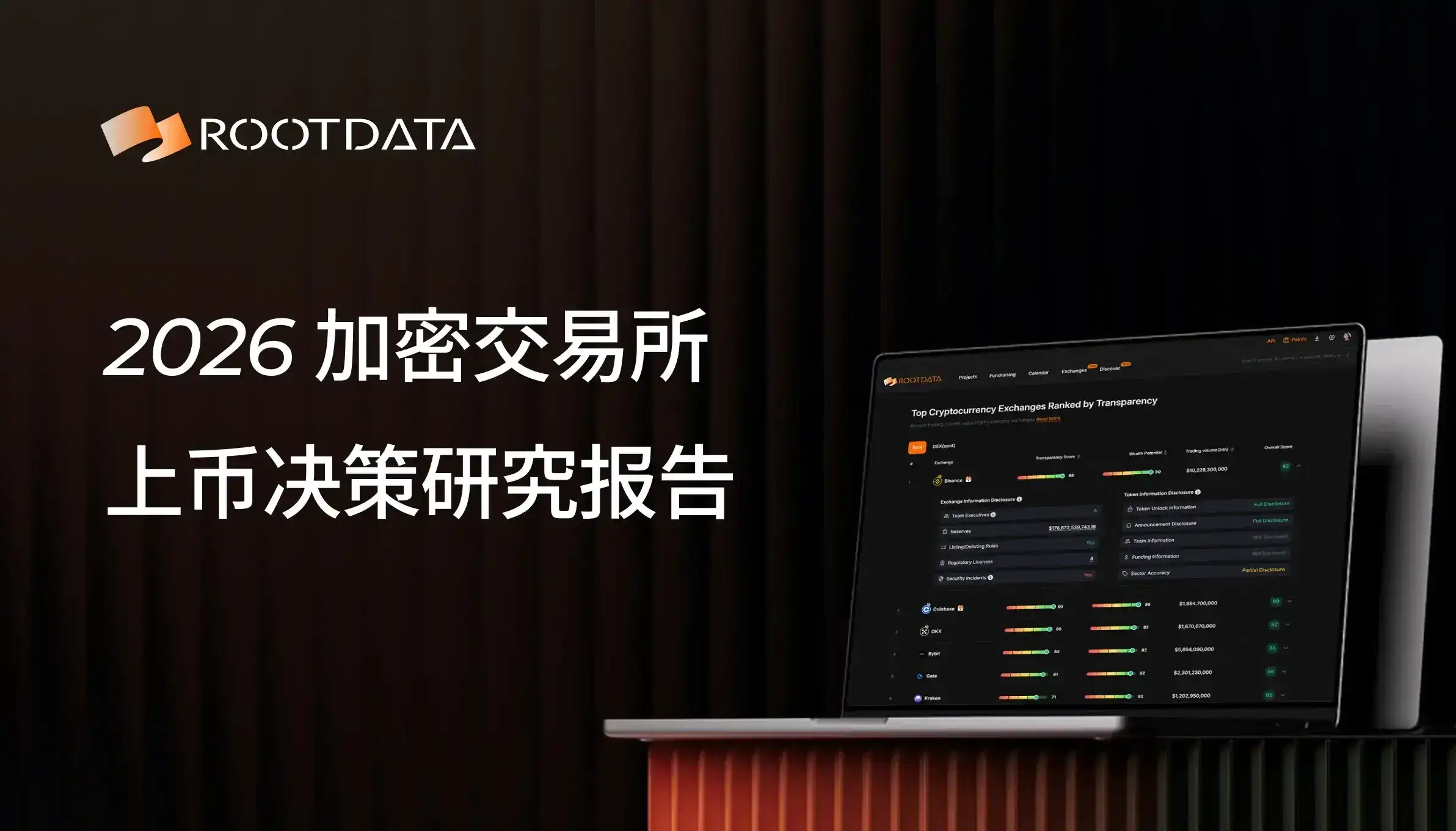
2026 Cryptocurrency Exchange Listing Decision Questionnaire Survey Report

The 2026 Cryptocurrency Exchange Listing Decision Survey Report, conducted by RootData, gathered 313 valid responses from professionals including Listing BD personnel, researchers, and listing committee members. Key findings reveal that over 69% of respondents are directly involved in or responsible for listing decisions, with many handling over 50 projects annually, leading to significant information overload. Major pain points in the decision-making process include fragmented and outdated data, with approximately 50% of respondents citing these issues. High "hidden costs of trust" and data inaccuracy often prolong the review process. Over 30% of respondents noted that data delays significantly impact decisions, potentially causing missed opportunities or errors. Transparency of project information—such as details about institutional investors, valuation, team, and product roadmap—is critical. More than half of the respondents rely on third-party data platforms like RootData (used by 88.9% of participants) for verification. Projects listed on authoritative platforms with detailed information can improve listing efficiency by at least 30%. Conversely, low transparency often triggers extended defensive reviews, with 16.7% of respondents likely rejecting such projects outright. The report concludes that data transparency is vital in listing approvals, significantly affecting both the efficiency and outcome of a project’s capitalization efforts.

marsbit01/21 12:31

2026 Cryptocurrency Exchange Listing Decision Questionnaire Survey Report

marsbit01/21 12:31

Dialogue with Hashkey Capital Partner Xiao Xiao: The Story and Key Insights Behind Raising $250 Million in 3 Months

HashKey Capital, a leading Asian crypto VC, successfully raised $250 million for its fourth fund, HashKey Fintech Multi-Strategy Fund IV, in just three months. The fund attracted institutional investors, family offices, and high-net-worth individuals, with a total target of $500 million. Unlike previous funds, this multi-strategy fund will focus on liquid assets, including public market investments, OTC purchases of tokenized assets, and selective private market deals. It offers greater flexibility and mid-term redemption options to meet LP demands for liquidity and exit opportunities. The fund will invest in global infrastructure, scalability solutions, and large-scale application scenarios. Xiao Xiao emphasized that mass adoption requires real usage motivation, sustainable business models, and network effects. Despite a market slowdown, HashKey remains active, seeking high-quality projects during cooler market periods. The firm avoids overvalued deals and prioritizes teams with strong execution, clear vision, and proper fund management. Xiao also discussed the evolving role of Chinese founders, noting their strength in execution and operational expertise, while highlighting the trend toward hybrid global teams. He expects greater transparency in the industry and a convergence of equity and token-based financing models. The crypto primary market is increasingly blending traditional and crypto-native exit strategies, with capital concentrating around top-tier projects and blurred lines between primary and secondary investments.

marsbit01/20 10:54

Dialogue with Hashkey Capital Partner Xiao Xiao: The Story and Key Insights Behind Raising $250 Million in 3 Months

marsbit01/20 10:54

Before You Jump on Any ICO Bandwagon, Read This First

Before participating in any ICO, it's crucial to understand that most projects fail, and only a few achieve success. The recent hype around ICOs, driven by projects like MegaETH and Plasma, often leads to impulsive investments without proper due diligence. Here are key points to consider: 1. **Product Fundamentals**: Evaluate if the product solves a real problem and has genuine innovation. Avoid projects based on future promises or testnet data without a working product. 2. **Team Experience**: The team's track record matters. Experienced teams can adapt to market changes, while weak teams may disappear when hype fades. 3. **Investors and Valuation**: Check if reputable VCs are involved and assess the valuation. Avoid projects where insiders have low valuations, leaving retail investors at risk. 4. **Authentic Data**: Look beyond surface metrics like TVL or user numbers. Ensure data is genuine and not inflated by incentives or fake activity. 5. **Marketing and Narrative**: Strong projects control their narrative and attract organic attention. Poor projects rely on buzzwords without substance. 6. **Tokenomics**: Understand token unlock schedules, vesting, and fully diluted valuation (FDV). Avoid structures that favor insiders and shift risk to retail. 7. **Market Conditions**: Market cycles significantly impact valuation and returns. The same project may perform differently in a bull vs. bear market. ICO investments are not free money. Avoid FOMO-driven decisions and prioritize projects with real value over hype.

深潮12/16 06:49

Before You Jump on Any ICO Bandwagon, Read This First

深潮12/16 06:49

活动图片